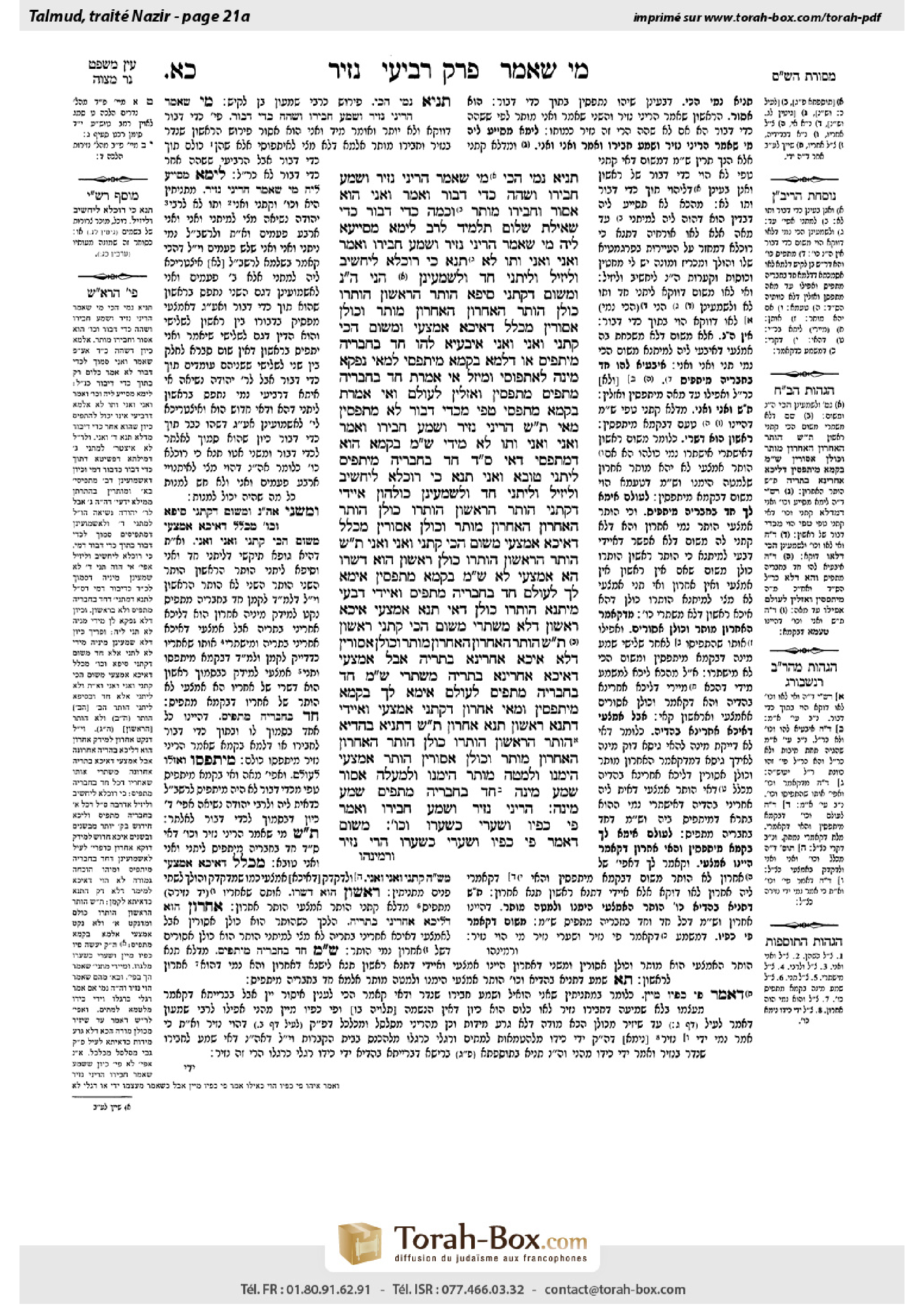
Nazir 21a: Talmud study for Daf Yomi
Daf Yomi is the daily study of one Talmud folio. Explore 37 tractates with scans, Hebrew text, Sefaria English and AI-generated French translations where annotated.
Passage selection and English or AI-generated French translation are available where the scan has annotations. Daf Study is independent of Torah-Box and Sefaria.
Browse Nazir · נזיר · All tractatesNazir 21a text and translations
This page of Nazir includes the Aramaic text, an English translation and an AI-generated French translation, alongside the scan above.
נזיר כ״א א · Aramaic and Hebrew text
תַּנְיָא נָמֵי הָכִי: מִי שֶׁאָמַר ״הֲרֵינִי נָזִיר״, וְשָׁמַע חֲבֵירוֹ וְשָׁהָה כְּדֵי דִבּוּר, וְאָמַר ״וַאֲנִי״ — הוּא אָסוּר, וַחֲבֵירוֹ מוּתָּר. וְכַמָּה כְּדֵי דִבּוּר — כְּדֵי שְׁאֵילַת שָׁלוֹם תַּלְמִיד לָרַב.
לֵימָא מְסַיְּיעָא לֵיהּ: מִי שֶׁאָמַר ״הֲרֵינִי נָזִיר״, וְשָׁמַע חֲבֵירוֹ וְאָמַר ״וַאֲנִי״ ״וַאֲנִי״, וְתוּ לָא! תַּנָּא כִּי רוֹכְלָא לִיחְשֹׁיב וְלֵיזִיל?!
וְלִיתְנֵי חַד וְלַשְׁמְעִינַן הָנֵי! הָכָא נָמֵי, וּמִשּׁוּם דְּקָתָנֵי סֵיפָא הוּתַּר הָרִאשׁוֹן הוּתְּרוּ כּוּלָּן, הוּתַּר הָאַחֲרוֹן — הָאַחֲרוֹן מוּתָּר וְכוּלָּן אֲסוּרִין, מִכְּלָל דְּאִיכָּא אֶמְצָעִי, וּמִשּׁוּם הָכִי קָתָנֵי ״וַאֲנִי״ ״וַאֲנִי״.
אִיבַּעְיָא לְהוּ: חַד בְּחַבְרֵיהּ מִיתְּפִיס, אוֹ דִּלְמָא בְּקַמָּא מִיתַּפְסִי? לְמַאי נָפְקָא מִינַּהּ — לְאִתְּפוֹסֵי וּמֵיזַל. אִי אָמְרַתְּ חַד בְּחַבְרֵיהּ מִתְּפִיס — מִתַּפְסִין וְאָזְלִין לְעוֹלָם. וְאִי אָמְרַתְּ בְּקַמָּא מִתַּפְסִי — טְפֵי מִכְּדֵי דִבּוּר לָא מִתַּפְסִין. מַאי?
תָּא שְׁמַע: ״הֲרֵינִי נָזִיר״, וְשָׁמַע חֲבֵירוֹ וְאָמַר ״וַאֲנִי״ ״וַאֲנִי״, וְתוּ לָא מִידֵּי, שְׁמַע מִינַּהּ בְּקַמָּא הוּא דְּמִתַּפְסִי, דְּאִי סָלְקָא דַעְתָּךְ חַד בְּחַבְרֵיהּ מִיתְּפִיס — לִיתְנֵי טוּבָא ״וַאֲנִי״! תַּנָּא כִּי רוֹכְלָא לִיחְשֹׁיב וְלֵיזִיל?!
וְלִיתְנֵי חַד וְלַשְׁמְעִינַן כּוּלְּהוֹן! אַיְּידֵי דְּקָתָנֵי הוּתַּר הָרִאשׁוֹן — הוּתְּרוּ כּוּלָּן, הוּתַּר הָאַחֲרוֹן — הָאַחֲרוֹן מוּתָּר וְכוּלָּן אֲסוּרִין, מִכְּלָל דְּאִיכָּא אֶמְצָעִי, מִשּׁוּם הָכִי קָתָנֵי ״וַאֲנִי״ ״וַאֲנִי״.
תָּא שְׁמַע: הוּתַּר הָרִאשׁוֹן — הוּתְּרוּ כּוּלָּן. רִאשׁוֹן הוּא דִּשְׁרוּ, הָא אֶמְצָעִי לָא, שְׁמַע מִינַּהּ בְּקַמָּא מִתַּפְסִין.
אֵימָא לָךְ: לְעוֹלָם חַד בְּחַבְרֵיהּ מִתְּפִיס. וְאַיְּידֵי דְּבָעֵי מִיתְנֵא ״הוּתְּרוּ כּוּלָּן״, דְּאִי תְּנָא אֶמְצָעִי, אִיכָּא רִאשׁוֹן דְּלָא מִשְׁתְּרֵי, מִשּׁוּם הָכִי קָתָנֵי רִאשׁוֹן.
תָּא שְׁמַע: הוּתַּר הָאַחֲרוֹן — הָאַחֲרוֹן מוּתָּר וְכוּלָּן אֲסוּרִין. דְּלָא אִיכָּא אַחֲרִינָא בָּתְרֵיהּ, אֲבָל אֶמְצָעִי, דְּאִיכָּא אַחֲרִינָא בָּתְרֵיהּ — מִשְׁתְּרֵי. שְׁמַע מִינַּהּ חַד בְּחַבְרֵיהּ מִתְּפִיס.
לְעוֹלָם אֵימָא לָךְ: בְּקַמָּא מִיתַּפְסִין, וּמַאי ״אַחֲרוֹן״ דְּקָתָנֵי — אֶמְצָעִי, וְאַיְּידֵי דִּתְנָא רִאשׁוֹן, תְּנָא אַחֲרוֹן.
תָּא שְׁמַע, דְּתַנְיָא בְּהֶדְיָא: הוּתַּר הָרִאשׁוֹן — הוּתְּרוּ כּוּלָּן, הוּתַּר הָאַחֲרוֹן — הָאַחֲרוֹן מוּתָּר וְכוּלָּן אֲסוּרִין, הוּתַּר אֶמְצָעִי — הֵימֶנּוּ וּלְמַטָּה מוּתָּר, הֵימֶנּוּ וּלְמַעְלָה — אָסוּר, שְׁמַע מִינַּהּ חַד בְּחַבְרֵיהּ מִתְּפִיס, שְׁמַע מִינַּהּ.
״הֲרֵינִי נָזִיר״, וְשָׁמַע חֲבֵירוֹ וְאָמַר ״פִּי כְּפִיו וּשְׂעָרִי כִּשְׂעָרוֹ וְכוּ׳״. מִשּׁוּם דְּאָמַר ״פִּי כְּפִיו וּשְׂעָרִי כִּשְׂעָרוֹ״ הֲרֵי נָזִיר?
Nazir 21a · English translation
This is also taught in a baraita: In the case of one who said: I am hereby a nazirite, and another heard him and waited the time required for speaking a short phrase and then said: And I, the first person is bound by his vow and the other is permitted, as too much time passed between their respective vows. And how much time is the time required for speaking? It is the time necessary for a student to inquire after the welfare of his rabbi.
The Gemara suggests: Shall we say that the mishna supports Reish Lakish’s opinion? As it is taught: In the case of one who said: I am hereby a nazirite, and another heard him and said: And I, and a third person heard him and said: And I, they are all nazirites. The mishna mentions: And I, twice and no more, which indicates that only two people can associate themselves with the vow of the first one. The reason for this must be because too much time has passed since the first person spoke. The Gemara rejects this argument: This is no proof, as should the tanna have continued reckoning cases like a peddler, who announces his wares over and over again, by repeating: And I, and I, over and over again?
The Gemara raises a difficulty: But if the tanna wishes to be concise, let him teach only one example, and teach us these other cases of others who say: And I, by means of a single example. The Gemara answers: Indeed, this is in fact correct, but because the tanna teaches in the latter clause: If the vow of the first was dissolved by a halakhic authority then they are all dissolved, but if the vow of the last individual was dissolved by a halakhic authority then the vow of the last individual is dissolved and all the others remain bound by their vow, one may conclude by inference that there is a middle person between the first and the last. And due to that reason the tanna teaches: And I, and I, so that the case would include three people, but not because a fourth person is unable to associate himself with the vow of the first in the same manner.
With regard to the same issue, a dilemma was raised before the Sages: Does each one take a vow by associating himself with the vow of the other, i.e., the individual who spoke immediately before him, or perhaps they all associate themselves with the vow of the first one? The Gemara asks: What difference is there? The Gemara answers that the difference is whether an unlimited number of people can continue to associate themselves with the vows. If you say that each one associates himself with the vow of the other who spoke immediately before him, others can continue to associate themselves with these vows forever, provided that they each do so immediately after the previous individual. And if you say they all associate themselves with the vow of the first one, they may not associate themselves with the vow if more time has elapsed than the time required for speaking a short phrase since the vow of the first individual. What is the answer to this dilemma?
The Gemara suggests: Come and hear a proof from the mishna: With regard to one who said: I am hereby a nazirite, and another heard this vow and said: And I, and a third person added: And I, they are all nazirites. The mishna mentions only two individuals who associated themselves with the initial vow, and no more. Learn from this that they all associated themselves with the vow of the first one, as, if it should enter your mind that each one associates himself with the vow of the other who came immediately before, let the mishna teach: And I, many times. The Gemara answers as before: This is no proof, as should the tanna have continued reckoning cases like a peddler? It was enough for him to state: And I, twice.
The Gemara asks: But if the tanna wished to avoid repeating: And I, so many times, let him teach it only once, and we would learn that they are all nazirites based on that example. The Gemara answers: Since the tanna teaches in the latter clause: If the vow of the first was dissolved by a halakhic authority then they are all dissolved, but if the vow of the last individual was dissolved by a halakhic authority then the vow of the last individual is dissolved and all the others remain bound by their vows, one may conclude by inference that there is a middle person between the first and the last. It is due to that reason that the tanna teaches: And I, and I, so that the case would include three people, but not because a fourth person is unable to associate himself with the vow of the first in the same manner.
The Gemara suggests: Come and hear a proof from the mishna: If the vow of the first individual was dissolved, they are all dissolved. This indicates that it is only if the first one was dissolved that they are all considered dissolved. However, if the vow of the middle person was dissolved, no, the vows of the individuals following him are not considered dissolved. Learn from this that they all associated themselves with the vow of the first one.
The Gemara refutes this argument: I could say to you that actually, each associates himself with the vow of the other who immediately preceded him, and therefore if the vow of the middle person was dissolved, the vows of all those who came after him are also dissolved. But since the tanna wanted to teach: They are all dissolved, and had he taught the case where the vow of the middle individual was dissolved, he would have had to state that there is still the vow of the first individual that is not dissolved, because his vow is not dependent on that of the middle one. Due to that reason the tanna teaches the case where the vow of the first one was dissolved. Consequently, no proof can be brought from here.
The Gemara suggests another proof from the mishna: Come and hear: If the last was dissolved, the last is dissolved and they are all bound by their vows. It can be inferred from here that only in that case is the vow of the last one alone dissolved, as he is not followed by anyone. However, if the dissolved vow was of the middle one, who is followed by someone else, the vow of the last one who comes after him is also dissolved. One can learn from this that each one associates himself with the vow of the other individual.
The Gemara rejects this claim as well: Actually, I could say to you that they all associate themselves with the vow of the first one, and what is the meaning of: The last one, that the mishna teaches? It means the middle one, the dissolution of whose vow does not cause the vow of the person who followed him to be dissolved. And why is the middle one called the last one? Since the tanna earlier taught: First, here he taught: Last, despite the fact that he is referring to the middle one.
The Gemara further suggests: Come and hear, as it is taught in a baraita explicitly: If the first one is dissolved, they are all dissolved; if the last one is dissolved, the last one is dissolved and they are all bound by their vows. If the middle one is dissolved, the vows of anyone from him and after him are dissolved; those who vowed from him and before him are bound by their vows. One can learn from this that each associates himself with the vow of the other individual. The Gemara concludes: Learn from this that it is so.
§ The mishna taught that one stated: I am hereby a nazirite, and if another heard and said, my mouth is like his mouth, and my hair is like his hair, he is a nazirite. The Gemara asks: Just because he said: My mouth is like his mouth and my hair is like his hair, is he a nazirite?
Nazir 21a · Traduction française (IA)
Cela est également enseigné dans une baraïta : si quelqu’un dit : « Me voici nazir », et qu’un autre l’entend, attend le temps nécessaire pour prononcer une courte phrase, puis dit : « Et moi », le premier est lié par son vœu, tandis que le second n’est pas tenu par le sien, car trop de temps s’est écoulé entre leurs vœux respectifs. Et quelle est la durée nécessaire pour prononcer une courte phrase ? Le temps qu’il faut à un élève pour s’enquérir de la santé de son maître.
La Guemara suggère : Faut-il dire que la Michna appuie l’opinion de Reish Lakish ? Car il est enseigné : si quelqu’un dit : « Me voici nazir », qu’un autre l’entend et dit : « Et moi », puis qu’un troisième l’entend et dit : « Et moi », ils sont tous naziréens. La Michna mentionne deux fois « Et moi », et pas davantage, ce qui indique que seules deux personnes peuvent s’associer au vœu du premier. Cela doit s’expliquer par le fait que trop de temps s’est écoulé depuis que le premier a parlé. La Guemara rejette cet argument : ce n’est pas une preuve, car le tanna aurait-il dû énumérer les cas comme un colporteur qui annonce sans cesse sa marchandise, en répétant encore et encore : « Et moi, et moi » ?
La Guemara soulève une difficulté : mais si le tanna souhaite être concis, qu’il n’enseigne qu’un seul exemple et nous apprenne, au moyen de cet exemple unique, les autres cas de personnes qui disent : « Et moi ». La Guemara répond : en effet, c’est bien ainsi, mais comme le tanna enseigne dans la dernière partie : si le vœu du premier est annulé par une autorité halakhique, ils sont tous libérés ; mais si le vœu du dernier est annulé par une autorité halakhique, seul le vœu du dernier est annulé et tous les autres restent liés par leurs vœux, on peut en déduire qu’il y a une personne intermédiaire entre le premier et le dernier. C’est pour cette raison que le tanna enseigne : « Et moi, et moi », afin que le cas comprenne trois personnes, et non parce qu’une quatrième personne ne pourrait pas s’associer au vœu du premier de la même manière.
À propos de la même question, les Sages ont soulevé une hésitation : chacun prend-il un engagement en s’associant au vœu de l’autre, c’est-à-dire de la personne qui a parlé immédiatement avant lui, ou bien tous s’associent-ils au vœu du premier ? La Guemara demande : quelle différence cela fait-il ? La Guemara répond que la différence porte sur la possibilité pour un nombre illimité de personnes de continuer à s’associer aux vœux. Si tu dis que chacun s’associe au vœu de la personne qui a parlé immédiatement avant lui, d’autres peuvent continuer à s’associer à ces vœux indéfiniment, à condition que chacun le fasse immédiatement après la personne précédente. Et si tu dis qu’ils s’associent tous au vœu du premier, ils ne peuvent pas s’associer au vœu si plus de temps que celui nécessaire pour prononcer une courte phrase s’est écoulé depuis le vœu du premier. Quelle est la réponse à cette hésitation ?
La Guemara suggère : viens et entends une preuve tirée de la Michna : si quelqu’un dit : « Me voici nazir », qu’un autre entend ce vœu et dit : « Et moi », puis qu’un troisième ajoute : « Et moi », ils sont tous naziréens. La Michna ne mentionne que deux personnes qui se sont associées au vœu initial, et pas davantage. Apprends-en que tous se sont associés au vœu du premier, car si tu envisages que chacun s’associe au vœu de la personne qui l’a immédiatement précédé, que la Michna enseigne donc : « Et moi » plusieurs fois. La Guemara répond comme précédemment : ce n’est pas une preuve, car le tanna aurait-il dû énumérer les cas comme un colporteur ? Il lui suffisait de dire deux fois : « Et moi ».
La Guemara demande : mais si le tanna souhaitait éviter de répéter « Et moi » tant de fois, qu’il ne l’enseigne qu’une seule fois, et nous apprendrions grâce à cet exemple qu’ils sont tous naziréens. La Guemara répond : comme le tanna enseigne dans la dernière partie : si le vœu du premier est annulé par une autorité halakhique, ils sont tous libérés ; mais si le vœu du dernier est annulé par une autorité halakhique, seul le vœu du dernier est annulé et tous les autres restent liés par leurs vœux, on peut en déduire qu’il y a une personne intermédiaire entre le premier et le dernier. C’est pour cette raison que le tanna enseigne : « Et moi, et moi », afin que le cas comprenne trois personnes, et non parce qu’une quatrième personne ne pourrait pas s’associer au vœu du premier de la même manière.
La Guemara suggère : viens et entends une preuve tirée de la Michna : si le vœu du premier est annulé, ils sont tous libérés. Cela indique que c’est uniquement si le vœu du premier est annulé qu’ils sont tous considérés comme libérés. En revanche, si le vœu de la personne intermédiaire est annulé, non, les vœux des personnes qui viennent après elle ne sont pas considérés comme annulés. Apprends-en que tous se sont associés au vœu du premier.
La Guemara réfute cet argument : je pourrais te dire qu’en réalité, chacun s’associe au vœu de la personne qui l’a immédiatement précédé ; par conséquent, si le vœu de la personne intermédiaire est annulé, les vœux de tous ceux qui sont venus après elle sont également annulés. Mais comme le tanna voulait enseigner : « Ils sont tous libérés », et que, s’il avait enseigné le cas où le vœu de la personne intermédiaire est annulé, il aurait dû préciser que le vœu du premier n’est toujours pas annulé, puisque son vœu ne dépend pas de celui de la personne intermédiaire, le tanna enseigne le cas où le vœu du premier est annulé. Par conséquent, on ne peut en tirer aucune preuve.
La Guemara suggère une autre preuve tirée de la Michna : viens et entends : si le vœu du dernier est annulé, seul le dernier est libéré et tous les autres restent liés par leurs vœux. On peut en déduire que, dans ce cas seulement, seul le vœu du dernier est annulé, puisqu’il n’est suivi par personne. En revanche, si le vœu annulé était celui de la personne intermédiaire, qui est suivie par quelqu’un d’autre, le vœu du dernier, qui vient après elle, est également annulé. On peut en apprendre que chacun s’associe au vœu de la personne précédente.
La Guemara rejette également cette affirmation : en réalité, je pourrais te dire qu’ils s’associent tous au vœu du premier. Et que signifie « le dernier », terme employé par la Michna ? Il désigne la personne intermédiaire, dont l’annulation du vœu n’entraîne pas celle du vœu de la personne qui l’a suivie. Et pourquoi appeler la personne intermédiaire « le dernier » ? Parce que le tanna a enseigné précédemment « le premier » ; ici, il enseigne « le dernier », bien qu’il fasse référence à la personne intermédiaire.
La Guemara suggère encore : viens et entends, car une baraïta l’enseigne explicitement : si le vœu du premier est annulé, ils sont tous libérés ; si le vœu du dernier est annulé, seul le dernier est libéré et tous les autres restent liés par leurs vœux. Si le vœu de la personne intermédiaire est annulé, les vœux de tous ceux qui sont à partir d’elle et après elle sont annulés ; ceux qui ont fait vœu à partir d’elle et avant elle restent liés par leurs vœux. On peut en apprendre que chacun s’associe au vœu de la personne qui l’a précédé. La Guemara conclut : apprends-en qu’il en est bien ainsi.
§ La Michna a enseigné qu’une personne a déclaré : « Me voici nazir », et que, si une autre l’a entendu et a dit : « Ma bouche est comme sa bouche, et mes cheveux comme ses cheveux », cette personne est nazir. La Guemara demande : suffit-il qu’elle dise : « Ma bouche est comme sa bouche, et mes cheveux comme ses cheveux », pour qu’elle soit nazir ?
Traduction française générée par IA à partir de l’édition anglaise de Sefaria. Vérifie toujours un passage avec le texte source.
Text from Sefaria: William Davidson Edition - Vocalized Aramaic (CC BY NC); William Davidson Edition - English (CC BY NC).