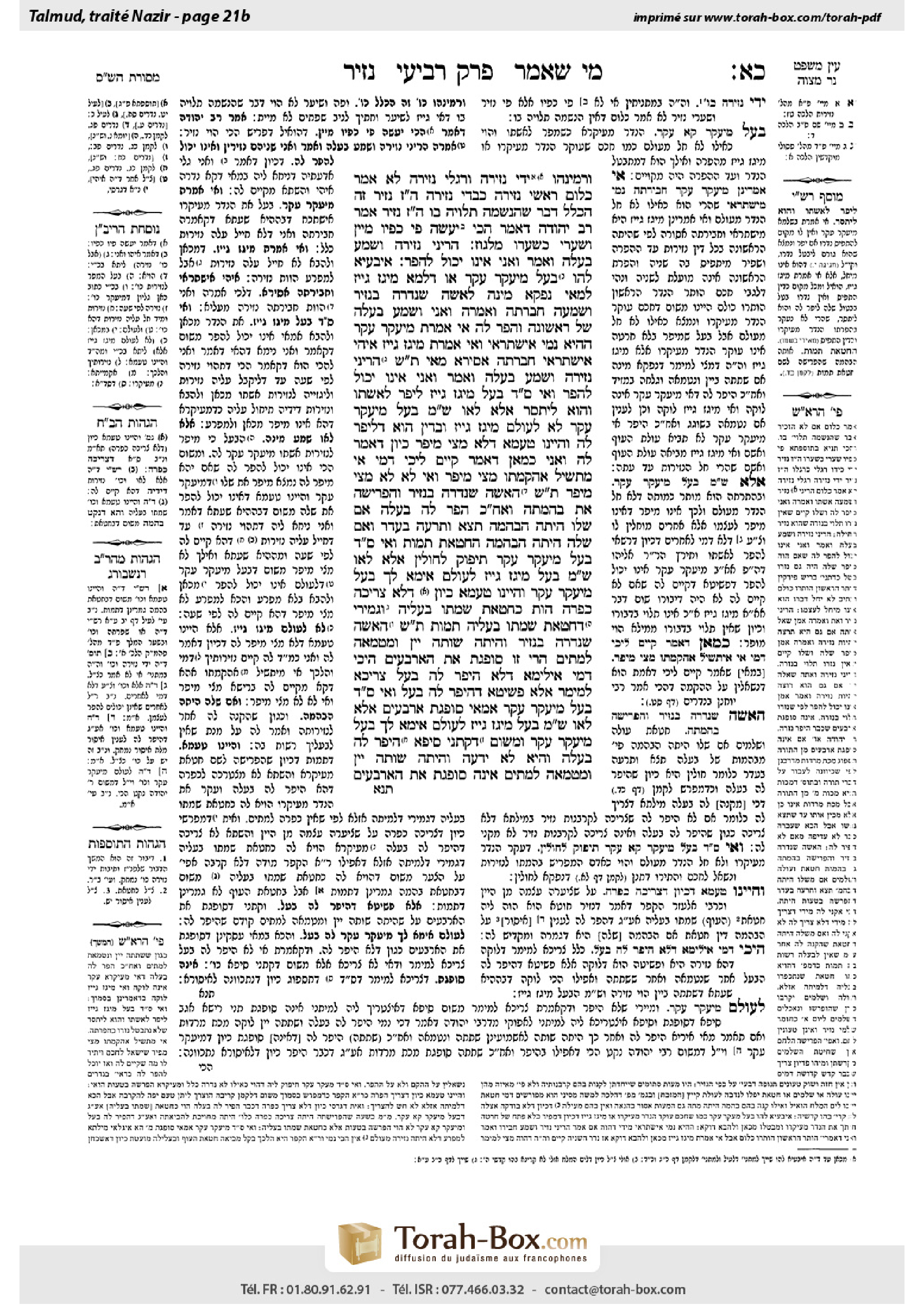
Nazir 21b: Talmud study for Daf Yomi
Daf Yomi is the daily study of one Talmud folio. Explore 37 tractates with scans, Hebrew text, Sefaria English and AI-generated French translations where annotated.
Passage selection and English or AI-generated French translation are available where the scan has annotations. Daf Study is independent of Torah-Box and Sefaria.
Browse Nazir · נזיר · All tractatesNazir 21b text and translations
This page of Nazir includes the Aramaic text, an English translation and an AI-generated French translation, alongside the scan above.
נזיר כ״א ב · Aramaic and Hebrew text
וּרְמִינְהוּ: ״יָדִי נְזִירָה״ וְ״רַגְלִי נְזִירָה״ — לֹא אָמַר כְּלוּם, ״רֹאשִׁי נְזִירָה״, ״כְּבֵדִי נְזִירָה״ — הֲרֵי זֶה נָזִיר. זֶה הַכְּלָל: דָּבָר שֶׁהַנְּשָׁמָה תְּלוּיָה בּוֹ — הֲרֵי זֶה נָזִיר.
אָמַר רַב יְהוּדָה, דְּאָמַר הָכִי: יֵעָשֶׂה פִּי כְּפִיו מִיַּיִן, וּשְׂעָרִי כִּשְׂעָרוֹ מִלָּגוֹז.
״הֲרֵינִי נְזִירָה״, וְשָׁמַע בַּעְלָהּ וַאֲמַר ״וַאֲנִי״ אֵינוֹ יָכוֹל לְהָפֵר. אִיבַּעְיָא לְהוּ: בַּעַל מִיעְקָר עָקַר, אוֹ דִּלְמָא מִיגָּז גָּיֵיז? לְמַאי נָפְקָא מִינַּהּ —
לְאִשָּׁה שֶׁנָּדְרָה בְּנָזִיר, וְשָׁמְעָה חֲבֶרְתָּהּ וְאָמְרָה ״וַאֲנִי״, וְשָׁמַע בַּעְלָהּ שֶׁל רִאשׁוֹנָה וְהֵפֵר לָהּ. אִי אָמְרַתְּ מִיעְקָר עָקַר — הַהִיא נָמֵי אִישְׁתְּרַאי. וְאִי אָמְרַתְּ מִיגָּז גָּיֵיז — אִיהִי אִישְׁתְּרַאי, חֲבֶרְתַּהּ אֲסִירָא. מַאי?
תָּא שְׁמַע: ״הֲרֵינִי נְזִירָה״ וְשָׁמַע בַּעְלָהּ וְאָמַר ״וַאֲנִי״ — אֵינוֹ יָכוֹל לְהָפֵר. וְאִי סָלְקָא דַּעְתָּךְ בַּעַל מִיגָּז גָּיֵיז — לֵיפַר לְאִישְׁתּוֹ וְהוּא לִיתְּסַר. אֶלָּא לָאו שְׁמַע מִינַּהּ, בַּעַל מִיעְקָר עָקַר.
לָא, לְעוֹלָם מִיגָּז גָּיֵיז. וּבְדִין הוּא דְּלֵיפַר לַהּ. וְהַיְינוּ טַעְמָא דְּלָא מָצֵי מֵיפַר, כֵּיוָן דְּאָמַר לַהּ ״וַאֲנִי״, כְּמַאן דְּאָמַר ״קַיָּים לִיכִי״ דָּמֵי. אִי מִתְּשִׁיל אַהֲקָמָתוֹ, — מָצֵי מֵיפַר, וְאִי לָא — לָא מָצֵי מֵיפַר.
תָּא שְׁמַע: הָאִשָּׁה שֶׁנָּדְרָה בְּנָזִיר, וְהִפְרִישָׁה אֶת בְּהֶמְתָּהּ, וְאַחַר כָּךְ הֵפֵר לָהּ בַּעְלָהּ, אִם שֶׁלּוֹ הָיְתָה הַבְּהֵמָה — תֵּצֵא וְתִרְעֶה בָּעֵדֶר. וְאִם שֶׁלָּהּ הָיְתָה הַבְּהֵמָה — הַחַטָּאת תָּמוּת.
וְאִי סָלְקָא דַעְתָּךְ בַּעַל מִיעְקָר עָקַר — תִּיפּוֹק לְחוּלִּין! אֶלָּא לָאו שְׁמַע מִינַּהּ, בַּעַל מִיגָּז גָּיֵיז!
לְעוֹלָם אֵימָא לָךְ בַּעַל מִיעְקָר עָקַר, וְהַיְינוּ טַעְמָא: כֵּיוָן דְּלֹא צְרִיכָה כַּפָּרָה, הֲוָת כְּחַטָּאת שֶׁמֵּתוּ בְּעָלֶיהָ, וּגְמִירִי דְּחַטָּאת שֶׁמֵּתוּ בְּעָלֶיהָ — תָּמוּת.
תָּא שְׁמַע: הָאִשָּׁה שֶׁנָּדְרָה בְּנָזִיר, וְהָיְתָה שׁוֹתָה יַיִן וּמִטַּמְּאָה לְמֵתִים — הֲרֵי זוֹ סוֹפֶגֶת אֶת הָאַרְבָּעִים. הֵיכִי דָמֵי? אִילֵּימָא דְּלָא הֵיפַר לַהּ בַּעַל — צְרִיכָא לְמֵימַר?
אֶלָּא פְּשִׁיטָא דְּהֵיפַר לַהּ בַּעַל. וְאִי סָלְקָא דַעְתָּךְ בַּעַל מִיעְקָר עָקַר — אַמַּאי סוֹפֶגֶת אַרְבָּעִים? אֶלָּא לָאו שְׁמַע מִינַּהּ, בַּעַל מִיגָּז גָּיֵיז?
לְעוֹלָם אֵימָא לָךְ בַּעַל מִיעְקָר עָקַר, וּמִשּׁוּם דְּקָתָנֵי סֵיפָא: הֵיפֵר לָהּ בַּעְלָהּ וְהִיא לֹא יָדְעָה, וְהָיְתָה שׁוֹתָה יַיִן וּמִטַּמְּאָה לְמֵתִים — אֵינָהּ סוֹפֶגֶת אֶת הָאַרְבָּעִים,
Nazir 21b · English translation
And the Gemara raises a contradiction against this. If one said: My hand is a nazirite, and similarly, if he said: My foot is a nazirite, he has not said anything of consequence. However, if he said: My head is a nazirite, or: My liver is a nazirite, he is a nazirite. This is the principle: If one accepted naziriteship by means of an entity upon which life depends, i.e., a limb or a body part that he cannot survive without, he is a nazirite. Conversely, if he mentioned part of the body that is not essential for life, he is not a nazirite. In this case, as he referred to his hair, which is certainly not a vital part of him, he should not be a nazirite.
Rav Yehuda said that it means that he said like this; this is what he intended: Let my mouth be like his mouth with regard to abstention from wine, and my hair be like his hair with regard to abstention from cutting it.
§ The mishna taught that if a woman said: I am hereby a nazirite, and her husband heard and said: And I, he cannot nullify her vow. A dilemma was raised before the Sages: When a husband nullifies the vow of his wife, does he uproot his wife’s vow, making it as though she never vowed, or perhaps he merely severs her vow from that point onward, but her vow was still in effect until he nullified it? The Gemara asks: What difference is there resulting from this dilemma?
The Gemara explains that the difference is with regard to a woman who vowed to be a nazirite, and another woman heard and said: And I, and the husband of the first woman heard and nullified her vow. If you say that the husband uproots the vow entirely, the vow of that second woman should also be dissolved, as she associated herself with a non-existent vow. And if you say he severs it from this point, the vow of his wife is dissolved, but the other woman remains bound by her vow, as the first vow was intact when she associated herself with it. What, then, is the answer to this dilemma?
The Gemara suggests: Come and hear the statement of the mishna: If she said: I am hereby a nazirite, and her husband heard and said: And I, he cannot nullify her vow. And if it should enter your mind that the husband severs the vow from that moment onward, let him nullify the vow for his wife and he will remain bound by his vow, since if the vow is not nullified retroactively, her vow was intact when he associated himself with it. Rather, must one not conclude from the mishna that the husband uproots the vow entirely, which means he would also uproot his own vow by nullifying hers, and that is why he is unable do so?
The Gemara refutes this argument: No; actually, one can say that the husband severs the vow from that point onward. And if there were no other points to consider, by right the mishna should have taught that he can nullify her vow for her; and this is the reason why he cannot nullify it: Since he said to her: And I, he is considered like one who said: It is upheld for you, and once a husband has upheld his wife’s vow he can no longer nullify it. Consequently, if he requested to have his upholding dissolved by a Sage, he can nullify her vow, and if not, he cannot nullify it. Consequently, the ruling of the mishna does not resolve the dilemma.
The Gemara cites another mishna (24a): Come and hear: With regard to a woman who vowed to be a nazirite and separated her animal for this purpose (see Numbers 6:13–14), and afterward her husband nullified her vow, which means that she is no longer obligated to bring an offering, if the animal was his, which he had given to her, it is as though it were never consecrated at all, and it shall go out and graze among the flock like a regular, non-consecrated animal, until it becomes blemished. And if the animal was hers, and it was designated for a sin-offering, it must be placed in isolation for it to die, in accordance with the general halakha that a sin-offering that may not be sacrificed must be left to die.
The Gemara explains the difficulty from this mishna: And if it should enter your mind that the husband uproots the vow, the sin-offering should be released as a non-sacred animal, in accordance with the halakha of a sin-offering of a nazirite whose vow was nullified (31a). Rather, must one not conclude from the mishna that the husband merely severs the vow, which means that she was a nazirite when she separated the animal, and therefore it is consecrated?
The Gemara rejects this proof: Actually, I could say to you that the husband uproots the vow, and this is the reason for the above ruling: Since she requires no atonement, as the vow is no longer in effect, this animal is treated as a sin-offering whose owners have died, and it is learned as a tradition that a sin-offering whose owners have died must be left to die.
The Gemara continues to cite relevant sources. Come and hear the following mishna (23a): With regard to a woman who vowed to be a nazirite and nevertheless was drinking wine and rendering herself ritually impure by contact with the dead, she incurs the forty lashes for violating a Torah prohibition. The Gemara analyzes this mishna: What are the circumstances of this case? If we say that her husband did not nullify her vow, need this be said that she is liable to receive lashes? After all, every nazirite who transgresses their vow incurs lashes.
Rather, it is obvious that the husband nullified her vow. And if it should enter your mind that the husband uproots his wife’s vow, why does she incur the forty lashes? It is as though she never vowed at all. Rather, must one not conclude from the mishna that the husband severs the vow, and therefore she is liable for her earlier transgression?
The Gemara refutes this argument: Actually, I could say to you that the husband uproots the vow, and the reason that the mishna teaches in this manner is due to the fact that the tanna teaches in the latter clause of the mishna: If the husband nullified her vow and she did not know, and she was drinking wine and rendering herself ritually impure by contact with the dead, she does not incur the forty lashes, despite her intention to sin, as she did not commit a transgression in practice.
Nazir 21b · Traduction française (IA)
La Guemara soulève une contradiction à ce sujet. Si quelqu’un dit : « Ma main est naziréenne », ou de même : « Mon pied est naziréen », il n’a rien dit qui ait de conséquence. En revanche, s’il dit : « Ma tête est naziréenne » ou : « Mon foie est naziréen », il devient nazir. Tel est le principe : celui qui accepte le naziréat en mentionnant une partie du corps dont dépend la vie, c’est-à-dire un membre ou une partie du corps sans lesquels il ne pourrait survivre, devient nazir. À l’inverse, s’il mentionne une partie du corps qui n’est pas indispensable à la vie, il ne devient pas nazir. Dans ce cas, puisqu’il a fait référence à ses cheveux, qui ne sont certainement pas une partie vitale de son corps, il ne devrait pas devenir nazir.
Rav Yehouda dit que cela signifie qu’il a dit ceci, et que telle était son intention : « Que ma bouche soit comme sa bouche en ce qui concerne l’abstention de vin, et que mes cheveux soient comme ses cheveux en ce qui concerne l’abstention de les couper. »
§ La Michna enseigne que si une femme dit : « Me voici naziréenne », et que son mari l’entend et dit : « Moi aussi », il ne peut pas annuler son vœu. Les Sages ont soulevé une question : lorsqu’un mari annule le vœu de sa femme, déracine-t-il son vœu, comme si elle n’avait jamais fait de vœu, ou bien y met-il seulement fin à partir de ce moment, de sorte que le vœu reste en vigueur jusqu’à ce qu’il l’annule ? La Guemara demande : Quelle différence cette question entraîne-t-elle ?
La Guemara explique que la différence concerne le cas d’une femme qui a fait vœu de devenir naziréenne, puis d’une autre femme qui l’a entendue et a dit : « Moi aussi », avant que le mari de la première femme n’entende et n’annule le vœu de celle-ci. Si l’on dit que le mari déracine entièrement le vœu, le vœu de la seconde femme devrait lui aussi être dissous, puisqu’elle s’est associée à un vœu inexistant. Mais si l’on dit qu’il y met fin à partir de ce moment, le vœu de son épouse est dissous, tandis que l’autre femme reste liée par son vœu, car le premier vœu était encore en vigueur lorsqu’elle s’y est associée. Quelle est donc la réponse à cette question ?
La Guemara propose : « Viens et entends » ce qu’enseigne la Michna : si elle dit : « Me voici naziréenne », et que son mari l’entend et dit : « Moi aussi », il ne peut pas annuler son vœu. Or, s’il te venait à l’esprit que le mari met fin au vœu seulement à partir de ce moment, qu’il annule donc le vœu de son épouse et reste lui-même lié par le sien, puisque celui de son épouse n’ayant pas été annulé rétroactivement, il était encore en vigueur lorsqu’il s’y est associé. Ne faut-il donc pas conclure de la Michna que le mari déracine entièrement le vœu, si bien qu’en annulant celui de son épouse, il déracinerait aussi son propre vœu, et que c’est pourquoi il ne peut pas le faire ?
La Guemara réfute cet argument : Non, en réalité, on peut dire que le mari met fin au vœu à partir de ce moment. Et s’il n’y avait pas d’autres considérations, la Michna aurait dû enseigner qu’il peut annuler le vœu de son épouse ; mais voici pourquoi il ne le peut pas : puisqu’il lui a dit « Moi aussi », il est considéré comme s’il lui avait dit : « Ton vœu est confirmé », et dès qu’un mari a confirmé le vœu de son épouse, il ne peut plus l’annuler. Par conséquent, s’il demande à un Sage de faire dissoudre sa confirmation, il peut annuler le vœu de son épouse ; sinon, il ne le peut pas. Ainsi, la décision de la Michna ne permet pas de trancher la question.
La Guemara cite une autre Michna (24a) : à propos d’une femme qui a fait vœu de devenir naziréenne et a mis un animal à part à cette fin (voir Nombres 6,13–14), puis dont le mari a annulé le vœu, de sorte qu’elle n’est plus tenue d’apporter un sacrifice : si l’animal était à lui et qu’il le lui avait donné, c’est comme s’il n’avait jamais été consacré ; il doit alors aller paître parmi le troupeau comme un animal ordinaire non consacré, jusqu’à ce qu’il devienne atteint d’un défaut. Mais si l’animal était à elle et avait été désigné comme sacrifice expiatoire, il faut le mettre à l’écart jusqu’à ce qu’il meure, conformément à la halakha générale selon laquelle un sacrifice expiatoire qui ne peut pas être offert doit être laissé à mourir.
La Guemara explique la difficulté soulevée par cette Michna : or, s’il te venait à l’esprit que le mari déracine le vœu, le sacrifice expiatoire devrait être libéré et devenir un animal non consacré, conformément à la halakha relative au sacrifice expiatoire d’un nazir dont le vœu a été annulé (31a). Ne faut-il donc pas conclure de la Michna que le mari met simplement fin au vœu, ce qui signifie qu’elle était naziréenne lorsqu’elle a mis l’animal à part, et que celui-ci est donc consacré ?
La Guemara rejette cette preuve : En réalité, je pourrais te dire que le mari déracine le vœu, et voici la raison de la décision précédente : puisqu’elle n’a pas besoin d’expiation, car le vœu n’est plus en vigueur, cet animal est considéré comme un sacrifice expiatoire dont les propriétaires sont morts. Or, la tradition enseigne qu’un sacrifice expiatoire dont les propriétaires sont morts doit être laissé à mourir.
La Guemara continue de citer des sources pertinentes. « Viens et entends » la Michna suivante (23a) : à propos d’une femme qui a fait vœu de devenir naziréenne, mais qui buvait néanmoins du vin et se rendait rituellement impure au contact des morts, elle encourt les quarante coups de fouet pour avoir transgressé une interdiction de la Torah. La Guemara analyse cette Michna : dans quelles circonstances cela se produit-il ? Si l’on dit que son mari n’a pas annulé son vœu, est-il nécessaire de préciser qu’elle est passible de coups de fouet ? Après tout, tout nazir qui transgresse son vœu encourt des coups de fouet.
Il est donc évident que le mari a annulé son vœu. Et s’il te venait à l’esprit que le mari déracine le vœu de son épouse, pourquoi encourrait-elle les quarante coups de fouet ? Ce serait comme si elle n’avait jamais fait de vœu. Ne faut-il donc pas conclure de la Michna que le mari met fin au vœu, et qu’elle est par conséquent passible de châtiment pour sa transgression antérieure ?
La Guemara réfute cet argument : En réalité, je pourrais te dire que le mari déracine le vœu, et si la Michna enseigne ainsi, c’est parce que le tanna enseigne dans la dernière partie de la Michna : si le mari a annulé son vœu sans qu’elle le sache, et qu’elle buvait du vin et se rendait rituellement impure au contact des morts, elle n’encourt pas les quarante coups de fouet, malgré son intention de pécher, puisqu’elle n’a pas commis de transgression dans les faits.
Traduction française générée par IA à partir de l’édition anglaise de Sefaria. Vérifie toujours un passage avec le texte source.
Text from Sefaria: William Davidson Edition - Vocalized Aramaic (CC BY NC); William Davidson Edition - English (CC BY NC).