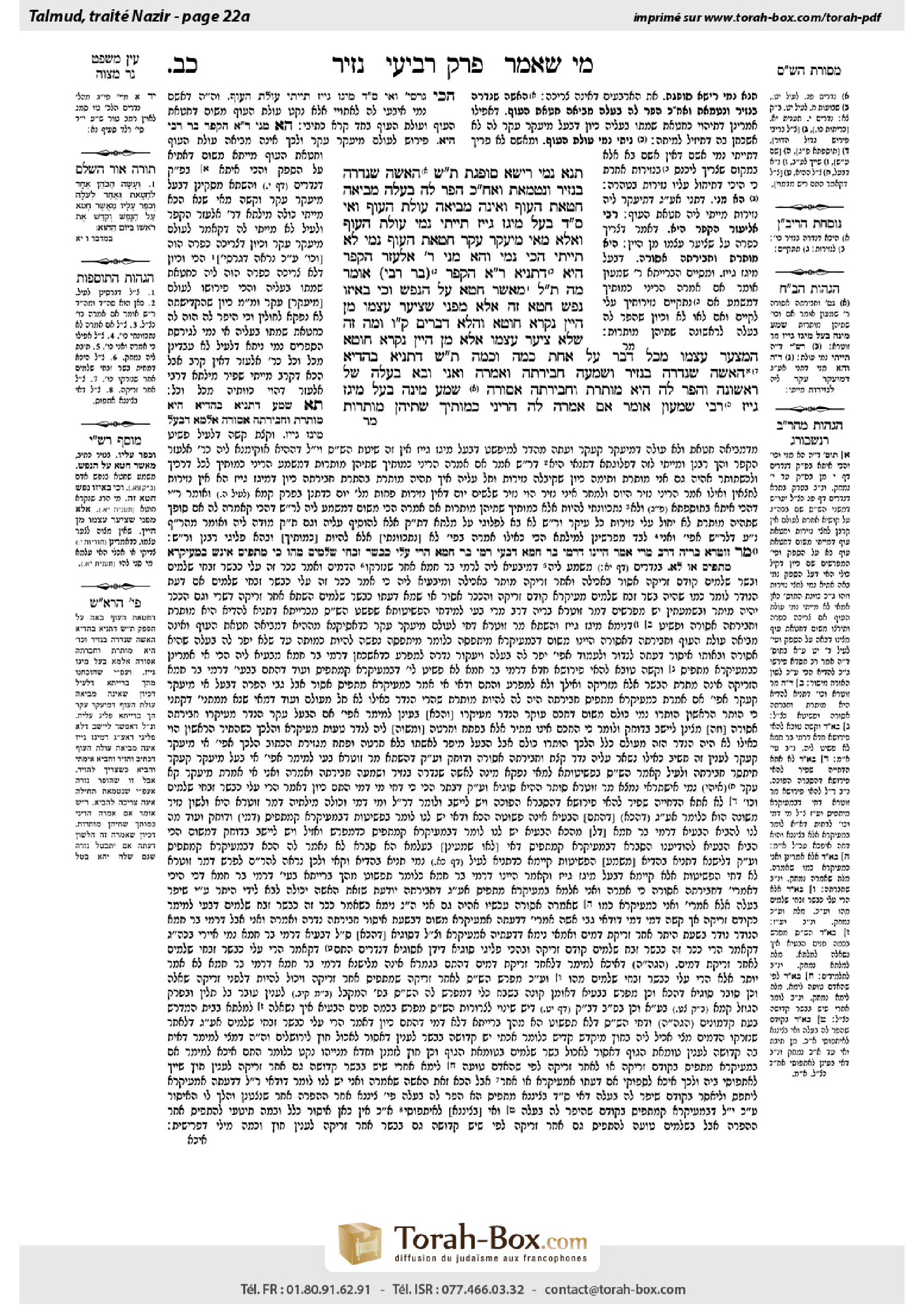
Nazir 22a: Talmud study for Daf Yomi
Daf Yomi is the daily study of one Talmud folio. Explore 37 tractates with scans, Hebrew text, Sefaria English and AI-generated French translations where annotated.
Passage selection and English or AI-generated French translation are available where the scan has annotations. Daf Study is independent of Torah-Box and Sefaria.
Browse Nazir · נזיר · All tractatesNazir 22a text and translations
This page of Nazir includes the Aramaic text, an English translation and an AI-generated French translation, alongside the scan above.
נזיר כ״ב א · Aramaic and Hebrew text
תְּנָא נָמֵי רֵישָׁא סוֹפֶגֶת.
תָּא שְׁמַע: הָאִשָּׁה שֶׁנָּדְרָה בְּנָזִיר וְנִטְמֵאת, וְאַחַר כָּךְ הֵפֵר לָהּ בַּעֲלָהּ — מְבִיאָה חַטַּאת הָעוֹף, וְאֵינָהּ מְבִיאָה עוֹלַת הָעוֹף. וְאִי סָלְקָא דַעְתָּךְ בַּעַל מִיגָּז גָּיֵיז — תַּיְיתֵי נָמֵי עוֹלַת הָעוֹף!
וְאֶלָּא מַאי, מִיעְקָר עָקַר? חַטַּאת הָעוֹף נָמֵי לָא תַּיְיתֵי! הָכִי נָמֵי, וְהָא מַנִּי — רַבִּי אֶלְעָזָר הַקַּפָּר הִיא.
דְּתַנְיָא, רַבִּי אֶלְעָזָר הַקַּפָּר (בַּר רַבִּי) אוֹמֵר: מָה תַּלְמוּד לוֹמַר ״מֵאֲשֶׁר חָטָא עַל הַנָּפֶשׁ״? וְכִי בְּאֵיזוֹ נֶפֶשׁ חָטָא זֶה? אֶלָּא מִפְּנֵי שֶׁצִּיעֵר עַצְמוֹ מִן הַיַּיִן נִקְרָא חוֹטֵא. וַהֲלֹא דְּבָרִים קַל וָחוֹמֶר: וּמָה זֶה שֶׁלֹּא צִיעֵר עַצְמוֹ אֶלָּא מִן הַיַּיִן נִקְרָא חוֹטֵא, הַמְצַעֵר עַצְמוֹ מִכׇּל דָּבָר — עַל אַחַת כַּמָּה וְכַמָּה.
תָּא שְׁמַע, דְּתַנְיָא בְּהֶדְיָא: הָאִשָּׁה שֶׁנָּדְרָה בְּנָזִיר, וְשָׁמְעָה חֲבֶירְתָּהּ וְאָמְרָה ״וַאֲנִי״, וּבָא בַּעְלָהּ שֶׁל רִאשׁוֹנָה וְהֵפֵר לָהּ — הִיא מוּתֶּרֶת וַחֲבֶירְתָּהּ אֲסוּרָה. שְׁמַע מִינַּהּ: בַּעַל מִיגָּז גָּיֵיז.
רַבִּי שִׁמְעוֹן אוֹמֵר: אִם אָמְרָה לָהּ ״הֲרֵינִי כְּמוֹתֵיךְ״ — שְׁתֵּיהֶן מוּתָּרוֹת.
Nazir 22a · English translation
For this reason the tanna also taught: She incurs, in the first clause, despite the fact that this teaches no novelty.
The Gemara further suggests: Come and hear a proof from a baraita: With regard to a woman who vowed to be a nazirite and she became ritually impure, and afterward her husband nullified her vow, she brings the bird sin-offering, and she does not bring the bird burnt-offering. And if it should enter your mind that the husband severs her vow, let her also bring the bird burnt-offering, to complete the atonement for becoming ritually impure when she was a nazirite. This indicates that the husband uproots the vow, which is why she is not required to bring the bird burnt-offering.
The Gemara refutes this proof: Rather, what then? Will you say that the husband uproots the vow entirely? If so, she should also not bring the bird sin-offering. The Gemara answers: So too, she should not have to bring the bird sin-offering either, but in accordance with whose opinion is this baraita? It is the opinion of Rabbi Elazar HaKappar.
As it is taught in a baraita that Rabbi Elazar HaKappar the esteemed says: What is the meaning when the verse states: “And make atonement for him, for that he sinned by reason of the soul” (Numbers 6:11)? And with which soul did this nazirite sin? Rather, because he deprived himself of wine he is therefore called a sinner. And are not these matters inferred a fortiori: And if this one, who deprived himself only of wine, is nevertheless called a sinner, in the case of one who deprives himself of everything by fasting or other acts of mortification, all the more so is he labeled a sinner. According to this opinion, she brings a sin-offering to atone for uttering the vow itself, despite the fact that her husband later uprooted it entirely.
The Gemara suggests: Come and hear a resolution, as it is taught in a baraita (Tosefta 3:10) explicitly: With regard to a woman who vowed to be a nazirite, and another woman heard her and said: And I, and the husband of the first one came and nullified her vow, she is permitted and the other woman is prohibited. One can learn from this that the husband severs the vow rather than uproots it.
The baraita continues: Rabbi Shimon says that if the second woman said to her, after hearing her vow of naziriteship: I am hereby like you, in that case they are both permitted. Since the second woman made her naziriteship entirely dependent on that of the first, the nullification of the first woman’s vow cancels the second naziriteship as well.
Nazir 22a · Traduction française (IA)
C’est pour cette raison que le tanna a également enseigné : « Elle est tenue [d’apporter le sacrifice] », dans la première clause, bien que cela n’apporte rien de nouveau.
La Guemara propose encore : « Viens et entends une preuve tirée d’une baraïta : une femme a fait vœu de devenir naziréenne, puis elle est devenue rituellement impure, et son mari a ensuite annulé son vœu. Elle apporte le sacrifice expiatoire d’oiseau, mais pas l’holocauste d’oiseau. Or, si tu pensais que le mari met fin à son vœu, elle devrait également apporter l’holocauste d’oiseau, afin d’achever l’expiation pour être devenue rituellement impure alors qu’elle était naziréenne. Cela indique que le mari déracine le vœu, raison pour laquelle elle n’est pas tenue d’apporter l’holocauste d’oiseau. »
La Guemara réfute cette preuve : « Que diras-tu alors ? Que le mari déracine entièrement le vœu ? Dans ce cas, elle ne devrait pas non plus apporter le sacrifice expiatoire d’oiseau. » La Guemara répond : « En effet, elle ne devrait pas non plus avoir à apporter le sacrifice expiatoire d’oiseau. Mais de qui cette baraïta reflète-t-elle l’opinion ? De Rabbi Elazar HaKappar. »
Comme il est enseigné dans une baraïta que Rabbi Elazar HaKappar, le vénéré, dit : « Que signifie le verset : “Et il fera expiation pour lui, car il a péché à cause de la personne” (Nombres 6:11) ? Et à cause de quelle personne ce nazir a-t-il péché ? C’est plutôt parce qu’il s’est privé de vin qu’il est appelé pécheur. Ces considérations ne se déduisent-elles pas a fortiori ? Si celui-ci, qui ne s’est privé que de vin, est néanmoins appelé pécheur, à plus forte raison celui qui se prive de tout par le jeûne ou d’autres actes de mortification est-il qualifié de pécheur. » Selon cette opinion, elle apporte un sacrifice expiatoire pour expier le fait même d’avoir prononcé le vœu, bien que son mari l’ait ensuite entièrement déraciné.
La Guemara propose : « Viens et entends une solution, car il est explicitement enseigné dans une baraïta (Tossefta 3:10) : une femme a fait vœu de devenir naziréenne, et une autre femme l’a entendue et a dit : “Moi aussi.” Le mari de la première est venu et a annulé son vœu : la première est autorisée, tandis que l’autre est interdite. » On peut en déduire que le mari met fin au vœu, au lieu de le déraciner.
La baraïta poursuit : Rabbi Shimon dit que si la seconde femme lui a dit, après avoir entendu son vœu de naziréat : « Je suis comme toi », alors elles sont toutes deux autorisées. Puisque la seconde femme a entièrement subordonné son naziréat à celui de la première, l’annulation du vœu de la première annule également le naziréat de la seconde.
Traduction française générée par IA à partir de l’édition anglaise de Sefaria. Vérifie toujours un passage avec le texte source.
Text from Sefaria: William Davidson Edition - Vocalized Aramaic (CC BY NC); William Davidson Edition - English (CC BY NC).