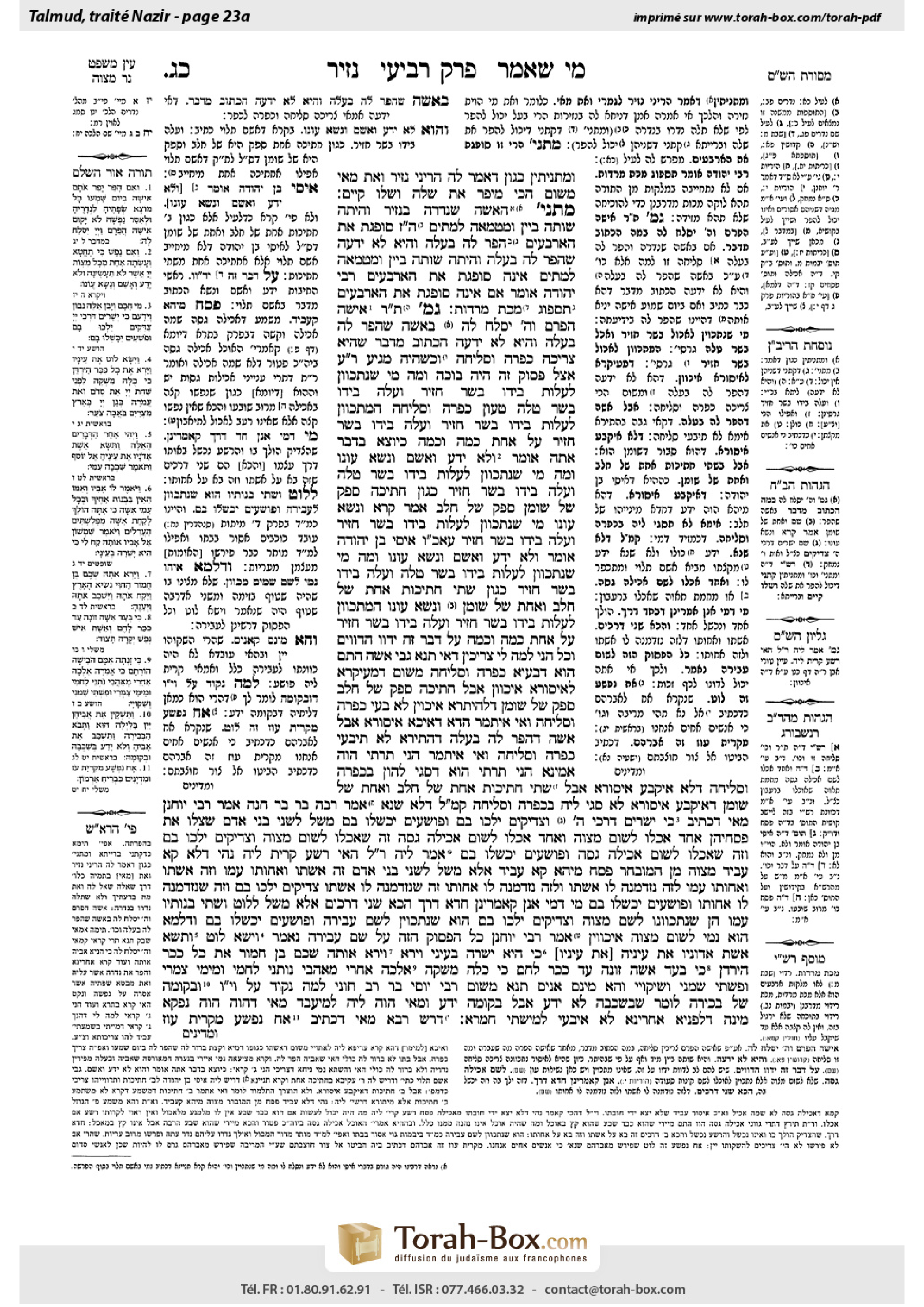
Nazir 23a: Talmud study for Daf Yomi
Daf Yomi is the daily study of one Talmud folio. Explore 37 tractates with scans, Hebrew text, Sefaria English and AI-generated French translations where annotated.
Passage selection and English or AI-generated French translation are available where the scan has annotations. Daf Study is independent of Torah-Box and Sefaria.
Browse Nazir · נזיר · All tractatesNazir 23a text and translations
This page of Nazir includes the Aramaic text, an English translation and an AI-generated French translation, alongside the scan above.
נזיר כ״ג א · Aramaic and Hebrew text
וּמַתְנִיתִין כְּגוֹן דַּאֲמַר לַהּ ״הֲרֵינִי נָזִיר, וְאַתְּ מַאי?״ מִשּׁוּם הָכִי, מֵיפֵר אֶת שֶׁלָּהּ וְשֶׁלּוֹ קַיָּים.
מַתְנִי׳ הָאִשָּׁה שֶׁנָּדְרָה בְּנָזִיר, וְהָיְתָה שׁוֹתֶה בְּיַיִן וּמִטַּמְּאָה לְמֵתִים — הֲרֵי זֶה סוֹפֶגֶת אֶת הָאַרְבָּעִים. הֵפֵר לָהּ בַּעְלָהּ, וְהִיא לֹא יָדְעָה שֶׁהֵפֵר לָהּ בַּעְלָהּ, וְהָיְתָה שׁוֹתָה בְּיַיִן וּמִטַּמְּאָה לְמֵתִים — אֵינָהּ סוֹפֶגֶת אֶת הָאַרְבָּעִים. רַבִּי יְהוּדָה אוֹמֵר: אִם אֵינָהּ סוֹפֶגֶת אֶת הָאַרְבָּעִים — תִּסְפּוֹג מַכַּת מַרְדּוּת.
גְּמָ׳ תָּנוּ רַבָּנַן: ״אִישָׁהּ הֲפֵרָם וַה׳ יִסְלַח לָהּ״ — בְּאִשָּׁה שֶׁהֵפֵר לָהּ בַּעְלָהּ וְהִיא לֹא יָדְעָה הַכָּתוּב מְדַבֵּר, שֶׁהִיא צְרִיכָה כַּפָּרָה וּסְלִיחָה.
וּכְשֶׁהָיָה מַגִּיעַ רַבִּי עֲקִיבָא אֵצֶל פָּסוּק זֶה, הָיָה בּוֹכֶה: וּמָה מִי שֶׁנִּתְכַּוֵּון לַעֲלוֹת בְּיָדוֹ בְּשַׂר חֲזִיר, וְעָלָה בְּיָדוֹ בְּשַׂר טָלֶה — טָעוּן כַּפָּרָה וּסְלִיחָה. הַמִּתְכַּוֵּון לַעֲלוֹת בְּיָדוֹ בְּשַׂר חֲזִיר וְעָלָה בְּיָדוֹ בְּשַׂר חֲזִיר — עַל אַחַת כַּמָּה וְכַמָּה.
כַּיּוֹצֵא בַּדָּבָר אַתָּה אוֹמֵר: ״וְלֹא יָדַע וְאָשֵׁם וְנָשָׂא עֲוֹנוֹ״,
וּמָה מִי שֶׁנִּתְכַּוֵּון לַעֲלוֹת בְּיָדוֹ בְּשַׂר טָלֶה, וְעָלָה בְּיָדוֹ בְּשַׂר חֲזִיר, כְּגוֹן חֲתִיכָה סָפֵק שֶׁל שׁוּמָּן סָפֵק שֶׁל חֵלֶב — אָמַר קְרָא ״וְנָשָׂא עֲוֹנוֹ״. מִי שֶׁנִּתְכַּוֵּון לַעֲלוֹת בְּיָדוֹ בְּשַׂר חֲזִיר, וְעָלָה בְּיָדוֹ בְּשַׂר חֲזִיר — עַל אַחַת כַּמָּה וְכַמָּה.
אִיסִי בֶּן יְהוּדָה אוֹמֵר: ״וְלֹא יָדַע וְאָשֵׁם וְנָשָׂא עֲוֹנוֹ״, וּמָה מִי שֶׁנִּתְכַּוֵּון לַעֲלוֹת בְּיָדוֹ בְּשַׂר טָלֶה, וְעָלָה בְּיָדוֹ בְּשַׂר חֲזִיר, כְּגוֹן שְׁתֵּי חֲתִיכוֹת אַחַת שֶׁל חֵלֶב וְאַחַת שֶׁל שׁוּמָּן — ״וְנָשָׂא עֲוֹנוֹ״. הַמִּתְכַּוֵּון לַעֲלוֹת בְּיָדוֹ בְּשַׂר חֲזִיר, וְעָלָה בְּיָדוֹ בְּשַׂר חֲזִיר — עַל אַחַת כַּמָּה וְכַמָּה.
עַל דָּבָר זֶה יִדְווּ הַדּוֹוִים.
וְכׇל הָנֵי לְמָה לִי? צְרִיכִין, דְּאִי תְּנָא גַּבֵּי אִשָּׁה, הָתָם הוּא דְּבָעֲיָא כַּפָּרָה וּסְלִיחָה — מִשּׁוּם דְּמֵעִיקָּרָא לְאִיסּוּרָא אִיכַּוֵון. אֲבָל חֲתִיכָה סָפֵק שֶׁל חֵלֶב סָפֵק שֶׁל שׁוּמָּן, דִּלְהֶיתֵּרָא אִיכַּוֵּין — לָא בָּעֵי כַּפָּרָה וּסְלִיחָה.
וְאִי אִיתְּמַר הָדָא — דְּאִיכָּא אִיסּוּרָא. אֲבָל אִשָּׁה דְּהֵפֵר לָהּ בַּעְלָהּ, דְּהֶתֵּירָא — לָא תִּיבְעֵי כַּפָּרָה וּסְלִיחָה.
וְאִי אִיתְּמַר הָנֵי תַּרְתֵּי, הֲוָה אָמֵינָא: הָנֵי תַּרְתֵּי הוּא דְּסַגִּי לְהוֹן בְּכַפָּרָה וּסְלִיחָה — דְּלָא אִיקְּבַע אִיסּוּרָא. אֲבָל שְׁתֵּי חֲתִיכוֹת אַחַת שֶׁל חֵלֶב וְאַחַת שֶׁל שׁוּמָּן, דְּאִיקְּבַע אִיסּוּרָא — לָא סַגִּי לֵיהּ בְּכַפָּרָה וּסְלִיחָה, קָא מַשְׁמַע לַן דְּלָא שְׁנָא.
אָמַר רַבָּה בַּר בַּר חָנָה אָמַר רַבִּי יוֹחָנָן: מַאי דִּכְתִיב ״כִּי יְשָׁרִים דַּרְכֵי ה׳ וְצַדִּקִים יֵלְכוּ בָם וּפֹשְׁעִים יִכָּשְׁלוּ בָם״ — מָשָׁל לִשְׁנֵי בְּנֵי אָדָם שֶׁצָּלוּ אֶת פִּסְחֵיהֶן, אֶחָד אֲכָלוֹ לְשׁוּם מִצְוָה, וְאֶחָד אֲכָלוֹ לְשׁוּם אֲכִילָה גַּסָּה. זֶה שֶׁאֲכָלוֹ לְשׁוּם מִצְוָה — ״וְצַדִּקִים יֵלְכוּ בָם״. וְזֶה שֶׁאֲכָלוֹ לְשׁוּם אֲכִילָה גַּסָּה — ״וּפֹשְׁעִים יִכָּשְׁלוּ בָם״.
אֲמַר לֵיהּ רֵישׁ לָקִישׁ: הַאי ״רָשָׁע״ קָרֵית לֵיהּ?! נְהִי דְּלָא קָא עָבֵיד מִצְוָה מִן הַמּוּבְחָר, פֶּסַח מִיהָא קָא עָבֵיד! אֶלָּא: מָשָׁל לִשְׁנֵי בְּנֵי אָדָם, זֶה אִשְׁתּוֹ וַאֲחוֹתוֹ עִמּוֹ, וְזֶה אִשְׁתּוֹ וַאֲחוֹתוֹ עִמּוֹ. לְזֶה נִזְדַּמְּנָה לוֹ אִשְׁתּוֹ, וּלְזֶה נִזְדַּמְּנָה לוֹ אֲחוֹתוֹ. זֶה שֶׁנִּזְדַּמְּנָה לוֹ אִשְׁתּוֹ — ״צַדִּקִים יֵלְכוּ בָם״, וְזֶה שֶׁנִּזְדַּמְּנָה לוֹ אֲחוֹתוֹ — ״וּפֹשְׁעִים יִכָּשְׁלוּ בָם״.
מִי דָּמֵי? אֲנַן קָאָמְרִינַן חֲדָא דֶּרֶךְ. הָכָא — שְׁנֵי דְרָכִים. אֶלָּא, מָשָׁל לְלוֹט וּשְׁתֵּי בְנוֹתָיו עִמּוֹ. הֵן שֶׁנִּתְכַּוְּונוּ לְשֵׁם מִצְוָה — ״וְצַדִּקִים יֵלְכוּ בָם״, הוּא שֶׁנִּתְכַּוֵּין לְשֵׁם עֲבֵירָה — ״וּפֹשְׁעִים יִכָּשְׁלוּ בָם״.
וְדִלְמָא הוּא נָמֵי לְשׁוּם מִצְוָה אִיכַּוֵּוין? אָמַר רַבִּי יוֹחָנָן: כׇּל הַפָּסוּק הַזֶּה עַל שֵׁם עֲבֵירָה נֶאֱמַר.
״וַיִּשָּׂא לוֹט״ — ״וַתִּשָּׂא אֵשֶׁת אֲדֹנָיו אֶת עֵינֶיהָ״. [״אֶת עֵינָיו״ —] ״כִּי הִיא יָשְׁרָה בְעֵינָי״.
״וַיַּרְא״ — ״וַיַּרְא אֹתָהּ שְׁכֶם בֶּן חֲמוֹר״. ״אֶת כׇּל כִּכַּר הַיַּרְדֵּן״ — ״כִּי בְעַד אִשָּׁה זוֹנָה עַד כִּכַּר לָחֶם״. ״כִּי כֻלָּהּ מַשְׁקֶה״ — ״אֵלְכָה אַחֲרֵי מְאַהֲבַי נֹתְנֵי לַחְמִי וּמֵימַי צַמְרִי וּפִשְׁתִּי שַׁמְנִי וְשִׁיקּוּיָי״.
וְהָא מֵינָס אֲנִיס! תָּנָא מִשּׁוּם רַבִּי יוֹסֵי בַּר רַב חוֹנִי: לָמָּה נָקוּד עַל וָיו ״וּבְקוּמָהּ״ שֶׁל בְּכִירָה, לוֹמַר שֶׁבְּשִׁכְבָהּ לָא יָדַע, אֲבָל בְּקוּמָהּ יָדַע.
וּמַאי הֲוָה לֵיהּ לְמִיעְבַּד? מַאי דַהֲוָה הֲוָה! נָפְקָא מִינַּהּ, דִּלְפַנְיָא אַחֲרִינָא לָא אִיבְּעִי לְמִישְׁתֵּי חַמְרָא.
דָּרֵשׁ רָבָא: מַאי דִּכְתִיב ״אָח נִפְשָׁע מִקִּרְיַת עֹז
Nazir 23a · English translation
And the mishna is referring to a case where he said to her in the form of a question: I am hereby a nazirite, and what about you? This indicates that he himself has completely accepted his naziriteship, and he is simply asking his wife if she would like to join him. Due to that reason, as he did not link his vow to hers, he may nullify hers and his is intact.
MISHNA: With regard to a woman who vowed to be a nazirite, and she transgressed her vow since she was drinking wine and rendering herself ritually impure by contact with the dead, she incurs the forty lashes for each of the Torah prohibitions she transgressed. If her husband nullified her vow, and she did not know that her husband had nullified her vow, and she was drinking wine and rendering herself impure by contact with the dead, she does not incur the forty lashes, as she is no longer a nazirite. Rabbi Yehuda says: Even if she does not incur the forty lashes by Torah law, she should incur lashes for rebelliousness [makat mardut], an extrajudicial punishment imposed by the Sages, for her intention to commit a transgression, since she believed that it was prohibited to her.
GEMARA: The Sages taught with regard to a verse in the section discussing vows: “Her husband has nullified them, and the Lord will forgive her” (Numbers 30:13), that the verse is speaking of a woman whose husband nullified her vow and she did not know that he had done so. It teaches that if she performs the actions prohibited by the vow she requires atonement and forgiveness.
And when Rabbi Akiva would reach this verse he would cry, saying: And if one who intended to pick up pork in his hand and eat it, and in fact he picked up the meat of a lamb in his hand and ate it, so that he did not in fact commit a transgression, like this woman who tried to sin and was unaware that her husband had nullified her vow, nevertheless requires atonement and forgiveness, then with regard to one who intends to pick up pork in his hand and in fact picked up pork in his hand, all the more so does he require atonement.
On a similar note, you can say and quote the following verse with regard to one who is liable to bring an uncertain guilt-offering, which is brought for a possible transgression: “Though he does not know it yet he is guilty, and shall bear his iniquity” (Leviticus 5:17).
This verse teaches: And if in a case similar to one who intended to pick up the meat of a lamb in his hand and eat it, which is permitted, and he picked up pork in his hand and ate it, thereby sinning unintentionally, for example, where one took a piece of meat with regard to which it is uncertain whether it is permitted fat and uncertain whether it is forbidden fat, and he ate it, rendering him liable to bring a provisional guilt-offering, the verse states: “And shall bear his iniquity,” indicating that he requires atonement via an offering; then with regard to one who intends to pick up pork in his hand and in fact picked up pork in his hand, all the more so he requires atonement.
Isi ben Yehuda says that this verse: “Though he does not know it yet he is guilty, and shall bear his iniquity” (Leviticus 5:17), should be explained in a slightly different manner: And if in a case similar to one who intended to pick up the meat of a lamb in his hand and he picked up pork in his hand, e.g., where there were two pieces before him, one of forbidden fat and one of permitted fat, and he picked up one and ate it without knowing which of them was forbidden, it states with regard to him: “And shall bear his iniquity,” i.e., he is obligated to bring an offering; then with regard to one who intends to pick up pork in his hand and picked up pork in his hand, all the more so is he in need of atonement.
The Gemara adds: And with regard to this matter, those who suffer should suffer, i.e., one can see from here the extent to which one requires atonement and forgiveness.
The Gemara asks: And why do I need all these examples for the same idea? The Gemara answers: All of them are necessary, as had we taught this idea only with regard to the case of a woman, one might have said that it is there that she requires atonement and forgiveness because at the outset her intention was to sin. However, in the case of one who took a piece with regard to which it was uncertain whether it was permitted fat and uncertain whether it was forbidden fat, who intended to eat permitted food, one might have said that he does not require atonement and forgiveness.
And had this case concerning one who eats a piece that might be forbidden been stated alone, one could say that atonement is required in this situation, as there is possibly a prohibition present before him. However, with regard to a woman whose husband nullified her vow, where she was in fact permitted to perform the actions she performed, perhaps she does not require atonement and forgiveness.
And had only these two cases been stated, I would say: It is in these two cases in which atonement and forgiveness are enough for them, as the prohibition is not established; even one who ate the piece that was possibly forbidden fat has not necessarily committed a sin. However, if there were two pieces, one of forbidden fat and one of permitted fat, where the prohibition is established, as there was definitely a forbidden piece before him and nevertheless he proceeded to eat one of them, one might have said that atonement and forgiveness should not suffice for him. Isi ben Yehuda therefore teaches us that there, it is no different, as even this individual is included in the verse: “And he shall be forgiven” (Leviticus 5:18).
§ Rabba bar bar Ḥanna said that Rabbi Yoḥanan said: What is the meaning of that which is written: “For the paths of the Lord are right, and the just walk in them, but transgressors stumble over them” (Hosea 14:10)? How can the same path lead to such different outcomes? This is comparable to two people who roasted their Paschal offerings on Passover eve, in the proper manner. One ate it for the sake of the mitzva, and one ate it for the sake of excessive eating. This one, who ate it for the sake of the mitzva, has fulfilled: “And the just walk in them,” while that one, who ate it for the sake of excessive eating, is described by the end of the verse: “But transgressors stumble over them.”
Reish Lakish said to Rabba bar bar Ḥanna: You call this individual wicked? Even though he had not performed the mitzva in the optimal manner when he eats this Paschal offering, he has at least performed the mitzva of the Paschal offering. Rather, this is comparable to two people; this one has his wife and sister in the same house with him, and that one has his wife and sister with him. Each husband arrives home and engages in sexual intercourse with one of the women. This one happened upon his wife, and that one happened upon his sister. This one, who happened upon his wife, is described by the phrase “And the just walk in them,” and that one, who happened upon his sister, is described by the phrase “But transgressors stumble over them.”
The Gemara raises a difficulty: Is it comparable? We said one path; i.e., two people follow the same path by performing the very same action with two different outcomes; whereas here there are two paths. Each person engaged in sexual intercourse with a different relative and therefore they cannot be said to have followed the same path. Rather, it is comparable to Lot and his two daughters, who were with him. They, who intended to engage in sexual intercourse with him for the sake of a mitzva, as they thought that the entire world was destroyed and wished to preserve the human race, are described in the first part of the verse: “And the just walk in them.” He who intended to act for the sake of a transgression is described by the last part: “But transgressors stumble over them.”
The Gemara asks: And perhaps Lot too intended that his actions should be for the sake of a mitzva? The Gemara answers: This was not the case, as Rabbi Yoḥanan said with regard to Lot: This entire verse: “And Lot lifted up his eyes, and saw all the plain of the Jordan, that it was well watered everywhere” (Genesis 13:10), is stated with regard to the sin of licentiousness. Since this verse teaches that Lot was a lustful man, it can therefore be assumed he meant to sin with his daughters as well.
Rabbi Yoḥanan explains: “And Lot lifted up his eyes” employs the same expression as a verse that refers to Joseph’s temptation: “That his master’s wife lifted up her eyes” (Genesis 39:7), which is clearly referring to sin. The phrase used in reference to Lot, “his eyes,” is stated similarly to Samson’s appraisal of the Philistine girl he sought to marry: “For she is pleasing in my eyes” (Judges 14:3).
Rabbi Yoḥanan continues to interpret the verse as a series of references to licentiousness. The phrase “and saw” is reminiscent of the verse dealing with Jacob’s daughter Dinah: “And Shechem, the son of Hamor the Hivite, saw her and he took her, and lay with her” (Genesis 34:2). The verse continues: “All the plain [kikar] of the Jordan,” which alludes to the verse: “For on account of a harlot a man is brought to a loaf [kikar] of bread” (Proverbs 6:26). The last part of the verse: “That it was well watered everywhere,” recalls: “I will go after my lovers, who give me my bread and my water, my wool and my flax, my oil and my drink” (Hosea 2:7).
The Gemara asks: But Lot was forced to participate in the sexual intercourse, as he was asleep at the time; how can he be considered a sinner? The Gemara answers that this is as a Sage taught in the name of Rabbi Yosei bar Rav Ḥoni: Why is there a dot in a Torah scroll over the letter vav of the word “uvekumah,” with regard to Lot’s elder daughter, in the verse: “And he did not know when she lay down and when she arose [uvekumah]” (Genesis 19:33)? This dot serves to say that when she lay down he did not know; however, when she arose he knew what she had done, as he later understood what had happened.
The Gemara asks: And what could he have done about it? What has happened has happened; i.e., Lot could not change the past. The Gemara answers: The difference is that on the other, following, night, he should not have drunk wine again. By allowing himself to get drunk a second time, he showed that the end result, engaging in sexual intercourse with his younger daughter, was something he desired.
§ Rava interpreted a verse homiletically with regard to Lot: What is the meaning of that which is written: “A brother offended is harder to be won than a strong city,
Nazir 23a · Traduction française (IA)
Et la Michna fait référence à un cas où il lui a dit sous forme de question : « Je suis désormais nassir, et toi, qu’en est-il ? » Cela indique qu’il a lui-même pleinement accepté son statut de nassir, et qu’il demande simplement à sa femme si elle souhaite le rejoindre. En raison de cela, comme il n’a pas lié son vœu au sien, il peut annuler le sien, tandis que le sien reste intact.
MICHNA : Concernant une femme qui a fait vœu d’être nassira, et qui a transgressé son vœu en buvant du vin et en se rendant rituellement impure par le contact avec un mort, elle encourt les quarante coups de fouet pour chacune des interdictions de la Torah qu’elle a transgressées. Si son mari a annulé son vœu, et qu’elle ne savait pas que son mari avait annulé son vœu, et qu’elle buvait du vin et se rendait impure par le contact avec un mort, elle n’encourt pas les quarante coups de fouet, car elle n’est plus nassira. Rabbi Yehouda dit : Même si elle n’encourt pas les quarante coups de fouet selon la loi de la Torah, elle devrait encourir les coups de fouet pour rébellion [makat mardut], une punition extra-judiciaire imposée par les Sages, pour son intention de commettre une transgression, puisqu’elle croyait que cela lui était interdit.
GUEMARA : Les Sages ont enseigné, à propos d’un verset dans la section traitant des vœux : « Son mari les a annulés, et l’Éternel lui pardonnera » (Nombres 30:13), que le verset parle d’une femme dont le mari a annulé son vœu et qui ne savait pas qu’il l’avait fait. Il enseigne que si elle accomplit les actes interdits par le vœu, elle a besoin d’expiation et de pardon.
Et lorsque Rabbi Akiva parvenait à ce verset, il pleurait en disant : Si celui qui avait l’intention de prendre du porc dans sa main pour le manger, mais qui a en réalité pris de la viande d’agneau dans sa main et l’a mangée, de sorte qu’il n’a pas en fait commis de transgression, comme cette femme qui a cherché à pécher sans savoir que son mari avait annulé son vœu, requiert néanmoins l’expiation et le pardon, alors, a fortiori, celui qui avait l’intention de prendre du porc dans sa main et qui a en réalité pris du porc dans sa main requiert l’expiation.
Dans le même ordre d’idées, on peut dire et citer le verset suivant à propos de celui qui est tenu d’offrir un sacrifice de culpabilité incertain, qui est offert pour une transgression possible : « Même s’il ne le sait pas, il est coupable, et il portera son iniquité » (Lévitique 5:17).
Ce verset enseigne : Si, dans un cas similaire à celui de celui qui avait l’intention de prendre de la viande d’agneau dans sa main pour la manger, ce qui est permis, mais qui a pris du porc dans sa main et l’a mangé, péchant ainsi involontairement, par exemple lorsque quelqu’un a pris un morceau de viande au sujet duquel il est incertain s’il s’agit de graisse permise ou de graisse interdite, et qu’il l’a mangé, ce qui le rend tenu d’offrir un sacrifice de culpabilité provisoire, le verset dit : « Et il portera son iniquité », indiquant qu’il requiert l’expiation par un sacrifice ; alors, a fortiori, celui qui avait l’intention de prendre du porc dans sa main et qui a en réalité pris du porc dans sa main requiert l’expiation.
Isi ben Yehuda dit que ce verset : « Même s’il ne le sait pas, il est coupable, et il portera son iniquité » (Lévitique 5:17), devrait être expliqué d’une manière légèrement différente : Et si, dans un cas similaire à celui de celui qui avait l’intention de prendre de la viande d’agneau dans sa main et qui a pris du porc dans sa main, par exemple, lorsqu’il y avait deux morceaux devant lui, l’un de graisse interdite et l’autre de graisse permise, et qu’il en a pris un et l’a mangé sans savoir lequel des deux était interdit, il est dit à son sujet : « Et il portera son iniquité », c’est-à-dire qu’il est tenu d’apporter un sacrifice ; alors, a fortiori, celui qui a l’intention de prendre du porc dans sa main et qui a pris du porc dans sa main a besoin d’expiation.
La Guemara ajoute : Et concernant cette affaire, ceux qui souffrent doivent souffrir, c’est-à-dire qu’on peut voir ici jusqu’où l’on a besoin d’expiation et de pardon.
La Guemara demande : Et pourquoi ai-je besoin de tous ces exemples pour la même idée ? La Guemara répond : Tous sont nécessaires, car si nous avions enseigné cette idée uniquement à propos du cas d’une femme, on pourrait dire que c’est là qu’elle a besoin d’expiation et de pardon parce que, au départ, son intention était de pécher. Cependant, dans le cas de celui qui a pris un morceau au sujet duquel il était incertain s’il s’agissait de graisse permise ou de graisse interdite, qui avait l’intention de manger de la nourriture permise, on pourrait dire qu’il n’a pas besoin d’expiation et de pardon.
Et si ce cas concernant celui qui mange un morceau qui pourrait être interdit avait été énoncé seul, on pourrait dire que l’expiation est requise dans cette situation, car il y a peut-être une interdiction présente devant lui. Cependant, concernant une femme dont le mari a annulé son vœu, où elle était en fait autorisée à accomplir les actes qu’elle a accomplis, peut-être n’a-t-elle pas besoin d’expiation et de pardon.
Et si seulement ces deux cas avaient été énoncés, je dirais : C’est dans ces deux cas que l’expiation et le pardon suffisent pour eux, car l’interdiction n’est pas établie ; même celui qui a mangé le morceau qui était peut-être de la graisse interdite n’a pas nécessairement commis un péché. Cependant, s’il y avait deux morceaux, l’un de graisse interdite et l’autre de graisse permise, où l’interdiction est établie, car il y avait définitivement un morceau interdit devant lui et néanmoins il a procédé à en manger un, on pourrait dire que l’expiation et le pardon ne devraient pas lui suffire. Isi ben Yehouda nous enseigne donc que, là, il n’y a pas de différence, car même cet individu est inclus dans le verset : « Et il lui sera pardonné » (Lévitique 5:18).
§ Rabba bar bar Ḥanna a dit que Rabbi Yoḥanan a dit : Quelle est la signification de ce qui est écrit : « Car les chemins de l’Éternel sont droits, et les justes marchent en eux, mais les transgresseurs trébuchent sur eux » (Osée 14:10) ? Comment le même chemin peut-il conduire à des résultats si différents ? Cela est comparable à deux personnes qui ont rôti leurs agneaux pascals la veille de Pâques, de la manière prescrite. L’une l’a mangé pour l’accomplissement de la mitsva, et l’autre l’a mangé par excès de gourmandise. Celui qui l’a mangé pour l’accomplissement de la mitsva a accompli : « Et les justes marchent en eux », tandis que celui qui l’a mangé par excès de gourmandise est décrit par la fin du verset : « Mais les transgresseurs trébuchent sur eux ».
Reish Lakish a dit à Rabba bar bar Ḥanna : Appelles-tu cet individu méchant ? Même s’il n’a pas accompli la mitsva de la manière optimale en mangeant cet agneau pascal, il a au moins accompli la mitsva de l’agneau pascal. Plutôt, cela est comparable à deux personnes ; l’une a sa femme et sa sœur dans la même maison que lui, et l’autre a sa femme et sa sœur avec lui. Chaque époux arrive à la maison et a des rapports sexuels avec l’une des femmes. Celui-ci est tombé sur sa femme, et celui-là est tombé sur sa sœur. Celui qui est tombé sur sa femme est décrit par l’expression « Et les justes marchent en eux », et celui qui est tombé sur sa sœur est décrit par l’expression « Mais les transgresseurs trébuchent sur eux ».
La Guemara soulève une difficulté : Est-ce comparable ? Nous avons dit un seul chemin ; c’est-à-dire que deux personnes suivent le même chemin en accomplissant exactement la même action avec deux résultats différents ; alors qu’ici, il y a deux chemins. Chaque personne a eu des rapports sexuels avec une parente différente et par conséquent, on ne peut pas dire qu’elles ont suivi le même chemin. Plutôt, cela est comparable à Lot et à ses deux filles, qui étaient avec lui. Elles, qui avaient l’intention d’avoir des rapports sexuels avec lui pour l’accomplissement d’une mitsva, car elles pensaient que le monde entier avait été détruit et souhaitaient préserver la race humaine, sont décrites dans la première partie du verset : « Et les justes marchent en eux ». Celui qui avait l’intention d’agir pour l’accomplissement d’une transgression est décrit par la dernière partie : « Mais les transgresseurs trébuchent sur eux ».
La Guemara demande : Et peut-être que Lot lui-même avait-il l'intention que ses actes soient accomplis pour l'amour d'une mitsva ? La Guemara répond : Ce n'était pas le cas, car Rabbi Yoḥanan a dit à propos de Lot : Ce verset tout entier : « Et Lot leva les yeux, et vit toute la plaine du Jourdain, car elle était bien arrosée partout » (Genèse 13:10), est énoncé à propos du péché de luxure. Puisque ce verset enseigne que Lot était un homme passionné, on peut donc supposer qu'il avait l'intention de pécher avec ses filles également.
Rabbi Yoḥanan explique : « Et Lot leva les yeux » emploie la même expression qu'un verset qui fait référence à la tentation de Joseph : « Que la femme de son maître leva les yeux » (Genèse 39:7), qui fait clairement référence au péché. L'expression utilisée à propos de Lot, « ses yeux », est énoncée de manière similaire à l'évaluation de Samson de la fille philistine qu'il cherchait à épouser : « Car elle est agréable à mes yeux » (Juges 14:3).
Rabbi Yoḥanan continue d'interpréter le verset comme une série de références à la luxure. L'expression « et vit » rappelle le verset traitant de la fille de Jacob, Dina : « Et Shechem, fils de Hamor le Hivvite, la vit et la prit, et coucha avec elle » (Genèse 34:2). Le verset continue : « Toute la plaine [kikar] du Jourdain », qui fait allusion au verset : « Car à cause d'une prostituée, un homme est amené à un pain [kikar] » (Proverbes 6:26). La dernière partie du verset : « Car elle était bien arrosée partout », rappelle : « J'irai après mes amants, qui me donnent mon pain et mon eau, ma laine et mon lin, mon huile et ma boisson » (Osée 2:7).
La Guemara demande : Mais Lot a été contraint de participer aux rapports sexuels, car il dormait à ce moment-là ; comment peut-il être considéré comme un pécheur ? La Guemara répond que c'est comme l'a enseigné un Sage au nom de Rabbi Yosei bar Rav Ḥoni : Pourquoi y a-t-il un point dans un rouleau de la Torah écrite au-dessus de la lettre vav du mot « uvekumah », à propos de la fille aînée de Lot, dans le verset : « Et il ne savait pas quand elle s'était couchée et quand elle s'était levée [uvekumah] » (Genèse 19:33) ? Ce point sert à dire que quand elle s'était couchée, il ne savait pas ; cependant, quand elle s'était levée, il savait ce qu'elle avait fait, car il a compris plus tard ce qui s'était passé.
La Guemara demande : Et que pouvait-il faire à ce sujet ? Ce qui est arrivé est arrivé ; c'est-à-dire que Lot ne pouvait pas changer le passé. La Guemara répond : La différence est que la nuit suivante, il ne devait pas boire de vin à nouveau. En se laissant enivrer une seconde fois, il a montré que le résultat final, avoir des rapports sexuels avec sa fille cadette, était quelque chose qu'il désirait.
§ Rava a interprété homilétiquement un verset à propos de Lot : Quelle est la signification de ce qui est écrit : « Un frère offensé est plus difficile à gagner qu'une ville forte,
Traduction française générée par IA à partir de l’édition anglaise de Sefaria. Vérifie toujours un passage avec le texte source.
Text from Sefaria: William Davidson Edition - Vocalized Aramaic (CC BY NC); William Davidson Edition - English (CC BY NC).