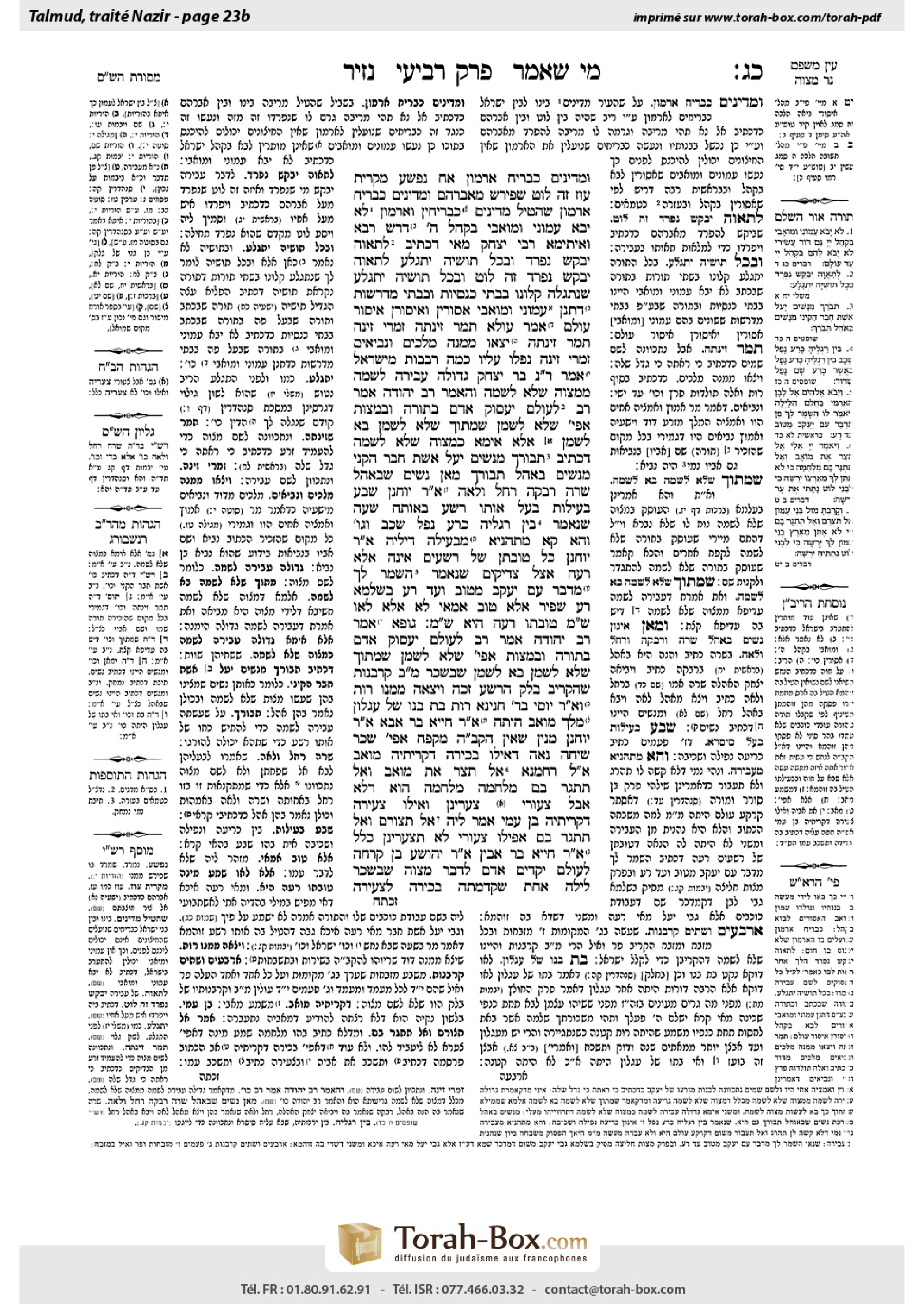
Nazir 23b: Talmud study for Daf Yomi
Daf Yomi is the daily study of one Talmud folio. Explore 37 tractates with scans, Hebrew text, Sefaria English and AI-generated French translations where annotated.
Passage selection and English or AI-generated French translation are available where the scan has annotations. Daf Study is independent of Torah-Box and Sefaria.
Browse Nazir · נזיר · All tractatesNazir 23b text and translations
This page of Nazir includes the Aramaic text, an English translation and an AI-generated French translation, alongside the scan above.
נזיר כ״ג ב · Aramaic and Hebrew text
וּמִדְיָנִים כִּבְרִיחַ אַרְמוֹן״? ״אָח נִפְשָׁע מִקִּרְיַת עֹז״ — זֶה לוֹט, שֶׁפֵּירַשׁ מֵאַבְרָהָם. ״וּמִדְיָנִים כִּבְרִיחַ אַרְמוֹן״ — שֶׁהֵטִיל מִדְיָנִים כִּבְרִיחִין וְאַרְמוֹן, ״לֹא יָבֹא עַמּוֹנִי וּמוֹאָבִי בִּקְהַל ה׳״.
דָּרֵשׁ רָבָא וְאִיתֵּימָא רַבִּי יִצְחָק: מַאי דִּכְתִיב ״לְתַאֲוָה יְבַקֵּשׁ נִפְרָד וּבְכׇל תּוּשִׁיָּה יִתְגַּלָּע״? ״לְתַאֲוָה יְבַקֵּשׁ נִפְרָד״ — זֶה לוֹט, ״וּבְכָל תּוּשִׁיָּה יִתְגַּלָּע״ — שֶׁנִּתְגַּלָּה קְלוֹנוֹ בְּבָתֵּי כְנֵסִיּוֹת וּבְבָתֵּי מִדְרָשׁוֹת. דִּתְנַן: עַמּוֹנִי וּמוֹאָבִי אֲסוּרִין, וְאִיסּוּרָן אִיסּוּר עוֹלָם.
אָמַר עוּלָּא: תָּמָר זִינְּתָה, זִמְרִי זִינָּה.
תָּמָר זִינְּתָה — יָצְאוּ מִמֶּנָּה מְלָכִים וּנְבִיאִים. זִמְרִי זִינָּה — נָפְלוּ עָלָיו כַּמָּה רְבָבוֹת מִיִּשְׂרָאֵל.
אָמַר רַב נַחְמָן בַּר יִצְחָק: גְּדוֹלָה עֲבֵירָה לִשְׁמָהּ מִמִּצְוָה שֶׁלֹּא לִשְׁמָהּ. וְהָאָמַר רַב יְהוּדָה אָמַר רַב: לְעוֹלָם יַעֲסוֹק אָדָם בְּתוֹרָה וּבְמִצְוֹת אֲפִילּוּ שֶׁלֹּא לִשְׁמָן, שֶׁמִּתּוֹךְ שֶׁלֹּא לִשְׁמָן בָּא לִשְׁמָן?
אֶלָּא אֵימָא: כְּמִצְוָה שֶׁלֹּא לִשְׁמָהּ. דִּכְתִיב: ״תְּבֹרַךְ מִנָּשִׁים יָעֵל אֵשֶׁת חֶבֶר הַקֵּינִי מִנָּשִׁים בָּאֹהֶל תְּבֹרָךְ״. מַאן נָשִׁים שֶׁבָּאֹהֶל — שָׂרָה רִבְקָה רָחֵל וְלֵאָה.
אָמַר רַבִּי יוֹחָנָן: שֶׁבַע בְּעִילוֹת בָּעַל אוֹתוֹ רָשָׁע בְּאוֹתָהּ שָׁעָה, שֶׁנֶּאֱמַר: ״בֵּין רַגְלֶיהָ כָּרַע נָפַל שָׁכָב וְגוֹ׳״.
וְהָא קָא מִתְהַנְיָא מִבְּעִילָה דִילֵיהּ? אָמַר רַבִּי יוֹחָנָן: כׇּל טוֹבָתָן שֶׁל רְשָׁעִים — אֵינָהּ אֶלָּא רָעָה אֵצֶל צַדִּיקִים,
שֶׁנֶּאֱמַר: ״הִשָּׁמֶר לְךָ מִדַּבֵּר עִם יַעֲקֹב מִטּוֹב וְעַד רָע״. בִּשְׁלָמָא רַע — שַׁפִּיר, אֶלָּא טוֹב אַמַּאי לָא? אֶלָּא, לָאו שְׁמַע מִינַּהּ: טוֹבָתוֹ — רָעָה הִיא. שְׁמַע מִינַּהּ.
גּוּפָא, אָמַר רַב יְהוּדָה אָמַר רַב: לְעוֹלָם יַעֲסוֹק אָדָם בְּתוֹרָה וּבְמִצְוֹת אֲפִילּוּ שֶׁלֹּא לִשְׁמָן, שֶׁמִּתּוֹךְ שֶׁלֹּא לִשְׁמָן בָּא לִשְׁמָן. שֶׁבִּשְׂכַר אַרְבָּעִים וּשְׁנַיִם קׇרְבָּנוֹת שֶׁהִקְרִיב בָּלָק הָרָשָׁע — זָכָה וְיָצְאָה מִמֶּנּוּ רוּת. וְאָמַר רַבִּי יוֹסֵי בְּרַבִּי חֲנִינָא: רוּת, בַּת בְּנוֹ שֶׁל עֶגְלוֹן מֶלֶךְ מוֹאָב הָיְתָה.
אָמַר רַבִּי חִיָּיא בַּר אַבָּא אָמַר רַבִּי יוֹחָנָן: מִנַּיִן שֶׁאֵין הַקָּדוֹשׁ בָּרוּךְ הוּא מְקַפֵּחַ אֲפִילּוּ שְׂכַר שִׂיחָה נָאָה, דְּאִילּוּ בְּכִירָה דִּקְרָיתֵיהּ מוֹאָב, אֲמַר לֵיהּ רַחֲמָנָא ״אַל תָּצַר אֶת מוֹאָב וְאַל תִּתְגָּר בָם מִלְחָמָה״. מִלְחָמָה הוּא דְּלָא, אֲבָל צַעוֹרֵי צַעֲרִינֻּן.
וְאִילּוּ צְעִירָה דִּקְרָיתֵיהּ בֶּן עַמִּי. אֲמַר לֵיהּ: ״אַל תְּצֻרֵם וְאַל תִּתְגָּר בָם״. אֲפִילּוּ צַעוֹרֵי, לָא תְּצַעֲרִינֻּן כְּלָל.
אָמַר רַבִּי חִיָּיא בַּר אָבִין, אָמַר רַבִּי יְהוֹשֻׁעַ בֶּן קׇרְחָה: לְעוֹלָם יַקְדִּים אָדָם לִדְבַר מִצְוָה, שֶׁבִּשְׂכַר לַיְלָה אַחַת שֶׁקְּדָמַתָּה בְּכִירָה לִצְעִירָה,
Nazir 23b · English translation
and their contentions are like the bars of a castle” (Proverbs 18:19)? “A brother offended is harder to be won than a strong city,” this is Lot, called Abraham’s brother (see Genesis 14:14), who separated from Abraham. “And their contentions are like the bars of a castle,” this is because Lot brought contention between the Jewish people and his own descendants like bars, which lock the gates of a castle. Just as no one can enter a locked castle, so too Lot’s descendants, Ammon and Moab, were prevented from joining the Jewish people, as it states: “An Ammonite and a Moabite shall not enter into the assembly of the Lord” (Deuteronomy 23:4).
On the same issue, Rava expounded a verse homiletically, and some say it was Rabbi Yitzḥak: What is the meaning of that which is written: “He who separates himself seeks his own desire, and snarls against all sound wisdom” (Proverbs 18:1)? “He who separates himself seeks his own desire,” this is Lot, who separated from Abraham. “And snarls [yitgala] against all sound wisdom,” this too describes Lot, as his shame was eventually revealed [nitgala] in the synagogues, when his actions recorded in the Torah are read in public, and in the study halls, where the halakhot of his descendants are taught. As we learned in a mishna: An Ammonite and a Moabite are prohibited from entering the congregation by marrying a Jewish woman, and their prohibition is permanent.
§ In relation to the preceding discussion with regard to the daughters of Lot, who acted in a wanton manner for the sake of a mitzva, the Gemara cites that which Ulla said: Tamar engaged in licentious sexual intercourse with her father-in-law, Judah (see Genesis, chapter 38), and Zimri ben Salu also engaged in licentious sexual intercourse with a Midianite woman (see Numbers, chapter 25).
Yet despite the similarity between their actions, Tamar engaged in licentious sexual intercourse for the sake of a mitzva, to have children, and therefore she merited that kings of the House of David descended from her. King David’s lineage traces back to Tamar’s son Peretz (see Ruth 4:18–22). And she also merited to be the ancestor of prophets, e.g., Isaiah, who was related to the royal family. Conversely, with regard to Zimri, who engaged in licentious sexual intercourse for the purpose of a transgression, several multitudes of Israel fell due to him; twenty-four thousand in a plague (see Numbers 25:9). This shows that a great deal depends on one’s intentions.
§ Rav Naḥman bar Yitzḥak said: Greater is a transgression committed for its own sake, i.e., for the sake of Heaven, than a mitzva performed not for its own sake. The Gemara questions this comparison: But didn’t Rav Yehuda say that Rav said: A person should always occupy himself with Torah and mitzvot even not for their own sake, as it is through acts performed not for their own sake that good deeds for their own sake come about? How, then, can any transgression be considered greater than a mitzva not for the sake of Heaven?
Rather, one must emend the above statement and say as follows: A transgression for the sake of Heaven is equivalent to a mitzva not for its own sake. The proof is as it is written: “Blessed above women shall Yael be, the wife of Hever the Kenite, above women in the tent she shall be blessed” (Judges 5:24), and it is taught: Who are these “women in the tent?” They are Sarah, Rebecca, Rachel, and Leah. Yael’s forbidden intercourse with Sisera for the sake of Heaven is compared to the sexual intercourse in which the Matriarchs engaged.
The Gemara asks: How is it derived that Yael engaged in sexual intercourse with Sisera? As Rabbi Yoḥanan said: That wicked one, Sisera, engaged in seven acts of sexual intercourse with Yael at that time, as it is stated: “Between her feet he sunk, he fell, he lay; between her feet he sunk, he fell; where he sunk, there he fell down dead” (Judges 5:27). Each mention of falling is referring to another act of intercourse.
The Gemara asks: But Yael at least enjoyed the sexual intercourse with him; why is the verse so effusive in her praise? Rabbi Yoḥanan said: All the good of the wicked, i.e., anything good received from wicked people, is nothing other than evil for the righteous, and therefore she certainly derived no pleasure from the act.
The Gemara asks: From where is this principle derived? As it is stated in the verse that God warned Laban the Aramean, when he was chasing Jacob: “Guard yourself from speaking to Jacob, from good to evil” (Genesis 31:24). Granted, with regard to the warning against speaking evil, it is fine that Laban was warned not to harm Jacob. However, why shouldn’t he say anything good to Jacob? Rather, must one not conclude from this verse that even Laban’s good is bad in Jacob’s eyes? The Gemara concludes: Learn from this that it is so.
§ The Gemara returns to analyze in greater detail the above matter itself. Rav Yehuda said that Rav said: A person should always occupy himself with Torah and mitzvot even not for their own sake, as through these acts performed not for their own sake, good deeds for their own sake come about. The proof for this is that in reward for the forty-two offerings that the wicked Balak sacrificed (see Numbers, chapter 23), although he did not do so for the sake of Heaven but to facilitate the cursing of the Jewish people, nevertheless he merited that Ruth descended from him. Not only was he the forebear of a righteous convert, but also of King David. And this is as Rabbi Yosei, son of Rabbi Ḥanina, said: Ruth was the daughter of the son of Eglon, king of Moab, who descended from Balak, king of Moab.
Rabbi Ḥiyya bar Abba said that Rabbi Yoḥanan said: From where is it derived that the Holy One, Blessed be He, does not deprive one of even the reward for proper speech, i.e., for speaking in a refined manner? As while there is the case of Lot’s elder daughter, who called her son Moab [mo’av], which alludes to his shameful origins, as me’av means: From father, and the Merciful One says to Moses: “Do not besiege Moab, nor contend with them in war” (Deuteronomy 2:9), which indicates: It is war that is not permitted; however, with regard to harassing, the Jews were permitted to harass them.
And while there is the case of Lot’s younger daughter, who called her son Ben-Ami, son of my people, without explicitly mentioning her father. With regard to her descendants, God said to Moses: “Do not harass them, nor contend with them” (Deuteronomy 2:19), which means even as far as harassing is concerned, you may not harass them at all.
Rabbi Ḥiyya bar Avin said that Rabbi Yehoshua ben Korḥa said: A person should always come first with regard to a matter of a mitzva, as in reward of the one night that the elder daughter of Lot preceded the younger for the sake of a mitzva,
Nazir 23b · Traduction française (IA)
« Et leurs querelles sont comme les barres d’une forteresse » (Proverbes 18:19). « Un frère offensé est plus difficile à gagner qu’une ville forte » : il s’agit de Lot, appelé le frère d’Abraham (voir Genèse 14:14), qui se sépara d’Abraham. « Et leurs querelles sont comme les barres d’une forteresse » : Lot suscita ainsi une querelle entre le peuple juif et ses propres descendants, pareille aux barres qui verrouillent les portes d’une forteresse. De même que nul ne peut entrer dans une forteresse verrouillée, les descendants de Lot, Ammon et Moab, furent empêchés de se joindre au peuple juif, comme il est dit : « Un Ammonite et un Moabite n’entreront pas dans l’assemblée du Seigneur » (Deutéronome 23:4).
Sur le même sujet, Rava interpréta un verset de manière homilétique, et certains disent que ce fut Rabbi Yitsḥak : Que signifie ce qui est écrit : « Celui qui se sépare recherche son propre désir et s’insurge contre toute sagesse » (Proverbes 18:1) ? « Celui qui se sépare recherche son propre désir » : il s’agit de Lot, qui se sépara d’Abraham. « Et s’insurge [yitgala] contre toute sagesse » : cela décrit également Lot, car sa honte finit par être dévoilée [nitgala] dans les synagogues, lorsque ses actes consignés dans la Torah sont lus en public, et dans les maisons d’étude, où sont enseignées les halakhot concernant ses descendants. Comme nous l’avons appris dans une Michna : un Ammonite et un Moabite ne peuvent entrer dans l’assemblée en épousant une femme juive, et cette interdiction est permanente.
§ À propos de la discussion précédente concernant les filles de Lot, qui agirent de manière dissolue pour accomplir une mitsva, la Guemara rapporte les propos d’Oula : Tamar eut des relations sexuelles illicites avec son beau-père, Juda (voir Genèse, chapitre 38), et Zimri ben Salu eut lui aussi des relations sexuelles illicites avec une femme madianite (voir Nombres, chapitre 25).
Pourtant, malgré la similitude de leurs actes, Tamar eut des relations sexuelles illicites dans le but d’accomplir une mitsva, afin d’avoir des enfants ; elle mérita donc que des rois de la maison de David descendent d’elle. La lignée du roi David remonte à Perets, fils de Tamar (voir Ruth 4:18–22). Elle mérita également d’être l’ancêtre de prophètes, comme Isaïe, qui était apparenté à la famille royale. En revanche, Zimri, qui eut des relations sexuelles illicites dans le but de commettre une transgression, causa la mort de plusieurs dizaines de milliers d’Israélites : vingt-quatre mille périrent dans une épidémie (voir Nombres 25:9). Cela montre que les intentions jouent un rôle considérable.
§ Rav Naḥman bar Yitsḥak dit : Une transgression commise pour elle-même, c’est-à-dire pour le Ciel, est supérieure à une mitsva accomplie sans que ce soit pour elle-même. La Guemara conteste cette comparaison : Rav Yehouda n’a-t-il pas dit au nom de Rav qu’une personne doit toujours s’adonner à la Torah et aux mitsvot, même si elle ne les accomplit pas pour elles-mêmes, car c’est par des actes accomplis sans que ce soit pour eux-mêmes que l’on en vient à accomplir de bonnes actions pour elles-mêmes ? Comment, dès lors, une transgression peut-elle être considérée comme supérieure à une mitsva accomplie sans que ce soit pour le Ciel ?
Il faut plutôt corriger la déclaration précédente et dire ceci : une transgression commise pour le Ciel équivaut à une mitsva accomplie sans que ce soit pour elle-même. La preuve en est qu’il est écrit : « Bénie entre les femmes sera Yaël, femme de Héber le Qénite ; bénie entre les femmes sous la tente » (Juges 5:24), et il est enseigné : Qui sont ces « femmes sous la tente » ? Ce sont Sarah, Rébecca, Rachel et Léa. Les relations sexuelles interdites de Yaël avec Sisera, accomplies pour le Ciel, sont comparées aux relations sexuelles des Matriarches.
La Guemara demande : Comment déduit-on que Yaël eut des relations sexuelles avec Sisera ? Rabbi Yoḥanan dit en effet : Ce scélérat de Sisera eut sept rapports sexuels avec Yaël à ce moment-là, comme il est écrit : « Entre ses pieds il s’affaissa, il tomba, il resta couché ; entre ses pieds il s’affaissa, il tomba ; là où il s’affaissa, il tomba, mort » (Juges 5:27). Chaque mention de sa chute fait référence à un autre rapport sexuel.
La Guemara demande : Mais Yaël, du moins, éprouva du plaisir lors de ces relations sexuelles avec lui ; pourquoi le verset la loue-t-il avec tant d’emphase ? Rabbi Yoḥanan dit : Tout ce qui est bon chez les méchants, c’est-à-dire tout bien reçu de personnes méchantes, n’est rien d’autre qu’un mal pour les justes ; Yaël ne tira donc certainement aucun plaisir de cet acte.
La Guemara demande : D’où tire-t-on ce principe ? Du verset où Dieu avertit Laban l’Araméen, alors qu’il poursuivait Jacob : « Garde-toi de parler à Jacob, en bien ou en mal » (Genèse 31:24). Pour ce qui est de l’interdiction de parler en mal, il est logique que Laban ait été averti de ne pas faire de mal à Jacob. Mais pourquoi ne devrait-il rien dire de bon à Jacob ? Ne faut-il pas plutôt conclure de ce verset que même ce que Laban considère comme bon est mauvais aux yeux de Jacob ? La Guemara conclut : Il faut en déduire que c’est bien le cas.
§ La Guemara revient sur le sujet précédent afin de l’analyser plus en détail. Rav Yehouda dit au nom de Rav : Une personne doit toujours s’adonner à la Torah et aux mitsvot, même si elle ne les accomplit pas pour elles-mêmes, car ces actes accomplis sans que ce soit pour eux-mêmes conduisent à accomplir de bonnes actions pour elles-mêmes. La preuve en est qu’en récompense des quarante-deux sacrifices offerts par le méchant Balaq (voir Nombres, chapitre 23), bien qu’il ne les ait pas offerts pour le Ciel, mais afin de rendre possible la malédiction du peuple juif, il mérita néanmoins que Ruth descende de lui. Il ne fut pas seulement l’ancêtre d’une convertie juste, mais aussi celui du roi David. C’est ce qu’a dit Rabbi Yossei, fils de Rabbi Ḥanina : Ruth était la fille du fils d’Eglon, roi de Moab, lui-même descendant de Balaq, roi de Moab.
Rabbi Ḥiyya bar Abba dit au nom de Rabbi Yoḥanan : D’où apprend-on que le Saint, béni soit-Il, ne prive personne, même de la récompense due à une parole convenable, c’est-à-dire à une manière raffinée de s’exprimer ? La fille aînée de Lot appela son fils Moab [mo’av], faisant ainsi allusion à ses origines honteuses, car me’av signifie « du père ». Pourtant, le Miséricordieux dit à Moïse : « N’assiège pas Moab et ne le provoque pas à la guerre » (Deutéronome 2:9), ce qui indique que seule la guerre était interdite ; en revanche, les Israélites étaient autorisés à les harceler.
La fille cadette de Lot, elle, appela son fils Ben-Ami, « fils de mon peuple », sans mentionner explicitement son père. Au sujet de ses descendants, Dieu dit à Moïse : « Ne les harcèle pas et ne les provoque pas » (Deutéronome 2:19), ce qui signifie que vous ne devez absolument pas les harceler.
Rabbi Ḥiyya bar Avin dit au nom de Rabbi Yehoshua ben Korḥa : Une personne doit toujours prendre l’initiative lorsqu’il s’agit d’une mitsva, car, en récompense de cette nuit où la fille aînée de Lot devança la cadette pour accomplir une mitsva,
Traduction française générée par IA à partir de l’édition anglaise de Sefaria. Vérifie toujours un passage avec le texte source.
Text from Sefaria: William Davidson Edition - Vocalized Aramaic (CC BY NC); William Davidson Edition - English (CC BY NC).