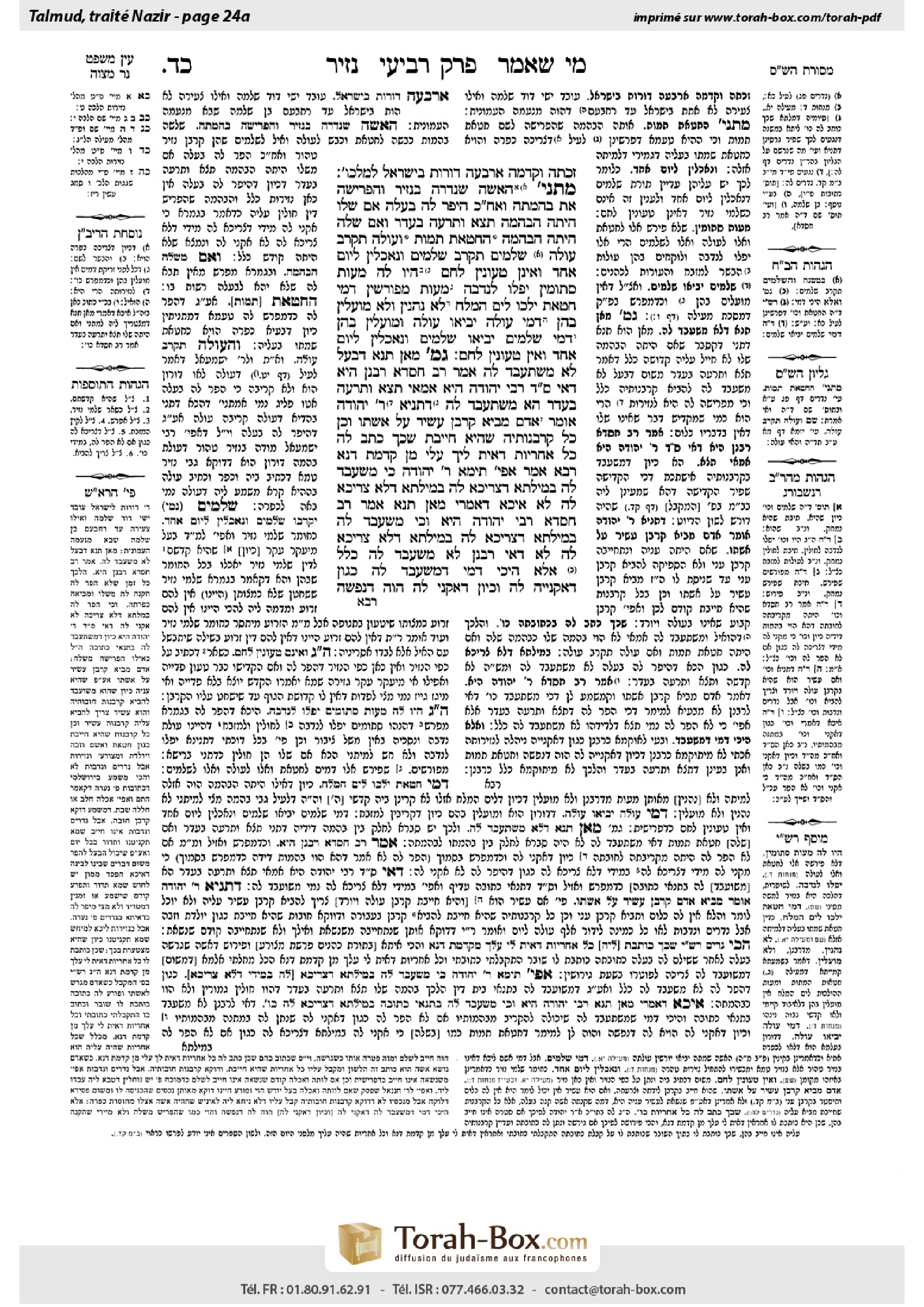
Nazir 24a: Talmud study for Daf Yomi
Daf Yomi is the daily study of one Talmud folio. Explore 37 tractates with scans, Hebrew text, Sefaria English and AI-generated French translations where annotated.
Passage selection and English or AI-generated French translation are available where the scan has annotations. Daf Study is independent of Torah-Box and Sefaria.
Browse Nazir · נזיר · All tractatesNazir 24a text and translations
This page of Nazir includes the Aramaic text, an English translation and an AI-generated French translation, alongside the scan above.
נזיר כ״ד א · Aramaic and Hebrew text
זָכְתָה וְקָדְמָה אַרְבָּעָה דּוֹרוֹת בְּיִשְׂרָאֵל לַמַּלְכוּת.
מַתְנִי׳ הָאִשָּׁה שֶׁנָּדְרָה בְּנָזִיר, וְהִפְרִישָׁה אֶת בְּהֶמְתָּהּ, וְאַחַר כָּךְ הֵיפֵר לָהּ בַּעֲלָהּ. אִם שֶׁלּוֹ הָיְתָה הַבְּהֵמָה — תֵּצֵא וְתִרְעֶה בָּעֵדֶר.
וְאִם שֶׁלָּהּ הָיְתָה הַבְּהֵמָה, הַחַטָּאת — תָּמוּת, וְעוֹלָה — תִּקְרַב עוֹלָה, שְׁלָמִים — תִּקְרַב שְׁלָמִים, וְנֶאֱכָלִין לְיוֹם אֶחָד, וְאֵינָן טְעוּנִין לֶחֶם.
הָיוּ לָהּ מָעוֹת סְתוּמִין — יִפְּלוּ לִנְדָבָה. מָעוֹת מְפוֹרָשִׁין, דְּמֵי חַטָּאת — יֵלְכוּ לְיָם הַמֶּלַח. לֹא נֶהֱנִין, וְלֹא מוֹעֲלִין בָּהֶן.
דְּמֵי עוֹלָה — יָבִיאוּ עוֹלָה, וּמוֹעֲלִין בָּהֶן. דְּמֵי שְׁלָמִים — יָבִיאוּ שְׁלָמִים, וְנֶאֱכָלִין לְיוֹם אֶחָד, וְאֵין טְעוּנִין לֶחֶם.
גְּמָ׳ מַאן תְּנָא דְּבַעַל לָא מִשְׁתַּעְבַּד לַהּ? אָמַר רַב חִסְדָּא: רַבָּנַן הִיא. דְּאִי סָלְקָא דַּעְתָּךְ רַבִּי יְהוּדָה הִיא, אַמַּאי תֵּצֵא וְתִרְעֶה בָּעֵדֶר? הָא מִשְׁתַּעְבַּד לַהּ.
דְּתַנְיָא, רַבִּי יְהוּדָה אוֹמֵר: אָדָם מֵבִיא קׇרְבַּן עָשִׁיר עַל אִשְׁתּוֹ.
וְכֵן כׇּל קׇרְבְּנוֹתֶיהָ שֶׁהִיא חַיֶּיבֶת, שֶׁכָּךְ כָּתַב לָהּ: ״כׇּל אַחְרָיוּת דְּאִית לִיךְ עֲלַי מִן קַדְמַת דְּנָא״.
רָבָא אָמַר: אֲפִילּוּ תֵּימָא רַבִּי יְהוּדָה, כִּי מְשַׁעְבַּד לַהּ — בְּמִילְּתָא דִּצְרִיכָא לַהּ, בְּמִילְּתָא דְּלָא צְרִיכָא לַהּ — לָא.
אִיכָּא דְּאָמְרִי: מַאן תַּנָּא? אָמַר רַב חִסְדָּא: רַבִּי יְהוּדָה הִיא. וְכִי מְשַׁעְבַּד לַהּ — בְּמִילְּתָא דִּצְרִיכָא לַהּ, בְּמִילְּתָא דְּלָא צְרִיכָא לָהּ — לָא. דְּאִי רַבָּנַן — לָא מְשַׁעְבַּד לַהּ כְּלָל.
אֶלָּא הֵיכִי דָּמֵי דִּמְשַׁעְבַּד לַהּ — כְּגוֹן דְּאַקְנְיַיהּ לַהּ, וְכֵיוָן דְּאַקְנֵי לַהּ — הָוֵה דְּנַפְשַׁהּ.
Nazir 24a · English translation
she merited to precede the younger daughter by four generations to the monarchy of the Jewish people. The descendants of Ruth the Moabite ruled over the Jewish people for four generations: Obed, Yishai, David, and Solomon, before the reign of Solomon’s son Rehoboam, whose mother was Naamah the Ammonite.
MISHNA: With regard to a woman who vowed to be a nazirite and separated her animals for her offerings of purity at the end of her term, and afterward her husband nullified her vow, which means that she is not in fact a nazirite, what becomes of these animals? If the animal was his, it shall go out and graze among the flock until it becomes blemished, like regular non-consecrated animals.
And if the animal was hers, different halakhot apply to the various offerings: The animal she set aside as a sin-offering must be left to die by being shut in an enclosed area and deprived of food and water, as will be explained in the Gemara. And the animal separated for a burnt-offering is sacrificed on the altar as a burnt-offering, as in any case one may bring a voluntary burnt-offering. As for the one designated for a peace-offering, it is sacrificed as a voluntary peace-offering. And this peace-offering is eaten for only one day, in accordance with the halakha of the nazirite’s peace-offering, despite the fact that regular peace-offerings may be eaten for two days. But the offering does not require bread, i.e., loaves and wafers, unlike that of a nazirite.
If she had unallocated funds, i.e., she had separated money for her offerings but had not stated which coins were designated for which offering, all the money will be earmarked for communal gift offerings. If she had allocated funds, i.e., she had decided which coins were for the payment of each offering, even if she had not yet purchased the animals, the money for the sin-offering is taken and cast into the Dead Sea, i.e., it must be destroyed, either by being thrown into the sea or by some other means. One may not benefit from it, as it possesses a measure of sanctity, but one also does not misuse property consecrated to the Temple with it. In other words, if one did derive benefit from this money he is not liable to bring an offering for misusing consecrated property.
As for the money for the burnt-offering, a burnt-offering is brought with those coins, and one who benefits from it is liable for misuse of consecrated property, as it is sacred since it can be used toward the purchase of a gift offering. Similarly, with regard to the money for a peace-offering, a peace-offering is brought with those coins, and it is eaten for one day and does not require bread.
GEMARA: The Gemara inquires: Who is the tanna who taught that a husband is not indebted to his wife, i.e., he is not required to provide her with her obligatory offerings? It is evident that the tanna of the mishna maintains that this is the case, as he rules that the animal does not remain sacred if it belonged to her husband. Rav Ḥisda said: It is the opinion of the Rabbis. As, if it should enter your mind that it is the opinion of Rabbi Yehuda, why should an animal that belonged to the husband go out and graze among the flock until it becomes blemished? After all, the husband is indebted and required to give her the offerings she requires, which means that her consecration is valid even if she used his animals.
The Gemara provides the source for the opinion of Rabbi Yehuda: As it is taught in a baraita that Rabbi Yehuda says: A person brings the offering of a rich man on behalf of his wife. If a wife is obligated to bring an offering that is different depending on whether she is wealthy or poor, e.g., the offering of a childbearing woman, then even if she herself does not own enough to be considered wealthy, if her husband can afford it he must bring the offering of a rich person on her behalf.
And similarly, he brings all her offerings that she is obligated to bring, even those whose obligation preceded their marriage. The reason is that he wrote to her in her marriage contract like this: I accept upon myself all claims of guarantee that you have upon me from beforehand. These obligations include her offerings.
Rava said: You can even say that the mishna is in accordance with the opinion of Rabbi Yehuda, and nevertheless the husband is under no obligation if he nullified her vow. The reason is as follows: When is he obligated to bring her offerings? It is only in the case of a matter that is necessary for her to bring. However, in the case of a matter that is not necessary for her to bring, he is under no such obligation. Here, too, once he has nullified her naziriteship, she is no longer in need of this offering.
Some say a different version of this discussion: Who is the tanna who taught that only a husband who nullified his wife’s vow is exempt from providing her offerings? Rav Ḥisda said that it is Rabbi Yehuda, and his opinion is as follows: When is he indebted to fund her offerings? It is in the case of a matter that is necessary for her to bring, but in the case of a matter that is not necessary for her to bring, he is under no such obligation. As, if it is in accordance with the opinion of the Rabbis, he is not mortgaged to her in this regard at all.
Rather, what are the circumstances in which he is obligated to provide her offering, according to the opinion of the Rabbis? For example, if he transferred the animal to her possession. But in that case, since he has transferred it to her, it is her own, which means that she has effectively separated the offering from her own property. The mishna cannot be referring to this situation, as the animal does not revert to a non-sacred state in a case of this kind. Evidently, the mishna is in accordance with the opinion of Rabbi Yehuda.
Nazir 24a · Traduction française (IA)
Elle eut le mérite de devancer la fille cadette de quatre générations jusqu’à la royauté du peuple juif. Les descendants de Ruth la Moabite régnèrent sur le peuple juif pendant quatre générations : Obed, Yichaï, David et Salomon, avant le règne de Roboam, fils de Salomon, dont la mère était Naama l’Ammonite.
MICHNA : À propos d’une femme qui avait fait vœu de devenir naziréenne et avait mis à part des animaux pour ses sacrifices de purification à la fin de son terme, puis dont le mari a annulé le vœu, de sorte qu’elle n’est en fait pas naziréenne : que deviennent ces animaux ? Si l’animal appartenait à son mari, il doit être laissé à paître parmi le troupeau jusqu’à ce qu’il soit atteint d’une infirmité, comme les animaux ordinaires non consacrés.
Et si l’animal lui appartenait, différentes halakhot s’appliquent aux divers sacrifices : l’animal qu’elle avait mis à part comme sacrifice expiatoire doit être enfermé dans un enclos et privé de nourriture et d’eau jusqu’à ce qu’il meure, comme la Guemara l’expliquera. L’animal mis à part pour l’holocauste est offert sur l’autel en holocauste, car on peut de toute façon apporter un holocauste volontaire. Quant à l’animal destiné au sacrifice de paix, il est offert comme sacrifice de paix volontaire. Ce sacrifice de paix ne se mange que pendant un jour, conformément à la halakha du sacrifice de paix de la naziréenne, bien que les sacrifices de paix ordinaires puissent être consommés pendant deux jours. Toutefois, ce sacrifice ne nécessite pas de pain, c’est-à-dire des miches et des galettes, contrairement au sacrifice de la naziréenne.
Si elle disposait de fonds non affectés, c’est-à-dire qu’elle avait mis de l’argent de côté pour ses sacrifices sans préciser quelles pièces étaient destinées à chacun d’eux, tout cet argent sera affecté aux offrandes volontaires de la communauté. Si elle disposait de fonds affectés, c’est-à-dire qu’elle avait décidé quelles pièces serviraient au paiement de chaque sacrifice, même si elle n’avait pas encore acheté les animaux, l’argent destiné au sacrifice expiatoire est pris et jeté dans la mer Morte, c’est-à-dire qu’il doit être détruit, soit en le jetant dans la mer, soit par un autre moyen. On ne peut en tirer aucun profit, car il possède un certain degré de sainteté, mais son utilisation ne constitue pas non plus un détournement de biens consacrés au Temple. Autrement dit, si quelqu’un tire profit de cet argent, il n’est pas tenu d’apporter un sacrifice pour détournement de biens consacrés.
Quant à l’argent destiné à l’holocauste, on achète avec ces pièces un holocauste, et celui qui en tire profit est passible pour détournement de biens consacrés, car cet argent est sacré puisqu’il peut servir à l’achat d’une offrande volontaire. De même, avec l’argent destiné au sacrifice de paix, on achète un sacrifice de paix, qui se mange pendant un jour et ne nécessite pas de pain.
GUEMARA : La Guemara demande : Quel est le tanna qui a enseigné qu’un mari n’est pas débiteur envers sa femme, c’est-à-dire qu’il n’est pas tenu de lui fournir les sacrifices qu’elle est obligée d’apporter ? Il est évident que le tanna de la Michna soutient cette opinion, puisqu’il statue que l’animal ne reste pas consacré s’il appartenait à son mari. Rav Ḥisda dit : C’est l’opinion des Rabbins. En effet, si tu devais penser qu’il s’agit de l’opinion de Rabbi Yehouda, pourquoi un animal qui appartenait au mari serait-il laissé à paître parmi le troupeau jusqu’à ce qu’il soit atteint d’une infirmité ? Après tout, le mari est débiteur et doit lui fournir les sacrifices dont elle a besoin, ce qui signifie que la consécration est valable même si elle a utilisé ses animaux à lui.
La Guemara donne la source de l’opinion de Rabbi Yehouda : il est enseigné dans une baraïta que Rabbi Yehouda dit : « Une personne apporte le sacrifice d’un riche au nom de sa femme. » Si une femme est tenue d’apporter un sacrifice dont la nature varie selon qu’elle est riche ou pauvre, par exemple le sacrifice d’une femme ayant accouché, alors, même si elle-même ne possède pas assez pour être considérée comme riche, son mari doit apporter en son nom le sacrifice d’un riche s’il en a les moyens.
De même, il apporte tous les sacrifices qu’elle est tenue d’apporter, y compris ceux dont l’obligation est antérieure à leur mariage. La raison en est qu’il lui a écrit dans son contrat de mariage : « J’accepte à ma charge toutes les obligations dont tu avais la garantie à mon égard auparavant. » Ces obligations comprennent ses sacrifices.
Rava dit : On peut même dire que la Michna est conforme à l’opinion de Rabbi Yehouda et que, néanmoins, le mari n’est pas tenu de fournir les sacrifices de sa femme lorsqu’il a annulé son vœu. Voici pourquoi : quand est-il tenu d’apporter ses sacrifices ? Uniquement lorsqu’il s’agit d’un sacrifice qu’elle doit apporter. Mais lorsqu’il s’agit d’un sacrifice qu’elle n’a pas besoin d’apporter, il n’est pas soumis à cette obligation. Ici aussi, dès lors qu’il a annulé son naziréat, elle n’a plus besoin de ce sacrifice.
Certains rapportent une autre version de cette discussion : Quel est le tanna qui a enseigné que seul un mari ayant annulé le vœu de sa femme est exempt de lui fournir ses sacrifices ? Rav Ḥisda dit qu’il s’agit de Rabbi Yehouda, et voici son opinion : quand est-il débiteur pour financer les sacrifices de sa femme ? Lorsqu’il s’agit d’un sacrifice qu’elle doit apporter ; mais lorsqu’il s’agit d’un sacrifice qu’elle n’a pas besoin d’apporter, il n’est soumis à aucune obligation de ce genre. En effet, s’il s’agissait de l’opinion des Rabbins, il ne serait aucunement engagé envers elle à cet égard.
Alors, dans quelles circonstances, selon l’opinion des Rabbins, est-il tenu de lui fournir son sacrifice ? Par exemple, s’il a transféré l’animal en sa possession. Mais dans ce cas, puisqu’il le lui a transféré, l’animal lui appartient, ce qui signifie qu’elle a effectivement mis le sacrifice à part avec ses propres biens. La Michna ne peut pas faire référence à cette situation, car, dans un tel cas, l’animal ne redevient pas profane. Il apparaît donc que la Michna est conforme à l’opinion de Rabbi Yehouda.
Traduction française générée par IA à partir de l’édition anglaise de Sefaria. Vérifie toujours un passage avec le texte source.
Text from Sefaria: William Davidson Edition - Vocalized Aramaic (CC BY NC); William Davidson Edition - English (CC BY NC).