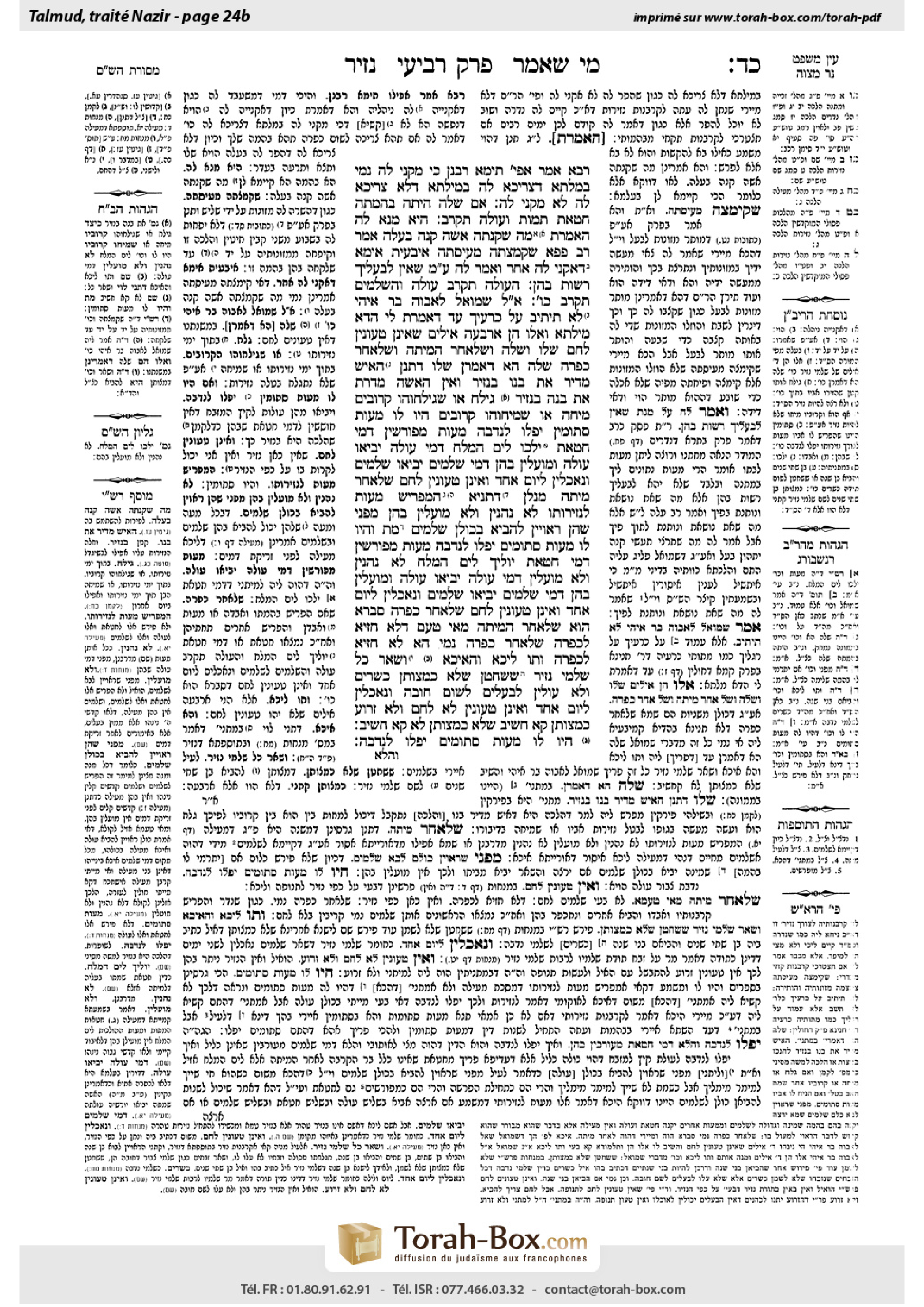
Nazir 24b: Talmud study for Daf Yomi
Daf Yomi is the daily study of one Talmud folio. Explore 37 tractates with scans, Hebrew text, Sefaria English and AI-generated French translations where annotated.
Passage selection and English or AI-generated French translation are available where the scan has annotations. Daf Study is independent of Torah-Box and Sefaria.
Browse Nazir · נזיר · All tractatesNazir 24b text and translations
This page of Nazir includes the Aramaic text, an English translation and an AI-generated French translation, alongside the scan above.
נזיר כ״ד ב · Aramaic and Hebrew text
רָבָא אָמַר: אֲפִילּוּ תֵּימָא רַבָּנַן, כִּי מַקְנֵי לַהּ — נָמֵי בְּמִלְּתָא דִּצְרִיכָא לַהּ, בְּמִילְּתָא דְּלָא צְרִיכָא לַהּ — לָא מַקְנֵי לַהּ.
אִם שֶׁלָּהּ הָיְתָה בְּהֶמְתָּהּ, חַטָּאת — תָּמוּת, וְעוֹלָה — תִּקְרַב. הִיא מְנָא לַהּ? הָאָמְרַתְּ: מַה שֶּׁקָּנְתָה אִשָּׁה קָנָה בַּעְלָהּ! אָמַר רַב פָּפָּא: שֶׁקִּמְּצַתָּה מֵעִיסָּתָהּ. אִיבָּעֵית אֵימָא: דְּאַקְנִי לַהּ אַחֵר, וַאֲמַר לַהּ: ״עַל מְנָת שֶׁאֵין לְבַעְלֵיךְ רְשׁוּת בָּהֶן״.
הָעוֹלָה — תִּקְרַב עוֹלָה, וְהַשְּׁלָמִים — תִּקְרַב כּוּ׳. אֲמַר לֵיהּ שְׁמוּאֵל לַאֲבוּהּ בַּר אִיהִי: לָא תִּיתֵּיב עַל כַּרְעָיךְ עַד דְּאָמְרַתְּ לִי הָדָא מִילְּתָא: וְאֵלּוּ הֵן אַרְבָּעָה אֵילִים שֶׁאֵינָן טְעוּנִין לֶחֶם: שֶׁלּוֹ, וְשֶׁלָּהּ, וְשֶׁלְּאַחַר הַמִּיתָה, וְשֶׁלְּאַחַר כַּפָּרָה.
שֶׁלָּהּ — הָא דַּאֲמַרַן. שֶׁלּוֹ — דִּתְנַן: הָאִישׁ מַדִּיר אֶת בְּנוֹ בְּנָזִיר, וְאֵין הָאִשָּׁה מַדֶּרֶת אֶת בְּנָהּ בְּנָזִיר. גִּילַּח, אוֹ שֶׁגִּילְּחוּהוּ קְרוֹבִים, מִיחָה, אוֹ שֶׁמִּיחוּהוּ קְרוֹבִים.
הָיוּ לוֹ מָעוֹת סְתוּמִין — יִפְּלוּ לִנְדָבָה. מָעוֹת מְפוֹרָשִׁין, דְּמֵי חַטָּאת — יֵלְכוּ לְיָם הַמֶּלַח, דְּמֵי עוֹלָה — יָבִיאוּ עוֹלָה, וּמוֹעֲלִין בָּהֶן. דְּמֵי שְׁלָמִים — יָבִיאוּ שְׁלָמִים, וְנֶאֱכָלִין לְיוֹם אֶחָד, וְאֵינָן טְעוּנִין לֶחֶם.
שֶׁלְּאַחַר מִיתָה מְנָלַן, דְּתַנְיָא: הַמַּפְרִישׁ מָעוֹת לִנְזִירוּתוֹ — לֹא נֶהֱנִין וְלֹא מוֹעֲלִין בָּהֶן, מִפְּנֵי שֶׁהֵן רְאוּיִין לְהָבִיא בְּכוּלָּן שְׁלָמִים.
מֵת, וְהָיוּ לוֹ מָעוֹת סְתוּמִים — יִפְּלוּ לִנְדָבָה. מָעוֹת מְפוֹרָשִׁין, דְּמֵי חַטָּאת — יוֹלִיךְ לְיָם הַמֶּלַח, לֹא נֶהֱנִין וְלֹא מוֹעֲלִין. דְּמֵי עוֹלָה — יָבִיאוּ עוֹלָה, וּמוֹעֲלִין בָּהֶן. דְּמֵי שְׁלָמִים — יָבִיאוּ שְׁלָמִים, וְנֶאֱכָלִין לְיוֹם אֶחָד, וְאֵינָן טְעוּנִין לֶחֶם.
שֶׁלְּאַחַר כַּפָּרָה — סְבָרָא הוּא, שֶׁלְּאַחַר הַמִּיתָה מַאי טַעַם — דְּלָא חַזְיָא לְכַפָּרָה, שֶׁלְּאַחַר כַּפָּרָה נָמֵי — הָא לָא חַזְיָא לְכַפָּרָה.
וְתוּ לֵיכָּא? וְהָאִיכָּא: וּשְׁאָר כׇּל שַׁלְמֵי נָזִיר שֶׁשְּׁחָטָן שֶׁלֹּא כְּמִצְוָתָן — כְּשֵׁרִים, וְלֹא עוֹלִין לַבְּעָלִים לְשׁוּם חוֹבָה, וְנֶאֱכָלִין לְיוֹם אֶחָד, וְאֵינָן טְעוּנִין לֹא לֶחֶם וְלֹא זְרוֹעַ!
כְּמִצְוָתָן קָא חָשֵׁיב, שֶׁלֹּא כְּמִצְוָתָן לָא קָא חָשֵׁיב.
הָיוּ לוֹ מָעוֹת סְתוּמִים — יִפְּלוּ לִנְדָבָה,
Nazir 24b · English translation
Rava said: You can even say that the mishna is in accordance with the opinion of the Rabbis, and the reason the animal loses its sanctity is that even when he transfers it to her, he does so for a matter that is necessary for her to bring, but for a matter that is not necessary for her to bring, he does not transfer it to her.
§ The mishna teaches: If the animal was hers, the sin-offering must be left to die and the burnt-offering is sacrificed. The Gemara asks: She, this married woman, from where does she have her own property? Haven’t you said as a principle that with regard to any item that a woman acquires, her husband automatically acquires it from her? Rav Pappa said: This is referring to a case where she saved it from her dough, i.e., she was able to buy the animal with the money she saved by eating less. And if you wish, say instead that another person transferred the property to her, and he said to her that he is doing so on the condition that your husband has no rights to it. In that case the wife is the exclusive owner of the animal.
§ The mishna taught that the burnt-offering is sacrificed as a burnt-offering and the peace-offering is sacrificed as a peace-offering. Shmuel said to Avuh bar Ihi: You shall not sit on your feet until you say and explain to me this matter taught in a baraita: And these are the four rams of the nazirite’s offering that do not require bread to be brought with them, in contrast to the usual practice: His, hers, the one brought after death, and the one brought after the nazirite has gained atonement by means of a different offering.
The Gemara clarifies this statement: Hers, this is that which we just said, the offering of a woman who separated an animal of her own before her husband proceeded to nullify her vow. His, as we learned in a mishna (28b): A man can vow his son to become a nazirite, i.e., he can apply a vow of naziriteship to his minor son, but a woman cannot vow her son to become a nazirite. If the son objects, either of his own initiative or at the behest of others, his father’s vow is canceled. Consequently, if the boy shaved his hair during the period of naziriteship, thereby demonstrating his desire not to be a nazirite, or if relatives shaved him, or even if the minor performed no action at all but simply objected, or if his relatives made him object, his naziriteship is canceled.
In that case, if he had unallocated funds, which had been consecrated for the child’s offerings but not designated for any particular offering, all the money will be earmarked for communal gift offerings. If he had allocated funds designated for a particular offering, the money for a sin-offering is taken and cast into the Dead Sea; the money for a burnt-offering is brought as a burnt-offering, and one who benefits from it is liable for misuse of consecrated property; and the money for a peace-offering is brought as a peace-offering and it is eaten for one day and does not require bread.
With regard to a ram that is after its owner’s death, from where do we derive that this offering requires no bread? As it is taught in a mishna (Me’ila 18a): With regard to one who separates money for his naziriteship without specifying an offering, he may not derive benefit from them, but one who benefits from it is not liable for misuse of consecrated property. Why is he not liable to bring an offering for misuse of consecrated property? It is because the money is fit to bring peace-offerings with all of it, and no misuse is effected by deriving benefit from a peace-offering until after its blood has been sprinkled.
The mishna continues: If the one who set aside the money died and he had unallocated funds, they are all allocated for communal gift offerings. If he left behind allocated funds, with regard to the money for a sin-offering, one must take it and cast it into the Dead Sea; one may not derive benefit from it but one who benefits from it is not liable for misuse of consecrated property. The money for a burnt-offering is brought as a burnt-offering, and one who benefits from it is liable for misuse of consecrated property. The money for a peace-offering is brought as a peace-offering, and it is eaten for one day and does not require bread. This is the case of a ram after its owner’s death that does not require bread.
As for the ram that is after atonement, whose owner has used a different offering to achieve atonement, the halakha that this offering does not require bread is not taught explicitly. Rather, it is based on logical reasoning: What is the reason that no bread is brought in the case of a ram that is sacrificed after the death of its owner? It is that this offering is not fit for atonement, as no atonement is granted to the dead through offerings. With regard to a ram that is sacrificed after atonement too, it is no longer fit for atonement, as the owner has already gained atonement by means of a different animal.
The Gemara asks: And is there nothing else? Are there no other instances of a peace-offering of a nazirite that does not require bread, apart from the aforementioned cases? But isn’t there the following halakha: And with regard to all the other peace-offerings of a nazirite that were slaughtered not in accordance with their mitzva, e.g., if the ram was not of the proper age, they are fit offerings and may be eaten, but they do not count toward the owner’s obligation, i.e., he must bring another offering. The baraita continues: And these offerings are eaten for one day, like regular peace-offerings of a nazirite, and they require neither bread nor the foreleg, unlike the peace-offering of a nazirite. This is another example of a nazirite’s peace-offering that does not require bread.
The Gemara answers: In the above list the tanna includes only offerings that were sacrificed in accordance with their mitzva; he does not include animals that were sacrificed not in accordance with their mitzva.
§ It was stated above, with regard to one who separated money for his naziriteship and then died, that if he had unallocated funds, they are all allocated for communal gift offerings.
Nazir 24b · Traduction française (IA)
Rava a dit : On peut même dire que la Michna suit l’opinion des Rabbins, et que si l’animal perd sa sainteté, c’est parce que, même lorsqu’il le lui transfère, il le fait pour une dépense nécessaire à l’offrande qu’elle doit apporter ; mais il ne le lui transfère pas pour une dépense qui n’est pas nécessaire à cette offrande.
§ La Michna enseigne : Si l’animal lui appartenait, le sacrifice expiatoire doit être laissé à mourir et l’holocauste est offert. La Guemara demande : D’où cette femme mariée tient-elle des biens qui lui appartiennent en propre ? N’a-t-on pas établi comme principe que tout bien acquis par une femme est automatiquement acquis par son mari ? Rav Pappa a dit : Il s’agit d’un cas où elle a économisé sur ses dépenses alimentaires, c’est-à-dire qu’elle a pu acheter l’animal avec l’argent économisé en mangeant moins. Ou bien, si tu préfères, une autre personne lui a transféré le bien en lui disant qu’elle le lui donnait à la condition que son mari n’y ait aucun droit. Dans ce cas, l’épouse est l’unique propriétaire de l’animal.
§ La Michna enseigne que l’holocauste est offert comme holocauste et que le sacrifice de paix est offert comme sacrifice de paix. Chmouel dit à Avuh bar Ihi : Tu ne te relèveras pas avant de m’avoir énoncé et expliqué cette question enseignée dans une baraïta : « Voici les quatre béliers de l’offrande du nazir qui ne nécessitent pas qu’on apporte du pain avec eux, contrairement à l’usage habituel : le sien, le sien à elle, celui qui est apporté après la mort et celui qui est apporté après que le nazir a obtenu l’expiation au moyen d’une autre offrande. »
La Guemara précise cette déclaration : « Le sien à elle », c’est le cas que nous venons d’évoquer : l’offrande d’une femme qui avait mis à part un animal lui appartenant avant que son mari n’annule son vœu. « Le sien », comme nous l’avons appris dans une Michna (28b) : Un homme peut vouer son fils à devenir nazir, c’est-à-dire imposer un vœu de naziréat à son fils mineur, mais une femme ne peut pas vouer son fils à devenir nazir. Si le fils s’y oppose, de sa propre initiative ou à l’instigation d’autrui, le vœu de son père est annulé. Ainsi, si le garçon s’est rasé les cheveux pendant la période de naziréat, montrant par là qu’il ne veut pas être nazir, ou si des proches l’ont rasé, ou encore si le mineur n’a rien fait, mais s’est simplement opposé, ou si ses proches l’ont poussé à s’opposer, son naziréat est annulé.
Dans ce cas, s’il avait des fonds non affectés, consacrés aux offrandes de l’enfant mais non désignés pour une offrande en particulier, tout l’argent sera affecté à des offrandes volontaires communautaires. S’il avait des fonds affectés à une offrande particulière, l’argent destiné au sacrifice expiatoire est pris et jeté dans la mer Morte ; l’argent destiné à l’holocauste sert à apporter un holocauste, et quiconque en tire profit est coupable d’un usage profane de biens consacrés ; l’argent destiné au sacrifice de paix sert à apporter un sacrifice de paix, qui est consommé en un jour et ne nécessite pas de pain.
En ce qui concerne un bélier offert après la mort de son propriétaire, d’où savons-nous que cette offrande ne nécessite pas de pain ? Comme on l’enseigne dans une Michna (Meïla 18a) : Celui qui met à part de l’argent pour son naziréat sans désigner d’offrande précise ne peut pas en tirer profit, mais celui qui en tire profit n’est pas coupable d’un usage profane de biens consacrés. Pourquoi n’est-il pas tenu d’apporter une offrande pour cet usage profane de biens consacrés ? Parce que tout cet argent peut servir à apporter des sacrifices de paix, et l’on ne commet pas d’usage profane en tirant profit d’un sacrifice de paix avant que son sang ait été aspergé.
La Michna poursuit : Si celui qui avait mis l’argent à part est mort et qu’il avait des fonds non affectés, ils sont tous affectés à des offrandes volontaires communautaires. S’il a laissé des fonds affectés, l’argent destiné au sacrifice expiatoire doit être pris et jeté dans la mer Morte ; on ne peut pas en tirer profit, mais celui qui en tire profit n’est pas coupable d’un usage profane de biens consacrés. L’argent destiné à l’holocauste sert à apporter un holocauste, et quiconque en tire profit est coupable d’un usage profane de biens consacrés. L’argent destiné au sacrifice de paix sert à apporter un sacrifice de paix, qui est consommé en un jour et ne nécessite pas de pain. C’est le cas du bélier offert après la mort de son propriétaire qui ne nécessite pas de pain.
Quant au bélier offert après l’expiation, dont le propriétaire a obtenu l’expiation au moyen d’une autre offrande, la halakha selon laquelle cette offrande ne nécessite pas de pain n’est pas enseignée explicitement. Elle se déduit plutôt d’un raisonnement logique : pourquoi n’apporte-t-on pas de pain dans le cas d’un bélier offert après la mort de son propriétaire ? Parce que cette offrande ne peut pas apporter l’expiation, les morts n’obtenant pas l’expiation par des offrandes. Le bélier offert après l’expiation ne peut lui non plus apporter l’expiation, puisque son propriétaire l’a déjà obtenue au moyen d’un autre animal.
La Guemara demande : N’y a-t-il pas d’autres cas ? N’existe-t-il pas d’autres cas de sacrifice de paix d’un nazir qui ne nécessite pas de pain, en dehors de ceux qui ont été mentionnés ? Pourtant, il est enseigné la halakha suivante : Tous les autres sacrifices de paix d’un nazir abattus sans être conformes à leur mitsva — par exemple, si le bélier n’avait pas l’âge requis — sont des offrandes valides et peuvent être consommés, mais ils ne comptent pas pour acquitter le propriétaire de son obligation, c’est-à-dire qu’il doit apporter une autre offrande. La baraïta poursuit : Ces offrandes sont consommées en un jour, comme les sacrifices de paix ordinaires d’un nazir, et ne nécessitent ni pain ni épaule, contrairement au sacrifice de paix d’un nazir. Voilà un autre exemple de sacrifice de paix d’un nazir qui ne nécessite pas de pain.
La Guemara répond : Dans la liste ci-dessus, le tanna ne comprend que les offrandes offertes conformément à leur mitsva ; il n’y inclut pas les animaux offerts sans être conformes à leur mitsva.
§ Il a été dit plus haut, au sujet de celui qui avait mis de l’argent à part pour son naziréat puis était mort, que s’il avait des fonds non affectés, ils sont tous affectés à des offrandes volontaires communautaires.
Traduction française générée par IA à partir de l’édition anglaise de Sefaria. Vérifie toujours un passage avec le texte source.
Text from Sefaria: William Davidson Edition - Vocalized Aramaic (CC BY NC); William Davidson Edition - English (CC BY NC).