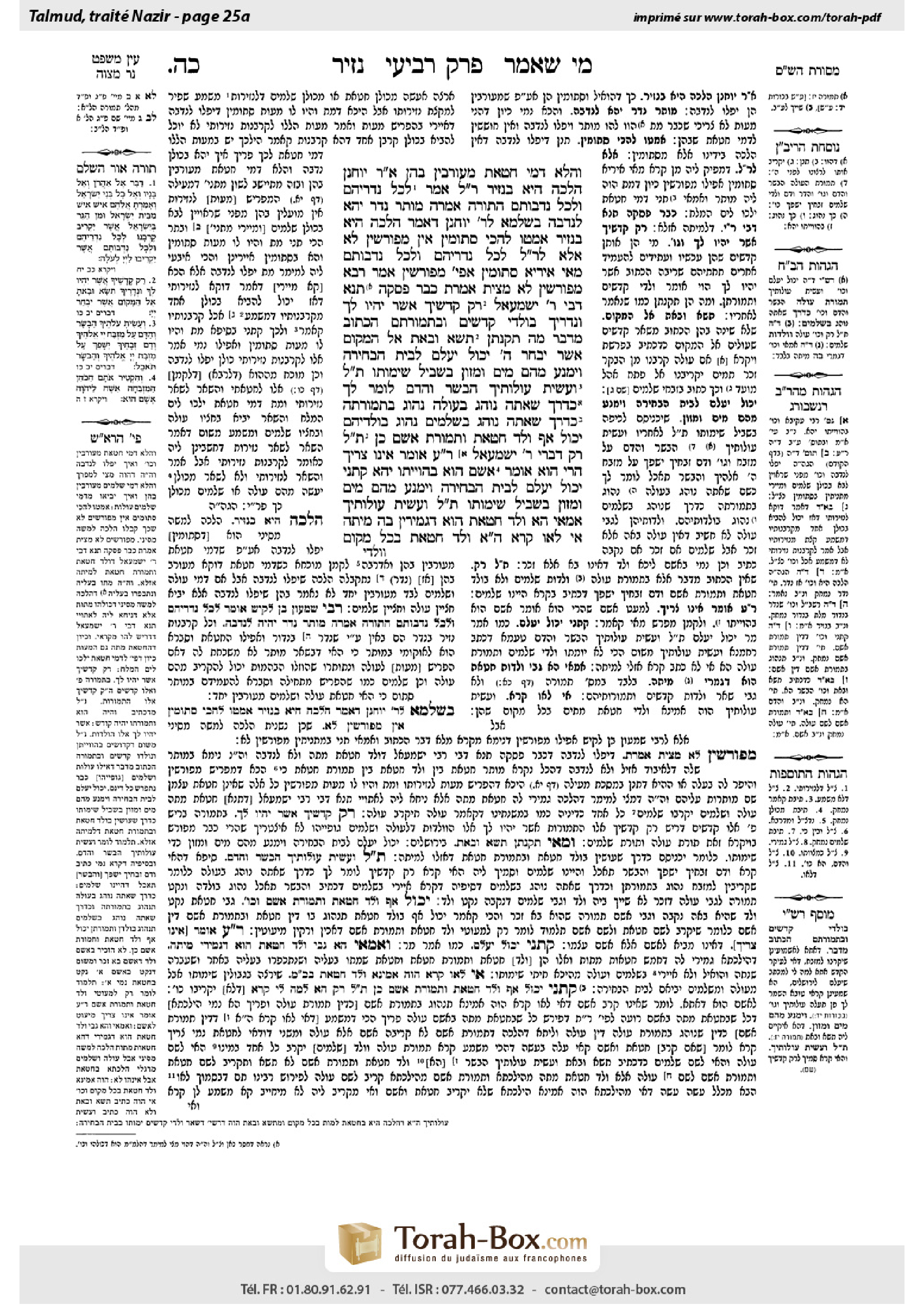
Nazir 25a: Talmud study for Daf Yomi
Daf Yomi is the daily study of one Talmud folio. Explore 37 tractates with scans, Hebrew text, Sefaria English and AI-generated French translations where annotated.
Passage selection and English or AI-generated French translation are available where the scan has annotations. Daf Study is independent of Torah-Box and Sefaria.
Browse Nazir · נזיר · All tractatesNazir 25a text and translations
This page of Nazir includes the Aramaic text, an English translation and an AI-generated French translation, alongside the scan above.
נזיר כ״ה א · Aramaic and Hebrew text
וַהֲלֹא דְּמֵי חַטָּאת מְעוֹרָבִין בָּהֶן? אָמַר רַבִּי יוֹחָנָן: הֲלָכָה הִיא בְּנָזִיר. רֵישׁ לָקִישׁ אָמַר: ״לְכׇל נִדְרֵיהֶם וּלְכׇל נִדְבוֹתָם״, הַתּוֹרָה אָמְרָה: מוֹתַר נֶדֶר יְהֵא לִנְדָבָה.
בִּשְׁלָמָא לְרַבִּי יוֹחָנָן, דְּאָמַר: הֲלָכָה הִיא בְּנָזִיר, אַמְּטוּ לְהָכִי סְתוּמִין — אִין, מְפוֹרָשִׁין — לָא. אֶלָּא לְרֵישׁ לָקִישׁ ״לְכׇל נִדְרֵיהֶם וּלְכׇל נִדְבוֹתָם״, מַאי אִירְיָא סְתוּמִין? אֲפִילּוּ מְפוֹרָשִׁין!
אָמַר רָבָא: מְפוֹרָשִׁין לָא מָצֵית אָמְרַתְּ, כְּבָר פַּסְקַהּ תַּנָּא דְּבֵי רַבִּי יִשְׁמָעֵאל: ״רַק קׇדָשֶׁיךָ אֲשֶׁר יִהְיוּ לְךָ וּנְדָרֶיךָ״ — בְּוַלְדֵי קָדָשִׁים וּבִתְמוּרָתָם הַכָּתוּב מְדַבֵּר.
מָה תַּקָּנָתָן — ״תִּשָּׂא וּבָאתָ אֶל הַמָּקוֹם אֲשֶׁר יִבְחַר ה׳״. יָכוֹל יַעֲלֵם לְבֵית הַבְּחִירָה, וְיִמְנַע מֵהֶם מַיִם וּמָזוֹן בִּשְׁבִיל שֶׁיָּמוּתוּ, תַּלְמוּד לוֹמַר: ״וְעָשִׂיתָ עֹלֹתֶיךָ הַבָּשָׂר וְהַדָּם״.
לוֹמַר לָךְ: כְּדֶרֶךְ שֶׁאַתָּה נוֹהֵג בָּעוֹלָה — נְהוֹג בִּתְמוּרָתָהּ, כְּדֶרֶךְ שֶׁאַתָּה נוֹהֵג בַּשְּׁלָמִים — נְהוֹג בְּוַלְדֵיהֶם. יָכוֹל אַף וְלַד חַטָּאת וּתְמוּרַת אָשָׁם כֵּן, — תַּלְמוּד לוֹמַר: ״רַק״, דִּבְרֵי רַבִּי יִשְׁמָעֵאל.
רַבִּי עֲקִיבָא אוֹמֵר: אֵינוֹ צָרִיךְ, הֲרֵי הוּא אוֹמֵר ״אָשָׁם הוּא״ — בַּהֲוָיָיתוֹ יְהֵא.
קָתָנֵי: יָכוֹל יַעֲלֵם לְבֵית הַבְּחִירָה וְיִמְנַע מֵהֶם מַיִם וּמָזוֹן בִּשְׁבִיל שֶׁיָּמוּתוּ — תַּלְמוּד לוֹמַר: ״וְעָשִׂיתָ עֹלֹתֶיךָ״. אַמַּאי? הָא וְלַד חַטָּאת הוּא דִּגְמִירִין בָּהּ מִיתָה? אִי לָאו קְרָא, הֲוָה אָמֵינָא וְלַד חַטָּאת בְּכׇל מָקוֹם,
Nazir 25a · English translation
The Gemara asks: But the money for the sin-offering is mingled with these unallocated funds. How can it all be used for gift burnt-offerings? Rabbi Yoḥanan said: It is an accepted halakha with regard to a nazirite that his unallocated funds are used for gift offerings, despite the fact that they include the value of a sin-offering. Reish Lakish said: The verse states: “Whether for any of their vows or for any of their gift offerings, which are brought to the Lord as a burnt-offering” (Leviticus 22:18). In this verse, the Torah states that the surplus of a vow shall be for a gift offering. Here too, if the vow of naziriteship cannot be fulfilled, due to the death of the one who took the vow, the money is for a gift offering.
The Gemara asks: Granted, according to the opinion of Rabbi Yoḥanan, who said that it is a halakha with regard to a nazirite, it is for this reason that if the funds were unallocated, yes, the money is used for gift offerings, but if they were allocated, no, they may not be used for this purpose, as this is the halakha passed down by tradition. However, according to the opinion of Reish Lakish, who derives the halakha from the verse: “For any of their vows or for any of their gift offerings,” why state specifically unallocated funds; even allocated money should be used for gift offerings after the death of their owner.
Rava said: You cannot say that this halakha should apply to allocated funds, as the tanna of the school of Rabbi Yishmael has already ruled in this regard. The tanna explained the following verse that deals with the obligation to bring consecrated animals to the Temple: “Only your sacred things that you have, and your vows” (Deuteronomy 12:26). The verse is speaking of the offspring of consecrated female peace-offerings and their substitutes, i.e., when one says a non-sacred animal should substitute for a sacred animal.
With regard to these animals, what is their means of remedy? “You shall take and go to the place that the Lord shall choose” (Deuteronomy 12:26). One might have thought that this means that he must bring them up to the Temple, and yet he does not sacrifice them but withholds water and food from them so that they should die. Therefore, the verse states: “And you shall sacrifice your burnt-offerings, the flesh and the blood, upon the altar of the Lord your God; and the blood of your offerings shall be poured out against the altar of the Lord your God, and you shall eat the flesh” (Deuteronomy 12:27).
The tanna explains that this verse comes to say to you: In the manner that you treat a burnt-offering you must treat its substitute, i.e., it should be sacrificed in its entirety; in the manner that you treat a peace-offering you must treat their offspring, as its inner parts must be sacrificed on the altar, with the rest eaten by the owners. One might have thought that the offspring of a sin-offering and the substitute of a guilt-offering should also be treated so, i.e., they too should be sacrificed on the altar like sin-offerings and guilt-offerings. Therefore the verse states: “Only” (Deuteronomy 12:26), which excludes these cases. This is the statement of Rabbi Yishmael.
Rabbi Akiva says: In the case of a guilt-offering this exposition is not necessary, as it says: “It is a guilt-offering” (Leviticus 5:19), from which it may be inferred: It alone shall be sacrificed in its current state, but not its substitute. This baraita explicitly teaches that the surplus money of a sin-offering cannot be used for another offering. Consequently, the money set aside for a nazirite’s sin-offering must be cast into the Dead Sea upon the death of its owner rather than used for a gift offering, even according to the opinion of Reish Lakish.
§ Since the Gemara has cited the above baraita, it analyzes it in detail. The baraita teaches: One might have thought that one must bring them up to the Temple and withhold water and food from them so that they should die. The verse states: “And you shall sacrifice your burnt-offerings.” The Gemara asks: Why would one think he should act in this manner? After all, it is only with regard to the offspring of a sin-offering that we learned that it must be left to die, but not other offerings. Why, then, is it necessary to derive the exclusion of the offspring of other offerings and the substitution of other offerings from a verse? The Gemara answers: If it were not for the verse, I would say that the offspring of a sin-offering may be killed anywhere, i.e., it need not be brought to the Temple and left to die there,
Nazir 25a · Traduction française (IA)
La Guemara demande : Mais l’argent du sacrifice expiatoire est mêlé à ces fonds non affectés. Comment peut-on utiliser le tout pour des holocaustes offerts en don ? Rabbi Yoḥanan dit : Il existe une halakha reçue concernant le nazir, selon laquelle ses fonds non affectés servent à des offrandes en don, bien qu’ils comprennent la valeur d’un sacrifice expiatoire. Reish Lakish dit : Le verset énonce : « Que ce soit pour l’un quelconque de leurs vœux ou pour l’une quelconque de leurs offrandes en don, qui sont apportées au Seigneur comme holocauste » (Lévitique 22, 18). Dans ce verset, la Torah enseigne que le surplus d’un vœu sert à une offrande en don. Ici aussi, si le vœu de naziréat ne peut être accompli en raison de la mort de celui qui l’a prononcé, l’argent sert à une offrande en don.
La Guemara demande : Cela se comprend selon l’opinion de Rabbi Yoḥanan, qui dit qu’il s’agit d’une halakha concernant le nazir : c’est pour cette raison que, si les fonds n’ont pas été affectés, l’argent sert à des offrandes en don, mais que, s’ils ont été affectés, il ne peut pas servir à cette fin, car telle est la halakha transmise par tradition. Cependant, selon l’opinion de Reish Lakish, qui déduit la halakha du verset « pour l’un quelconque de leurs vœux ou pour l’une quelconque de leurs offrandes en don », pourquoi préciser qu’il s’agit de fonds non affectés ? Même l’argent affecté devrait servir à des offrandes en don après la mort de son propriétaire.
Rava dit : On ne peut pas dire que cette halakha s’applique aux fonds affectés, car le tanna de l’école de Rabbi Yishmaël a déjà statué à ce sujet. Le tanna a expliqué le verset suivant, qui traite de l’obligation d’apporter au Temple les animaux consacrés : « Seulement, tes choses saintes que tu as, et tes vœux » (Deutéronome 12, 26). Le verset parle des petits de femelles consacrées comme sacrifices de paix, ainsi que de leurs substituts, c’est-à-dire des cas où l’on désigne un animal non consacré comme substitut d’un animal consacré.
Quel est le moyen de remédier au statut de ces animaux ? « Tu prendras et tu iras au lieu que le Seigneur choisira » (Deutéronome 12, 26). On aurait pu penser que cela signifie qu’il doit les amener au Temple, sans les sacrifier, et les priver d’eau et de nourriture afin qu’ils meurent. Le verset enseigne donc : « Tu offriras tes holocaustes, la chair et le sang, sur l’autel du Seigneur ton Dieu ; le sang de tes sacrifices sera répandu contre l’autel du Seigneur ton Dieu, et tu mangeras la chair » (Deutéronome 12, 27).
Le tanna explique que ce verset vient t’enseigner ceci : tu dois traiter le substitut d’un holocauste comme l’holocauste lui-même, c’est-à-dire qu’il doit être sacrifié entièrement ; tu dois traiter les petits d’un sacrifice de paix comme le sacrifice de paix lui-même, puisque ses parties intérieures doivent être sacrifiées sur l’autel, tandis que le reste est consommé par les propriétaires. On aurait pu penser que les petits d’un sacrifice expiatoire et le substitut d’un sacrifice de culpabilité devaient eux aussi être traités ainsi, c’est-à-dire être sacrifiés sur l’autel comme les sacrifices expiatoires et les sacrifices de culpabilité. Le verset dit donc : « Seulement » (Deutéronome 12, 26), ce qui exclut ces cas. Telle est la déclaration de Rabbi Yishmaël.
Rabbi Akiva dit : Dans le cas d’un sacrifice de culpabilité, cette interprétation n’est pas nécessaire, car il est dit : « C’est un sacrifice de culpabilité » (Lévitique 5, 19), d’où l’on peut déduire que lui seul doit être sacrifié dans son état actuel, mais pas son substitut. Cette baraïta enseigne explicitement que le surplus d’argent d’un sacrifice expiatoire ne peut pas servir à une autre offrande. Par conséquent, à la mort de son propriétaire, l’argent mis de côté pour le sacrifice expiatoire d’un nazir doit être jeté dans la mer Morte plutôt que d’être utilisé pour une offrande en don, même selon l’opinion de Reish Lakish.
§ Puisque la Guemara a cité la baraïta ci-dessus, elle l’analyse en détail. La baraïta enseigne : On aurait pu penser qu’il faut les amener au Temple et les priver d’eau et de nourriture afin qu’ils meurent. Le verset dit : « Tu offriras tes holocaustes. » La Guemara demande : Pourquoi penserait-on qu’il faut agir ainsi ? Après tout, nous avons appris que seul le petit d’un sacrifice expiatoire doit être laissé mourir, et non les autres sacrifices. Pourquoi faut-il donc déduire d’un verset l’exclusion des petits d’autres sacrifices et des substituts d’autres sacrifices ? La Guemara répond : Sans le verset, j’aurais dit que le petit d’un sacrifice expiatoire peut être mis à mort n’importe où, c’est-à-dire qu’il n’est pas nécessaire de l’amener au Temple pour l’y laisser mourir,
Traduction française générée par IA à partir de l’édition anglaise de Sefaria. Vérifie toujours un passage avec le texte source.
Text from Sefaria: William Davidson Edition - Vocalized Aramaic (CC BY NC); William Davidson Edition - English (CC BY NC).