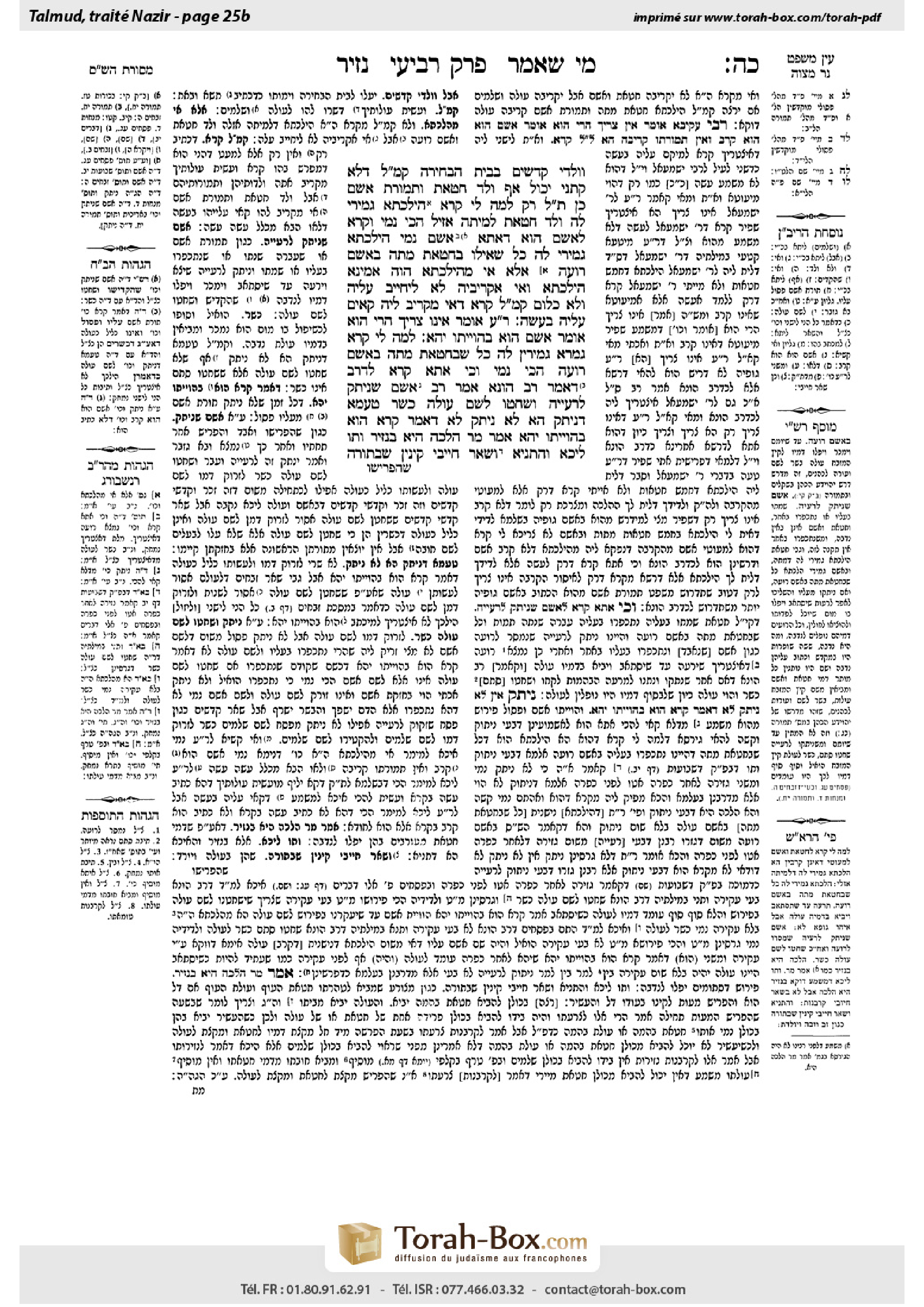
Nazir 25b: Talmud study for Daf Yomi
Daf Yomi is the daily study of one Talmud folio. Explore 37 tractates with scans, Hebrew text, Sefaria English and AI-generated French translations where annotated.
Passage selection and English or AI-generated French translation are available where the scan has annotations. Daf Study is independent of Torah-Box and Sefaria.
Browse Nazir · נזיר · All tractatesNazir 25b text and translations
This page of Nazir includes the Aramaic text, an English translation and an AI-generated French translation, alongside the scan above.
נזיר כ״ה ב · Aramaic and Hebrew text
וּוַלְדֵי קָדָשִׁים בְּבֵית הַבְּחִירָה, קָא מַשְׁמַע לַן דְּלָא.
קָתָנֵי: יָכוֹל אַף וְלַד חַטָּאת וּתְמוּרַת אָשָׁם כֵּן — תַּלְמוּד לוֹמַר: ״רַק״. לְמָה לִי קְרָא? הִילְכְתָא גְּמִירִי לַהּ: וְלַד חַטָּאת לְמִיתָה אָזֵיל! הָכִי נָמֵי, וּקְרָא לְאָשָׁם הוּא דַּאֲתָא.
אָשָׁם נָמֵי הִילְכְתָא גְּמִירִי לָהּ: כֹּל שֶׁאִילּוּ בְּחַטָּאת מֵתָה, בְּאָשָׁם רוֹעֶה!
אֶלָּא: אִי מֵהִילְכְתָא, הֲוָה אָמֵינָא: הִילְכְתָא, וְאִי אַקְרְיבֵיהּ — לָא לִיחַיַּיב עֲלֵיהּ וְלֹא כְּלוּם, קָא מַשְׁמַע לַן קְרָא דְּאִי מַקְרֵיב לֵיהּ — קָאֵים עֲלֵיהּ בַּעֲשֵׂה.
רַבִּי עֲקִיבָא אוֹמֵר אֵינוֹ צָרִיךְ, הֲרֵי הוּא אוֹמֵר ״אָשָׁם הוּא״ — בַּהֲוָיָיתוֹ יְהֵא. לְמָה לִי קְרָא? גְּמָרָא גְּמִירִין לַהּ: כׇּל שֶׁבְּחַטָּאת מֵתָה — בְּאָשָׁם רוֹעֶה!
הָכִי נָמֵי, וְכִי אֲתָא קְרָא — לִדְרַב. דְּאָמַר רַב הוּנָא אָמַר רַב: אָשָׁם שֶׁנִּיתַּק לִרְעִיָּיה, וּשְׁחָטוֹ לְשֵׁם עוֹלָה — כָּשֵׁר.
טַעְמָא דְּנִיתַּק, הָא לֹא נִיתַּק — לָא. דְּאָמַר קְרָא ״הוּא״ — בַּהֲוָיָיתוֹ יְהֵא.
אָמַר מָר: הֲלָכָה הִיא בְּנָזִיר. וְתוּ לֵיכָּא? וְהָתַנְיָא: וּשְׁאָר חַיָּיבֵי קִינִּין שֶׁבַּתּוֹרָה,
Nazir 25b · English translation
but the offspring of other sacred animals, for peace-offerings, must be brought to the Temple and left to die there. The verse therefore teaches us that one does not leave the offspring of peace-offerings to die. Rather, they are sacrificed upon the altar.
§ The Gemara continues to discuss the baraita. The baraita teaches: One might have thought that the offspring of a sin-offering and the substitute of a guilt-offering should also be treated so, i.e., they too should be sacrificed on the altar like sin-offerings and guilt-offerings. Therefore, the verse states: “Only” (Deuteronomy 12:26). The Gemara asks: Why do I need a verse for this halakha? After all, this halakha is learned as a tradition that the offspring of a sin-offering goes to its death. The Gemara answers: So too, this is correct as far as the offspring of a sin-offering is concerned, and the verse comes to teach that this halakha applies to a guilt-offering as well.
The Gemara asks: With regard to a guilt-offering as well, this halakha is learned as a tradition: Any situation that if it were to occur with a sin-offering it would be left to die, i.e., any offering that is invalid in such a manner that it would have to be left to die if it were a sin-offering, which includes a substitute, if it occurs with a guilt-offering it is left to graze until it develops a blemish so that it is no longer fit for the altar. Why, then, is a verse required to teach this halakha?
Rather, the argument is as follows: If one would have learned this ruling only from the aforementioned halakha transmitted to Moses from Sinai, I would say: It is admittedly the halakha that the offspring of a sin-offering must die and the substitute of a guilt-offering is left to graze, but if he sacrificed it regardless, he would not be liable to receive any punishment for it. The verse therefore teaches us that if he sacrifices the offspring or substitute of a guilt-offering, he transgresses a positive mitzva by it, as derived from the verse: “Only your sacred things which you have, and your vows, you shall take and go to the place which the Lord shall choose” (Deuteronomy 12:26).
§ The same baraita teaches that Rabbi Akiva says: In the case of a guilt-offering this exposition is not necessary, as it says: “It is a guilt-offering” (Leviticus 5:19), which indicates: It alone shall be sacrificed in its current state, but not its substitute. The Gemara asks: Why do I need a verse for this halakha? We learned it as a halakha: Any situation that if it were to occur with a sin-offering it would be left to die, if it occurs with a guilt-offering it is left to graze. If so, it is clear that this guilt-offering cannot be sacrificed.
The Gemara answers: So too, this is correct, and when the verse comes to teach a halakha, it comes for that which was said by Rav. As Rav Huna said that Rav said: With regard to a guilt-offering that was consigned to grazing, i.e., it had been ruled that the animal must be left to graze until it develops a blemish as it could not be sacrificed as a guilt-offering, at which point it was sold so that the proceeds could be used for voluntary burnt-offerings, and one transgressed and slaughtered the guilt-offering itself for the sake of a burnt-offering rather than using an animal purchased with the money of its sale, it is valid.
The Gemara infers from Rav’s statement: The reason for this ruling is that it is a guilt-offering that was consigned to grazing, from which it may be inferred that if it were not consigned in this manner it is not valid as a burnt-offering. This is because the verse states: “It is a guilt-offering,” which indicates that it shall be in its current state, and if it were sacrificed as a different offering it is invalid.
§ The Gemara returns to the issue of a nazirite’s offerings: The Master, Rabbi Yoḥanan, said earlier: It is a halakha with regard to a nazirite that his unallocated funds, including the value of his sin-offering, are used for the purchase of gift offerings. The Gemara asks: This formulation indicates that this halakha pertains only to a nazirite, but is there no other case where the surplus goes toward the purchase of gift offerings? But isn’t it taught in a baraita: And the rest of those liable to bring nests by Torah law, i.e., those paupers who are obligated to bring only a bird-offering, e.g., a poor leper, who must bring two turtledoves, one for a burnt-offering and one for a sin-offering, instead of a sheep or a ewe,
Nazir 25b · Traduction française (IA)
mais les petits des autres animaux consacrés destinés à des sacrifices de paix doivent être apportés au Temple et y être laissés jusqu’à leur mort. Le verset nous enseigne donc qu’on ne laisse pas mourir les petits des sacrifices de paix. Au contraire, on les sacrifie sur l’autel.
§ La Guemara poursuit l’examen de la baraïta. La baraïta enseigne : On aurait pu penser que le petit d’un sacrifice expiatoire et le substitut d’un sacrifice de culpabilité doivent eux aussi être traités de cette manière, c’est-à-dire sacrifiés sur l’autel comme des sacrifices expiatoires et des sacrifices de culpabilité. Le verset dit donc : « Seulement » (Deutéronome 12,26). La Guemara demande : Pourquoi faut-il un verset pour enseigner cette halakha ? Après tout, nous savons par tradition que le petit d’un sacrifice expiatoire est voué à la mort. La Guemara répond : Certes, cela est vrai pour le petit d’un sacrifice expiatoire ; le verset vient enseigner que cette halakha s’applique également à un sacrifice de culpabilité.
La Guemara demande : Pour le sacrifice de culpabilité également, cette halakha nous est transmise par tradition : toute situation qui, si elle se produisait avec un sacrifice expiatoire, conduirait à le laisser mourir — c’est-à-dire tout sacrifice invalide qui, s’il s’agissait d’un sacrifice expiatoire, devrait être laissé jusqu’à sa mort, notamment un substitut —, lorsqu’elle se produit avec un sacrifice de culpabilité, celui-ci est laissé au pâturage jusqu’à ce qu’il présente un défaut qui le rende impropre à être offert sur l’autel. Pourquoi faut-il donc un verset pour enseigner cette halakha ?
L’argument est plutôt le suivant : si l’on avait appris cette règle uniquement de la halakha transmise à Moïse au Sinaï, j’aurais dit : Certes, la halakha veut que le petit d’un sacrifice expiatoire meure et que le substitut d’un sacrifice de culpabilité soit laissé au pâturage ; mais si quelqu’un le sacrifiait malgré tout, il ne serait passible d’aucune peine. Le verset nous enseigne donc que s’il sacrifie le petit ou le substitut d’un sacrifice de culpabilité, il transgresse une mitsva positive, comme on le déduit du verset : « Mais tes choses saintes et tes vœux, tu les prendras et tu iras au lieu que l’Éternel choisira » (Deutéronome 12,26).
§ La même baraïta enseigne que Rabbi Akiva dit : Pour un sacrifice de culpabilité, cette interprétation n’est pas nécessaire, car il est dit : « C’est un sacrifice de culpabilité » (Lévitique 5,19), ce qui indique qu’il doit être sacrifié seul, dans son état actuel, et non son substitut. La Guemara demande : Pourquoi faut-il un verset pour enseigner cette halakha ? Nous savons déjà que toute situation qui, si elle se produisait avec un sacrifice expiatoire, conduirait à le laisser mourir, lorsqu’elle se produit avec un sacrifice de culpabilité, celui-ci est laissé au pâturage. Il est donc évident que ce sacrifice de culpabilité ne peut pas être sacrifié.
La Guemara répond : Certes, cela est vrai ; lorsque le verset vient enseigner une halakha, il vient enseigner celle qu’a énoncée Rav. En effet, Rav Houna a dit au nom de Rav : lorsqu’un sacrifice de culpabilité a été destiné au pâturage — c’est-à-dire qu’il a été décidé que l’animal devait être laissé au pâturage jusqu’à ce qu’il présente un défaut, puisqu’il ne pouvait pas être offert comme sacrifice de culpabilité, puis qu’il a été vendu afin que le produit de la vente serve à acheter des holocaustes volontaires — et que quelqu’un transgresse en égorgeant le sacrifice de culpabilité lui-même en vue d’un holocauste, au lieu d’utiliser un animal acheté avec le produit de sa vente, l’offrande est valide.
La Guemara déduit de la déclaration de Rav que la raison de cette règle est qu’il s’agit d’un sacrifice de culpabilité destiné au pâturage. On peut en déduire que s’il n’avait pas été destiné ainsi, il ne serait pas valide comme holocauste. En effet, le verset dit : « C’est un sacrifice de culpabilité », ce qui indique qu’il doit rester dans son état actuel ; s’il était offert comme un autre type de sacrifice, il serait invalide.
§ La Guemara revient à la question des sacrifices du nazir : Le Maître, Rabbi Yoḥanan, a dit précédemment que, selon une halakha concernant le nazir, ses fonds non affectés, y compris la valeur de son sacrifice expiatoire, servent à acheter des offrandes volontaires. La Guemara demande : Cette formulation indique que cette halakha ne concerne que le nazir ; n’existe-t-il aucun autre cas où le surplus sert à acheter des offrandes volontaires ? Pourtant, n’enseigne-t-on pas dans une baraïta : « Et le reste des personnes tenues, selon la Torah, d’apporter des nids », c’est-à-dire les pauvres qui sont obligés de n’apporter qu’une offrande d’oiseaux, par exemple un lépreux pauvre, qui doit apporter deux tourterelles, l’une pour un holocauste et l’autre pour un sacrifice expiatoire, au lieu d’un mouton ou d’une brebis,
Traduction française générée par IA à partir de l’édition anglaise de Sefaria. Vérifie toujours un passage avec le texte source.
Text from Sefaria: William Davidson Edition - Vocalized Aramaic (CC BY NC); William Davidson Edition - English (CC BY NC).