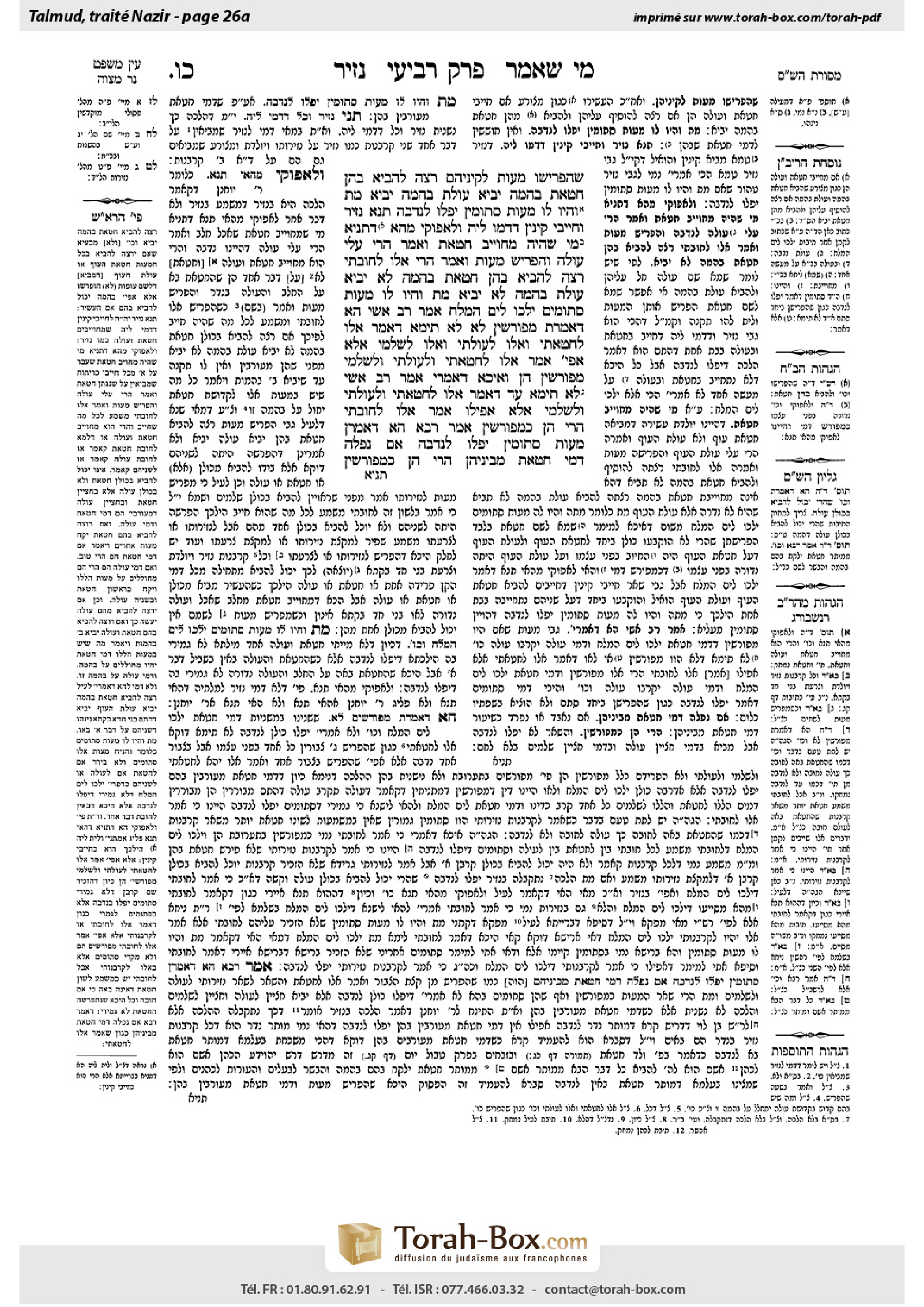
Nazir 26a: Talmud study for Daf Yomi
Daf Yomi is the daily study of one Talmud folio. Explore 37 tractates with scans, Hebrew text, Sefaria English and AI-generated French translations where annotated.
Passage selection and English or AI-generated French translation are available where the scan has annotations. Daf Study is independent of Torah-Box and Sefaria.
Browse Nazir · נזיר · All tractatesNazir 26a text and translations
This page of Nazir includes the Aramaic text, an English translation and an AI-generated French translation, alongside the scan above.
נזיר כ״ו א · Aramaic and Hebrew text
שֶׁהִפְרִישׁוּ מָעוֹת לְקִינֵּיהֶם, רָצָה לְהָבִיא בָּהֶן חַטַּאת בְּהֵמָה — יָבִיא, עוֹלַת בְּהֵמָה — יָבִיא. מֵת וְהָיוּ לוֹ מָעוֹת סְתוּמִין — יִפְּלוּ לִנְדָבָה!
תַּנָּא נָזִיר וְחַיָּיבֵי קִינִּין דְּדָמוּ לֵיהּ, וּלְאַפּוֹקֵי מֵהָא דְּתַנְיָא: מִי שֶׁהָיָה מְחוּיָּיב חַטָּאת, וְאָמַר: ״הֲרֵי עָלַי עוֹלָה״, וְהִפְרִישׁ מָעוֹת וְאָמַר ״הֲרֵי אֵלּוּ לְחוֹבָתִי״,
רָצָה לְהָבִיא בָּהֶן חַטַּאת בְּהֵמָה — לֹא יָבִיא. עוֹלַת בְּהֵמָה — לֹא יָבִיא. מֵת וְהָיוּ לוֹ מָעוֹת סְתוּמִים — יֵלְכוּ לְיָם הַמֶּלַח.
אָמַר רַב אָשֵׁי: הָא דְּאָמְרַתְּ מְפוֹרָשִׁין לָא — לָא תֵּימָא דְּאָמַר ״אֵלּוּ לְחַטָּאתִי, וְאֵלּוּ לְעוֹלָתִי, וְאֵלּוּ לִשְׁלָמַי״. אֶלָּא אֲפִילּוּ אָמַר ״אֵלּוּ לְחַטָּאתִי וּלְעוֹלָתִי וְלִשְׁלָמַי״ — מְפוֹרָשִׁין הֵן.
וְאִיכָּא דְּאָמְרִי, אָמַר רַב אָשֵׁי: לָא תֵּימָא עַד דְּאָמַר ״אֵלּוּ לְחַטָּאתִי וּלְעוֹלָתִי וְלִשְׁלָמַי״, אֶלָּא אֲפִילּוּ אָמַר: ״אֵלּוּ לְחוֹבָתִי״ — הֲרֵי הֵן כִּמְפוֹרָשִׁין.
אָמַר רָבָא: הָא דַּאֲמַרַן מָעוֹת סְתוּמִין יִפְּלוּ לִנְדָבָה, אִם נָפְלָה דְּמֵי חַטָּאת מִבֵּינֵיהֶן — הֲרֵי הֵן כִּמְפוֹרָשִׁין.
Nazir 26a · English translation
who separated money for their nests and then became wealthy, if the owner wishes to change their designation and to bring an animal sin-offering with them, he may bring a sin-offering with them. If he wishes to use them to buy an animal burnt-offering he may bring it, supplementing the required amount with other money. If the owner died and he had unallocated funds, they all will be allocated for communal gift offerings, including the value of the sin-offering. This shows that the halakha that unallocated funds are used for gift offerings applies in cases other than that of a nazirite.
The Gemara answers: He taught the case of a nazirite and also the case of those obligated to bring nests, which is similar to that of a nazirite and is therefore treated identically with regard to its halakha. This serves to exclude that case which is taught in a baraita. The situation discussed in the baraita involves one who was obligated to bring a sin-offering for a transgression he committed, and he also said: It is incumbent upon me to bring a gift burnt-offering, and he separated money and said: These are hereby for my obligatory offering. Since he might have meant either his obligation of the sin-offering or his burnt-offering for the new vow, the question arises as to what should be done with the money.
The baraita explains that if he wishes to bring an animal sin-offering with it, he may not bring one; if he wishes to use it to purchase an animal burnt-offering, he may not bring it either. If he died and had unallocated funds, one must take them and cast them into the Dead Sea. Since the two offerings are not part of the same obligation, the unallocated funds may not be used for gift offerings.
§ Rav Ashi said: That which you said with regard to a nazirite who had allocated money, that he may not use it all for gift offerings because the value of the sin-offering must be taken and cast into the Dead Sea, do not say that this is referring only to a case where he explicitly said: These are for my sin-offering, and these are for my burnt-offering, and these are for my peace-offering, each one separately. Rather, even if he said: These are for my sin-offering and for my burnt-offering and for my peace-offering, they are considered allocated for the purposes of this halakha, despite the fact that he did not designate the money for particular offerings.
And some say a different version of this statement. Rav Ashi said: Do not say they are deemed allocated only if he says: These are for my sin-offering and for my burnt-offering and for my peace-offering; rather, even if he said it in broader terms: These are for my obligation, they are considered as allocated.
§ Rava said: That which we said, that if one had unallocated funds they will be allocated for communal gift offerings, applies only if the money for all of the offerings was mixed together. However, if the money for the sin-offering fell and was separated from the others, all the remaining money is now considered as allocated. This means that instead of the entire sum being used for a gift burnt-offering, part of it is used for a peace-offering, which is eaten for one day and does not require bread.
Nazir 26a · Traduction française (IA)
Celui qui a mis de l’argent de côté pour ses nids, puis s’est enrichi : si le propriétaire souhaite en changer l’affectation et apporter avec cet argent un sacrifice expiatoire animal, il peut le faire. S’il souhaite utiliser cet argent pour acheter un holocauste animal, il peut l’apporter en complétant la somme nécessaire avec d’autres fonds. Si le propriétaire est mort et qu’il lui restait des fonds non affectés, tous seront affectés à des offrandes volontaires communautaires, y compris la valeur du sacrifice expiatoire. Cela montre que la halakha selon laquelle les fonds non affectés sont utilisés pour des offrandes volontaires s’applique aussi dans des cas autres que celui d’un nazir.
La Guemara répond : Il a enseigné le cas d’un nazir ainsi que celui des personnes tenues d’apporter des nids, cas similaire à celui d’un nazir et qui reçoit donc le même traitement du point de vue de la halakha. Cela vise à exclure le cas enseigné dans une baraïta. La baraïta traite du cas d’un homme tenu d’apporter un sacrifice expiatoire pour une transgression qu’il a commise et qui a également déclaré : « Je suis tenu d’apporter un holocauste volontaire », puis a mis de l’argent de côté en disant : « Voici pour mon offrande obligatoire. » Comme il a pu vouloir parler soit de son obligation d’apporter un sacrifice expiatoire, soit de l’holocauste dû à son nouveau vœu, la question se pose de savoir ce qu’il faut faire de cet argent.
La baraïta précise que s’il souhaite apporter avec cet argent un sacrifice expiatoire animal, il ne peut pas le faire ; et que s’il souhaite l’utiliser pour acheter un holocauste animal, il ne peut pas non plus le faire. S’il est mort et qu’il lui restait des fonds non affectés, on doit les prendre et les jeter dans la mer Morte. Puisque les deux sacrifices ne relèvent pas de la même obligation, les fonds non affectés ne peuvent pas être utilisés pour des offrandes volontaires.
§ Rav Achi dit : Au sujet de ce que tu as dit à propos d’un nazir ayant affecté ses fonds, à savoir qu’il ne peut pas les utiliser tous pour des offrandes volontaires, car la valeur du sacrifice expiatoire doit être prise et jetée dans la mer Morte, ne dis pas que cela se rapporte uniquement au cas où il a dit explicitement : « Ceux-ci sont pour mon sacrifice expiatoire, ceux-ci pour mon holocauste et ceux-ci pour mon sacrifice de paix », en les distinguant les uns des autres. Au contraire, même s’il a dit : « Ceux-ci sont pour mon sacrifice expiatoire, mon holocauste et mon sacrifice de paix », les fonds sont considérés comme affectés au regard de cette halakha, bien qu’il n’ait pas désigné l’argent pour des sacrifices particuliers.
Certains transmettent une autre version de cette déclaration. Rav Achi dit : Ne dis pas que les fonds sont considérés comme affectés uniquement s’il dit : « Ceux-ci sont pour mon sacrifice expiatoire, mon holocauste et mon sacrifice de paix » ; au contraire, même s’il l’a dit en termes plus généraux : « Ceux-ci sont pour mon obligation », ils sont considérés comme affectés.
§ Rava dit : Ce que nous avons dit, à savoir que si quelqu’un avait des fonds non affectés, ceux-ci seraient affectés à des offrandes volontaires communautaires, ne s’applique que si l’argent destiné à tous les sacrifices était mélangé. Toutefois, si l’argent destiné au sacrifice expiatoire est tombé et s’est séparé des autres fonds, tout l’argent restant est désormais considéré comme affecté. Cela signifie qu’au lieu que la somme entière serve à un holocauste volontaire, une partie sert à un sacrifice de paix, qui se mange pendant un jour et ne nécessite pas de pains.
Traduction française générée par IA à partir de l’édition anglaise de Sefaria. Vérifie toujours un passage avec le texte source.
Text from Sefaria: William Davidson Edition - Vocalized Aramaic (CC BY NC); William Davidson Edition - English (CC BY NC).