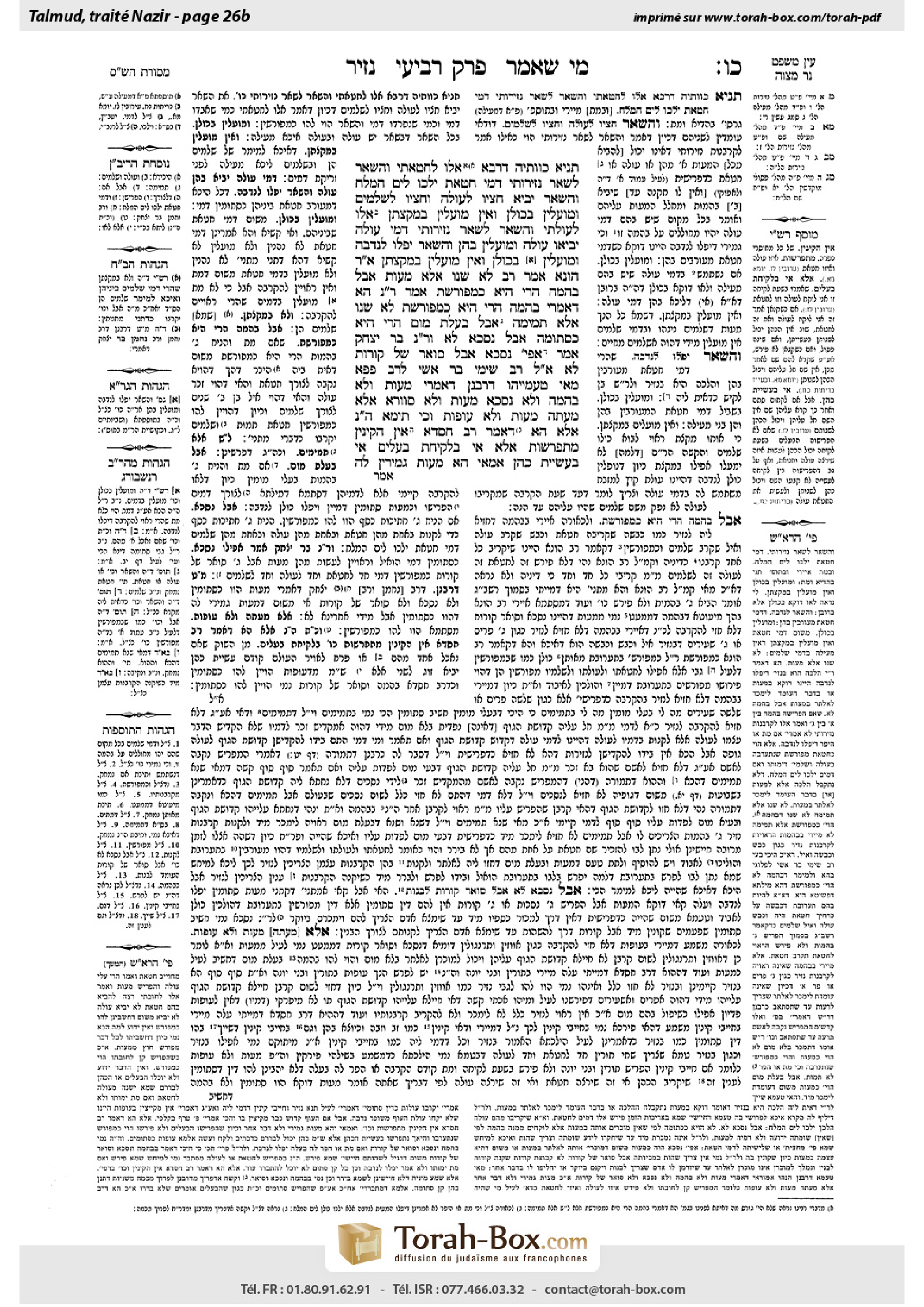
Nazir 26b: Talmud study for Daf Yomi
Daf Yomi is the daily study of one Talmud folio. Explore 37 tractates with scans, Hebrew text, Sefaria English and AI-generated French translations where annotated.
Passage selection and English or AI-generated French translation are available where the scan has annotations. Daf Study is independent of Torah-Box and Sefaria.
Browse Nazir · נזיר · All tractatesNazir 26b text and translations
This page of Nazir includes the Aramaic text, an English translation and an AI-generated French translation, alongside the scan above.
נזיר כ״ו ב · Aramaic and Hebrew text
תַּנְיָא כְּווֹתֵיהּ דְּרָבָא: ״אֵלּוּ לְחַטָּאתִי וְהַשְּׁאָר לִשְׁאָר נְזִירוּתִי״, דְּמֵי חַטָּאת — יֵלְכוּ לְיָם הַמֶּלַח, וְהַשְּׁאָר — יָבִיא חֶצְיוֹ לְעוֹלָה וְחֶצְיוֹ לִשְׁלָמִים. וּמוֹעֲלִין בְּכוּלָּן, וְאֵין מוֹעֲלִין בְּמִקְצָתָן.
״אֵלּוּ לְעוֹלָתִי וְהַשְּׁאָר לִשְׁאָר נְזִירוּתִי״, דְּמֵי עוֹלָה — יָבִיאוּ עוֹלָה, וּמוֹעֲלִין בָּהֶן. וְהַשְּׁאָר יִפְּלוּ לִנְדָבָה, וּמוֹעֲלִין בְּכוּלָּן, וְאֵין מוֹעֲלִין בְּמִקְצָתָן.
אָמַר רַב הוּנָא אָמַר רַב: לֹא שָׁנוּ אֶלָּא מָעוֹת, אֲבָל בְּהֵמָה — הֲרֵי הִיא כִּמְפוֹרֶשֶׁת.
אָמַר רַב נַחְמָן: הָא דְּאָמְרִי בְּהֵמָה הֲרֵי הִיא כִּמְפוֹרֶשֶׁת, לֹא שָׁנוּ אֶלָּא תְּמִימָה, אֲבָל בַּעֲלַת מוּם — הֲרֵי הִיא כִּסְתוּמָה. אֲבָל נְסָכָא — לָא.
וְרַב נַחְמָן בַּר יִצְחָק אָמַר: אֲפִילּוּ נְסָכָא, אֲבָל סְוָאר שֶׁל קוֹרוֹת — לָא. אֲמַר לֵיהּ רַב שִׁימִי בַּר אָשֵׁי לְרַב פָּפָּא: מַאי טַעְמַיְיהוּ דְּרַבָּנַן — דְּאָמְרִי: מָעוֹת, וְלֹא בְּהֵמָה וְלָא נְסָכָא, מָעוֹת וְלָא סְווֹרָא? אֶלָּא מֵעַתָּה: מָעוֹת וְלֹא עוֹפוֹת!
וְכִי תֵּימָא הָכִי נָמֵי, אֶלָּא הָא דְּאָמַר רַב חִסְדָּא: אֵין הַקִּינִּין מִתְפָּרְשׁוֹת, אֶלָּא אִי בִּלְקִיחַת בְּעָלִים, אִי בַּעֲשִׂיַּית כֹּהֵן.
אַמַּאי? הָא מָעוֹת גְּמִירִין לָהּ!
Nazir 26b · English translation
The Gemara notes that it is taught in a baraita in accordance with the opinion of Rava: If one said: This money is for my sin-offering and the rest is for the rest of my obligations of naziriteship, and he died, the money for the sin-offering is taken and cast into the Dead Sea, and as for the rest, he brings a burnt-offering with half of it, and half of it goes for a peace-offering. And one who benefits from all of it is liable for misuse of consecrated property, due to the value of a burnt-offering that is included in the money. But one is not liable for misuse of consecrated property if he benefits from some of the money, as the money he took is possibly that of the peace-offering, to which the prohibition against misuse does not apply.
If one said: This money is for my burnt-offering and the rest is for the rest of my obligations of naziriteship, the money for the burnt-offering goes for a burnt-offering, and one who benefits from it is liable for misuse of consecrated property. And the rest is allocated for communal gift offerings, as the sum includes the value of a sin-offering. And one who benefits from all of it is liable for misuse of consecrated property, due to the value of a sin-offering included in it, but one is not liable for misuse of consecrated property if he benefits from some of the money, as he might have taken the money for a peace-offering, as stated above.
§ Rav Huna said that Rav said: They taught only that there is a difference between unallocated and allocated money of a nazirite with regard to money designated for the purchase of offerings. However, if one designated an animal it is treated as allocated. A nazirite is obligated to bring three types of animals, a female sheep for a sin-offering, a male sheep for a burnt-offering, and a ram in its second year for a peace-offering. It is therefore evident which offering he had in mind when designating a particular animal. Consequently, if the owner died each offering is treated in the appropriate manner: The sin-offering must be left to die, like all sin-offerings whose owners have died; the burnt-offering is sacrificed as a burnt-offering; and the peace-offering is brought as a peace-offering, although it must be eaten in one day and does not require bread.
Rav Naḥman said: When they say that if one designates an animal it is considered as allocated, they taught this only if it is unblemished and is fit to be sacrificed itself. However, if one separated a blemished animal, even if he set aside the three required types, a female sheep, a male sheep, and a ram in its second year, each one is considered as unallocated. This is because one will not sacrifice the animals themselves but will sell them and use the money. However, this is not the case with regard to a bar of silver [naskha]. If one separated three silver bars they are considered allocated, as each is a distinct item, designated for a particular offering.
And Rav Naḥman bar Yitzḥak said: Even a silver bar is considered unallocated; however, a pile [sevar] of beams is not. If he set aside three piles of construction beams for his offerings, they are treated as allocated money. Rav Shimi bar Ashi said to Rav Pappa: What is the reasoning of the Rabbis, i.e., Rav, Rav Naḥman, and Rav Naḥman bar Yitzḥak, who say: Money and not an animal, and not a silver bar; and similarly, money and not a pile? Do they maintain that the halakha of unallocated funds applies only to money and not to other items? However, if that is so, one should likewise say that it applies to money and not birds.
And if you would say: So too, this is in fact the case, and birds cannot be considered allocated, but what about this statement that Rav Ḥisda said: Nests, i.e., a pair of turtle doves or pigeons, one for a burnt-offering and the other for a sin-offering, are considered allocated only by either the acquisition of the owner, if the owner designates each bird for a particular offering upon their purchase, or by the actions of the priest who decides which bird is for which offering when he sacrifices them. This clearly indicates that the birds are considered unallocated beforehand.
Therefore, the question arises: Why is this so? Didn’t we learn this halakha only with regard to money, whereas Rav Ḥisda’s statement indicates that birds are also considered unallocated? If Rav Ḥisda’s opinion is accepted, the same halakhot should also apply to animals, bars, and piles of beams.
Nazir 26b · Traduction française (IA)
La Guemara relève qu’une baraïta enseigne conformément à l’avis de Rava : si quelqu’un a dit : « Cet argent est destiné à mon sacrifice expiatoire, et le reste à mes autres obligations de naziréat », puis qu’il est mort, l’argent destiné au sacrifice expiatoire est pris et jeté dans la mer Morte. Quant au reste, on apporte un holocauste avec la moitié de la somme, et l’autre moitié est affectée à un sacrifice de paix. Celui qui tire profit de la totalité de cette somme est passible d’un détournement de biens consacrés, à hauteur de la valeur de l’holocauste qu’elle comprend. En revanche, celui qui ne tire profit que d’une partie de l’argent n’est pas passible d’un détournement de biens consacrés, car l’argent qu’il a pris pourrait être celui du sacrifice de paix, auquel l’interdiction de détournement ne s’applique pas.
Si quelqu’un a dit : « Cet argent est destiné à mon holocauste, et le reste à mes autres obligations de naziréat », l’argent destiné à l’holocauste est affecté à un holocauste, et celui qui en tire profit est passible d’un détournement de biens consacrés. Le reste est affecté aux offrandes volontaires communautaires, puisque la somme comprend la valeur d’un sacrifice expiatoire. Celui qui tire profit de la totalité de l’argent est passible d’un détournement de biens consacrés, à hauteur de la valeur du sacrifice expiatoire qu’elle comprend. En revanche, celui qui ne tire profit que d’une partie de l’argent n’est pas passible d’un détournement de biens consacrés, car il se peut qu’il ait pris l’argent destiné à un sacrifice de paix, comme indiqué ci-dessus.
§ Rav Houna a dit au nom de Rav : Ils ont enseigné qu’il existe une différence entre l’argent non affecté et l’argent affecté d’un nazir uniquement en ce qui concerne l’argent destiné à l’achat des sacrifices. En revanche, si quelqu’un a désigné un animal, celui-ci est considéré comme affecté. Un nazir est tenu d’apporter trois sortes d’animaux : une brebis pour un sacrifice expiatoire, un bélier pour un holocauste et un bélier dans sa deuxième année pour un sacrifice de paix. On sait donc clairement quel sacrifice il avait en vue lorsqu’il a désigné un animal particulier. Par conséquent, si le propriétaire est mort, chaque sacrifice est traité de la manière qui convient : le sacrifice expiatoire doit être laissé à mourir, comme tous les sacrifices expiatoires dont les propriétaires sont morts ; l’holocauste est offert comme holocauste ; et le sacrifice de paix est apporté comme sacrifice de paix, bien qu’il doive être mangé en un jour et ne nécessite pas de pain.
Rav Naḥman a dit : Lorsqu’on enseigne qu’un animal désigné est considéré comme affecté, cela ne concerne que le cas d’un animal sans défaut, apte à être offert lui-même. En revanche, si quelqu’un a mis à part un animal présentant un défaut, même s’il a réservé les trois catégories requises — une brebis, un bélier et un bélier dans sa deuxième année —, chacun d’eux est considéré comme non affecté. En effet, on n’offrira pas les animaux eux-mêmes, mais on les vendra et on utilisera l’argent. Il n’en va toutefois pas de même pour une barre d’argent [naskha]. Si quelqu’un a mis à part trois barres d’argent, elles sont considérées comme affectées, car chacune constitue un objet distinct destiné à une offrande particulière.
Et Rav Naḥman bar Yitzḥak a dit : Même une barre d’argent est considérée comme non affectée ; en revanche, un tas [sevar] de poutres ne l’est pas. Si quelqu’un a mis de côté trois tas de poutres de construction pour ses offrandes, ils sont traités comme de l’argent affecté. Rav Shimi bar Ashi dit à Rav Pappa : Quel est le raisonnement des Rabbins, c’est-à-dire de Rav, Rav Naḥman et Rav Naḥman bar Yitzḥak, qui disent : de l’argent, mais pas un animal ni une barre d’argent ; et de même, de l’argent, mais pas un tas ? Estiment-ils que la halakha des fonds non affectés ne s’applique qu’à l’argent et non aux autres objets ? Mais si c’est le cas, il faudrait également dire qu’elle s’applique à l’argent, mais pas aux oiseaux.
Et si tu disais : il en est effectivement ainsi, et les oiseaux ne peuvent pas être considérés comme affectés, qu’en est-il toutefois de cette déclaration de Rav Ḥisda : les nids, c’est-à-dire une paire de tourterelles ou de pigeons, l’un destiné à un holocauste et l’autre à un sacrifice expiatoire, ne sont considérés comme affectés que soit par l’acquisition du propriétaire, lorsque celui-ci désigne chaque oiseau pour une offrande particulière au moment de l’achat, soit par l’intervention du prêtre, qui décide quel oiseau est destiné à quelle offrande au moment de les sacrifier. Cela indique clairement que les oiseaux sont considérés comme non affectés jusque-là.
La question se pose donc : pourquoi en est-il ainsi ? N’avons-nous pas appris cette halakha uniquement à propos de l’argent, alors que la déclaration de Rav Ḥisda indique que les oiseaux aussi sont considérés comme non affectés ? Si l’avis de Rav Ḥisda est retenu, les mêmes halakhot devraient également s’appliquer aux animaux, aux barres d’argent et aux tas de poutres.
Traduction française générée par IA à partir de l’édition anglaise de Sefaria. Vérifie toujours un passage avec le texte source.
Text from Sefaria: William Davidson Edition - Vocalized Aramaic (CC BY NC); William Davidson Edition - English (CC BY NC).