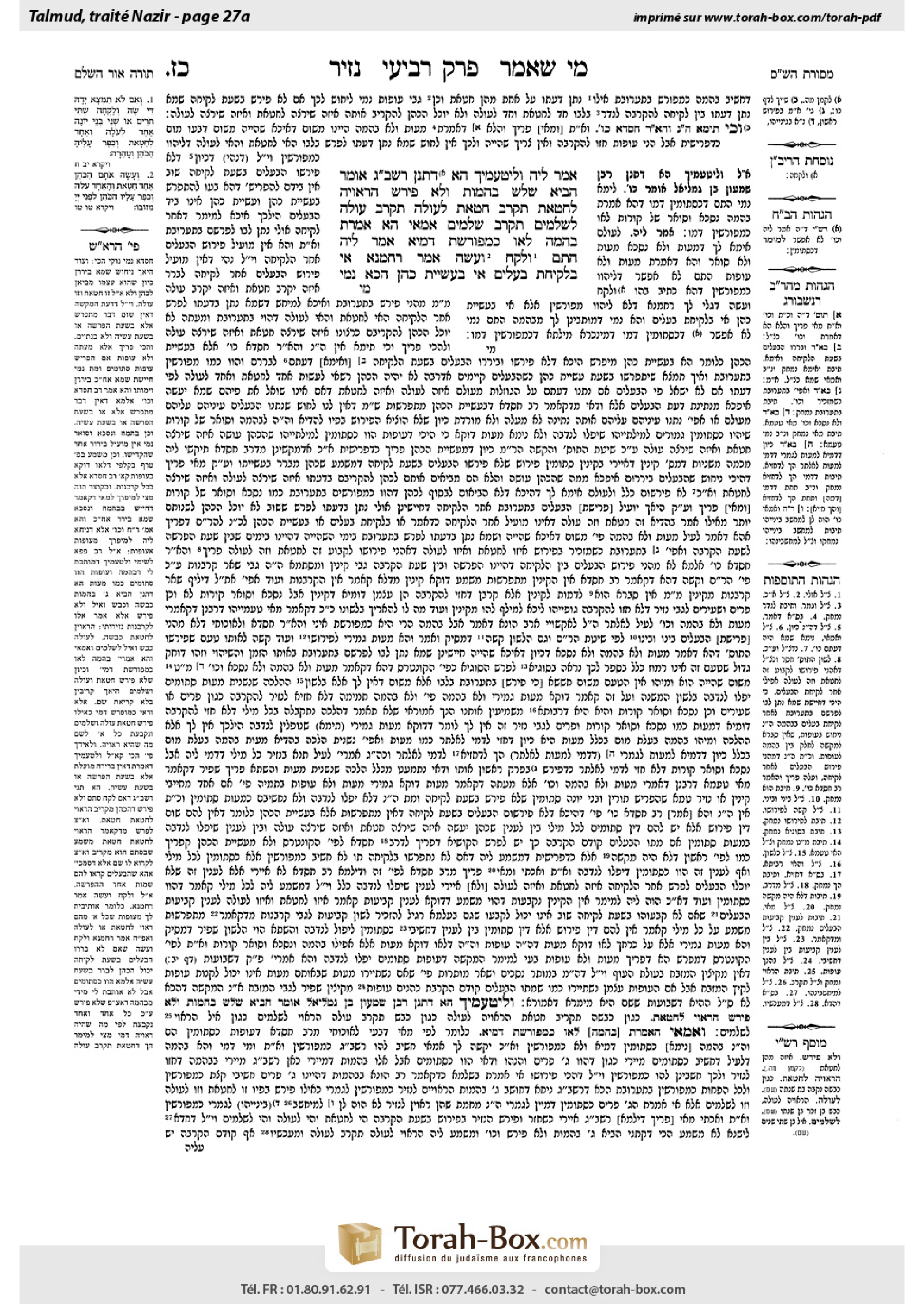
Nazir 27a: Talmud study for Daf Yomi
Daf Yomi is the daily study of one Talmud folio. Explore 37 tractates with scans, Hebrew text, Sefaria English and AI-generated French translations where annotated.
Passage selection and English or AI-generated French translation are available where the scan has annotations. Daf Study is independent of Torah-Box and Sefaria.
Browse Nazir · נזיר · All tractatesNazir 27a text and translations
This page of Nazir includes the Aramaic text, an English translation and an AI-generated French translation, alongside the scan above.
נזיר כ״ז א · Aramaic and Hebrew text
אֲמַר לֵיהּ: וְלִיטַעְמָיךְ, הָא דִּתְנַן: רַבָּן שִׁמְעוֹן בֶּן גַּמְלִיאֵל אוֹמֵר: הֵבִיא שָׁלֹשׁ בְּהֵמוֹת וְלֹא פֵּירֵשׁ, הָרְאוּיָה לְחַטָּאת — תִּקְרַב חַטָּאת, לְעוֹלָה — תִּקְרַב עוֹלָה, לִשְׁלָמִים — תִּקְרַב שְׁלָמִים. אַמַּאי? הָא אָמְרַתְּ: בְּהֵמָה לָאו כִּמְפוֹרֶשֶׁת דָּמְיָא!
אֲמַר לֵיהּ, הָתָם: ״וְלָקַח ... וְעָשָׂה״.
אָמַר רַחֲמָנָא: אִי בִּלְקִיחַת בְּעָלִים, אִי בַּעֲשִׂיַּית כֹּהֵן. הָכָא נָמֵי,
Nazir 27a · English translation
Rav Pappa said to him: And according to your reasoning, which leads to the conclusion that all items can have the status of unallocated funds, consider that which we learned in a mishna (45a): Rabban Shimon ben Gamliel says: If one brought three different animals for his naziriteship and did not specify which was for which offering, that which is fit for a sin-offering, a ewe, is sacrificed as a sin-offering; the animal suitable for a burnt-offering, a male sheep or bull, is sacrificed as a burnt-offering; and the animal fit for a peace-offering, any other male or female, is sacrificed as a peace-offering. But according to your opinion, why is this so? Didn’t you say that an animal is not considered as allocated, but is instead like unallocated funds; how can one decide which animal to use for each offering?
Rav Shimi bar Ashi said to him: As for the case of birds, this is an exception, as there is an explicit verse to this effect there: It states with regard to the owner of a bird offering: “And he shall take one he-lamb for a guilt-offering to be waved, to make atonement for him, and one tenth part of an ephah of fine flour mingled with oil for a meal-offering, and a log of oil; and two turtledoves or two young pigeons, such as his means suffice for, and the one shall be a sin-offering and the other a burnt-offering” (Leviticus 14:21–22), and it later states with regard to the priest: “And he shall sacrifice one of the turtledoves, or of the young pigeons, such as his means suffice for; even such as his means suffice for, the one for a sin-offering, and the other for a burnt-offering” (Leviticus 14:30–31).
The Merciful One thereby states that the birds are allocated and designated for their offering either by the acquisition of the owner, by designating each bird for a particular offering upon their purchase, or by the action of the priest. With regard to the ruling of Rabban Shimon ben Gamliel, it presents no difficulty either, as it is a special case as well. Here too, when one separates these particular animals for his naziriteship offerings,
Nazir 27a · Traduction française (IA)
Rav Pappa lui dit : Mais, selon ton raisonnement, qui conduit à conclure que toutes les choses peuvent avoir le statut de fonds non affectés, considère ce que nous avons appris dans une Michna (45a) : Rabban Shimon ben Gamliel dit : Si quelqu’un a apporté trois animaux différents pour son naziréat sans préciser lequel était destiné à quelle offrande, celui qui convient comme sacrifice expiatoire, une brebis, est offert en sacrifice expiatoire ; l’animal qui convient comme holocauste, un mâle, mouton ou taureau, est offert en holocauste ; et celui qui convient comme sacrifice de paix, tout autre mâle ou femelle, est offert en sacrifice de paix. Mais, selon ton opinion, pourquoi en est-il ainsi ? N’as-tu pas dit qu’un animal n’est pas considéré comme affecté, mais qu’il est plutôt comme des fonds non affectés ? Comment peut-on décider quel animal utiliser pour chaque offrande ?
Rav Shimi bar Ashi lui dit : Le cas des oiseaux fait exception, car un verset explicite le prescrit. Au sujet du propriétaire d’une offrande d’oiseau, il est dit : « Il prendra un agneau mâle pour un sacrifice de culpabilité, qui sera agité en offrande, afin de faire expiation pour lui, ainsi qu’un dixième d’épha de fleur de farine pétrie à l’huile pour une offrande végétale, et un log d’huile ; et deux tourterelles ou deux jeunes pigeons, selon ses moyens, l’un en sacrifice expiatoire et l’autre en holocauste » (Lévitique 14, 21-22). Puis, au sujet du prêtre, il est dit : « Il offrira l’une des tourterelles ou l’un des jeunes pigeons, selon ses moyens, l’une en sacrifice expiatoire et l’autre en holocauste » (Lévitique 14, 30-31).
Le Miséricordieux indique ainsi que les oiseaux sont affectés et désignés pour leur offrande soit par l’acquisition du propriétaire, qui désigne chaque oiseau pour une offrande particulière au moment de leur achat, soit par l’action du prêtre. Quant à la décision de Rabban Shimon ben Gamliel, elle ne pose pas non plus de difficulté, car il s’agit également d’un cas particulier. Ici aussi, lorsque quelqu’un met à part ces animaux précis pour les offrandes de son naziréat,
Traduction française générée par IA à partir de l’édition anglaise de Sefaria. Vérifie toujours un passage avec le texte source.
Text from Sefaria: William Davidson Edition - Vocalized Aramaic (CC BY NC); William Davidson Edition - English (CC BY NC).