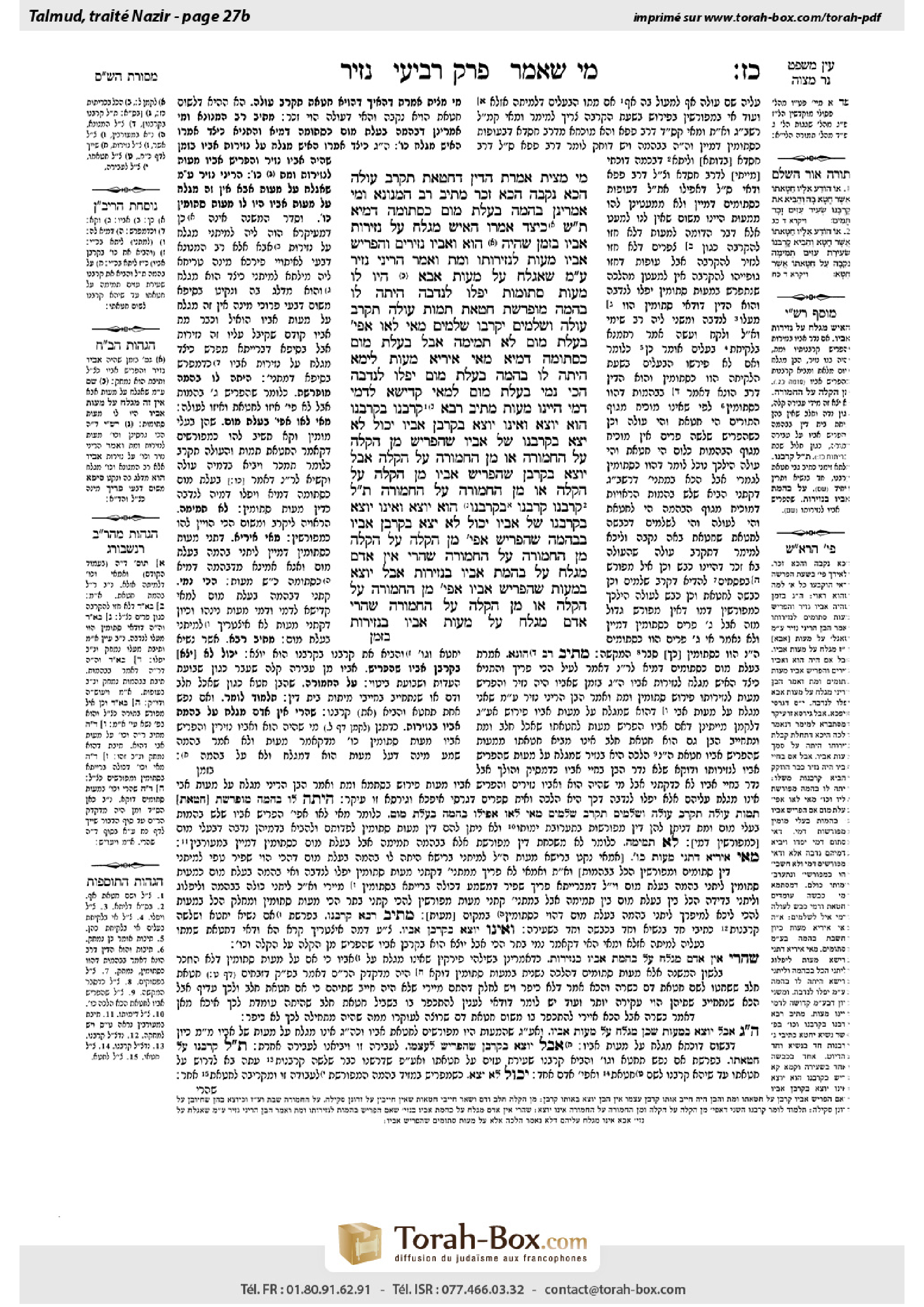
Nazir 27b: Talmud study for Daf Yomi
Daf Yomi is the daily study of one Talmud folio. Explore 37 tractates with scans, Hebrew text, Sefaria English and AI-generated French translations where annotated.
Passage selection and English or AI-generated French translation are available where the scan has annotations. Daf Study is independent of Torah-Box and Sefaria.
Browse Nazir · נזיר · All tractatesNazir 27b text and translations
This page of Nazir includes the Aramaic text, an English translation and an AI-generated French translation, alongside the scan above.
נזיר כ״ז ב · Aramaic and Hebrew text
מִי מָצֵית אָמְרַתְּ הָדֵין דְּחַטָּאת תִּקְרַב עוֹלָה? הָכָא נְקֵבָה, הָכָא זָכָר.
מֵתִיב רַב הַמְנוּנָא: וּמִי אָמְרִינַן בְּהֵמָה בַּעֲלַת מוּם כִּסְתוּמָה דָּמְיָא? תָּא שְׁמַע: כֵּיצַד אָמְרוּ הָאִישׁ מְגַלֵּחַ עַל נְזִירוּת אָבִיו? בִּזְמַן שֶׁהָיָה הוּא וְאָבִיו נְזִירִים, וְהִפְרִישׁ אָבִיו מָעוֹת לִנְזִירוּתוֹ וָמֵת, וְאָמַר: ״הֲרֵינִי נָזִיר עַל מְנָת שֶׁאֲגַלֵּחַ עַל מְעוֹת אַבָּא״.
הָיוּ לוֹ מָעוֹת סְתוּמוֹת — יִפְּלוּ לִנְדָבָה. הָיְתָה לוֹ בְּהֵמָה מוּפְרֶשֶׁת חַטָּאת — תָּמוּת. עוֹלָה — תִּקְרַב עוֹלָה, וּשְׁלָמִים — יְקָרְבוּ שְׁלָמִים. מַאי לָאו, אֲפִילּוּ בַּעֲלַת מוּם?
לֹא, תְּמִימָה. אֲבָל בַּעֲלַת מוּם, כִּסְתוּמָה דָּמְיָא? מַאי אִירְיָא מָעוֹת? לֵימָא: הָיְתָה לוֹ בְּהֵמָה בַּעֲלַת מוּם — יִפְּלוּ לִנְדָבָה!
הָכִי נָמֵי, בַּעֲלַת מוּם לְמַאי קַדִּישָׁא — לִדְמֵי, דְּמֵי הַיְינוּ — מָעוֹת.
מֵתִיב רָבָא: ״קׇרְבָּנוֹ״, בְּקׇרְבָּנוֹ הוּא יוֹצֵא, וְאֵינוֹ יוֹצֵא בְּקׇרְבַּן אָבִיו. יָכוֹל לֹא יֵצֵא בְּקׇרְבָּנוֹ שֶׁל אָבִיו שֶׁהִפְרִישׁ מִן הַקַּלָּה עַל הַחֲמוּרָה, אוֹ מִן הַחֲמוּרָה עַל הַקַּלָּה,
אֲבָל יוֹצֵא בְּקׇרְבָּן שֶׁהִפְרִישׁ אָבִיו מִן הַקַּלָּה עַל הַקַּלָּה אוֹ מִן הַחֲמוּרָה עַל הַחֲמוּרָה — תַּלְמוּד לוֹמַר: ״קׇרְבָּנוֹ״, ״קׇרְבָּנוֹ״. בְּקׇרְבָּנוֹ הוּא יוֹצֵא, וְאֵינוֹ יוֹצֵא בְּקׇרְבָּנוֹ שֶׁל אָבִיו.
יָכוֹל לֹא יֵצֵא בְּקׇרְבַּן אָבִיו בִּבְהֵמָה שֶׁהִפְרִישׁ אֲפִילּוּ מִן הַקַּלָּה עַל הַקַּלָּה, מִן הַחֲמוּרָה עַל הַחֲמוּרָה, שֶׁהֲרֵי אֵין אָדָם מְגַלֵּחַ עַל בֶּהֱמַת אָבִיו בִּנְזִירוּת, אֲבָל יוֹצֵא בְּמָעוֹת שֶׁהִפְרִישׁ אָבִיו, אֲפִילּוּ מִן הַחֲמוּרָה עַל הַקַּלָּה, אוֹ מִן הַקַּלָּה עַל הַחֲמוּרָה, שֶׁהֲרֵי אָדָם מְגַלֵּחַ עַל מְעוֹת אָבִיו בִּנְזִירוּת,
Nazir 27b · English translation
how can you say that this one that is for the sin-offering shall be sacrificed as a burnt-offering? Here, only a female may be sacrificed as a sin-offering, whereas here, in the case of a burnt-offering, it must be male. Therefore, it is as though he allocated each animal for a specific offering. Consequently, you cannot compare this case to that of items that are not inherently designated for a particular purpose, e.g., a blemished animal or a silver bar, as they have the status of unallocated funds.
§ Rav Hamnuna raised an objection against Rav Naḥman’s statement: And do we say that a blemished animal is considered like unallocated funds? Come and hear a proof to the contrary from the following baraita, which begins: How, in what case, did the Sages say that a man shaves, i.e., bring the offerings sacrificed at the end of a term of naziriteship, for his father’s naziriteship? The Gemara cites a part of that baraita which records a case where the son does not bring the offerings for his father’s naziriteship: When he and his father were both nazirites, and his father separated money for the offerings of his naziriteship and died, and the son said: I am hereby a nazirite on the condition that I will shave, i.e., bring my offerings, through the money my father set aside, in that case he cannot shave for his father’s naziriteship.
Consequently, if the father had unallocated funds, they are allocated for communal gift offerings. If he had allocated animals, that which is for a sin-offering must be left to die, like any sin-offering whose owner has died; the animal for a burnt-offering is sacrificed as a burnt-offering, and the animal for a peace-offering is sacrificed as a peace-offering. What, is it not referring even to the case of a blemished animal, as the baraita differentiated only between money and animals? This indicates that a blemished animal is also considered allocated, which contradicts Rav Naḥman’s ruling.
The Gemara rejects this suggestion: No; it is referring only to an unblemished animal, which is considered allocated because it is suitable for an offering itself. The Gemara asks: However, if that is so, is a blemished animal considered like unallocated funds? In that case, why does the baraita specifically distinguish between animals and unallocated funds? Let the baraita say as follows: If he had a blemished animal its money is allocated for communal gift offerings. The baraita would thereby distinguish between two similar cases that involve animals, from which one could infer the halakha of unallocated funds.
The Gemara answers: So too, this is the meaning of the baraita, and there is no difference between a blemished animal and money. The Gemara clarifies this claim: For what purpose is a blemished animal consecrated? It is for the value of its sale, and this value is provided in money. Consequently, this baraita does not refute Rav Naḥman’s opinion that the halakha of a blemished animal is like that of unallocated funds.
§ Rava also raises an objection against Rav Naḥman’s opinion, from a baraita that deals with sin-offerings. The Torah states: “And he shall bring for his offering” (Leviticus 4:23), which indicates: He fulfills his obligation with his own offering, but he does not fulfill his obligation with his father’s offering, if his father was obligated to bring a sin-offering and died after separating an animal for this purpose. One might have thought that one does not fulfill his obligation with an offering that his father separated only in a case where the son’s transgression is not equal in severity to that of his father’s sin, e.g., sacrificing his offering from animals that his father designated to atone for a minor transgression to atone for his own major transgression, or from animals that his father designated to atone for a major transgression, to atone for his own minor transgression.
However, one might have thought that he does fulfill his obligation with an offering that his father separated if it is from animals his father set aside to atone for a minor transgression and the son atones for his own minor one, or from animals the father set aside to atone for a major transgression and the son atones for his own major one. Therefore, the verse states: “His offering” (Leviticus 4:23), and it repeats: “His offering” (Leviticus 4:28), to emphasize that he fulfills his obligation with his own offering, and he does not fulfill his obligation with his father’s offering even for similar transgressions.
The baraita continues: One might have thought that a son does not fulfill his obligation with his father’s offering, i.e., with an animal that his father separated, even from animals that his father designated to atone for a minor transgression, to atone for the son’s minor one, or from animals the father set aside to atone for a major transgression, to atone for the son’s major one, as stated above, as a person cannot shave, i.e., bring an offering, for naziriteship with his father’s animal. Consequently, the halakhot of inheritance do not apply to this animal. However, it is nevertheless possible that a son can fulfill his obligation by purchasing a sin-offering with money that his father separated for his own sin-offering, even from money the father set aside to atone for a major transgression in a case where the son is atoning for a minor transgression, or from money the father set aside to atone for a minor transgression in a case where the son is atoning for a major one, as a person can shave, i.e., purchase an offering, with the money his father set aside for naziriteship,
Nazir 27b · Traduction française (IA)
Comment peut-on dire que cet animal, destiné au sacrifice expiatoire, sera sacrifié comme holocauste ? Ici, seul un animal femelle peut être offert en sacrifice expiatoire, tandis que, dans le cas d’un holocauste, il doit s’agir d’un mâle. C’est donc comme s’il avait affecté chaque animal à un sacrifice précis. On ne peut donc pas comparer ce cas à celui d’éléments qui ne sont pas intrinsèquement destinés à un usage particulier, tels qu’un animal atteint d’un défaut ou un lingot d’argent, car ceux-ci ont le statut de fonds non affectés.
§ Rav Hamnouna souleva une objection contre l’affirmation de Rav Naḥman : peut-on vraiment dire qu’un animal atteint d’un défaut est considéré comme des fonds non affectés ? Écoute plutôt une preuve en sens contraire tirée de la baraïta suivante, qui commence ainsi : Dans quel cas les Sages ont-ils dit qu’un homme accomplit le rasage, c’est-à-dire apporte les sacrifices offerts à la fin de sa période de naziréat, pour le naziréat de son père ? La Guemara cite une partie de cette baraïta, qui rapporte un cas où le fils n’apporte pas les sacrifices pour le naziréat de son père : si lui et son père étaient tous deux naziréens, que son père avait mis de l’argent de côté pour les sacrifices de son naziréat et qu’il est mort, et que le fils a dit : « Me voici naziréen à condition d’accomplir le rasage, c’est-à-dire d’apporter mes sacrifices, au moyen de l’argent que mon père a mis de côté », alors il ne peut pas accomplir le rasage pour le naziréat de son père.
Par conséquent, si le père avait des fonds non affectés, ceux-ci sont affectés à des offrandes volontaires communautaires. S’il avait affecté des animaux, l’animal destiné au sacrifice expiatoire doit être laissé à mourir, comme tout sacrifice expiatoire dont le propriétaire est mort ; l’animal destiné à l’holocauste est offert en holocauste, et celui destiné au sacrifice de paix est offert en sacrifice de paix. Ne s’agit-il pas également d’un animal atteint d’un défaut, puisque la baraïta établit une distinction uniquement entre l’argent et les animaux ? Cela indique qu’un animal atteint d’un défaut est lui aussi considéré comme affecté, ce qui contredit la décision de Rav Naḥman.
La Guemara rejette cette hypothèse : Non, il s’agit uniquement d’un animal sans défaut, considéré comme affecté parce qu’il peut lui-même être offert en sacrifice. La Guemara demande : Mais si tel est le cas, un animal atteint d’un défaut est-il considéré comme des fonds non affectés ? Alors pourquoi la baraïta distingue-t-elle précisément les animaux des fonds non affectés ? Que la baraïta dise plutôt ceci : si le père avait un animal atteint d’un défaut, sa valeur serait affectée à des offrandes volontaires communautaires. La baraïta distinguerait ainsi deux cas semblables impliquant des animaux, ce qui permettrait de déduire la halakha concernant les fonds non affectés.
La Guemara répond : Tel est aussi le sens de la baraïta, et il n’y a pas de différence entre un animal atteint d’un défaut et de l’argent. À quoi consacre-t-on un animal atteint d’un défaut ? À la valeur de sa vente, laquelle est versée en argent. Par conséquent, cette baraïta ne réfute pas l’opinion de Rav Naḥman, selon laquelle la halakha d’un animal atteint d’un défaut est la même que celle des fonds non affectés.
§ Rava soulève lui aussi une objection contre l’opinion de Rav Naḥman, à partir d’une baraïta qui traite des sacrifices expiatoires. La Torah dit : « Et il apportera son offrande » (Lévitique 4,23), ce qui indique qu’il s’acquitte de son obligation avec sa propre offrande, mais non avec celle de son père, si celui-ci était tenu d’apporter un sacrifice expiatoire et qu’il est mort après avoir mis un animal de côté à cette fin. On aurait pu penser qu’il ne s’acquitte pas de son obligation au moyen d’une offrande mise de côté par son père uniquement lorsque la transgression du fils n’est pas de la même gravité que celle de son père : par exemple, s’il utilise pour expier sa propre transgression grave des animaux que son père avait désignés pour expier une transgression mineure, ou s’il utilise pour expier sa propre transgression mineure des animaux que son père avait désignés pour expier une transgression grave.
Cependant, on aurait pu penser qu’il s’acquitte de son obligation au moyen d’une offrande mise de côté par son père si elle provient d’animaux que celui-ci avait mis de côté pour expier une transgression mineure et que le fils expie lui aussi une transgression mineure, ou d’animaux que le père avait mis de côté pour expier une transgression grave et que le fils expie lui aussi une transgression grave. Le verset dit donc : « Son offrande » (Lévitique 4,23), puis répète : « Son offrande » (Lévitique 4,28), afin de souligner qu’il s’acquitte de son obligation avec sa propre offrande, mais non avec celle de son père, même lorsque les transgressions sont semblables.
La baraïta poursuit : On aurait pu penser qu’un fils ne s’acquitte pas de son obligation avec l’offrande de son père, c’est-à-dire avec un animal que celui-ci avait mis de côté, même s’il s’agit d’animaux que son père avait désignés pour expier une transgression mineure et que le fils entend utiliser pour expier sa propre transgression mineure, ou d’animaux que son père avait mis de côté pour expier une transgression grave et que le fils entend utiliser pour expier sa propre transgression grave, comme indiqué plus haut, puisqu’une personne ne peut pas accomplir le rasage, c’est-à-dire apporter une offrande, pour son naziréat avec l’animal de son père. Par conséquent, les règles de l’héritage ne s’appliquent pas à cet animal. Il est toutefois possible qu’un fils s’acquitte de son obligation en achetant un sacrifice expiatoire avec l’argent que son père avait mis de côté pour son propre sacrifice expiatoire, même s’il s’agit d’argent que le père avait mis de côté pour expier une transgression grave alors que le fils expie une transgression mineure, ou d’argent que le père avait mis de côté pour expier une transgression mineure alors que le fils expie une transgression grave, puisqu’une personne peut accomplir le rasage, c’est-à-dire acheter une offrande, avec l’argent que son père avait mis de côté pour son naziréat,
Traduction française générée par IA à partir de l’édition anglaise de Sefaria. Vérifie toujours un passage avec le texte source.
Text from Sefaria: William Davidson Edition - Vocalized Aramaic (CC BY NC); William Davidson Edition - English (CC BY NC).