Nazir 28a: Talmud study for Daf Yomi
Daf Yomi is the daily study of one Talmud folio. Explore 37 tractates with scans, Hebrew text, Sefaria English and AI-generated French translations where annotated.
Passage selection and English or AI-generated French translation are available where the scan has annotations. Daf Study is independent of Torah-Box and Sefaria.
Browse Nazir · נזיר · All tractatesNazir 28a text and translations
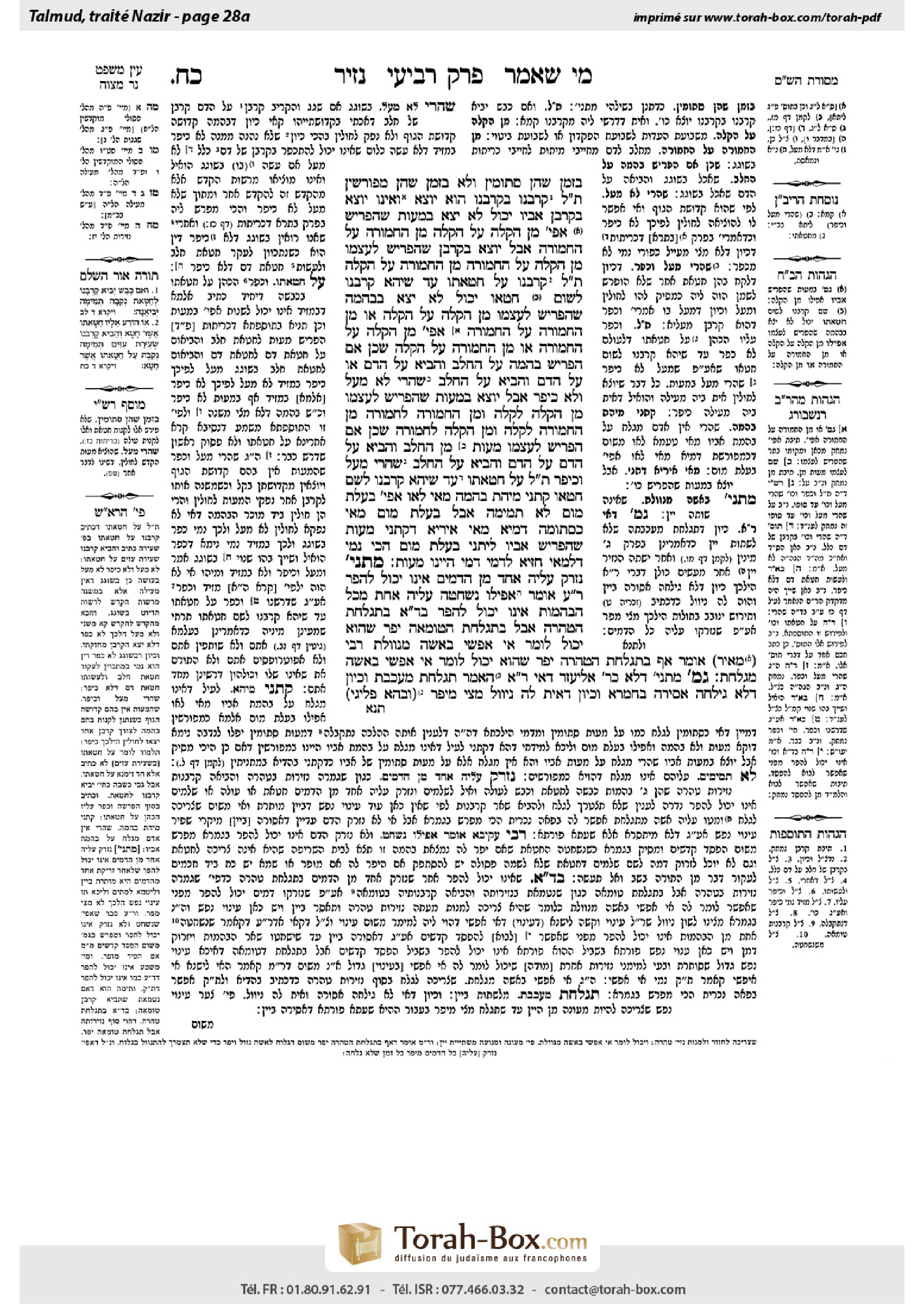
This page of Nazir includes the Aramaic text, an English translation and an AI-generated French translation, alongside the scan above.
נזיר כ״ח א · Aramaic and Hebrew text
בִּזְמַן שֶׁהֵן סְתוּמִין וְלֹא בִּזְמַן שֶׁהֵן מְפוֹרָשִׁין — תַּלְמוּד לוֹמַר: ״קׇרְבָּנוֹ״. בְּקׇרְבָּנוֹ הוּא יוֹצֵא, וְאֵינוֹ יוֹצֵא בְּקׇרְבַּן אָבִיו.
יָכוֹל לֹא יֵצֵא בְּמָעוֹת שֶׁהִפְרִישׁ אֲפִילּוּ מִן הַקַּלָּה עַל הַקַּלָּה, מִן הַחֲמוּרָה עַל הַחֲמוּרָה, אֲבָל יוֹצֵא בְּקׇרְבָּן שֶׁהִפְרִישׁ לְעַצְמוֹ מִן הַקַּלָּה עַל הַחֲמוּרָה, מִן הַחֲמוּרָה עַל הַקַּלָּה — תַּלְמוּד לוֹמַר: ״קׇרְבָּנוֹ ... עַל חַטָּאתוֹ״, עַד שֶׁיְּהֵא קׇרְבָּנוֹ לְשׁוּם חֶטְאוֹ.
יָכוֹל לֹא יֵצֵא בִּבְהֵמָה שֶׁהִפְרִישׁ לְעַצְמוֹ מִן הַקַּלָּה עַל הַקַּלָּה אוֹ מִן הַחֲמוּרָה עַל הַחֲמוּרָה, אֲפִילּוּ מִן הַקַּלָּה עַל הַחֲמוּרָה אוֹ מִן הַחֲמוּרָה עַל הַקַּלָּה,
שֶׁכֵּן אִם הִפְרִישׁ בְּהֵמָה עַל הַחֵלֶב וְהֵבִיא עַל הַדָּם, אוֹ עַל הַדָּם וְהֵבִיא עַל הַחֵלֶב — שֶׁהֲרֵי לֹא מָעַל וְלֹא כִּיפֵּר,
אֲבָל יוֹצֵא בְּמָעוֹת שֶׁהִפְרִישׁ לְעַצְמוֹ מִן הַקַּלָּה לַקַּלָּה, וּמִן הַחֲמוּרָה לַחֲמוּרָה, מִן הַחֲמוּרָה לַקַּלָּה, וּמִן הַקַּלָּה לַחֲמוּרָה,
שֶׁכֵּן אִם הִפְרִישׁ לְעַצְמוֹ מָעוֹת מִן הַחֵלֶב וְהֵבִיא עַל הַדָּם, עַל הַדָּם וְהֵבִיא עַל הַחֵלֶב, שֶׁהֲרֵי מָעַל וְכִיפֵּר —
תַּלְמוּד לוֹמַר: ״עַל חַטָּאתוֹ״ — עַד שֶׁיְּהֵא קׇרְבָּנוֹ לְשֵׁם חֶטְאוֹ.
קָתָנֵי מִיהַת בְּהֵמָה, מַאי לָאו אֲפִילּוּ בַּעֲלַת מוּם? לָא, תְּמִימָה.
אֲבָל בַּעֲלַת מוּם מַאי — כִּסְתוּמָה דָּמְיָא? מַאי אִירְיָא דְּקָתָנֵי מָעוֹת שֶׁהִפְרִישׁ אָבִיו? לִיתְנֵי בַּעֲלַת מוּם! הָכִי נָמֵי, דִּלְמַאי חַזְיָא — לִדְמֵי, דְּמֵי הַיְינוּ מָעוֹת.
מַתְנִי׳ נִזְרַק עָלֶיהָ אֶחָד מִן הַדָּמִים, אֵינוֹ יָכוֹל לְהָפֵר. רַבִּי עֲקִיבָא אוֹמֵר: אֲפִילּוּ נִשְׁחֲטָה עָלֶיהָ אַחַת מִכׇּל הַבְּהֵמוֹת — אֵינוֹ יָכוֹל לְהָפֵר.
בַּמֶּה דְּבָרִים אֲמוּרִים — בְּתִגְלַחַת הַטׇּהֳרָה, אֲבָל בְּתִגְלַחַת הַטּוּמְאָה — יָפֵר, שֶׁהוּא יָכוֹל לוֹמַר: אִי אֶפְשִׁי בְּאִשָּׁה מְנֻוֶּולֶת. רַבִּי מֵאִיר אוֹמֵר: אַף בְּתִגְלַחַת הַטׇּהֳרָה יָפֵר, שֶׁהוּא יָכוֹל לוֹמַר: אִי אֶפְשִׁי בְּאִשָּׁה מְגַלַּחַת.
גְּמָ׳ מַתְנִיתִין דְּלָא כְּרַבִּי אֱלִיעֶזֶר, דְּאִי רַבִּי אֱלִיעֶזֶר, הָאָמַר: תִּגְלַחַת מְעַכֶּבֶת. וְכֵיוָן דְּלָא גִּילְּחָה — אֲסִירָה בְּחַמְרָא. וְכֵיוָן דְּאִית לַהּ נִיוּוּל — מָצֵי מֵיפַר (וּבְהָא פְּלִיגִי),
Nazir 28a · English translation
when they are unallocated and not when they are allocated. Consequently, the same should apply to one whose father separated money for a regular sin-offering, i.e., he should be able to use them for his own sin-offering. Therefore, the verse states: “His offering” (Leviticus 4:32), which serves to emphasize: He fulfills his obligation with his own offering, but he does not fulfill his obligation with the money separated for his father’s offering.
The baraita continues this line of argument: One might have thought that he does not fulfill his obligation with the money that his father separated if it is from money the father set aside to atone for a minor transgression and the son atones for a minor one, or from money the father set aside to atone for a major transgression and the son atones for a major one. However, the son may fulfill his obligation with the offering he separated for himself. From animals he set aside to atone for a minor transgression, he may atone for a major one, or from animals he set aside to atone for a major transgression he may atone for a minor one. Therefore, the verse states: “Then he shall bring for his offering a goat, a female without blemish, for his sin” (Leviticus 4:28), which indicates that he does not fulfill his obligation unless his offering is for the sake of his particular sin, not for some other transgression.
One might have thought that he does not fulfill his obligation with the animal he separated for himself, from animals he set aside to atone for a minor transgression to atone for a minor one; or from animals he set aside to atone for a major transgression, to atone for a major one; or even when from animals he set aside to atone for a minor transgression to atone for a major one; or from animals he set aside to atone for a major transgression to atone for a minor one.
The reason is that if he separated an animal to bring as an offering for unintentionally eating forbidden fat and he instead brought that sin-offering for unintentionally consuming blood, or if he separated an animal to bring as an offering to atone for blood and instead brought it for eating forbidden fat, in that case he has not misused consecrated property, as the animal cannot lose its consecrated status. And just as it cannot lose its consecrated status, so too it cannot be redesignated to atone for a different sin, and therefore this animal also does not atone for him.
However, one might think that he fulfills his obligation with the money he separated for himself, from money he set aside to atone for a minor transgression to atone for a different minor transgression; or from money he set aside to atone for a major transgression to atone for a different major transgression; or from money he set aside to atone for a major transgression to atone for a minor one; or from money he set aside to atone for a minor transgression to atone for a major one.
The reason is that if he separated money for himself to purchase a sin-offering to atone for unintentionally eating forbidden fat and he instead brought a sin-offering with that money for unintentionally consuming blood, or if he separated money to purchase a sin-offering to atone for consuming blood and with that money he instead brought a sin-offering for unintentionally eating forbidden fat, in that case he has misused consecrated property if he uses that money for a non-sacred purpose, as money can lose its sacred status when misappropriated. And just as it can lose its consecrated status, it can be redesignated to atone for a different sin; therefore this money atones for him if it was used to purchase an offering for a different transgression.
Therefore, the verse states: “For his sin” (Leviticus 4:35), which indicates that he does not fulfill his obligation unless his offering is for the sake of his particular sin, and he is not permitted to use money he consecrated for one type of sin to atone for a different sin. This concludes the baraita.
Rava now asks his question: In any event, the baraita teaches that a son may not use an animal separated by his father for his naziriteship offering. What, is it not referring even to a blemished animal? The fact that the baraita does not differentiate between types of animals indicates that a blemished animal has the status of allocated funds, as opposed to Rav Naḥman’s ruling that this animal is like his father’s unallocated funds, which the son himself may use. The Gemara rejects this: No; the baraita refers solely to an unblemished animal that is fit to be sacrificed; only an animal of this kind is considered allocated.
The Gemara asks: However, according to this explanation, what is the halakha of a blemished animal? Is it considered like an unallocated animal? If so, why does the baraita specifically teach that one may purchase an offering with the unallocated funds that his father separated? Let the baraita teach this halakha with regard to a blemished animal, and one would infer that the same applies to money. The Gemara answers as above: So too, this is the case; there is no difference between the two. The reason is that what is a blemished animal fit for? It is fit for its value, and this value is essentially money. Consequently, this baraita does not contradict Rav Naḥman’s opinion that a blemished animal has the status of unallocated funds.
MISHNA: The previous mishna discussed the case of a husband who nullified his wife’s vow after she separated her offerings of naziriteship. This mishna deals with a husband who nullified his wife’s naziriteship after she had completed her term and brought her offerings to the Temple. If the blood from one of her naziriteship offerings was sprinkled on the altar on her behalf, the husband cannot nullify her vow at this point. Rabbi Akiva says: Even before the sprinkling of the blood, he cannot nullify the vow as soon as any one of the animals for her offerings has been slaughtered on her behalf.
The mishna continues: In what case is this statement, that he can no longer nullify the vow, said? It is when she is bringing the offerings for her shaving of ritual purity, when she has completed her term of naziriteship without becoming ritually impure (see Numbers 6:18). However, if she is sacrificing the offerings for her shaving of impurity, when she became ritually impure during her term of naziriteship, after which she restarts her naziriteship (see Numbers 6:9), her husband can nullify her vow. The reason is that he can say: I do not want a downcast [menuvvelet] wife, who does not drink wine. She would have to refrain from wine for a lengthy period if she were to begin her naziriteship anew. Rabbi Meir says: He can nullify her vow even at the stage of her shaving of purity, after she has begun sacrificing her offerings, as he can say: I do not want a shaven wife, and a nazirite is obligated to shave after bringing his or her offerings.
GEMARA: The Gemara comments: The mishna, which rules that a husband cannot nullify his wife’s naziriteship after the blood of her offering has been sprinkled at the end of the naziriteship term, is not in accordance with the opinion of Rabbi Eliezer. As, if it followed the ruling of Rabbi Eliezer, didn’t he say that shaving is indispensable for the end of a nazirite’s term, i.e., a nazirite at the end of his naziriteship is prohibited from drinking wine and becoming impure from the dead until he actually shaves? And in this case, since she has not yet shaved, she remains prohibited from drinking wine. And since she becomes downcast through her abstinence from wine, evidently the husband can nullify her vow even after the sprinkling of the blood of her offerings of purity.
Nazir 28a · Traduction française (IA)
lorsqu’elles ne sont pas affectées, et non lorsqu’elles le sont. Par conséquent, il devrait en aller de même pour celui dont le père a mis de l’argent de côté pour un sacrifice expiatoire ordinaire : il devrait pouvoir l’utiliser pour son propre sacrifice expiatoire. Le verset dit donc : « Son offrande » (Lévitique 4,32), ce qui souligne qu’il s’acquitte de son obligation avec sa propre offrande, mais non avec l’argent mis de côté pour l’offrande de son père.
La baraïta poursuit ce raisonnement : On aurait pu penser qu’il ne s’acquitte pas de son obligation avec l’argent que son père a mis de côté, qu’il provienne de fonds réservés par son père pour expier une faute mineure et que le fils expie une faute mineure, ou de fonds réservés par son père pour expier une faute majeure et que le fils expie une faute majeure. Cependant, le fils peut s’acquitter de son obligation avec l’offrande qu’il a mise de côté pour lui-même. Il peut utiliser des animaux qu’il a mis de côté pour expier une faute mineure afin d’expier une faute majeure, ou des animaux qu’il a mis de côté pour expier une faute majeure afin d’expier une faute mineure. Le verset dit donc : « Alors il apportera en offrande une chèvre, une femelle sans défaut, pour son péché » (Lévitique 4,28), ce qui indique qu’il ne s’acquitte de son obligation que si son offrande est destinée à expier son péché particulier, et non une autre faute.
On aurait pu penser qu’il ne s’acquitte pas de son obligation avec l’animal qu’il a mis de côté pour lui-même, que ce soit avec des animaux réservés pour expier une faute mineure afin d’expier une faute mineure, avec des animaux réservés pour expier une faute majeure afin d’expier une faute majeure, voire avec des animaux réservés pour expier une faute mineure afin d’expier une faute majeure, ou avec des animaux réservés pour expier une faute majeure afin d’expier une faute mineure.
La raison en est que, s’il a mis un animal de côté pour l’offrir en sacrifice expiatoire après avoir consommé involontairement de la graisse interdite, puis qu’il l’a présenté en sacrifice expiatoire après avoir consommé involontairement du sang, ou s’il a mis un animal de côté pour offrir un sacrifice expiatoire après avoir consommé du sang, puis qu’il l’a présenté après avoir consommé de la graisse interdite, il n’y a pas eu détournement d’un bien consacré, car l’animal ne peut pas perdre son statut sacré. Et de même qu’il ne peut pas perdre son statut sacré, il ne peut pas non plus être réaffecté à l’expiation d’un autre péché ; cet animal ne l’expie donc pas non plus.
Cependant, on pourrait penser qu’il s’acquitte de son obligation avec l’argent qu’il a mis de côté pour lui-même : avec de l’argent réservé pour expier une faute mineure afin d’expier une autre faute mineure ; avec de l’argent réservé pour expier une faute majeure afin d’expier une autre faute majeure ; avec de l’argent réservé pour expier une faute majeure afin d’expier une faute mineure ; ou avec de l’argent réservé pour expier une faute mineure afin d’expier une faute majeure.
La raison en est que, s’il a mis de l’argent de côté pour acheter un sacrifice expiatoire destiné à expier la consommation involontaire de graisse interdite, puis qu’il a acheté avec cet argent un sacrifice expiatoire pour la consommation involontaire de sang, ou s’il a mis de l’argent de côté pour acheter un sacrifice expiatoire destiné à expier la consommation de sang et qu’il a acheté avec cet argent un sacrifice expiatoire pour la consommation involontaire de graisse interdite, il y a détournement d’un bien consacré s’il utilise cet argent à des fins profanes, car l’argent peut perdre son statut sacré lorsqu’il est détourné. Et de même qu’il peut perdre son statut consacré, il peut être réaffecté à l’expiation d’un autre péché ; cet argent l’expie donc s’il a été utilisé pour acheter une offrande destinée à expier une autre faute.
Le verset dit donc : « Pour son péché » (Lévitique 4,35), ce qui indique qu’il ne s’acquitte de son obligation que si son offrande est destinée à expier son péché particulier, et qu’il ne lui est pas permis d’utiliser de l’argent consacré pour un type de péché afin d’expier un autre péché. La baraïta s’achève ici.
Rava pose alors sa question : Quoi qu’il en soit, la baraïta enseigne qu’un fils ne peut pas utiliser un animal que son père a mis de côté pour son offrande de naziréat. Ne s’agit-il pas même d’un animal atteint d’un défaut ? Le fait que la baraïta ne distingue pas entre les types d’animaux indique qu’un animal atteint d’un défaut a le statut de fonds affectés, contrairement à l’avis de Rav Naḥman selon lequel cet animal est comme les fonds non affectés de son père, que le fils peut lui-même utiliser. La Guemara rejette cette déduction : Non, la baraïta parle uniquement d’un animal sans défaut, apte à être sacrifié ; seul un animal de cette sorte est considéré comme affecté.
La Guemara demande : Cependant, selon cette explication, quel est le statut d’un animal atteint d’un défaut ? Est-il considéré comme un animal non affecté ? Si c’est le cas, pourquoi la baraïta enseigne-t-elle précisément qu’on peut acheter une offrande avec les fonds non affectés que son père a mis de côté ? Que la baraïta enseigne cette halakha au sujet d’un animal atteint d’un défaut, et l’on en déduirait qu’il en va de même pour l’argent. La Guemara répond comme précédemment : En effet, c’est également le cas ; il n’y a aucune différence entre les deux. La raison en est la suivante : À quoi un animal atteint d’un défaut est-il apte ? Il est apte à être utilisé à hauteur de sa valeur, et cette valeur équivaut essentiellement à de l’argent. Par conséquent, cette baraïta ne contredit pas l’avis de Rav Naḥman selon lequel un animal atteint d’un défaut a le statut de fonds non affectés.
Michna : La Michna précédente traitait du cas d’un mari qui avait annulé le vœu de sa femme après qu’elle eut mis de côté ses offrandes de naziréat. Cette Michna traite du cas d’un mari qui annule le naziréat de sa femme après qu’elle a achevé sa période et apporté ses offrandes au Temple. Si le sang de l’une de ses offrandes de naziréat a été aspergé sur l’autel en sa faveur, le mari ne peut plus annuler son vœu à ce stade. Rabbi Akiva dit : Même avant l’aspersion du sang, il ne peut plus annuler le vœu dès que l’un des animaux destinés à ses offrandes a été abattu en sa faveur.
La Michna poursuit : Dans quel cas a-t-on dit qu’il ne peut plus annuler le vœu ? Lorsqu’elle apporte les offrandes de sa tonte de pureté rituelle, après avoir achevé sa période de naziréat sans devenir rituellement impure (voir Nombres 6,18). Toutefois, si elle apporte les offrandes de sa tonte d’impureté, après être devenue rituellement impure pendant sa période de naziréat, puis avoir repris son naziréat (voir Nombres 6,9), son mari peut annuler son vœu. La raison en est qu’il peut dire : « Je ne veux pas d’une femme abattue [menuvvelet], qui ne boit pas de vin. » Elle devrait s’abstenir de vin pendant une longue période si elle devait recommencer son naziréat. Rabbi Meïr dit : Il peut annuler son vœu même au stade de sa tonte de pureté, après qu’elle a commencé à apporter ses offrandes, car il peut dire : « Je ne veux pas d’une femme rasée » ; or, un nazir est tenu de se raser après avoir apporté ses offrandes.
Guemara : La Guemara fait remarquer que la Michna, selon laquelle le mari ne peut pas annuler le naziréat de sa femme après que le sang de son offrande a été aspergé à la fin de sa période de naziréat, n’est pas conforme à l’opinion de Rabbi Eliezer. En effet, si elle suivait l’avis de Rabbi Eliezer, celui-ci n’a-t-il pas dit que la tonte est indispensable à la fin de la période du naziréat, c’est-à-dire qu’à la fin de son naziréat, le nazir ne peut ni boire de vin ni devenir impur au contact des morts tant qu’il ne s’est pas effectivement rasé ? Dans ce cas, puisqu’elle ne s’est pas encore rasée, il lui est toujours interdit de boire du vin. Et puisqu’elle est abattue du fait de son abstinence de vin, il est évident que le mari peut annuler son vœu même après l’aspersion du sang de ses offrandes de pureté.
Traduction française générée par IA à partir de l’édition anglaise de Sefaria. Vérifie toujours un passage avec le texte source.
Text from Sefaria: William Davidson Edition - Vocalized Aramaic (CC BY NC); William Davidson Edition - English (CC BY NC).