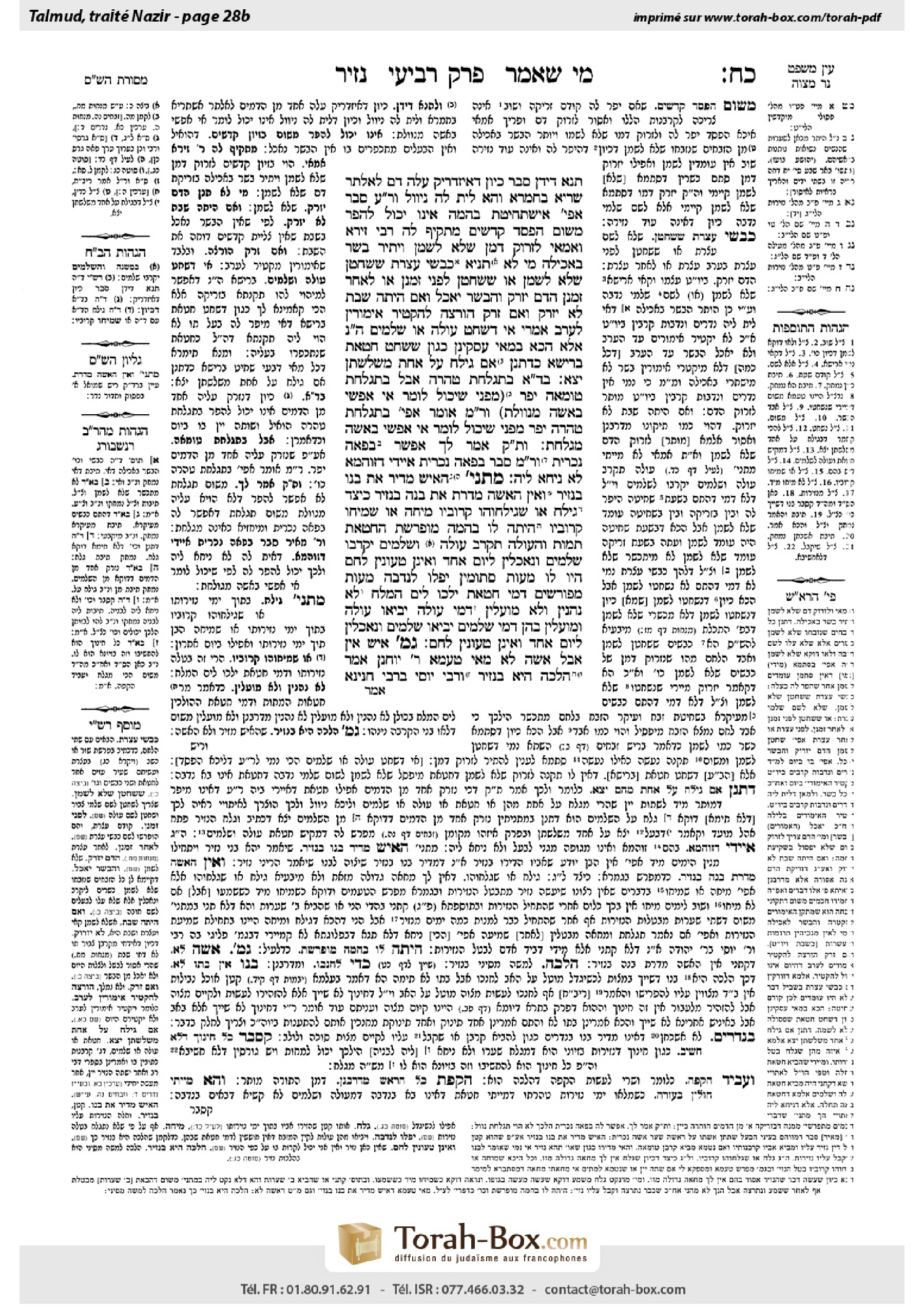
Nazir 28b: Talmud study for Daf Yomi
Daf Yomi is the daily study of one Talmud folio. Explore 37 tractates with scans, Hebrew text, Sefaria English and AI-generated French translations where annotated.
Passage selection and English or AI-generated French translation are available where the scan has annotations. Daf Study is independent of Torah-Box and Sefaria.
Browse Nazir · נזיר · All tractatesNazir 28b text and translations
This page of Nazir includes the Aramaic text, an English translation and an AI-generated French translation, alongside the scan above.
נזיר כ״ח ב · Aramaic and Hebrew text
תַּנָּא דִידַן סָבַר: כֵּיוָן דְּאִיזְדְּרִיק עֲלַהּ דָּם, לְאַלְתַּר שַׁרְיָא בְּחַמְרָא, וְהָא לֵית לַהּ נִיוּוּל. וְרַבִּי עֲקִיבָא סָבַר: אֲפִילּוּ אִישְׁתְּחִיטַת בְּהֵמָה — אֵינוֹ יָכוֹל לְהָפֵר, מִשּׁוּם הֶפְסֵד קָדָשִׁים.
מַתְקֵיף לַהּ רַבִּי זֵירָא: וְאַמַּאי? לִזְרוֹק דָּמָן שֶׁלֹּא לִשְׁמָן, וְיַתִּיר בָּשָׂר בַּאֲכִילָה! מִי לָא תַּנְיָא: כִּבְשֵׂי עֲצֶרֶת שֶׁשְּׁחָטָן שֶׁלֹּא לִשְׁמָן, אוֹ שֶׁשְּׁחָטָן לִפְנֵי זְמַנָּן אוֹ לְאַחַר זְמַנָּן — הַדָּם יִזָּרֵק וְהַבָּשָׂר יֵאָכֵל.
וְאִם הָיְתָה שַׁבָּת — לֹא יִזָּרֵק. וְאִם זָרַק — הוּרְצָה, לְהַקְטִיר אֵימוּרִין לָעֶרֶב!
אָמְרִי: אִי דִּשְׁחַט עוֹלָה אוֹ שְׁלָמִים — הָכִי נָמֵי. אֶלָּא הָכָא בְּמַאי עָסְקִינַן, כְּגוֹן שֶׁשָּׁחַט חַטָּאת בְּרֵישָׁא.
כְּדִתְנַן: אִם גִּילַּח עַל אַחַת מִשְּׁלׇשְׁתָּן — יָצָא.
בַּמֶּה דְּבָרִים אֲמוּרִים — בְּתִגְלַחַת טׇהֳרָה. אֲבָל בְּתִגְלַחַת טוּמְאָה — יָפֵר (מִפְּנֵי שֶׁיָּכוֹל לוֹמַר: אִי אֶפְשִׁי בְּאִשָּׁה מְנֻוֶּולֶת). וְרַבִּי מֵאִיר אוֹמֵר: אֲפִילּוּ בְּתִגְלַחַת טׇהֳרָה — יָפֵר, מִפְּנֵי שֶׁיָּכוֹל לוֹמַר: אִי אֶפְשִׁי בְּאִשָּׁה מְגַלַּחַת.
וְתַנָּא קַמָּא אָמַר לָךְ: אֶפְשָׁר בְּפֵאָה נׇכְרִית. וְרַבִּי מֵאִיר סָבַר: בְּפֵאָה נׇכְרִית, אַיְּידֵי דְּזוּהֲמָא — לָא נִיחָא לֵיהּ.
מַתְנִי׳ הָאִישׁ מַדִּיר אֶת בְּנוֹ בְּנָזִיר, וְאֵין הָאִשָּׁה מַדֶּרֶת אֶת בְּנָהּ בְּנָזִיר. כֵּיצַד? גִּילַּח, אוֹ שֶׁגִּילְּחוּהוּ קְרוֹבָיו. מִיחָה, אוֹ שֶׁמִּיחוּ קְרוֹבָיו.
הָיְתָה לוֹ בְּהֵמָה מוּפְרֶשֶׁת, הַחַטָּאת — תָּמוּת, וְהָעוֹלָה — תִּקְרַב עוֹלָה. וּשְׁלָמִים — יִקְרְבוּ שְׁלָמִים, וְנֶאֱכָלִין לְיוֹם אֶחָד, וְאֵינָן טְעוּנִין לֶחֶם.
הָיוּ לוֹ מָעוֹת סְתוּמִין — יִפְּלוּ לִנְדָבָה. מָעוֹת מְפוֹרָשִׁים, דְּמֵי חַטָּאת — יֵלְכוּ לְיָם הַמֶּלַח, לֹא נֶהֱנִין וְלֹא מוֹעֲלִין. דְּמֵי עוֹלָה — יָבִיאוּ עוֹלָה, וּמוֹעֲלִין בָּהֶן, דְּמֵי שְׁלָמִים — יָבִיאוּ שְׁלָמִים וְנֶאֱכָלִין לְיוֹם אֶחָד, וְאֵינָן טְעוּנִין לֶחֶם.
גְּמָ׳ אִישׁ — אִין, אֲבָל אִשָּׁה — לָא. מַאי טַעְמָא? רַבִּי יוֹחָנָן אָמַר: הֲלָכָה הִיא בְּנָזִיר. וְרַבִּי יוֹסֵי בְּרַבִּי חֲנִינָא
Nazir 28b · English translation
The tanna of our mishna holds: Once the blood has been sprinkled on her behalf she is immediately permitted to drink wine, and therefore she is not downcast. Consequently, the husband has no right to nullify her naziriteship vow at that point, as her vow does not affect him. And Rabbi Akiva holds: Even if the blood has yet to be sprinkled and wine remains forbidden to her, as soon as an animal is slaughtered for one of her offerings the husband can no longer nullify the vow, due to the loss of consecrated property. If he were to nullify her vow she would have no further need of the offerings, and it is prohibited to waste Sanctuary property.
Rabbi Zeira objects to this: And why should the result be a loss to the Sanctuary? He can avoid this by sprinkling their blood not for the sake of the offerings of a nazirite, and he will thereby permit the meat of the offering to be eaten, and the consecrated animal will not go to waste. Isn’t it taught in a baraita: With regard to the communal peace-offering of two sheep that accompanies the two loaves on Shavuot, if one slaughtered them not for the sake of that offering, or slaughtered them before their time, on the eve of the Festival, or after their time, after the Festival, the blood shall be sprinkled, although not for the sake of that offering, as it is no longer fit for that purpose, and the meat is eaten.
And if it was a Shabbat, the blood may not be sprinkled. Since the meat cannot be eaten on that day, sprinkling the blood is considered a form of unnecessary labor on Shabbat. And if he sprinkled the blood on Shabbat anyway, the offering is accepted, and he must wait to burn its sacrificial parts on the altar in the evening, after the conclusion of Shabbat. In any case, this shows that it is permitted to sprinkle the blood of an offering not for its own sake ab initio so that its flesh can be eaten.
The Sages say in response: If he had slaughtered only the woman’s naziriteship offerings of the burnt-offering or the peace-offering, so too, he may certainly proceed to sprinkle the blood not for the sake of that offering, to avoid the loss of a consecrated animal. In that case Rabbi Akiva would agree that the husband can still nullify her vow. However, with what are we dealing here? It is with a case where he slaughtered the sin-offering first. Since a sin-offering whose blood was sprinkled not for its sake is invalid, if the husband were to nullify her vow this would cause a loss of consecrated property.
The Gemara cites the source that the order of a nazirite’s offerings may be changed and the sin-offering may be sacrificed first. As we learned in a mishna (45a): If he shaved after the sacrifice of one of the three nazirite offerings, either the burnt-offering, the peace-offering, or the sin-offering, he has fulfilled his obligation.
§ The mishna taught: In what case is this statement, that a husband cannot nullify his wife’s vow, said? It is with regard to a shaving of ritual purity; however, with regard to a shaving of impurity the husband can nullify it if he wishes. And Rabbi Meir says: He may even nullify the vow at her shaving of purity because he can say: I do not want a shaven wife.
The Gemara analyzes these opinions: And the first tanna could have said to you in response to Rabbi Meir’s argument: It is possible for her to compensate by wearing a wig, and therefore she would not appear shaven, and her husband would have no cause for complaint. And Rabbi Meir holds: As for compensating by wearing a wig, since it is dirty he is not amenable to this solution, and he may therefore nullify her vow.
MISHNA: A man can vow that his minor son should be a nazirite, i.e., a father can declare his son a nazirite, but a woman cannot vow that her son should be a nazirite. How so; what are the details of this naziriteship? If the son shaved his hair, thereby demonstrating his rejection of the vow imposed by his father; or if his relatives shaved him; or if the son objected by saying that he has no desire for this naziriteship; or if his relatives objected on his behalf, the naziriteship is canceled.
If this son who canceled the naziriteship had animals separated for his offerings, the one set aside for the sin-offering must die, and the burnt-offering is sacrificed as a burnt-offering, and the peace-offering is sacrificed as a peace-offering. And the peace-offering is eaten for one day, like the peace-offering of a nazirite, rather than the two days of a regular peace-offering, and it does not require bread, i.e., the loaves that accompany a nazirite’s peace-offering.
If he had unallocated funds, they will be allocated for communal gift offerings. If he had allocated funds for his offerings, the money for the sin-offering is taken and cast into the Dead Sea, as one may not benefit from it ab initio, but if he benefits from it, he is not liable to bring an offering for misuse of consecrated property. With the money for the burnt-offering they bring a burnt-offering; it is prohibited to derive benefit from those coins and if he benefits from it, he is liable to bring an offering for misuse of consecrated property. With the money for the peace-offering they bring a peace-offering, and it is eaten for one day and does not require bread.
GEMARA: The mishna taught that a man can vow that his son should be a nazirite, but a woman cannot do so. The Gemara asks: What is the reason for this? Rabbi Yoḥanan said: It is a halakha transmitted to Moses from Sinai with regard to a nazirite. And Rabbi Yosei, son of Rabbi Ḥanina,
Nazir 28b · Traduction française (IA)
Le tanna de notre Michna tient que, dès que le sang a été aspergé pour elle, elle est immédiatement autorisée à boire du vin et n’est donc pas abattue. Par conséquent, à ce stade, son mari n’a pas le droit d’annuler son vœu de naziréat, car ce vœu ne le concerne pas. Rabbi Akiva, quant à lui, tient que même si le sang n’a pas encore été aspergé et que le vin lui reste interdit, dès qu’un animal est abattu pour l’un de ses sacrifices, le mari ne peut plus annuler le vœu, en raison de la perte de biens consacrés. S’il annulait son vœu, elle n’aurait plus besoin des sacrifices, et il est interdit de gaspiller les biens du Sanctuaire.
Rabbi Zeira objecte : pourquoi cela entraînerait-il une perte pour le Sanctuaire ? Il peut l’éviter en aspergeant le sang sans que ce soit pour un sacrifice de nazir, ce qui rendra la viande du sacrifice propre à la consommation et évitera que l’animal consacré soit gaspillé. N’est-il pas enseigné dans une baraïta : au sujet du sacrifice de paix communautaire constitué de deux moutons, qui accompagne les deux pains de Chavouot, si on les a abattus sans que ce soit pour ce sacrifice, ou avant le moment prévu, la veille de la fête, ou après ce moment, après la fête, on aspergera le sang, quoique sans que ce soit pour ce sacrifice, car ils ne sont plus aptes à cet usage, et la viande sera consommée ?
Et si c’est Chabbat, le sang ne peut pas être aspergé. Puisque la viande ne peut pas être consommée ce jour-là, asperger le sang est considéré comme un travail inutile le Chabbat. Et si, malgré tout, il a aspergé le sang le Chabbat, le sacrifice est valide, mais il doit attendre le soir, après la fin du Chabbat, pour brûler ses parties sacrificielles sur l’autel. Quoi qu’il en soit, cela montre qu’il est permis, a priori, d’asperger le sang d’un sacrifice sans que ce soit pour ce sacrifice, afin que sa viande puisse être consommée.
Les Sages répondent : s’il n’avait abattu que les sacrifices de naziréat de la femme qui sont l’holocauste ou le sacrifice de paix, il pourrait effectivement asperger le sang sans que ce soit pour ce sacrifice, afin d’éviter la perte d’un animal consacré. Dans ce cas, Rabbi Akiva conviendrait que le mari peut encore annuler son vœu. Mais de quel cas s’agit-il ici ? Il s’agit d’un cas où il a d’abord abattu le sacrifice expiatoire. Puisqu’un sacrifice expiatoire dont le sang a été aspergé sans que ce soit pour ce sacrifice est invalide, si le mari annulait son vœu, cela entraînerait une perte de biens consacrés.
La Guemara cite la source indiquant que l’ordre des sacrifices d’un nazir peut être modifié et que le sacrifice expiatoire peut être offert en premier. En effet, nous avons appris dans une Michna (45a) : s’il s’est rasé après l’offrande de l’un des trois sacrifices du nazir — l’holocauste, le sacrifice de paix ou le sacrifice expiatoire —, il s’est acquitté de son obligation.
§ La Michna a enseigné : dans quel cas dit-on que le mari ne peut pas annuler le vœu de son épouse ? Lorsqu’il s’agit d’un rasage de pureté rituelle ; mais s’il s’agit d’un rasage lié à l’impureté, le mari peut l’annuler s’il le souhaite. Rabbi Meir dit : il peut même annuler le vœu lors de son rasage de pureté, car il peut dire : « Je ne veux pas d’une épouse rasée. »
La Guemara examine ces opinions : le premier tanna aurait pu répondre à l’argument de Rabbi Meir : elle peut compenser en portant une perruque et ainsi ne pas paraître rasée ; son mari n’aurait donc aucun motif de se plaindre. Rabbi Meir, quant à lui, tient que son mari n’accepte pas cette solution, car la perruque est sale, et qu’il peut donc annuler son vœu.
MICHNA : Un homme peut faire le vœu que son fils mineur soit nazir, c’est-à-dire qu’un père peut déclarer son fils nazir, mais une femme ne peut pas faire le vœu que son fils soit nazir. Comment cela se passe-t-il ? Quels sont les détails de ce naziréat ? Si le fils s’est rasé les cheveux, manifestant ainsi son rejet du vœu imposé par son père ; ou si ses proches l’ont rasé ; ou si le fils s’y est opposé en disant qu’il ne souhaite pas ce naziréat ; ou si ses proches s’y sont opposés en son nom, le naziréat est annulé.
Si ce fils, qui a annulé le naziréat, avait des animaux mis à part pour ses sacrifices, celui qui était destiné au sacrifice expiatoire doit mourir ; l’holocauste est offert comme holocauste, et le sacrifice de paix est offert comme sacrifice de paix. Le sacrifice de paix est consommé pendant un jour, comme le sacrifice de paix d’un nazir, et non pendant les deux jours habituels d’un sacrifice de paix ; il ne nécessite pas de pain, c’est-à-dire les pains qui accompagnent le sacrifice de paix d’un nazir.
S’il avait des fonds non affectés, ceux-ci seront affectés à des offrandes volontaires communautaires. S’il avait affecté des fonds à ses sacrifices, l’argent destiné au sacrifice expiatoire est pris et jeté dans la mer Morte, car il est interdit d’en tirer profit a priori ; mais s’il en tire profit, il n’est pas tenu d’apporter un sacrifice pour détournement de biens consacrés. Avec l’argent destiné à l’holocauste, on apporte un holocauste ; il est interdit de tirer profit de ces pièces et, s’il en tire profit, il est tenu d’apporter un sacrifice pour détournement de biens consacrés. Avec l’argent destiné au sacrifice de paix, on apporte un sacrifice de paix, qui est consommé pendant un jour et ne nécessite pas de pain.
GUEMARA : La Michna a enseigné qu’un homme peut faire le vœu que son fils soit nazir, mais qu’une femme ne peut pas le faire. La Guemara demande : quelle en est la raison ? Rabbi Yoḥanan a dit : c’est une halakha transmise à Moïse au Sinaï au sujet du nazir. Et Rabbi Yosei, fils de Rabbi Ḥanina,
Traduction française générée par IA à partir de l’édition anglaise de Sefaria. Vérifie toujours un passage avec le texte source.
Text from Sefaria: William Davidson Edition - Vocalized Aramaic (CC BY NC); William Davidson Edition - English (CC BY NC).