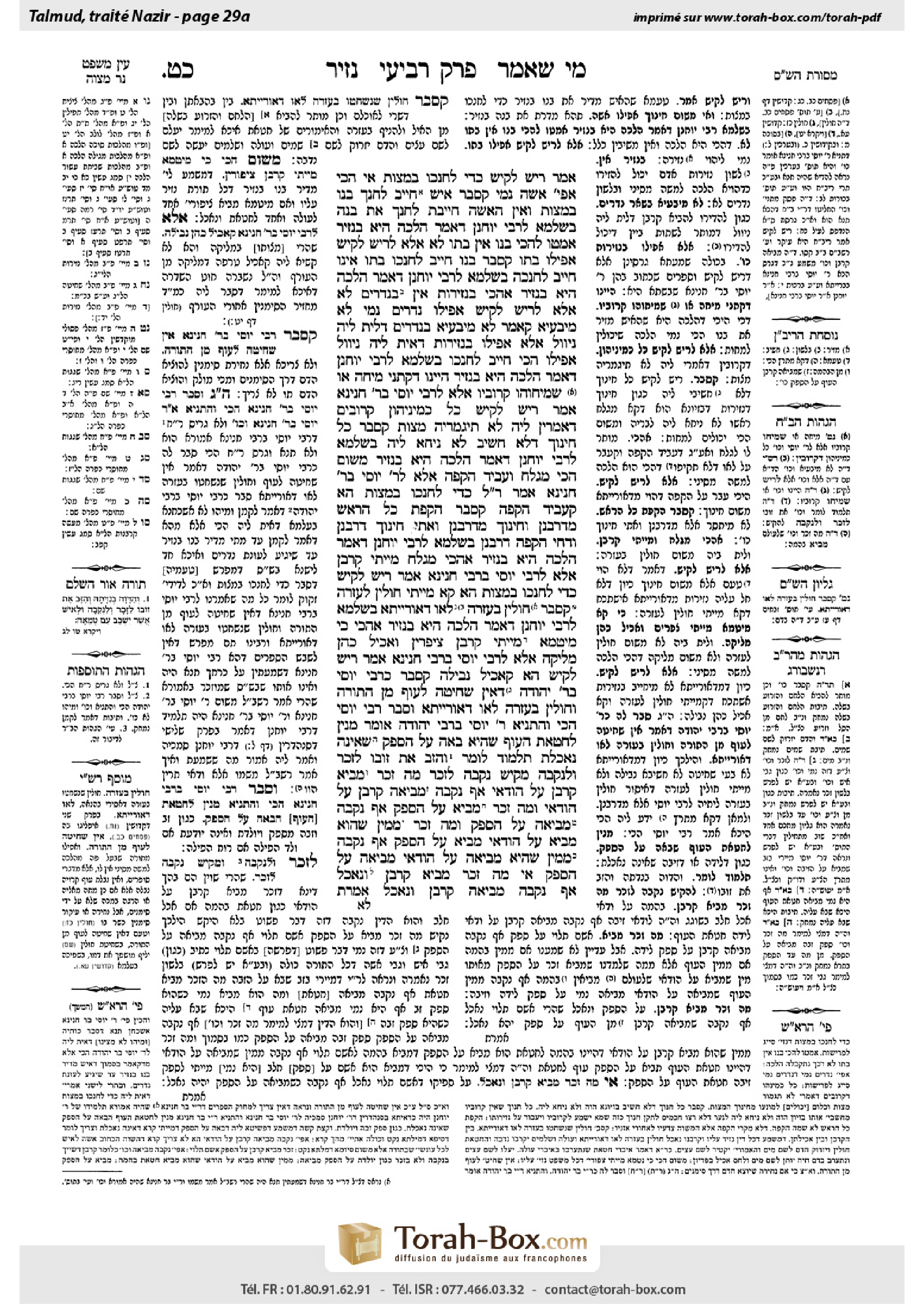
Nazir 29a: Talmud study for Daf Yomi
Daf Yomi is the daily study of one Talmud folio. Explore 37 tractates with scans, Hebrew text, Sefaria English and AI-generated French translations where annotated.
Passage selection and English or AI-generated French translation are available where the scan has annotations. Daf Study is independent of Torah-Box and Sefaria.
Browse Nazir · נזיר · All tractatesNazir 29a text and translations
This page of Nazir includes the Aramaic text, an English translation and an AI-generated French translation, alongside the scan above.
נזיר כ״ט א · Aramaic and Hebrew text
אָמַר רֵישׁ לָקִישׁ: כְּדֵי לְחַנְּכוֹ בְּמִצְוֹת. אִי הָכִי, אֲפִילּוּ אִשָּׁה נָמֵי! סָבַר: אִישׁ חַיָּיב לְחַנֵּךְ בְּנוֹ בְּמִצְוֹת, וְאֵין הָאִשָּׁה חַיֶּיבֶת לְחַנֵּךְ אֶת בְּנָהּ.
בִּשְׁלָמָא לְרַבִּי יוֹחָנָן, דְּאָמַר: הֲלָכָה הִיא בְּנָזִיר, אַמְּטוּ לְהָכִי: בְּנוֹ — אִין, בִּתּוֹ — לָא. אֶלָּא לְרֵישׁ לָקִישׁ, אֲפִילּוּ בִּתּוֹ! קָסָבַר: בְּנוֹ — חַיָּיב לְחַנְּכוֹ, בִּתּוֹ — אֵינוֹ חַיָּיב לְחַנְּכָהּ.
בִּשְׁלָמָא לְרַבִּי יוֹחָנָן, דְּאָמַר: הֲלָכָה הִיא בְּנָזִיר, אַהָכִי: בִּנְזִירוּת — אִין, בִּנְדָרִים — לָא. אֶלָּא לְרֵישׁ לָקִישׁ — אֲפִילּוּ נְדָרִים נָמֵי!
לָא מִיבַּעְיָא קָאָמַר: לָא מִיבַּעְיָא בִּנְדָרִים, דְּלֵית לֵיהּ נִיוּוּל, אֶלָּא אֲפִילּוּ בִּנְזִירוּת, דְּאִית לֵיהּ נִיוּוּל — אֲפִילּוּ הָכִי חַיָּיב לְחַנְּכוֹ.
בִּשְׁלָמָא לְרַבִּי יוֹחָנָן, דְּאָמַר: הֲלָכָה הִיא בְּנָזִיר, הַיְינוּ דְּקָתָנֵי: מִיחָה אוֹ שֶׁמִּיחוּהוּ קְרוֹבָיו.
אֶלָּא לְרַבִּי יוֹסֵי בְּרַבִּי חֲנִינָא אָמַר רֵישׁ לָקִישׁ, כׇּל כְּמִינֵיהוֹן קְרוֹבִים דְּאָמְרִין לֵיהּ: לָא תַּיגְמְרֵיהּ מִצְוֹת?! קָסָבַר: כֹּל חִינּוּךְ דְּלָא חֲשִׁיב — לָא נִיחָא לֵיהּ.
בִּשְׁלָמָא לְרַבִּי יוֹחָנָן, דְּאָמַר: הֲלָכָה הִיא בְּנָזִיר, מִשּׁוּם הָכִי מְגַלֵּחַ וְעָבֵיד הַקָּפָה.
אֶלָּא לְרַבִּי יוֹסֵי בְּרַבִּי חֲנִינָא אָמַר רֵישׁ לָקִישׁ כְּדֵי לְחַנְּכוֹ בְּמִצְוֹת, הָא קָעָבֵיד הַקָּפָה!
קָסָבַר: הַקָּפַת כׇּל הָרֹאשׁ מִדְּרַבָּנַן, וְחִינּוּךְ מִדְּרַבָּנַן. וְאָתֵי חִינּוּךְ דְּרַבָּנַן, וְדָחֵי הַקָּפָה דְּרַבָּנַן.
בִּשְׁלָמָא לְרַבִּי יוֹחָנָן, דְּאָמַר: הֲלָכָה הִיא בְּנָזִיר, אַהָכִי מְגַלֵּחַ מַיְיתֵי קׇרְבָּן.
אֶלָּא לְרַבִּי יוֹסֵי בְּרַבִּי חֲנִינָא אָמַר רֵישׁ לָקִישׁ, כְּדֵי לְחַנְּכוֹ בְּמִצְוֹת — הָא קָא מַיְיתֵי חוּלִּין לָעֲזָרָה! קָסָבַר: חוּלִּין בַּעֲזָרָה לָאו דְּאוֹרָיְיתָא.
בִּשְׁלָמָא לְרַבִּי יוֹחָנָן, דְּאָמַר: הֲלָכָה הִיא בְּנָזִיר, אַהָכִי כִּי מִיטַּמֵּא מַיְיתֵי קׇרְבַּן צִיפֳּרִין, וְאָכֵיל כֹּהֵן מְלִיקָה.
אֶלָּא לְרַבִּי יוֹסֵי בְּרַבִּי חֲנִינָא אָמַר רֵישׁ לָקִישׁ, הָא קָאָכֵיל נְבֵילָה!
קָסָבַר כְּרַבִּי יוֹסֵי בְּרַבִּי יְהוּדָה, דְּאֵין שְׁחִיטָה לָעוֹף מִן הַתּוֹרָה. וְחוּלִּין בַּעֲזָרָה לָאו דְּאוֹרָיְיתָא.
וְסָבַר רַבִּי יוֹסֵי הָכִי? וְהָתַנְיָא, רַבִּי יוֹסֵי בְּרַבִּי יְהוּדָה אוֹמֵר: מִנַּיִן לְחַטַּאת הָעוֹף שֶׁהִיא בָּאָה עַל הַסָּפֵק שֶׁאֵינָהּ נֶאֱכֶלֶת — תַּלְמוּד לוֹמַר: ״וְהַזָּב אֶת זוֹבוֹ לַזָּכָר וְלַנְּקֵבָה״, מַקִּישׁ נְקֵבָה לְזָכָר: מָה זָכָר מֵבִיא קׇרְבָּן עַל הַוַּדַּאי — אַף נְקֵבָה מְבִיאָה קׇרְבָּן עַל הַוַּדַּאי, וּמָה זָכָר מֵבִיא עַל הַסָּפֵק — אַף נְקֵבָה מְבִיאָה עַל הַסָּפֵק.
וּמָה זָכָר, מִמִּין שֶׁהוּא מֵבִיא עַל הַוַּדַּאי מֵבִיא עַל הַסָּפֵק — אַף נְקֵבָה מִמִּין שֶׁהִיא מְבִיאָה עַל הַוַּדַּאי מְבִיאָה עַל הַסָּפֵק. אִי: מָה זָכָר מֵבִיא קׇרְבָּן וְנֶאֱכָל — אַף נְקֵבָה מְבִיאָה קׇרְבָּן וְנֶאֱכָל! אָמַרְתָּ:
Nazir 29a · English translation
said that Reish Lakish said: The purpose is in order to educate him in mitzvot, to teach him how to observe the mitzva of naziriteship. The Gemara asks: If so, even a woman as well should be able to impose naziriteship on her son for educational purposes. The Gemara answers: Reish Lakish holds that a man is obligated to educate his son in mitzvot, but a woman is not obligated to educate her son in mitzvot.
The Gemara asks: Granted, according to the opinion of Rabbi Yoḥanan, who said it is a halakha transmitted to Moses from Sinai with regard to a nazirite, for that reason one can understand the ruling of the mishna, which indicates that for his son, yes, a father can vow that he should be a nazirite, but with regard to his daughter, no, he cannot do so, as a halakha learned by tradition cannot be questioned. However, according to the opinion of Reish Lakish, a father should even be able to impose naziriteship upon his daughter for the sake of her education. Why does the mishna specify a son? The Gemara answers that Reish Lakish holds: A father is obligated to educate his son, whereas he is not obligated to educate his daughter, and for this reason he cannot vow that she should be a nazirite.
The Gemara asks another question: Granted, according to the opinion of Rabbi Yoḥanan, who said that it is a halakha with regard to a nazirite, this is why the mishna indicates that with regard to naziriteship, yes, a father can impose a vow upon his son, but with regard to other vows, no, he cannot do so. However, according to the opinion of Reish Lakish, who says it is for the son’s education, a father should even be able to impose regular vows upon him as well. Why does the mishna specify naziriteship?
The Gemara answers: According to Reish Lakish the tanna of this mishna is speaking utilizing the style of: It is not necessary, as follows: It is not necessary to ask whether a father can impose regular vows of a mitzva where there is no deprivation of the son when he fulfills his father’s vow, but even with regard to naziriteship, where there is deprivation of his son, as the son must refrain from wine and shaving, even so the father is obligated to educate him, and therefore he can vow in this manner too.
The Gemara asks another question: Granted, according to the opinion of Rabbi Yoḥanan, who said it is a halakha transmitted to Moses from Sinai with regard to a nazirite, this explanation is consistent with that which the mishna teaches: If he objected, or his relatives objected for him, the naziriteship is canceled, as the transmitted halakha may be that the acquiescence of the relatives is necessary.
The Gemara continues its question: However, according to the opinion of Rabbi Yosei, son of Rabbi Ḥanina, who said that Reish Lakish said that this vow serves educational purposes, is this really in the power of the relatives to say to the father: Do not teach him mitzvot? The Gemara answers: Reish Lakish holds that with regard to any education that is not important, e.g., the optional mitzva of naziriteship, the son is not amenable to the suffering he must endure for this purpose, and therefore he or his relatives can object.
The Gemara raises a further difficulty: Granted, according to the opinion of Rabbi Yoḥanan, who said it is a halakha with regard to a nazirite, it is due to that reason that the son must shave all of his hair at the conclusion of his naziriteship, despite the fact that he thereby performs the rounding of the corners of his head, in violation of the prohibition: “You shall not round the corners of your heads” (Leviticus 19:27). Since a halakha transmitted to Moses from Sinai has the status of Torah law, a minor nazirite shaves despite this prohibition.
The Gemara continues its question: However, according to the opinion of Rabbi Yosei, son of Rabbi Ḥanina, who said that Reish Lakish said that the reason the vow of naziriteship takes effect is in order to educate him in mitzvot, and it applies only by rabbinic law, how does he explain the fact that this nazirite performs the rounding of the head? How does a naziriteship, which is by rabbinic law, override a Torah prohibition?
The Gemara answers: Reish Lakish holds that the rounding of the entire head is prohibited only by rabbinic law, as the Torah itself prohibited shaving only the corners of the head, and the mitzva of education also applies by rabbinic law. And therefore the mitzva of education, which is by rabbinic law, comes and overrides the prohibition against rounding the head, which likewise applies by rabbinic law.
The Gemara continues to ask along the same lines: Granted, according to the opinion of Rabbi Yoḥanan, who said it is a halakha with regard to a nazirite, this is why when he shaves at the conclusion of his naziriteship he brings an offering, as the halakha is that the minor is a nazirite in all regards, which means his offering is obligatory, like that of an adult nazirite.
The Gemara continues its question: However, according to the opinion of Rabbi Yosei, son of Rabbi Ḥanina, who said that Reish Lakish said that the reason is in order to educate him in mitzvot, the minor’s offering is not a Torah obligation, which means that he brings non-sacred animals into the Temple courtyard for slaughter. The Gemara answers: Reish Lakish holds that the prohibition against slaughtering non-sacred animals in the Temple courtyard does not apply by Torah law but by rabbinic law, and therefore this prohibition is disregarded due to the importance of the son’s education.
The Gemara asks yet another question: Granted, according to the opinion of Rabbi Yoḥanan, who said it is a halakha with regard to a nazirite, this is why when the son becomes ritually impure he brings an offering of birds, and the priest may eat the bird sin-offering that was killed by means of pinching, nipping the neck of the bird, rather than by regular slaughter. This permits a bird to be eaten only in the case of a proper bird offering.
The Gemara continues its question: However, according to the opinion of Rabbi Yosei, son of Rabbi Ḥanina, who said that Reish Lakish said that the reason the vow takes effect is to educate the son in mitzvot, in this case the priest eats an unslaughtered animal carcass. If the son is not obligated to bring the offering, the priest will be eating a bird that was killed in a manner that does not render it fit for consumption, which means it has the status of an unslaughtered carcass.
The Gemara answers: Reish Lakish holds in accordance with the opinion of Rabbi Yosei, son of Rabbi Yehuda, who holds that slaughter of a bird is not obligatory by Torah law. Rather, by Torah law birds are fit to be eaten no matter how they are killed, and it was the Sages who decreed that they must be slaughtered. And he also maintains that the prohibition against bringing non-sacred animals for slaughter in the Temple courtyard does not apply by Torah law. Consequently the rabbinic mitzva of education overrides these prohibitions, as they too are rabbinic.
The Gemara asks: And does Rabbi Yosei hold this opinion? But isn’t it taught in a baraita that Rabbi Yosei, son of Rabbi Yehuda, says: From where is it derived that the bird sin-offering that comes due to uncertainty is not eaten? The verse states: “And they who have an issue, whether a male or a female” (Leviticus 15:33), which juxtaposes a female to a male: Just as a male brings an offering for a definite sin, i.e., for a transgression he is sure he committed inadvertently, so too, a female brings an offering for a definite sin. And just as a male brings a provisional guilt-offering for his uncertain transgression, so too, a female brings an offering for her case of uncertainty.
And furthermore: Just as a male brings an animal for his uncertain transgression, a ram as a guilt-offering, from the same type from which he brings a definite sin-offering, an animal sin-offering, so too, a female brings the same type for her case of uncertainty from the same type from which she brings for a definite offering, i.e., a bird if she is a zava or gave birth. This leads to the following question: If so, one can continue this line of thought: Just as a male brings an offering and it is eaten, so too, a female brings an offering and it should be eaten when she sacrifices an offering for uncertain childbirth. With regard to this case you say:
Nazir 29a · Traduction française (IA)
… a dit que Reish Lakish a dit : Le but est de l’éduquer aux mitsvot, de lui apprendre à observer la mitsva du naziréat. La Guemara demande : Si tel est le cas, une femme aussi devrait pouvoir imposer le naziréat à son fils à des fins éducatives. La Guemara répond : Reish Lakish estime qu’un homme est tenu d’éduquer son fils aux mitsvot, mais qu’une femme n’est pas tenue de le faire.
La Guemara demande : Certes, selon l’opinion de Rabbi Yoḥanan, qui a dit qu’il s’agit d’une halakha transmise à Moïse au Sinaï concernant le naziréat, on comprend la décision de la Michna : un père peut faire vœu pour que son fils soit nazir, mais il ne le peut pas pour sa fille, puisqu’une halakha transmise par tradition ne peut être remise en question. Cependant, selon l’opinion de Reish Lakish, un père devrait même pouvoir imposer le naziréat à sa fille afin de l’éduquer. Pourquoi la Michna précise-t-elle « un fils » ? La Guemara répond que Reish Lakish estime qu’un père est tenu d’éduquer son fils, mais pas sa fille ; c’est pourquoi il ne peut pas faire vœu pour qu’elle soit nazir.
La Guemara pose une autre question : Certes, selon l’opinion de Rabbi Yoḥanan, qui a dit qu’il s’agit d’une halakha concernant le naziréat, la Michna indique pour cette raison qu’un père peut imposer à son fils un vœu de naziréat, mais pas d’autres vœux. Cependant, selon l’opinion de Reish Lakish, qui dit que cela vise l’éducation du fils, un père devrait aussi pouvoir lui imposer des vœux ordinaires. Pourquoi la Michna précise-t-elle le naziréat ?
La Guemara répond : Selon Reish Lakish, le tanna de cette Michna s’exprime selon la formule « il n’est pas nécessaire », comme suit : il n’est pas nécessaire de demander si un père peut imposer des vœux ordinaires portant sur une mitsva, puisque le fils ne subit aucune privation lorsqu’il accomplit le vœu de son père ; mais même dans le cas du naziréat, qui entraîne une privation pour le fils, puisqu’il doit s’abstenir de vin et de se raser, le père est malgré tout tenu de l’éduquer et peut donc aussi faire un vœu de cette manière.
La Guemara pose une autre question : Certes, selon l’opinion de Rabbi Yoḥanan, qui a dit qu’il s’agit d’une halakha transmise à Moïse au Sinaï concernant le naziréat, cette explication concorde avec ce que la Michna enseigne : s’il a protesté, ou si ses proches ont protesté pour lui, le naziréat est annulé, car la halakha transmise peut stipuler que l’assentiment des proches est nécessaire.
La Guemara poursuit sa question : Cependant, selon l’opinion de Rabbi Yosei, fils de Rabbi Ḥanina, qui a dit que Reish Lakish a dit que ce vœu sert à des fins éducatives, les proches ont-ils vraiment le pouvoir de dire au père : « Ne lui enseigne pas les mitsvot » ? La Guemara répond : Reish Lakish estime que, lorsqu’il s’agit d’une éducation qui n’est pas importante, par exemple la mitsva facultative du naziréat, le fils n’est pas disposé à endurer les souffrances que cela implique ; il peut donc protester, ou ses proches peuvent le faire.
La Guemara soulève une autre difficulté : Certes, selon l’opinion de Rabbi Yoḥanan, qui a dit qu’il s’agit d’une halakha concernant le naziréat, le fils doit pour cette raison se raser tous les cheveux à la fin de son naziréat, bien qu’il rase ainsi les coins de sa tête, transgressant l’interdiction : « Vous ne raserez pas les coins de votre tête » (Lévitique 19,27). Puisqu’une halakha transmise à Moïse au Sinaï a le statut d’une loi de la Torah, un nazir mineur se rase malgré cette interdiction.
La Guemara poursuit sa question : Cependant, selon l’opinion de Rabbi Yosei, fils de Rabbi Ḥanina, qui a dit que Reish Lakish a dit que le vœu de naziréat prend effet afin d’éduquer le fils aux mitsvot et ne s’applique qu’en vertu du droit rabbinique, comment explique-t-il que ce nazir se rase les coins de la tête ? Comment un naziréat relevant du droit rabbinique peut-il déroger à une interdiction de la Torah ?
La Guemara répond : Reish Lakish estime que le rasage de toute la tête n’est interdit que par le droit rabbinique, car la Torah elle-même n’a interdit que le rasage des coins de la tête, et la mitsva d’éducation relève elle aussi du droit rabbinique. Par conséquent, la mitsva d’éducation, qui relève du droit rabbinique, déroge à l’interdiction de raser toute la tête, qui relève également du droit rabbinique.
La Guemara poursuit son questionnement dans le même sens : Certes, selon l’opinion de Rabbi Yoḥanan, qui a dit qu’il s’agit d’une halakha concernant le naziréat, le fils apporte pour cette raison un sacrifice lorsqu’il se rase à la fin de son naziréat : selon la halakha, le mineur est nazir à tous égards, ce qui signifie que son sacrifice est obligatoire, comme celui d’un nazir adulte.
La Guemara poursuit sa question : Cependant, selon l’opinion de Rabbi Yosei, fils de Rabbi Ḥanina, qui a dit que Reish Lakish explique que la raison est d’éduquer le fils aux mitsvot, le sacrifice du mineur n’est pas une obligation prescrite par la Torah ; il apporte donc des animaux profanes dans le parvis du Temple pour les abattre. La Guemara répond : Reish Lakish estime que l’interdiction d’abattre des animaux profanes dans le parvis du Temple relève du droit rabbinique, et non de la Torah ; elle est donc écartée en raison de l’importance de l’éducation du fils.
La Guemara pose encore une autre question : Certes, selon l’opinion de Rabbi Yoḥanan, qui a dit qu’il s’agit d’une halakha concernant le naziréat, le fils apporte pour cette raison un sacrifice d’oiseaux lorsqu’il devient rituellement impur, et le prêtre peut manger l’oiseau du sacrifice expiatoire, tué par pincement — on pince le cou de l’oiseau — plutôt que par abattage ordinaire. Une telle mise à mort ne permet de manger un oiseau que dans le cas d’un sacrifice d’oiseau valide.
La Guemara poursuit sa question : Cependant, selon l’opinion de Rabbi Yosei, fils de Rabbi Ḥanina, qui a dit que Reish Lakish explique que le vœu prend effet afin d’éduquer le fils aux mitsvot, le prêtre mangerait dans ce cas une carcasse d’oiseau. Si le fils n’est pas tenu d’apporter le sacrifice, le prêtre mangerait un oiseau tué d’une manière qui ne le rend pas propre à la consommation ; il aurait donc le statut d’une carcasse.
La Guemara répond : Reish Lakish suit l’opinion de Rabbi Yosei, fils de Rabbi Yehuda, selon laquelle l’abattage d’un oiseau n’est pas obligatoire en vertu de la Torah. En effet, selon la Torah, les oiseaux peuvent être consommés quelle que soit la manière dont ils sont tués ; ce sont les Sages qui ont décrété qu’ils doivent être abattus. Reish Lakish soutient également que l’interdiction d’amener des animaux profanes pour les abattre dans le parvis du Temple ne relève pas de la Torah. Par conséquent, la mitsva rabbinique d’éducation déroge à ces interdictions, qui sont elles aussi rabbiniques.
La Guemara demande : Rabbi Yosei soutient-il vraiment cette opinion ? N’est-il pas enseigné dans une baraïta que Rabbi Yosei, fils de Rabbi Yehuda, dit : D’où déduit-on que l’oiseau du sacrifice expiatoire offert en raison d’un doute n’est pas consommé ? Le verset dit : « Et ceux qui ont un écoulement, homme ou femme » (Lévitique 15,33), mettant en parallèle la femme et l’homme : de même que l’homme apporte un sacrifice pour une faute certaine, c’est-à-dire pour une transgression qu’il est sûr d’avoir commise par inadvertance, de même la femme apporte un sacrifice pour une faute certaine. Et de même que l’homme apporte un sacrifice de culpabilité provisoire pour sa transgression incertaine, de même la femme apporte un sacrifice pour son cas d’incertitude.
Et en outre : de même que l’homme apporte, pour sa transgression incertaine, un animal — un bélier en sacrifice de culpabilité — du même type que celui qu’il apporte pour une faute certaine, à savoir un animal en sacrifice expiatoire, de même la femme apporte, pour son cas d’incertitude, le même type de sacrifice que pour une faute certaine, c’est-à-dire un oiseau si elle est zava ou si elle a accouché. Cela conduit à la question suivante : Si tel est le cas, on peut poursuivre ce raisonnement : de même que l’homme apporte un sacrifice et que celui-ci est consommé, de même la femme apporte un sacrifice et celui-ci devrait être consommé lorsqu’elle apporte un sacrifice pour un accouchement incertain. Concernant ce cas, tu dis :
Traduction française générée par IA à partir de l’édition anglaise de Sefaria. Vérifie toujours un passage avec le texte source.
Text from Sefaria: William Davidson Edition - Vocalized Aramaic (CC BY NC); William Davidson Edition - English (CC BY NC).