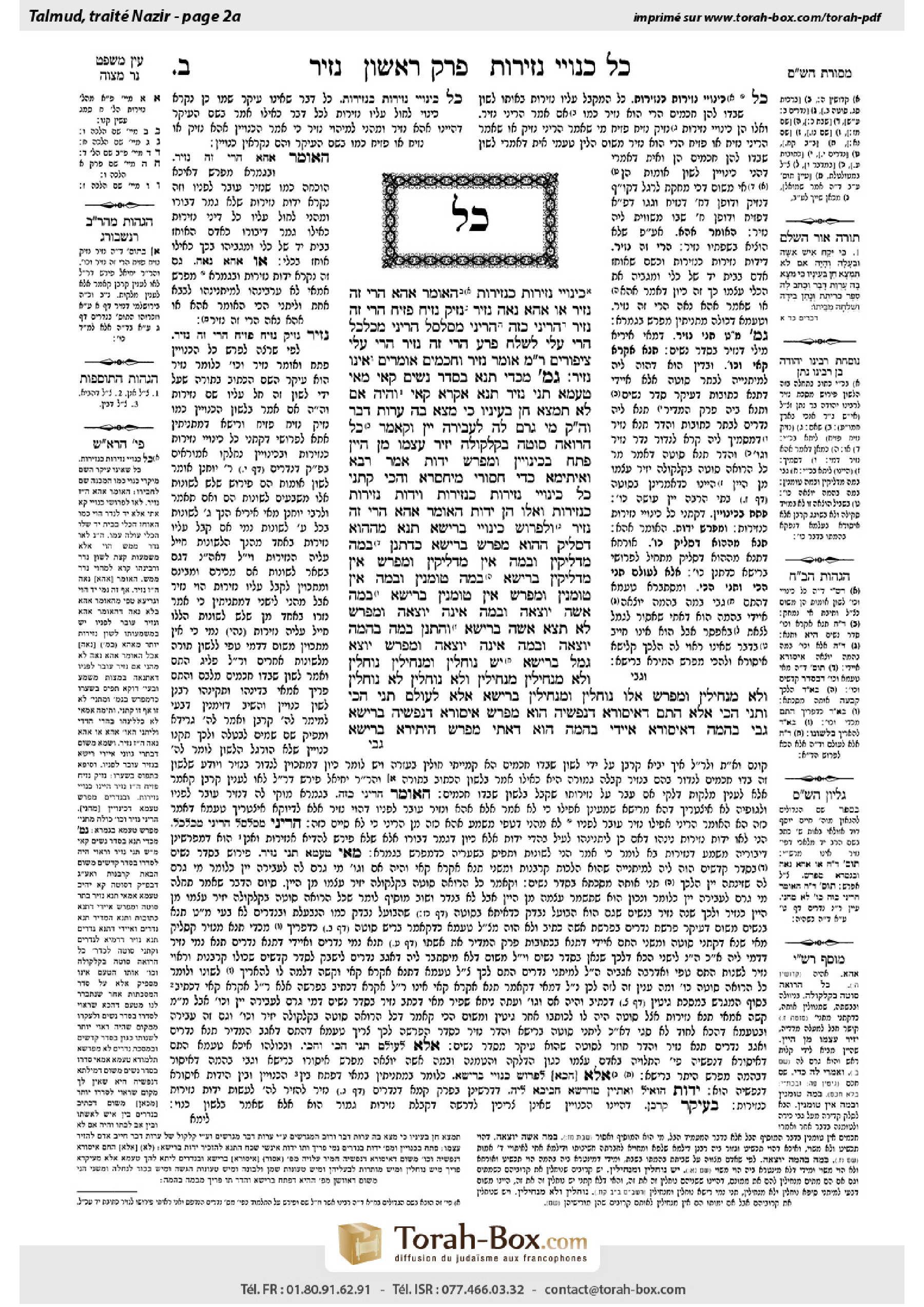
Nazir 2a: Talmud study for Daf Yomi
Daf Yomi is the daily study of one Talmud folio. Explore 37 tractates with scans, Hebrew text, Sefaria English and AI-generated French translations where annotated.
Passage selection and English or AI-generated French translation are available where the scan has annotations. Daf Study is independent of Torah-Box and Sefaria.
Browse Nazir · נזיר · All tractatesNazir 2a text and translations
This page of Nazir includes the Aramaic text, an English translation and an AI-generated French translation, alongside the scan above.
נזיר ב׳ א · Aramaic and Hebrew text
כׇּל כִּינּוּיֵי נְזִירוּת — כִּנְזִירוּת.
הָאוֹמֵר ״אֱהֵא״ — הֲרֵי זֶה נָזִיר, אוֹ ״אֱהֵא נָאֶה״ — נָזִיר, ״נָזִיק״, ״נָזִיחַ״, ״פָּזִיחַ״ — הֲרֵי זֶה נָזִיר. ״הֲרֵינִי כָּזֶה״, ״הֲרֵינִי מְסַלְסֵל״, ״הֲרֵינִי מְכַלְכֵּל״, ״הֲרֵי עָלַי לְשַׁלֵּחַ פֶּרַע״ — הֲרֵי זֶה נָזִיר.
״הֲרֵי עָלַי צִיפּוֹרִים״ — רַבִּי מֵאִיר אוֹמֵר: נָזִיר. וַחֲכָמִים אוֹמְרִים: אֵינוֹ נָזִיר.
גְּמָ׳ מִכְּדֵי תַּנָּא בְּסֵדֶר נָשִׁים קָאֵי, מַאי טַעְמָא תָּנֵי נָזִיר?
תַּנָּא אַקְּרָא קָאֵי: ״וְהָיָה אִם לֹא תִמְצָא חֵן בְּעֵינָיו כִּי מָצָא בָהּ עֶרְוַת דָּבָר״. וְהָכִי קָאָמַר: מִי גָּרַם לָהּ לָעֲבֵירָה — יַיִן, וְקָאָמַר: כׇּל הָרוֹאֶה סוֹטָה בְּקִלְקוּלָהּ יַזִּיר עַצְמוֹ מִן הַיַּיִן.
פָּתַח בְּכִינּוּיִין, וּמְפָרֵשׁ יָדוֹת.
אָמַר רָבָא, וְאִיתֵּימָא כְּדִי: חַסּוֹרֵי מִיחַסְּרָא וְהָכִי קָתָנֵי: כׇּל כִּינּוּיֵי נְזִירוּת — כִּנְזִירוּת, וִידוֹת נְזִירוּת — כִּנְזִירוּת, וְאֵלּוּ הֵן יָדוֹת: הָאוֹמֵר ״אֱהֵא״ — הֲרֵי זֶה נָזִיר.
וְלִפְרוֹשׁ כִּינּוּיֵי בְּרֵישָׁא! תַּנָּא מֵהָהוּא דְּסָלֵיק — הָהוּא מְפָרֵשׁ בְּרֵישָׁא. כְּדִתְנַן: בַּמֶּה מַדְלִיקִין וּבַמָּה אֵין מַדְלִיקִין, וּמְפָרֵשׁ ״אֵין מַדְלִיקִין״ בְּרֵישָׁא.
בַּמֶּה טוֹמְנִין וּבַמָּה אֵין טוֹמְנִין, וּמְפָרֵשׁ ״אֵין טוֹמְנִין״ בְּרֵישָׁא.
בַּמָּה אִשָּׁה יוֹצְאָה וּבַמָּה אֵינָהּ יוֹצְאָה, וּמְפָרֵשׁ ״לֹא תֵּצֵא אִשָּׁה״ בְּרֵישָׁא.
וְהָתְנַן: בַּמֶּה בְּהֵמָה יוֹצְאָה וּבַמָּה אֵינָהּ יוֹצְאָה, וּמְפָרֵשׁ ״יוֹצֵא גָּמָל״ בְּרֵישָׁא.
יֵשׁ נוֹחֲלִין וּמַנְחִילִין, נוֹחֲלִין וְלֹא מַנְחִילִין, מַנְחִילִין וְלֹא נוֹחֲלִין, לֹא נוֹחֲלִין וְלֹא מַנְחִילִין, וּמְפָרֵשׁ ״אֵלּוּ נוֹחֲלִין וּמַנְחִילִין״ בְּרֵישָׁא!
אֶלָּא, לְעוֹלָם תָּנֵי הָכִי וְתָנֵי הָכִי.
אֶלָּא: הָתָם, דְּאִיסּוּרָא דְנַפְשֵׁיהּ הוּא — מְפָרֵשׁ אִיסּוּרָא דְנַפְשֵׁיהּ בְּרֵישָׁא. גַּבֵּי בְּהֵמָה, דְּאִיסּוּרָא אַיְּידֵי בְּהֵמָה הוּא דְּאָתֵי — מְפָרֵשׁ הֶיתֵּירָא בְּרֵישָׁא.
Nazir 2a · English translation
MISHNA: One becomes a nazirite by taking a nazirite vow, in which he simply declares himself a nazirite, as detailed in the Torah (Numbers 6:1–21). Additionally, all substitutes for the language of nazirite vows are like nazirite vows and are binding. Furthermore, intimations of nazirite vows, i.e., incomplete statements that are understood from context to be meant as nazirite vows, are considered binding nazirite vows.
Consequently, one who says: I will be, without further clarification, is a nazirite, as this is his implied intention. Or, if he said: I will be beautiful, he is a nazirite. The substitutes for the language of nazirite vows are as follows: If one says: I will be a nazik, a nazi’aḥ, or a pazi’aḥ, he is a nazirite. If one says: I am hereby like this, I am hereby a hair curler, I am hereby growing my hair; or: It is incumbent upon me to grow long hair, he is a nazirite.
If one says: An obligation is hereby incumbent upon me with regard to birds, Rabbi Meir says: He is a nazirite. A nazirite brings two bird-offerings if he inadvertently becomes ritually impure from a corpse (Numbers 6:10), and it is understood that the individual used this indirect phrase to take a vow of naziriteship. And the Sages say: He is not a nazirite.
GEMARA: The Gemara begins by clarifying why this tractate appears in the order of Nashim within the six orders of the Mishna. Now, the tanna is engaged in the study of the order of Nashim, which discusses laws concerning marriage and the resulting obligations as well as with forbidden sexual relations. What then is the reason that he teaches the laws of the nazirite here?
The Gemara answers: The tanna is engaged in the study of the verse pertaining to divorce: “Then it comes to pass, if she finds no favor in his eyes, because he has found some unseemly matter about her” (Deuteronomy 24:1). And this is what he is saying: What caused the woman to commit the transgression of adultery, alluded to in the verse by the phrase “unseemly matter”? It was wine. And the tanna is saying: Anyone who sees a sota in her disgrace should abstain from wine. Consequently, tractate Nazir is placed in the order of Nashim, immediately preceding tractate Sota, which is about a woman suspected by her husband of having been unfaithful, and tractate Gittin, which discusses divorce.
§ The Gemara asks a question with regard to the mishna’s presentation of the different topics it addresses: The tanna began with the statement that all substitutes for the language of nazirite vows are considered nazirite vows, but then it explains the halakha of intimations of nazirite vows by providing examples of intimations rather than examples of substitutes for nazirite vows. Why didn’t the mishna provide examples of substitutes immediately after stating the halakha concerning substitutes?
Rava said, and some say this statement without attribution [kedi]: The mishna is incomplete and is teaching the following: All substitutes for the language of nazirite vows are like nazirite vows. And similarly, all intimations of nazirite vows are like nazirite vows. And these are examples of intimations: One who says: I will be, is a nazirite.
The Gemara asks: But nevertheless, let the tanna explain the cases of substitutes first, before providing examples of intimations, as the halakha of substitutes is mentioned before the halakha of intimations. The Gemara answers: The tanna employs the general style of the Mishna, which is that the subject with which it concludes is the one that it explains first, as we learned in a mishna (Shabbat 20b): With what may one light the Shabbat lamp and with what may one not light it? And the mishna explains the details of what one may not light first, before providing examples of fuel that may be used to light the Shabbat lamp.
Similarly, another mishna (Shabbat 47b) states: In what may one insulate a pot of cooked food on Shabbat eve, and in what may one not insulate it? And the mishna explains the cases of material in which one may not insulate it first, before providing examples of materials in which one may insulate a pot of cooked food.
A third example of this style is in the following mishna (Shabbat 57a): With what items may a woman go out into the public domain on Shabbat and with what items may she not go out? And the mishna explains the items with which a woman may not go out first, before providing examples of items with which she may go out.
The Gemara challenges this explanation: But didn’t we learn in a mishna (Shabbat 51b): With what may an animal go out into the public domain on Shabbat, and with what may it not go out? And it explains the items with which a camel may go out first, before providing examples of items with which it may not go out.
Similarly, it is taught in another mishna (Bava Batra 108a): There are some relatives who inherit and bequeath, e.g., a father and son, who are heirs to each other; some who inherit but do not bequeath; some bequeath but do not inherit; and some do not inherit and do not bequeath. And the mishna explains the cases of those who both inherit and bequeath first, before providing examples of the other categories that were mentioned later in the opening clause of the mishna.
Rather, the mishna actually teaches in this manner at times, and it teaches in that manner at other times. There are instances where the tanna begins by elaborating on the first principle mentioned in the mishna, while on other occasions he first elaborates upon the last principle mentioned.
However, there is a rationale as to when the tanna employs each style. There, in the passages concerning the fuels one may use to light the Shabbat lamp, the materials one may use to insulate a pot on Shabbat eve, and the items with which a woman may go out on Shabbat to the public domain, where it is the individual’s own prohibition that is being discussed, the tanna explains the cases pertaining to the individual’s own prohibition first. By contrast, with regard to the mishna that addresses an animal carrying into the public domain on Shabbat, where the prohibition comes by means of the animal, the tanna explains what is permitted first.
Nazir 2a · Traduction française (IA)
MICHNA : On devient nazir en prononçant un vœu de naziréat, par lequel on se déclare simplement nazir, comme le détaille la Torah (Nombres 6, 1-21). En outre, toutes les expressions de substitution aux formules des vœux de naziréat ont la même valeur que ces vœux et engagent celui qui les prononce. De même, les allusions à un vœu de naziréat, c’est-à-dire les déclarations incomplètes que le contexte permet de comprendre comme des vœux de naziréat, sont considérées comme des vœux de naziréat contraignants.
Par conséquent, celui qui dit simplement : « Je serai », sans autre précision, devient nazir, car telle est son intention implicite. De même, s’il dit : « Je serai beau », il devient nazir. Voici les expressions de substitution aux formules des vœux de naziréat : si quelqu’un dit : « Je serai nazik », « nazi’aḥ » ou « pazi’aḥ », il devient nazir. Si quelqu’un dit : « Me voici comme cela », « Me voici en train de me boucler les cheveux », « Me voici en train de laisser pousser mes cheveux », ou : « Je suis tenu de laisser pousser mes cheveux », il devient nazir.
Si quelqu’un dit : « Une obligation m’incombe à présent concernant des oiseaux », Rabbi Méïr dit : il devient nazir. Un nazir apporte deux offrandes d’oiseaux s’il devient rituellement impur au contact d’un cadavre par inadvertance (Nombres 6, 10), et l’on comprend que cet homme a employé cette expression indirecte pour faire vœu de naziréat. Les Sages disent : il ne devient pas nazir.
GUEMARA : La Guemara commence par éclaircir la raison pour laquelle ce traité figure dans l’ordre Nashim, parmi les six ordres de la Michna. Or, le tanna étudie l’ordre Nashim, qui traite des lois relatives au mariage et aux obligations qui en découlent, ainsi que des relations sexuelles interdites. Pourquoi enseigne-t-il donc ici les lois du naziréat ?
La Guemara répond : Le tanna étudie le verset relatif au divorce : « S’il arrive qu’elle ne trouve pas grâce à ses yeux, parce qu’il a découvert en elle quelque chose d’inconvenant » (Deutéronome 24, 1). Voici ce qu’il veut dire : Qu’est-ce qui a poussé la femme à commettre la faute d’adultère, à laquelle fait allusion dans le verset l’expression « quelque chose d’inconvenant » ? Le vin. Le tanna enseigne donc : quiconque voit une sota dans son humiliation doit s’abstenir de vin. Par conséquent, le traité Nazir est placé dans l’ordre Nashim juste avant le traité Sota, qui traite d’une femme soupçonnée par son mari d’avoir été infidèle, et le traité Gittin, qui traite du divorce.
§ La Guemara pose une question sur la présentation des différents sujets dans la Michna : le tanna commence par déclarer que toutes les expressions de substitution aux formules des vœux de naziréat sont considérées comme des vœux de naziréat, mais il explique ensuite la halakha des allusions à ces vœux en donnant des exemples d’allusions, plutôt que des exemples d’expressions de substitution. Pourquoi la Michna ne donne-t-elle pas des exemples d’expressions de substitution immédiatement après avoir énoncé la halakha les concernant ?
Rava a dit, et certains rapportent cette déclaration sans attribution [kedi] : le texte de la Michna est incomplet et enseigne ceci : toutes les expressions de substitution aux formules des vœux de naziréat ont la même valeur que des vœux de naziréat. De même, toutes les allusions à un vœu de naziréat ont la même valeur qu’un vœu de naziréat. Voici des exemples d’allusions : celui qui dit : « Je serai » devient nazir.
La Guemara demande : Mais malgré tout, le tanna ne devrait-il pas exposer d’abord les cas d’expressions de substitution, avant de donner des exemples d’allusions, puisque la halakha relative aux expressions de substitution est mentionnée avant celle des allusions ? La Guemara répond : le tanna suit le style général de la Michna, qui consiste à expliquer d’abord le sujet par lequel elle se termine, comme nous l’avons appris dans une Michna (Chabbat 20b) : « Avec quoi peut-on allumer la lampe de Chabbat et avec quoi ne peut-on pas l’allumer ? » La Michna expose d’abord les détails des matières avec lesquelles on ne peut pas l’allumer, avant de donner des exemples de combustibles qui peuvent servir à allumer la lampe de Chabbat.
De même, une autre Michna (Chabbat 47b) enseigne : « Dans quoi peut-on isoler une marmite contenant un plat cuit, la veille de Chabbat, et dans quoi ne peut-on pas l’isoler ? » La Michna expose d’abord les cas des matériaux dans lesquels on ne peut pas isoler la marmite, avant de donner des exemples de matériaux dans lesquels on peut isoler une marmite contenant un plat cuit.
Un troisième exemple de ce style se trouve dans la Michna suivante (Chabbat 57a) : « Avec quels objets une femme peut-elle sortir dans le domaine public pendant Chabbat, et avec quels objets ne peut-elle pas sortir ? » La Michna expose d’abord les objets avec lesquels une femme ne peut pas sortir, avant de donner des exemples d’objets avec lesquels elle peut sortir.
La Guemara conteste cette explication : N’avons-nous pas appris dans une Michna (Chabbat 51b) : « Avec quoi un animal peut-il sortir dans le domaine public pendant Chabbat, et avec quoi ne peut-il pas sortir ? » La Michna expose d’abord les objets avec lesquels un chameau peut sortir, avant de donner des exemples d’objets avec lesquels il ne peut pas sortir.
De même, il est enseigné dans une autre Michna (Bava Batra 108a) : « Certains proches héritent et transmettent un héritage, par exemple un père et son fils, qui héritent l’un de l’autre ; certains héritent mais ne transmettent pas d’héritage ; certains transmettent un héritage mais n’héritent pas ; et certains n’héritent pas et ne transmettent pas d’héritage. » La Michna expose d’abord les cas de ceux qui héritent et transmettent tous deux un héritage, avant de donner des exemples des autres catégories, mentionnées plus tard dans la proposition introductive de la Michna.
La Michna enseigne donc parfois de cette manière et parfois de l’autre. Il arrive que le tanna commence par développer le premier principe mentionné dans la Michna, tandis qu’en d’autres occasions il développe d’abord le dernier principe mentionné.
Toutefois, il y a une raison pour laquelle le tanna adopte l’un ou l’autre de ces styles. Dans les passages relatifs aux combustibles que l’on peut utiliser pour allumer la lampe de Chabbat, aux matériaux que l’on peut utiliser pour isoler une marmite la veille de Chabbat, et aux objets avec lesquels une femme peut sortir dans le domaine public pendant Chabbat, où il est question d’une interdiction qui incombe à la personne elle-même, le tanna expose d’abord les cas relevant de cette interdiction. En revanche, dans la Michna qui traite d’un animal portant une charge dans le domaine public pendant Chabbat, où l’interdiction s’applique par l’intermédiaire de l’animal, le tanna expose d’abord ce qui est permis.
Traduction française générée par IA à partir de l’édition anglaise de Sefaria. Vérifie toujours un passage avec le texte source.
Text from Sefaria: William Davidson Edition - Vocalized Aramaic (CC BY NC); William Davidson Edition - English (CC BY NC).