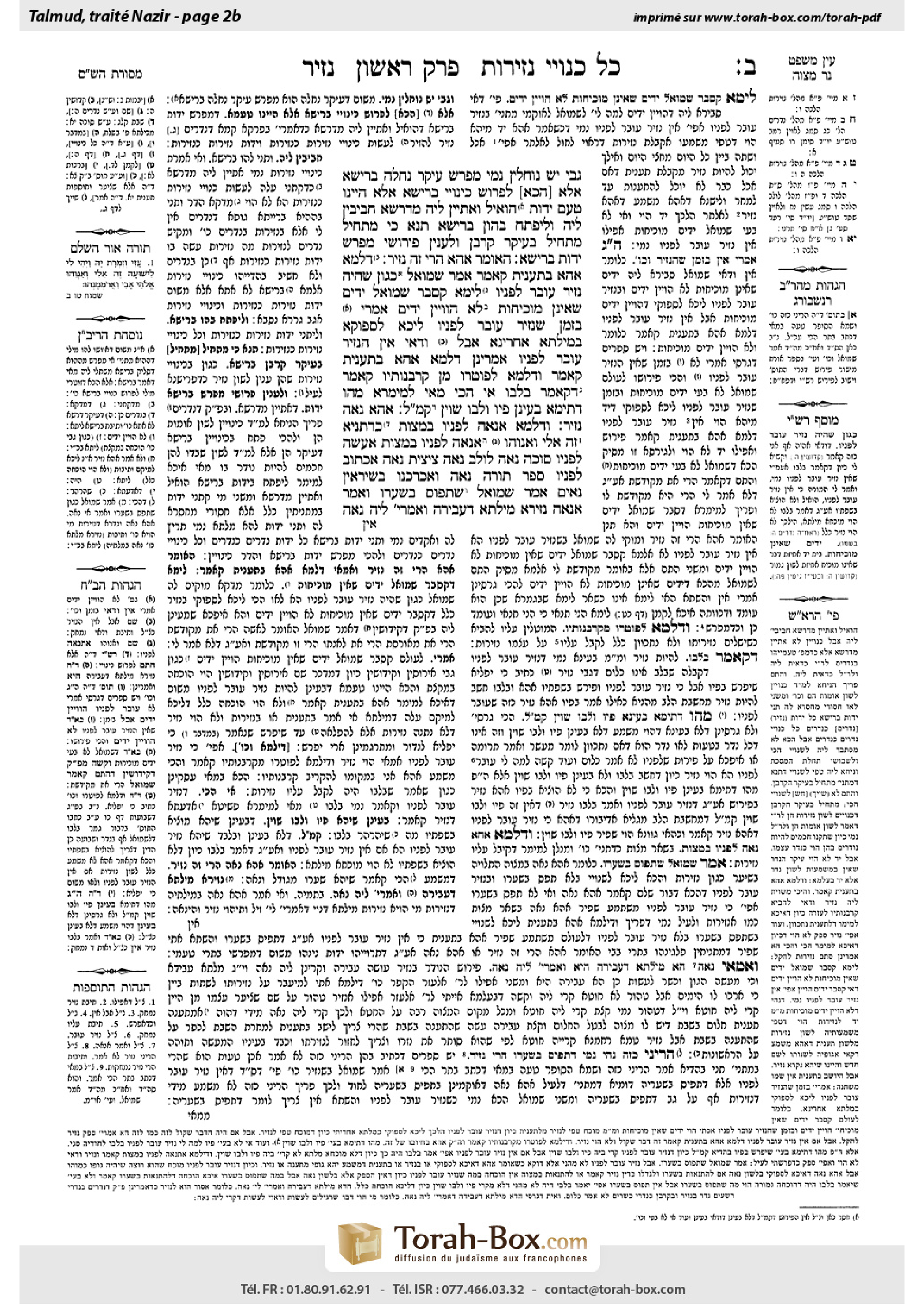
Nazir 2b: Talmud study for Daf Yomi
Daf Yomi is the daily study of one Talmud folio. Explore 37 tractates with scans, Hebrew text, Sefaria English and AI-generated French translations where annotated.
Passage selection and English or AI-generated French translation are available where the scan has annotations. Daf Study is independent of Torah-Box and Sefaria.
Browse Nazir · נזיר · All tractatesNazir 2b text and translations
This page of Nazir includes the Aramaic text, an English translation and an AI-generated French translation, alongside the scan above.
נזיר ב׳ ב · Aramaic and Hebrew text
גַּבֵּי ״יֵשׁ נוֹחֲלִין״ נָמֵי, מְפָרֵשׁ עִיקַּר נַחֲלָה בְּרֵישָׁא.
אֶלָּא [הָכָא] לִפְרוֹשׁ כִּינּוּיֵי בְּרֵישָׁא! אֶלָּא הַיְינוּ טַעַם: יָדוֹת, הוֹאִיל וְאָתְיָין לֵיהּ מִדְּרָשָׁא, חֲבִיבִין לֵיהּ.
וְלִיפְתַּח בְּהוֹן בְּרֵישָׁא! תַּנָּא כִּי מַתְחִיל — מַתְחִיל בְּעִיקַּר קׇרְבָּן, וּלְעִנְיַן פָּירוּשֵׁי — מְפָרֵשׁ יָדוֹת בְּרֵישָׁא.
הָאוֹמֵר ״אֱהֵא״ — הֲרֵי זֶה נָזִיר. דִּלְמָא ״אֱהֵא בְּתַעֲנִית״ קָאָמַר? אָמַר שְׁמוּאֵל: כְּגוֹן שֶׁהָיָה נָזִיר עוֹבֵר לְפָנָיו.
לֵימָא קָסָבַר שְׁמוּאֵל יָדַיִם שֶׁאֵינָן מוֹכִיחוֹת לָא הָוְויָין יָדַיִם? אָמְרִי: בִּזְמַן שֶׁנָּזִיר עוֹבֵר לְפָנָיו לֵיכָּא לְסַפּוֹקֵא בְּמִילְּתָא אַחֲרִינָא. אֲבָל וַדַּאי אֵין הַנָּזִיר עוֹבֵר לְפָנָיו, אָמְרִינַן: דִּלְמָא ״אֱהֵא בְּתַעֲנִית״ קָאָמַר.
וְדִלְמָא לְפוֹטְרוֹ מִן קׇרְבְּנוֹתָיו קָאָמַר? דְּקָאָמַר בְּלִבּוֹ.
אִי הָכִי, מַאי לְמֵימְרָא! מַהוּ דְּתֵימָא: בָּעִינַן פִּיו וְלִבּוֹ שָׁוִין, קָא מַשְׁמַע לַן.
״אֱהֵא נָאֶה״ — נָזִיר. וְדִלְמָא: אֶנָּאֶה לְפָנָיו בְּמִצְוֹת? כִּדְתַנְיָא: ״זֶה אֵלִי וְאַנְוֵהוּ״ — אֶנָּאֶה לְפָנָיו בְּמִצְוֹת. אֶעֱשֶׂה לְפָנָיו סוּכָּה נָאָה, לוּלָב נָאֶה, צִיצִית נָאָה, אֶכְתּוֹב לְפָנָיו סֵפֶר תּוֹרָה נָאֶה וְאֶכְרְכֶנּוּ בְּשִׁירָאִין נָאִים!
אָמַר שְׁמוּאֵל: שֶׁתָּפוּס בִּשְׂעָרוֹ, וְאָמַר ״אֶנָּאֶה״.
נְזִירָא מִילְּתָא דַעֲבֵירָה, וְאָמְרִינַן לֵיהּ ״נָאֶה״?
Nazir 2b · English translation
Similarly, with regard to the mishna that teaches that there are some relatives who inherit and bequeath, the tanna also had a reason for initially providing examples from the first category: He thereby explains the principal case of the Torah’s halakhot of inheritance first.
The Gemara now returns to its question: But here, let the tanna explain the cases of substitutes first. The Gemara explains: Rather, this is the reason: Since intimations are derived from the exposition of verses and are not explicitly mentioned in the Torah, they are dear to the tanna and he therefore mentions them first.
The Gemara asks: But if that is so, then let him begin with them first in the opening clause of the mishna as well. The Gemara answers: When the tanna begins, he begins with the main offering of the nazirite, i.e., with the halakha that has a basis in the Torah. But with regard to the explanation of these halakhot, he explains the cases of intimations first, as he favors that topic.
§ The mishna taught: One who says: I will be, is a nazirite. The Gemara asks: Perhaps he is saying: I will be fasting, i.e., his intention is to take a vow that will obligate himself to fast rather than to be a nazirite. The Gemara answers that Shmuel said: The mishna is describing a case where a nazirite was passing before him, so that it is clear that he is taking a nazirite vow.
The Gemara asks: Shall we say that Shmuel holds as a principle that ambiguous intimations are not considered intimations, i.e., they are not considered vows? The Gemara rejects this suggestion: Say that when a nazirite is passing before him, there is no reason to doubt his intention. There is no possibility that he is referring to another matter, and therefore his statement is definitely an intimation of naziriteship. However, it is certainly the case that when a nazirite is not passing before him, and he states: I will be, we say that perhaps he is saying: I will be fasting. It is only in the latter case, where one’s intimation is so ambiguous that it offers no evidence whatsoever of his intentions, that Shmuel holds that one’s statement is not considered a vow.
The Gemara asks: But even if he made his statement when a nazirite was passing before him, perhaps he was saying that he intends to purchase the animals the nazirite will need for his offerings and thereby exempt the nazirite from paying for his own offerings. The Gemara answers: This is a case where he said in his heart that he accepts upon himself a nazirite vow.
The Gemara asks: If that is so, then what is the purpose of stating this halakha? Isn’t it obvious that he becomes a nazirite? The Gemara answers: It is necessary to state this halakha, lest you say that we require his mouth and heart to be identical. If that were the case, then if one did not clearly articulate his nazirite vow, he would not become a nazirite even if he intended to become one. Therefore, the mishna teaches us that since his words can be interpreted as referring to a nazirite vow, and that was his intention, he becomes a nazirite.
§ The mishna taught that if one says: I will be beautiful [na’e], he is a nazirite. The Gemara asks: But perhaps when he said: I will be beautiful, he meant: I will be beautiful before Him in mitzvot? As it is taught in a baraita: “This is my God and I will glorify Him [anvehu]” (Exodus 15:2). Anvehu has the same root as the word na’e; therefore, the verse means: I will be beautiful before Him in mitzvot. How is this done? I will make before Him a beautiful sukka, a beautiful lulav, beautiful ritual fringes. I will write before Him a beautiful Torah scroll, and I will wrap it in beautiful silk cloths [shira’in].
The Gemara answers that Shmuel said: The mishna is referring to a case where one is holding his hair and says: I will be beautiful. This clearly indicates that he is referring to naziriteship.
The Gemara asks: Since naziriteship is a matter of transgression, can we say about a nazirite that he is beautiful?
Nazir 2b · Traduction française (IA)
De même, à propos de la Michna qui enseigne qu’il y a des proches qui héritent et transmettent leur héritage, le tanna avait également une raison de donner d’abord des exemples de la première catégorie : il explique ainsi en premier le cas principal des lois de la Torah sur l’héritage.
La Guemara revient maintenant à sa question : Mais ici, que le tanna expose d’abord les cas de substitutions. La Guemara explique : Voici plutôt la raison : les allusions étant déduites de l’interprétation des versets et n’étant pas explicitement mentionnées dans la Torah, elles sont précieuses aux yeux du tanna, qui les mentionne donc en premier.
La Guemara demande : Mais si tel est le cas, qu’il commence également par elles dans la première partie de la Michna. La Guemara répond : Lorsque le tanna commence, il commence par le principal sacrifice du nazir, c’est-à-dire par la halakha qui a un fondement dans la Torah. Mais lorsqu’il explique ces halakhot, il expose d’abord les cas d’allusions, car ce sujet lui est cher.
§ La Michna enseigne : Celui qui dit : « Je serai », est un nazir. La Guemara demande : Peut-être veut-il dire : « Je jeûnerai », c’est-à-dire qu’il a l’intention de prononcer un vœu qui l’obligera à jeûner plutôt que de devenir nazir. La Guemara répond que Shmuel a dit : La Michna décrit le cas où un nazir passait devant lui, de sorte qu’il est clair qu’il prononce un vœu de naziréat.
La Guemara demande : Faut-il en conclure que Shmuel pose en principe que les allusions ambiguës ne sont pas considérées comme des allusions, c’est-à-dire qu’elles ne sont pas considérées comme des vœux ? La Guemara rejette cette suggestion : Dis plutôt que, lorsqu’un nazir passe devant lui, il n’y a aucune raison de douter de son intention. Il ne peut pas faire référence à autre chose ; sa déclaration est donc nécessairement une allusion au naziréat. Cependant, il est certain que lorsqu’aucun nazir ne passe devant lui et qu’il déclare : « Je serai », nous disons qu’il veut peut-être dire : « Je jeûnerai ». Ce n’est que dans ce dernier cas, où son allusion est si ambiguë qu’elle ne fournit absolument aucun indice de ses intentions, que Shmuel considère que sa déclaration ne constitue pas un vœu.
La Guemara demande : Mais même s’il a fait cette déclaration alors qu’un nazir passait devant lui, peut-être voulait-il dire qu’il avait l’intention d’acheter les animaux dont le nazir aurait besoin pour ses sacrifices et de le dispenser ainsi de payer lui-même ses sacrifices. La Guemara répond : Il s’agit d’un cas où il a dit en son cœur qu’il acceptait sur lui un vœu de naziréat.
La Guemara demande : Si tel est le cas, à quoi bon énoncer cette halakha ? N’est-il pas évident qu’il devient nazir ? La Guemara répond : Cette halakha doit être énoncée, de peur que tu ne dises qu’il faut que sa bouche et son cœur concordent. Si tel était le cas, celui qui n’aurait pas formulé clairement son vœu de naziréat ne deviendrait pas nazir, même s’il avait l’intention de le devenir. La Michna nous enseigne donc que, puisque ses paroles peuvent être interprétées comme se rapportant à un vœu de naziréat et que telle était son intention, il devient nazir.
§ La Michna enseigne que si quelqu’un dit : « Je serai beau [na’e] », il est nazir. La Guemara demande : Mais lorsqu’il a dit : « Je serai beau », peut-être voulait-il dire : « Je serai beau devant Lui par mes mitsvot » ? Car il est enseigné dans une baraïta : « C’est mon Dieu et je le glorifierai [anvehu] » (Exode 15:2). Anvehu a la même racine que le mot na’e ; le verset signifie donc : « Je serai beau devant Lui par mes mitsvot. » Comment cela se fait-il ? Je ferai devant Lui une belle soukka, un beau loulav, de beaux tsitsit. J’écrirai devant Lui un beau rouleau de la Torah et je l’envelopperai de beaux tissus de soie [shira’in].
La Guemara répond que Shmuel a dit : La Michna traite du cas où quelqu’un tient ses cheveux et dit : « Je serai beau. » Cela indique clairement qu’il fait référence au naziréat.
La Guemara demande : Puisque le naziréat est une transgression, peut-on dire d’un nazir qu’il est beau ?
Traduction française générée par IA à partir de l’édition anglaise de Sefaria. Vérifie toujours un passage avec le texte source.
Text from Sefaria: William Davidson Edition - Vocalized Aramaic (CC BY NC); William Davidson Edition - English (CC BY NC).