Nazir 3a: Talmud study for Daf Yomi
Daf Yomi is the daily study of one Talmud folio. Explore 37 tractates with scans, Hebrew text, Sefaria English and AI-generated French translations where annotated.
Passage selection and English or AI-generated French translation are available where the scan has annotations. Daf Study is independent of Torah-Box and Sefaria.
Browse Nazir · נזיר · All tractatesNazir 3a text and translations
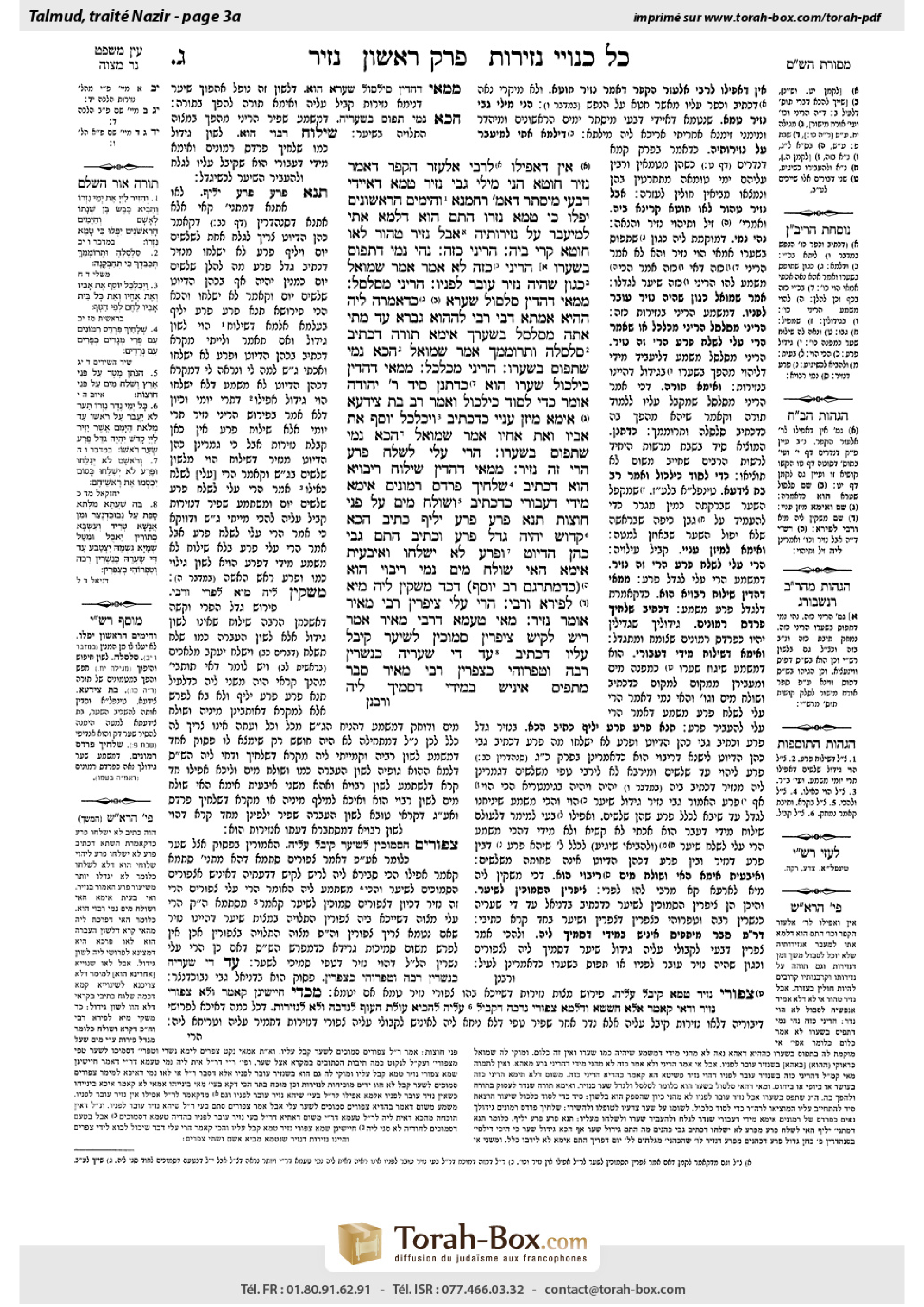
This page of Nazir includes the Aramaic text, an English translation and an AI-generated French translation, alongside the scan above.
נזיר ג׳ א · Aramaic and Hebrew text
אִין, דַּאֲפִילּוּ לְרַבִּי אֶלְעָזָר הַקַּפָּר דְּאָמַר: נָזִיר חוֹטֵא, הָנֵי מִילֵּי גַּבֵּי נָזִיר טָמֵא, דְּאַיְּידֵי דְּבָעֵי מִיסְתַּר, דְּאָמַר רַחֲמָנָא: ״וְהַיָּמִים הָרִאשֹׁנִים יִפְּלוּ כִּי טָמֵא נִזְרוֹ״, הָתָם הוּא, דִּלְמָא אָתֵי לְמִיעְבַּר עַל נְזִירוּתֵיהּ, אֲבָל נָזִיר טָהוֹר — לָאו חוֹטֵא קָרֵי בֵּיהּ.
״הֲרֵינִי כָּזֶה״ — נְהִי נָמֵי דְּתָפוּס בִּשְׂעָרוֹ, ״הֲרֵינִי כָּזֶה״ — לָא אָמַר! אָמַר שְׁמוּאֵל: כְּגוֹן שֶׁהָיָה נָזִיר עוֹבֵר לְפָנָיו.
״הֲרֵינִי מְסַלְסֵל״ — מִמַּאי דְּהָדֵין סִלְסוּל שַׂעְרָא? כְּדַאֲמַרָה לֵיהּ הָהִיא אַמְּתָא דְבֵי רַבִּי לְהָהוּא גַּבְרָא: עַד מָתַי אַתָּה מְסַלְסֵל בִּשְׂעָרְךָ?
אֵימָא תּוֹרָה, דִּכְתִיב ״סַלְסְלֶהָ וּתְרוֹמְמֶךָּ״? אָמַר שְׁמוּאֵל: הָכָא נָמֵי שֶׁתָּפוּס בִּשְׂעָרוֹ.
״הֲרֵינִי מְכַלְכֵּל״ — מִמַּאי דְּהָדֵין כִּילְכּוּל שְׂעָרוֹ הוּא? כְּדִתְנַן: סִיד, רַבִּי יְהוּדָה אוֹמֵר: כְּדֵי לָסוּד כִּילְכּוּל. וְאָמַר רַב: בַּת צִידְעָא.
אֵימָא מֵיזַן עַנְיֵי, כְּדִכְתִיב: ״וַיְכַלְכֵּל יוֹסֵף אֶת אָבִיו וְאֶת אֶחָיו״. אָמַר שְׁמוּאֵל: הָכָא נָמֵי שֶׁתָּפוּס בִּשְׂעָרוֹ.
״הֲרֵי עָלַי לְשַׁלֵּחַ פֶּרַע״ — הֲרֵי זֶה נָזִיר. מִמַּאי דְּהָדֵין שִׁלּוּחַ רִיבּוּיָא הוּא, דִּכְתִיב: ״שְׁלָחַיִךְ פַּרְדֵּס רִמּוֹנִים״.
אֵימָא מִידֵּי דְעַבּוֹרֵי, כְּדִכְתִיב: ״וְשֹׁלֵחַ מַיִם עַל פְּנֵי חוּצוֹת״!
תַּנָּא ״פֶּרַע״ ״פֶּרַע״ יָלֵיף. כְּתִיב הָכָא ״קָדֹשׁ יִהְיֶה גַּדֵּל פֶּרַע״, וּכְתִיב הָתָם גַּבֵּי כֹּהֵן הֶדְיוֹט ״וּפֶרַע לֹא יְשַׁלֵּחוּ״.
וְאִיבָּעֵית אֵימָא הַאי ״שׁוֹלֵחַ מַיִם״ נָמֵי רִיבּוּי הוּא, (כְּדִמְתַרְגֵּם רַב יוֹסֵף:) דְּכַד מַשְׁקִין לֵיהּ מַיָּא לְפֵירָא וְרָבֵי.
״הֲרֵי עָלַי צִיפֳּרִין״ — רַבִּי מֵאִיר אוֹמֵר: נָזִיר. מַאי טַעְמָא דְּרַבִּי מֵאִיר? אָמַר רֵישׁ לָקִישׁ: צִיפֳּרִין סְמוּכִין לְשֵׂיעָר קִיבֵּל עָלָיו, דִּכְתִיב ״עַד דִּי שַׂעְרֵיהּ כְּנִשְׁרִין רְבָה וְטִפְרוֹהִי כְצִפְּרִין״.
רַבִּי מֵאִיר סָבַר: מַתְפֵּיס אִינִישׁ בְּמִידֵּי דִּסְמִיךְ לֵיהּ.
Nazir 3a · English translation
The Gemara answers: Yes, as even according to Rabbi Elazar HaKappar, who said that a nazirite is a sinner, that applies only with regard to a ritually impure nazirite. This is because it is necessary for him to void the days of his vow that have been observed and to begin his term anew, as the Merciful One states in the Torah: “But the first days will be void, because his consecration was defiled” (Numbers 6:12). It is there that Rabbi Elazar HaKappar called the nazirite a sinner, because perhaps he will come to transgress his naziriteship now that he is a nazirite for a longer period than he originally intended. However, with regard to a ritually pure nazirite, Rabbi Elazar HaKappar does not call him a sinner.
§ The mishna taught that one who says: I am hereby like this, is a nazirite. The Gemara asks: Though this is indeed a case where he is holding his hair at the time, since he did not say: I am hereby like this, how can this statement constitute an acceptance of naziriteship? Shmuel said: It is a case where a nazirite was passing before him when he made his statement. His intention was to declare himself a nazirite like the individual passing before him, and his statement therefore constitutes a nazirite vow.
The mishna rules that one who says: I am hereby a hair curler is a nazirite. The Gemara asks: From where is it known that this term is referring to the curling [silsul] of hair by allowing it to grow? The Gemara answers: As that maidservant of the house of Rabbi Yehuda HaNasi said to a certain man who grew his hair long: Until when will you curl [mesalsel] your hair? This shows that mesalsel means to grow hair.
The Gemara suggests: Say that the word mesalsel is referring to the study of Torah, as it is written with regard to Torah: “Extol her [salseleha] and she will exalt you” (Proverbs 4:8). The Gemara responds that Shmuel said: Here too, the case is where he was holding his hair at the time of his pronouncement.
The mishna rules that one who says: I am hereby growing my hair is a nazirite. The Gemara asks: From where is it known that this term is a reference to growing [kilkul] his hair? The Gemara answers: As we learned in a mishna (Shabbat 78b): With regard to the measure that determines liability for carrying out lime on Shabbat from a private to a public domain, Rabbi Yehuda says: The measure is equivalent to that which is used to spread on one’s kilkul. And Rav said: This is referring to the hair that grows on the areas beneath the temple.
The Gemara suggests: Say that he vowed to sustain the poor, as it is written: “And Joseph sustained [vaykhalkel] his father and his brethren” (Genesis 47:12). The Gemara responds that Shmuel said: Here too, in the mishna, the case is one where the individual was holding his hair when he made his pronouncement, so that it was clear that he was referring to growing his hair.
The mishna rules that with regard to one who says: It is incumbent upon me to grow [leshale’aḥ] long hair, he is a nazirite. The Gemara asks: From where is it known that this term shilu’aḥ, which is a different form of the word leshale’aḥ, is an expression of increase and growth? The Gemara answers: As it is written: “Your tresses [shelaḥayikh] are a park of pomegranates” (Song of Songs 4:13).
The Gemara suggests: Say that it is referring to a matter involving transfer, as it is written: “And sends [shole’aḥ] water upon the earth” (Job 5:10), where the word shole’aḥ is referring to the transport of water from one place to another. Here too, the individual taking the vow might mean that he intends to transfer, i.e., to remove, his hair.
The Gemara answers: The tanna derives the meaning of this term based upon a verbal analogy of the term long locks [pera] written with regard to a nazirite and the term long locks [pera] written with regard to a priest. It is written here, with regard to a nazirite: “He shall be holy, he shall let the hair of his head grow [gadel] long locks [pera]” (Numbers 6:5). And it is written there, with regard to a common priest serving in the Temple: “And they will not let their locks grow long [pera lo yeshaleḥu]” (Ezekiel 44:20). Just as the word pera with regard to a nazirite indicates growing long hair, so too, in the case of a priest it is referring to growing long hair. This proves that the term shilu’aḥ means letting one’s hair grow.
The Gemara offers an alternate answer: And if you wish, say that the meaning of the word shole’aḥ in that phrase: Sends [shole’aḥ] water, is also increase and growth, as Rav Yosef translated this verse into Aramaic in the following manner: When one waters produce, it grows. Consequently, the verse is referring to growth by means of water.
§ The mishna taught that if one says: An obligation is hereby incumbent upon me with regard to birds, Rabbi Meir says: He is a nazirite, and the Sages say: He is not a nazirite. The Gemara asks: What is the reason for the opinion of Rabbi Meir? Reish Lakish said: He accepted upon himself an obligation with regard to the birds that are juxtaposed in a verse to hair, as it is written: “Until his hair was grown like eagles’ feathers, and his nails like birds’ claws” (Daniel 4:30). Since the verse juxtaposes birds with growing hair, it is understood that when this individual accepted an obligation with regard to birds, he was referring to growing his hair as a nazirite.
The Gemara explains the basis of the dispute: Rabbi Meir holds that a person associates the object of his vow with something that is juxtaposed to it in a verse, so that when he says that it is incumbent upon him to bring birds, he means that it is incumbent upon him to grow his hair.
Nazir 3a · Traduction française (IA)
La Guemara répond : Oui, car même selon Rabbi Elazar HaKappar, qui a dit qu’un nazir est un pécheur, cela ne s’applique qu’au nazir rituellement impur. En effet, celui-ci doit annuler les jours de son vœu qu’il a déjà observés et recommencer son terme depuis le début, comme le Miséricordieux l’énonce dans la Torah : « Mais les premiers jours seront annulés, car sa consécration a été souillée » (Nombres 6:12). C’est dans ce cas que Rabbi Elazar HaKappar a qualifié le nazir de pécheur, car il pourrait en venir à transgresser son naziréat, puisqu’il est désormais nazir pour une période plus longue que celle qu’il avait initialement prévue. En revanche, s’agissant d’un nazir rituellement pur, Rabbi Elazar HaKappar ne le qualifie pas de pécheur.
§ La Michna enseigne que celui qui dit : « Je suis désormais comme ceci » est nazir. La Guemara demande : Même s’il tenait effectivement ses cheveux au moment de parler, puisqu’il n’a pas dit : « Je suis désormais comme ceci », comment cette déclaration peut-elle constituer l’acceptation du naziréat ? Shmuel dit : Un nazir passait devant lui au moment où il a fait sa déclaration. Il avait l’intention de se déclarer nazir comme celui qui passait devant lui ; sa déclaration constitue donc un vœu de naziréat.
La Michna statue que celui qui dit : « Je suis désormais un friseur de cheveux » est nazir. La Guemara demande : D’où sait-on que ce terme désigne le fait de laisser pousser les cheveux [silsul] ? La Guemara répond : Une servante de la maison de Rabbi Yehouda HaNassi dit à un homme qui laissait pousser ses cheveux : « Jusqu’à quand vas-tu laisser pousser [mesalsel] tes cheveux ? » Cela montre que mesalsel signifie laisser pousser les cheveux.
La Guemara suggère : Disons que le mot mesalsel désigne l’étude de la Torah, comme il est écrit à propos de la Torah : « Exalte-la [salseleha], et elle t’élèvera » (Proverbes 4:8). La Guemara répond que Shmuel a dit : Ici aussi, il s’agit du cas où l’homme tenait ses cheveux au moment de sa déclaration.
La Michna statue que celui qui dit : « Je suis désormais en train de laisser pousser mes cheveux » est nazir. La Guemara demande : D’où sait-on que ce terme désigne le fait de laisser pousser [kilkul] ses cheveux ? La Guemara répond : Nous avons appris dans une Michna (Chabbat 78b) : Concernant la quantité de chaux dont le transport d’un domaine privé vers un domaine public, pendant Chabbat, engage la responsabilité, Rabbi Yehouda dit : La mesure équivaut à celle que l’on utilise pour enduire son kilkul. Rav a dit : Cela désigne les cheveux qui poussent dans les zones situées sous les tempes.
La Guemara suggère : Disons qu’il a fait vœu de subvenir aux besoins des pauvres, comme il est écrit : « Et Joseph nourrit [vaykhalkel] son père et ses frères » (Genèse 47:12). La Guemara répond que Shmuel a dit : Ici aussi, dans la Michna, il s’agit du cas où l’homme tenait ses cheveux au moment de sa déclaration, de sorte qu’il était clair qu’il parlait de les laisser pousser.
La Michna statue que celui qui dit : « J’ai l’obligation de laisser pousser [leshale’aḥ] mes cheveux longs » est nazir. La Guemara demande : D’où sait-on que le terme shilu’aḥ, une autre forme du mot leshale’aḥ, exprime l’accroissement et la pousse ? La Guemara répond : Comme il est écrit : « Tes tresses [shelaḥayikh] sont un verger de grenadiers » (Cantique des Cantiques 4:13).
La Guemara suggère : Disons que cela désigne une action de transfert, comme il est écrit : « Et envoie [shole’aḥ] de l’eau sur la terre » (Job 5:10), où le mot shole’aḥ désigne le transport de l’eau d’un endroit à un autre. Ici aussi, celui qui fait le vœu pourrait vouloir dire qu’il entend transférer, c’est-à-dire enlever, ses cheveux.
La Guemara répond : Le tanna déduit le sens de ce terme au moyen d’une analogie verbale entre le terme « longues mèches » [pera], écrit à propos du nazir, et le terme « longues mèches » [pera], écrit à propos du prêtre. Il est écrit ici, à propos du nazir : « Il sera saint ; il laissera pousser [gadel] les cheveux de sa tête, ses longues mèches [pera] » (Nombres 6:5). Et il est écrit là, à propos d’un prêtre ordinaire officiant au Temple : « Ils ne laisseront pas pousser leurs mèches [pera lo yeshaleḥu] » (Ézéchiel 44:20). De même que le mot pera, à propos du nazir, désigne le fait de laisser pousser les cheveux longs, de même, dans le cas du prêtre, il désigne le fait de laisser pousser les cheveux longs. Cela prouve que le terme shilu’aḥ signifie laisser pousser ses cheveux.
La Guemara propose une autre réponse : Et si tu le souhaites, dis que le mot shole’aḥ dans l’expression « envoie [shole’aḥ] de l’eau » signifie lui aussi accroître et faire pousser, car Rav Yossef a traduit ce verset en araméen de la manière suivante : Quand on arrose les cultures, elles poussent. Par conséquent, le verset parle d’une pousse rendue possible par l’eau.
§ La Michna enseigne que si quelqu’un dit : « J’ai désormais une obligation concernant les oiseaux », Rabbi Meïr dit : Il est nazir, tandis que les Sages disent : Il n’est pas nazir. La Guemara demande : Quelle est la raison de l’opinion de Rabbi Meïr ? Reish Lakish dit : Il a accepté une obligation concernant les oiseaux, qui sont associés aux cheveux dans un verset, comme il est écrit : « Jusqu’à ce que ses cheveux aient poussé comme les plumes des aigles, et ses ongles comme les griffes des oiseaux » (Daniel 4:30). Puisque le verset associe les oiseaux à la pousse des cheveux, on comprend que, lorsqu’il a accepté une obligation concernant les oiseaux, cet homme voulait dire qu’il s’engageait à laisser pousser ses cheveux comme un nazir.
La Guemara explique le fondement du désaccord : Rabbi Meïr considère qu’une personne associe l’objet de son vœu à quelque chose qui lui est juxtaposé dans un verset. Ainsi, lorsqu’elle dit qu’elle a l’obligation d’apporter des oiseaux, elle veut dire qu’elle a l’obligation de laisser pousser ses cheveux.
Traduction française générée par IA à partir de l’édition anglaise de Sefaria. Vérifie toujours un passage avec le texte source.
Text from Sefaria: William Davidson Edition - Vocalized Aramaic (CC BY NC); William Davidson Edition - English (CC BY NC).