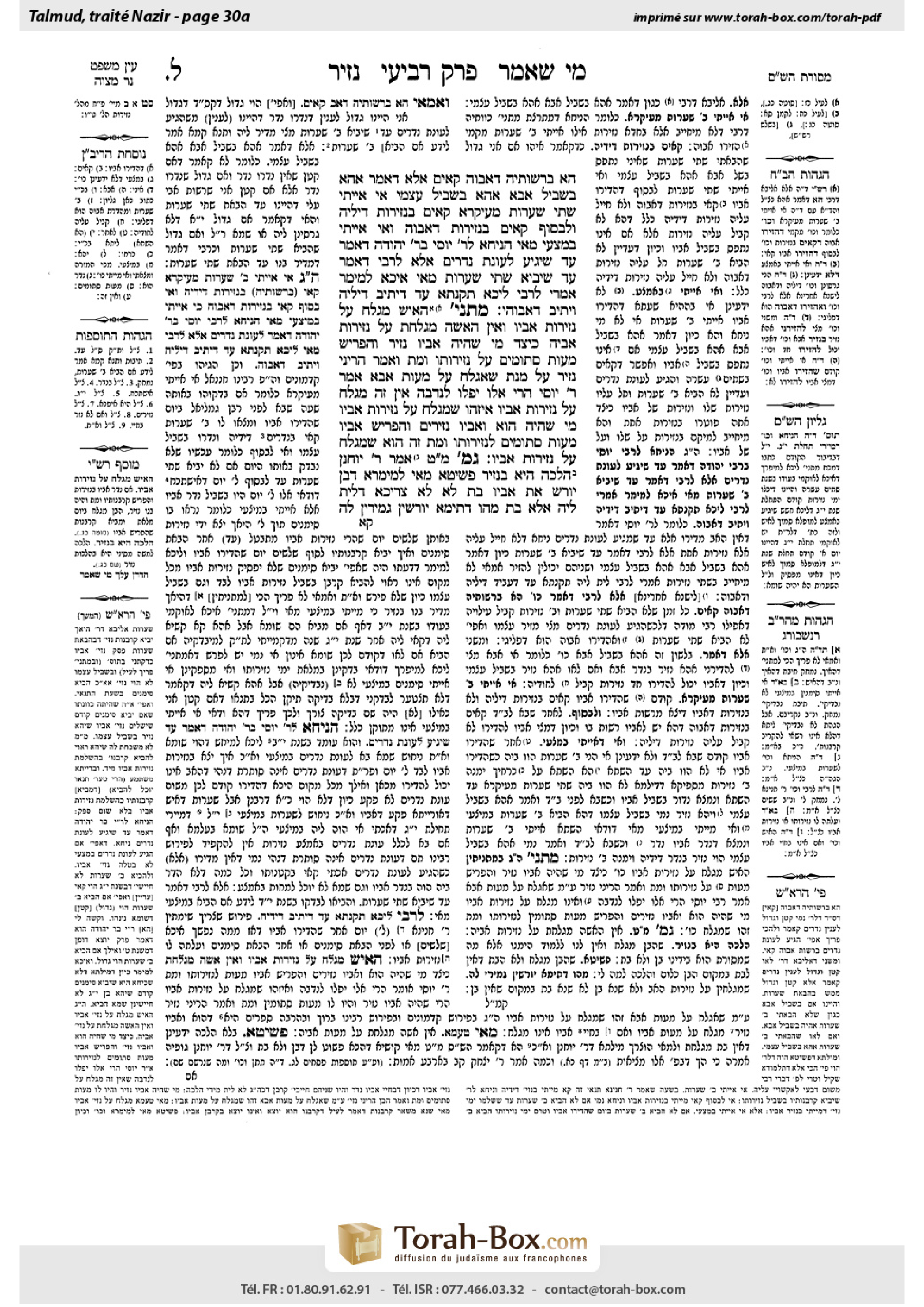
Nazir 30a: Talmud study for Daf Yomi
Daf Yomi is the daily study of one Talmud folio. Explore 37 tractates with scans, Hebrew text, Sefaria English and AI-generated French translations where annotated.
Passage selection and English or AI-generated French translation are available where the scan has annotations. Daf Study is independent of Torah-Box and Sefaria.
Browse Nazir · נזיר · All tractatesNazir 30a text and translations
This page of Nazir includes the Aramaic text, an English translation and an AI-generated French translation, alongside the scan above.
נזיר ל׳ א · Aramaic and Hebrew text
הָא בִּרְשׁוּתֵיהּ דַּאֲבוּהּ קָאֵים! אֶלָּא דְּאָמַר: אֱהֵא בִּשְׁבִיל אַבָּא, אֱהֵא בִּשְׁבִיל עַצְמִי.
אִי אַיְיתִי שְׁתֵּי שְׂעָרוֹת מֵעִיקָּרָא — קָאֵים בִּנְזִירוּת דִּילֵיהּ, וּלְבַסּוֹף — קָאֵים בִּנְזִירוּת דַּאֲבוּהּ. וְאִי אַיְיתִי בְּמִצְעֵי מַאי?
הָנִיחָא לְרַבִּי יוֹסֵי בְּרַבִּי יְהוּדָה דְּאָמַר: עַד שֶׁיַּגִּיעַ לְעוֹנַת נְדָרִים.
אֶלָּא לְרַבִּי דְּאָמַר: עַד שֶׁיָּבִיא שְׁתֵּי שְׂעָרוֹת, מַאי אִיכָּא לְמֵימַר? אָמְרִי: לְרַבִּי לֵיכָּא תַּקַּנְתָּא עַד דְּיָתֵיב דִּילֵיהּ וְיָתֵיב דַּאֲבוּהִי.
מַתְנִי׳ הָאִישׁ מְגַלֵּחַ עַל נְזִירוּת אָבִיו, וְאֵין הָאִשָּׁה מְגַלַּחַת עַל נְזִירוּת אָבִיהָ. כֵּיצַד? מִי שֶׁהָיָה אָבִיו נָזִיר, וְהִפְרִישׁ מָעוֹת סְתוּמִים עַל נְזִירוּתוֹ וָמֵת, וְאָמַר: ״הֲרֵינִי נָזִיר עַל מְנָת שֶׁאֲגַלֵּחַ עַל מְעוֹת אַבָּא״.
אָמַר רַבִּי יוֹסֵי: הֲרֵי אֵלּוּ יִפְּלוּ לִנְדָבָה, אֵין זֶה מְגַלֵּחַ עַל נְזִירוּת אָבִיו. אֵיזֶהוּ שֶׁמְּגַלֵּח עַל נְזִירוּת אָבִיו? מִי שֶׁהָיָה הוּא וְאָבִיו נְזִירִים, וְהִפְרִישׁ אָבִיו מָעוֹת סְתוּמִים לִנְזִירוּתוֹ וָמֵת — זֶה הוּא שֶׁמְּגַלֵּחַ עַל נְזִירוּת אָבִיו.
גְּמָ׳ מַאי טַעְמָא? אָמַר רַבִּי יוֹחָנָן: הֲלָכָה הִיא בְּנָזִיר. פְּשִׁיטָא! מַאי לְמֵימְרָא: דְּבֵן יוֹרֵשׁ אֶת אָבִיו, בַּת לָא?
לָא צְרִיכָא, דְּלֵית לֵיהּ אֶלָּא בַּת. מַהוּ דְּתֵימָא: יוֹרְשִׁין גְּמִירִין לָהּ,
Nazir 30a · English translation
After all, he still remains under his father’s authority with regard to naziriteship, as he has yet to develop two pubic hairs. Rather, one must explain that he said the following: I shall be a nazirite due to my father; I shall be a nazirite due to my own vow. In other words, he did not link his statement to the question of whether he was old enough to vow but to the issue of his father’s authority with regard to naziriteship, i.e., whether he had developed two hairs.
The Gemara asks: According to the opinion of Rabbi Yehuda HaNasi, if he had developed two pubic hairs from the outset, i.e., before his father vowed, he would stand bound by his own naziriteship, and if he reached physical maturity at the end, i.e., after the vow ended, he would stand bound by his father’s vow of naziriteship. But if he developed two hairs in the middle of his naziriteship term, of what use would the son’s vow be?
The Gemara clarifies: This works out well according to the opinion of Rabbi Yosei, son of Rabbi Yehuda, who said that a father can vow on behalf of his son until he reaches the age of vows. The reason is that this stage is by rabbinic law, and therefore the fact that the son has reached this stage does not automatically cancel the father’s vow. The son would complete his term and bring his offerings.
However, according to the opinion of Rabbi Yehuda HaNasi, who said that a father can vow for his son only until he develops two pubic hairs, what can be said? If he grew two hairs during his father’s naziriteship it is no longer in effect, as by Torah law he is no longer under his father’s authority, so what is the halakha in that case? The Sages say in response: According to the opinion of Rabbi Yehuda HaNasi, this child has no rectification until he sits for his term of naziriteship and also sits for the naziriteship of his father, i.e., he must be a nazirite for sixty days, to ensure that he completes a full term of thirty days, either for his own naziriteship or for that of his father.
MISHNA: A man can shave, i.e., bring the offerings at the close of his term of naziriteship, by using offerings originally designated for his father’s naziriteship, but a woman cannot shave by means of the offerings for her father’s naziriteship. How so; how is this halakha applied? It applies to one whose father was a nazirite and separated unallocated money for his naziriteship, i.e., he did not state which coins were for which of his offerings, and he died before buying the animals, and the son said after his father’s death: I am hereby a nazirite on the condition that I will shave by means of the money that my father set aside.
Rabbi Yosei said: In that case these coins are allocated for communal gift offerings, and the son may not use them, as this is not the case of the halakha that a son can shave by using his father’s naziriteship. Rather, who is the son who can shave by using his father’s naziriteship? This is referring to a son and his father who were both nazirites during his father’s lifetime, and his father separated unallocated money for his naziriteship and died; this is the one who may shave by using his father’s naziriteship.
GEMARA: The Gemara asks: What is the reason for this difference between a man and a woman? Rabbi Yoḥanan said: It is a halakha transmitted to Moses from Sinai with regard to a nazirite. The Gemara asks: It is obvious that this is so, even without this halakha. What is the purpose of stating this? Is Rabbi Yoḥanan coming to say that a son inherits from his father whereas a daughter does not, and therefore only a son who inherits from his father can use his animals, but not a daughter? This is obvious, as it is stated in the Torah that a daughter does not inherit from her father if he has a son (see Numbers 27:8).
The Gemara answers: No, this halakha is necessary in a case when he has only a daughter, who does inherit from him. Lest you say that we learned this halakha with regard to heirs, i.e., that the halakha is that all heirs, including a daughter, can shave by means of their father’s offerings,
Nazir 30a · Traduction française (IA)
Après tout, il reste soumis à l’autorité de son père en matière de naziréat, puisqu’il n’a pas encore développé deux poils pubiens. Il faut plutôt expliquer qu’il a dit ceci : « Je serai naziréen en raison de mon père ; je serai naziréen en raison de mon propre vœu. » Autrement dit, il n’a pas lié sa déclaration à la question de savoir s’il était assez âgé pour faire un vœu, mais à celle de l’autorité de son père en matière de naziréat, c’est-à-dire à la question de savoir s’il avait développé deux poils.
La Guemara demande : Selon l’opinion de Rabbi Yehuda HaNassi, s’il avait développé deux poils pubiens dès le départ, c’est-à-dire avant que son père ne fasse son vœu, il serait tenu par son propre naziréat ; et s’il atteignait la maturité physique à la fin, c’est-à-dire après la fin du vœu, il serait tenu par le vœu de naziréat de son père. Mais s’il développait deux poils au cours de sa période de naziréat, à quoi servirait le vœu du fils ?
La Guemara précise : Cela fonctionne bien selon l’opinion de Rabbi Yosei, fils de Rabbi Yehuda, qui dit qu’un père peut faire un vœu pour son fils jusqu’à ce que celui-ci atteigne l’âge où il peut faire des vœux. En effet, cette étape relève du droit rabbinique ; par conséquent, le fait que le fils l’ait atteinte n’annule pas automatiquement le vœu de son père. Le fils achèverait sa période et apporterait ses offrandes.
Cependant, que peut-on dire selon l’opinion de Rabbi Yehuda HaNassi, qui dit qu’un père ne peut faire un vœu pour son fils que jusqu’à ce que celui-ci développe deux poils pubiens ? S’il développe deux poils pendant le naziréat de son père, celui-ci cesse d’être en vigueur, car, selon la Torah, le fils n’est plus soumis à l’autorité de son père. Quelle est donc la halakha dans ce cas ? Les Sages répondent : selon l’opinion de Rabbi Yehuda HaNassi, cet enfant ne peut résoudre sa situation qu’en accomplissant sa propre période de naziréat ainsi que celle du naziréat de son père ; autrement dit, il doit être naziréen pendant soixante jours, afin d’être sûr d’accomplir une période complète de trente jours, soit pour son propre naziréat, soit pour celui de son père.
MICHNA : Un homme peut se raser, c’est-à-dire apporter les offrandes à la fin de sa période de naziréat, au moyen d’offrandes initialement destinées au naziréat de son père, mais une femme ne peut pas se raser au moyen des offrandes destinées au naziréat de son père. Comment cela s’applique-t-il ? Cette halakha concerne un homme dont le père était naziréen et avait mis de côté de l’argent non affecté à son naziréat, c’est-à-dire sans préciser quelles pièces étaient destinées à chacune de ses offrandes. Le père mourut avant d’acheter les animaux, et, après sa mort, le fils dit : « Je fais vœu de naziréat à condition de pouvoir me raser au moyen de l’argent que mon père a mis de côté. »
Rabbi Yosei dit : Dans ce cas, ces pièces sont affectées aux offrandes volontaires de la communauté, et le fils ne peut pas les utiliser, car ce n’est pas le cas visé par la halakha selon laquelle un fils peut se raser au moyen du naziréat de son père. Alors, quel est le fils qui peut se raser au moyen du naziréat de son père ? Il s’agit d’un fils et de son père qui étaient tous deux naziréens du vivant du père. Le père avait mis de côté de l’argent non affecté à son naziréat, puis il mourut ; c’est ce fils qui peut se raser au moyen du naziréat de son père.
GUEMARA : La Guemara demande : Quelle est la raison de cette différence entre un homme et une femme ? Rabbi Yoḥanan dit : C’est une halakha concernant le naziréat, transmise à Moïse au Sinaï. La Guemara demande : Cela va de soi, même sans cette halakha. À quoi sert-il de l’énoncer ? Rabbi Yoḥanan veut-il dire qu’un fils hérite de son père, tandis qu’une fille n’hérite pas de lui, et que seul le fils, parce qu’il hérite de son père, peut donc utiliser ses animaux, à la différence d’une fille ? Cela va de soi, puisque la Torah dit qu’une fille n’hérite pas de son père s’il a un fils (voir Nombres 27:8).
La Guemara répond : Non, cette halakha est nécessaire dans le cas où il n’a qu’une fille, qui hérite de lui. De peur que tu ne dises que nous avons appris cette halakha au sujet des héritiers, c’est-à-dire que la halakha est que tous les héritiers, y compris une fille, peuvent se raser au moyen des offrandes de leur père,
Traduction française générée par IA à partir de l’édition anglaise de Sefaria. Vérifie toujours un passage avec le texte source.
Text from Sefaria: William Davidson Edition - Vocalized Aramaic (CC BY NC); William Davidson Edition - English (CC BY NC).