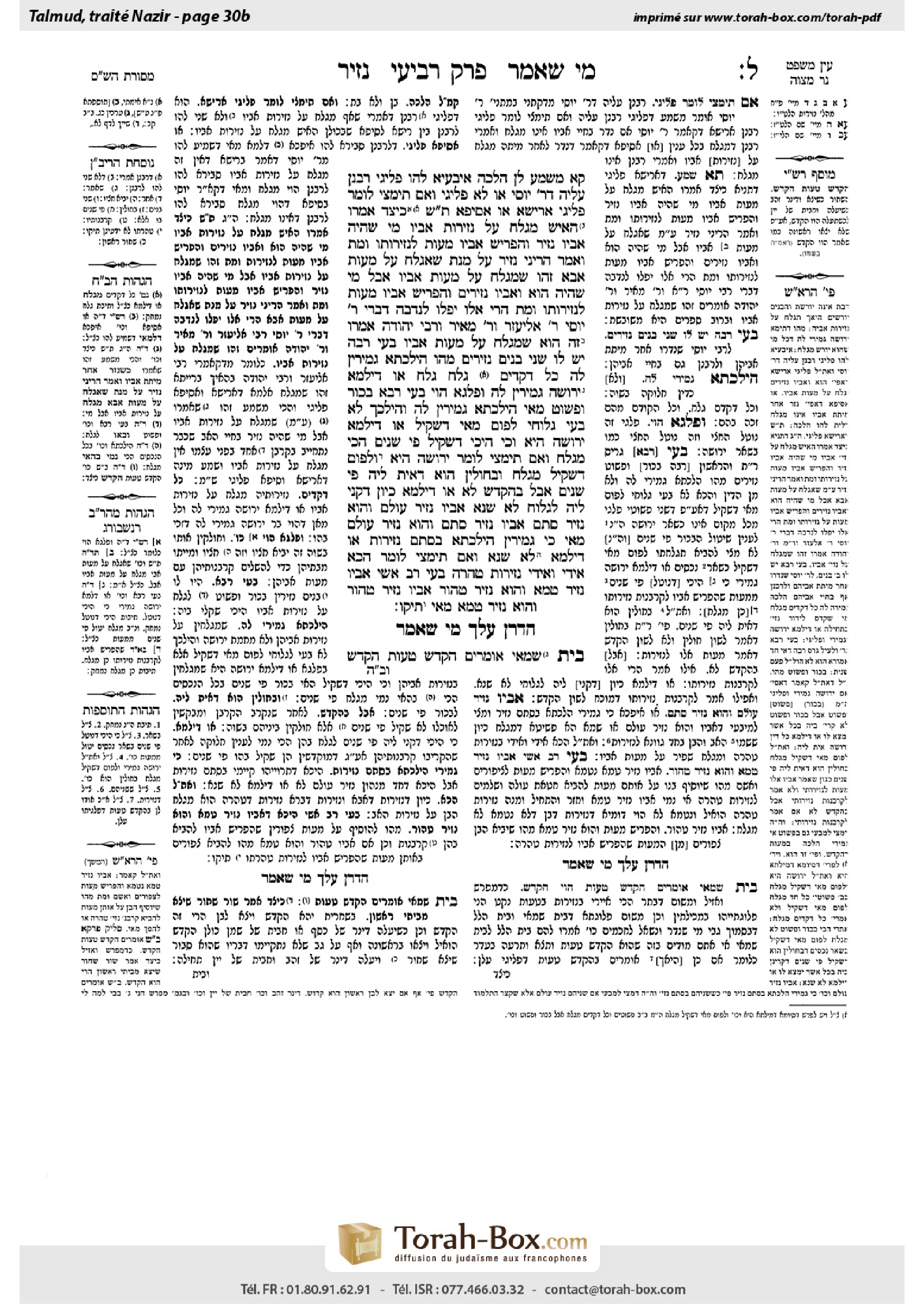
Nazir 30b: Talmud study for Daf Yomi
Daf Yomi is the daily study of one Talmud folio. Explore 37 tractates with scans, Hebrew text, Sefaria English and AI-generated French translations where annotated.
Passage selection and English or AI-generated French translation are available where the scan has annotations. Daf Study is independent of Torah-Box and Sefaria.
Browse Nazir · נזיר · All tractatesNazir 30b text and translations
This page of Nazir includes the Aramaic text, an English translation and an AI-generated French translation, alongside the scan above.
נזיר ל׳ ב · Aramaic and Hebrew text
קָא מַשְׁמַע לַן הֲלָכָה.
אִיבַּעְיָא לְהוּ: פְּלִיגִי רַבָּנַן עֲלֵיהּ דְּרַבִּי יוֹסֵי, אוֹ לָא פְּלִיגִי? וְאִם תִּימְצֵי לוֹמַר פְּלִיגִי, אַרֵישָׁא אוֹ אַסֵּיפָא? תָּא שְׁמַע: כֵּיצַד אָמְרוּ הָאִישׁ מְגַלֵּחַ עַל נְזִירוּת אָבִיו?
מִי שֶׁהָיָה אָבִיו נָזִיר, וְהִפְרִישׁ אָבִיו מָעוֹת לִנְזִירוּתוֹ וָמֵת, וְאָמַר: ״הֲרֵינִי נָזִיר עַל מְנָת שֶׁאֲגַלֵּחַ עַל מְעוֹת אַבָּא״ — זֶהוּ שֶׁמְּגַלֵּחַ עַל מְעוֹת אָבִיו. אֲבָל מִי שֶׁהָיָה הוּא וְאָבִיו נְזִירִים, וְהִפְרִישׁ אָבִיו מָעוֹת לִנְזִירוּתוֹ וָמֵת — הֲרֵי אֵלּוּ יִפְּלוּ לִנְדָבָה, דִּבְרֵי רַבִּי יוֹסֵי.
רַבִּי אֱלִיעֶזֶר וְרַבִּי מֵאִיר וְרַבִּי יְהוּדָה אָמְרוּ: זֶה הוּא שֶׁמְּגַלֵּחַ עַל מְעוֹת אָבִיו.
בָּעֵי רַבָּה: יֵשׁ לוֹ שְׁנֵי בָנִים נְזִירִים, מַהוּ? הִילְכְתָא גְּמִירִין לַהּ: כֹּל דִּקְדֵים גַּלַּח — גַּלַּח, אוֹ דִילְמָא: יְרוּשָּׁה גְּמִירִין לַהּ, וּפַלְגָא הָוֵי?
בָּעֵי רָבָא: בְּכוֹר וּפָשׁוּט, מַאי? הִילְכְתָא גְּמִירִין לַהּ, וְהִילְכָּךְ לָא בָּעֵי גַּלּוֹחֵי לְפוּם מַאי דְּשָׁקֵיל. אוֹ דִילְמָא: יְרוּשָּׁה הִיא, וְכִי הֵיכִי דְּשָׁקֵיל פִּי שְׁנַיִם, הָכִי מְגַלַּח?
וְאִם תִּימְצֵי לוֹמַר: יְרוּשָּׁה הִיא, וּלְפוּם דְּשָׁקֵיל מְגַלַּח, וּבְחוּלִּין הוּא דְּאִית לֵיהּ פִּי שְׁנַיִם, אֲבָל בְּהֶקְדֵּשׁ לָא. אוֹ דִילְמָא: כֵּיוָן דְּקָנֵי לֵיהּ לְגִלּוּחַ, לָא שְׁנָא?
אָבִיו נְזִיר עוֹלָם וְהוּא נָזִיר סְתָם, אָבִיו נָזִיר סְתָם וְהוּא נְזִיר עוֹלָם, מַאי? כִּי גְּמִירִין הִילְכְתָא, בִּסְתָם נְזִירוּת, אוֹ דִילְמָא לָא שְׁנָא?
וְאִם תִּימְצֵי לוֹמַר: הָכָא אִידֵּי וְאִידֵּי, נְזִירוּת טׇהֳרָה, בָּעֵי רַב אָשֵׁי: אָבִיו נָזִיר טָמֵא, וְהוּא נָזִיר טָהוֹר. אָבִיו נָזִיר טָהוֹר, וְהוּא נָזִיר טָמֵא, מַאי? תֵּיקוּ.
הַדְרָן עֲלָךְ מִי שֶׁאָמַר
בֵּית שַׁמַּאי אוֹמְרִים: הֶקְדֵּשׁ טָעוּת — הֶקְדֵּשׁ,
Nazir 30b · English translation
the mishna therefore teaches us that it is a halakha that is unrelated to inheritance; there is simply a tradition that a son can use the offerings for his father’s naziriteship while a daughter cannot.
§ A dilemma was raised before the Sages: Do the Rabbis disagree with Rabbi Yosei, or do they not disagree? If you say they disagree, do they take issue with the first clause or with the latter clause of his halakha? The Gemara suggests an answer: Come and hear the following baraita: How did the Sages say that a man can shave by using his father’s naziriteship?
With regard to one whose father was a nazirite and his father separated money for his naziriteship and died, and the son said: I am hereby a nazirite on the condition that I can shave by using my father’s money, this is the one who can shave by means of his father’s money. However, if a son and his father were both nazirites, and his father separated money for his own naziriteship and died, this money is allocated for communal gift offerings. This is the statement of Rabbi Yosei.
Rabbi Eliezer, and Rabbi Meir, and Rabbi Yehuda said: This is the one who can shave by using his father’s money. Their emphasis of: This is the one, indicates that they disagree with Rabbi Yosei entirely. In other words, where Rabbi Yosei rules that one can use his father’s money, they maintain that he cannot do so; and conversely, in a case where Rabbi Yosei says that one cannot spend his father’s money for his nazirite offerings, the Rabbis rule that he can do so.
§ Rabba raised a dilemma: If a father has two nazirite sons, what is the halakha? The Gemara clarifies the sides of the dilemma: Does one say that we learned it as a halakha that a son can shave using money left for his father’s naziriteship, and therefore any son who precedes his brother and shaves using his father’s money has shaved and gained the entire sum? Or perhaps we learned this halakha from the case of inheritance, and consequently, each receives a half?
Similarly, Rava raised a dilemma: If one has two nazirite sons, a firstborn and a regular son, what is the halakha? Does one say that we learned it as a halakha that a son may shave using money left for his father’s naziriteship, and this ruling is unconnected to inheritance, and therefore he does not need to shave only in accordance with what he receives as an inheritance? Instead, either each son receives half the money, or whoever precedes the other receives the entire sum. Or perhaps it is an inheritance, and just as the firstborn takes a double portion of the estate, so too he shaves with a double portion of this money?
And if you say it is an inheritance and he shaves in accordance with the portion he receives, it is still possible that it is only with regard to non-sacred matters that a firstborn has a double portion, but with regard to consecrated property this halakha does not apply. Or perhaps, since he acquires that money, although he uses it for the purpose of shaving it is no different, i.e., it does not matter that the money is for a sacred matter.
The Gemara raises another dilemma: If his father was a permanent nazirite and he was an unspecified nazirite, or if his father was an unspecified nazirite and he was a permanent nazirite, what is the halakha? Can this son shave using money left for his father’s naziriteship? Does one say that when we learned the halakha that a son can shave using money left for his father’s naziriteship, this applies only in a case where they are both unspecified nazirites, or perhaps it is no different, and the same halakha applies even if their naziriteships are of two different kinds?
And if you say: Here, both cases are at least similar in that they involve ritually pure naziriteship, and therefore the son can make use of his father’s money, then Rav Ashi raises a different dilemma: If his father was an impure nazirite and he was a pure nazirite, or if his father was a pure nazirite and he was an impure nazirite, what is the halakha? Can the son shave using money left for his father’s naziriteship or not? No answer was found for any of these dilemmas, and the Gemara says that they shall stand unresolved.
MISHNA: Beit Shammai say: Consecration that one performs in error nevertheless renders property consecrated,
Nazir 30b · Traduction française (IA)
La Michna nous enseigne donc qu’il s’agit d’une halakha sans rapport avec l’héritage : il existe simplement une tradition selon laquelle un fils peut utiliser les offrandes destinées au naziréat de son père, contrairement à une fille.
§ Une question fut posée aux Sages : les Rabbins sont-ils en désaccord avec Rabbi Yossi, ou non ? Si l’on dit qu’ils sont en désaccord, contestent-ils la première partie ou la dernière partie de sa halakha ? La Guemara propose une réponse : viens et entends la baraïta suivante : comment les Sages ont-ils enseigné qu’un homme peut se raser en utilisant le naziréat de son père ?
Dans le cas d’un homme dont le père était nazir et qui avait mis de l’argent de côté pour son naziréat avant de mourir, si le fils dit : « Me voici nazir, à condition de pouvoir me raser en utilisant l’argent de mon père », c’est celui qui peut se raser grâce à l’argent de son père. Cependant, si un fils et son père étaient tous deux nazir, et que le père avait mis de l’argent de côté pour son propre naziréat avant de mourir, cet argent est affecté aux offrandes volontaires collectives. Telle est la déclaration de Rabbi Yossi.
Rabbi Eliezer, Rabbi Meïr et Rabbi Yehouda ont dit : « C’est celui qui peut se raser en utilisant l’argent de son père. » En insistant sur « c’est celui », ils indiquent qu’ils sont entièrement en désaccord avec Rabbi Yossi. Autrement dit, dans le cas où Rabbi Yossi statue qu’on peut utiliser l’argent de son père, ils soutiennent qu’on ne le peut pas ; inversement, dans le cas où Rabbi Yossi dit qu’on ne peut pas utiliser l’argent de son père pour les offrandes de naziréat, les Rabbins statuent qu’on le peut.
§ Rabba souleva une question : si un père a deux fils nazir, quelle est la halakha ? La Guemara précise les termes de la question : dit-on que nous avons appris comme halakha qu’un fils peut se raser en utilisant l’argent laissé pour le naziréat de son père, et que, par conséquent, le fils qui devance son frère et se rase grâce à l’argent de son père se rase et obtient la totalité de la somme ? Ou bien avons-nous appris cette halakha du cas de l’héritage, auquel cas chacun en reçoit la moitié ?
De même, Rava souleva une question : si un homme a deux fils nazir, un fils aîné et un fils ordinaire, quelle est la halakha ? Dit-on que nous avons appris comme halakha qu’un fils peut se raser en utilisant l’argent laissé pour le naziréat de son père, et que cette règle est sans rapport avec l’héritage ; il n’a donc pas à se raser uniquement en fonction de la part qu’il reçoit en héritage ? Dans ce cas, soit chaque fils reçoit la moitié de l’argent, soit celui qui devance l’autre reçoit la totalité de la somme. Ou bien s’agit-il d’un héritage et, tout comme l’aîné reçoit une double part de la succession, se rase-t-il lui aussi grâce à une double part de cet argent ?
Et si tu dis qu’il s’agit d’un héritage et qu’il se rase en fonction de la part qu’il reçoit, il est encore possible que l’aîné ne reçoive une double part que pour les biens profanes, mais que cette halakha ne s’applique pas aux biens consacrés. Ou peut-être, puisqu’il acquiert cet argent, le fait qu’il l’utilise pour se raser ne change-t-il rien, c’est-à-dire que l’affectation de cet argent à une affaire sacrée n’a pas d’importance.
La Guemara soulève une autre question : si son père était nazir à vie et lui-même nazir sans précision, ou si son père était nazir sans précision et lui-même nazir à vie, quelle est la halakha ? Ce fils peut-il se raser en utilisant l’argent laissé pour le naziréat de son père ? Dit-on que, lorsque nous avons appris comme halakha qu’un fils peut se raser en utilisant l’argent laissé pour le naziréat de son père, cela ne s’applique que lorsqu’ils sont tous deux nazir sans précision, ou bien n’y a-t-il pas de différence et la même halakha s’applique-t-elle même si leurs naziréats sont de deux types différents ?
Et si tu dis : ici, les deux cas présentent au moins une similitude, puisqu’ils concernent un naziréat en état de pureté rituelle, et que le fils peut donc utiliser l’argent de son père, Rav Ashi soulève une autre question : si son père était nazir en état d’impureté et lui-même nazir en état de pureté, ou si son père était nazir en état de pureté et lui-même nazir en état d’impureté, quelle est la halakha ? Le fils peut-il se raser en utilisant l’argent laissé pour le naziréat de son père ou non ? Aucune réponse n’a été trouvée à aucune de ces questions, et la Guemara dit qu’elles restent sans solution.
MICHNA : Beit Shammaï disent : une consécration effectuée par erreur rend néanmoins le bien consacré.
Traduction française générée par IA à partir de l’édition anglaise de Sefaria. Vérifie toujours un passage avec le texte source.
Text from Sefaria: William Davidson Edition - Vocalized Aramaic (CC BY NC); William Davidson Edition - English (CC BY NC).