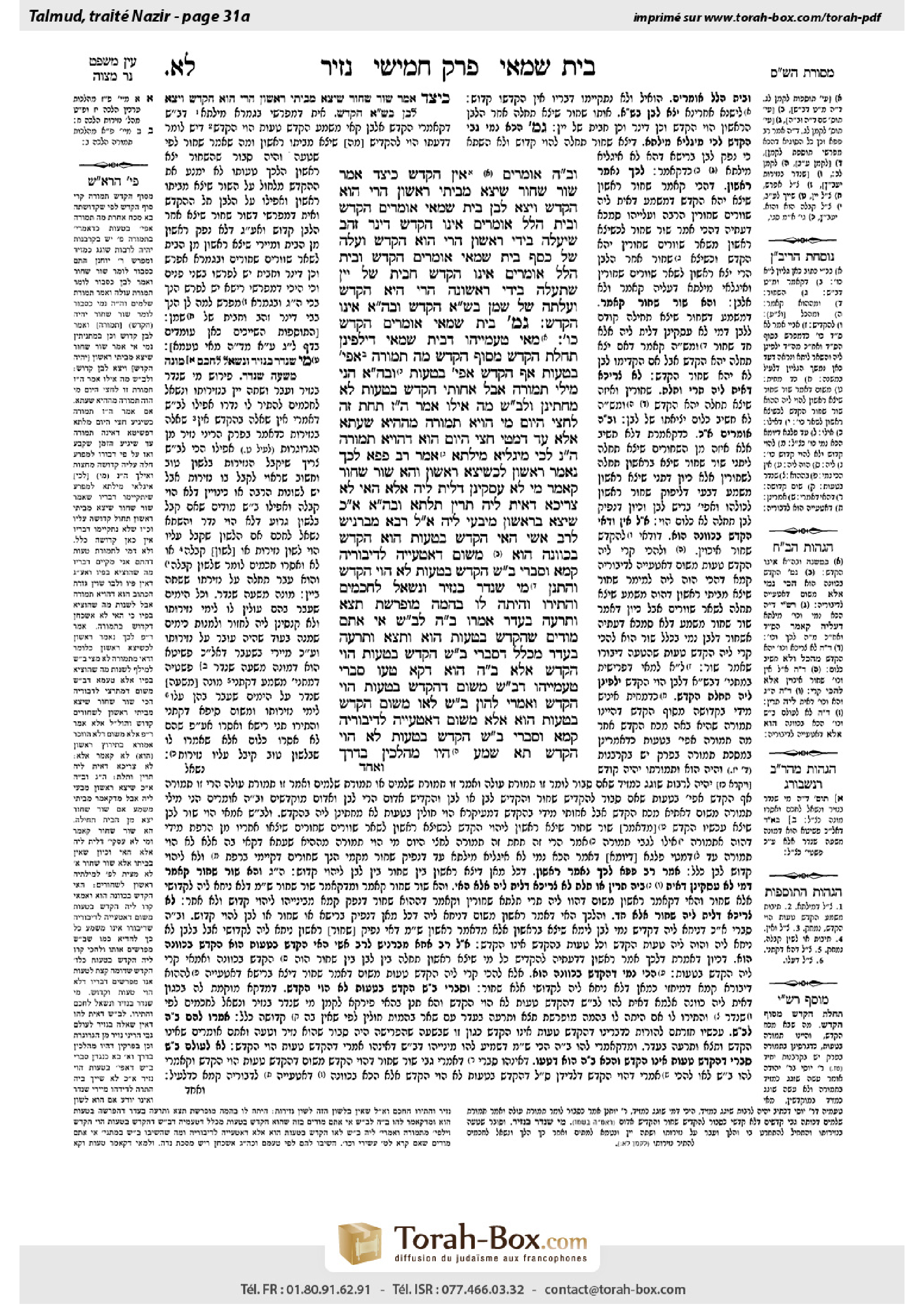
Nazir 31a: Talmud study for Daf Yomi
Daf Yomi is the daily study of one Talmud folio. Explore 37 tractates with scans, Hebrew text, Sefaria English and AI-generated French translations where annotated.
Passage selection and English or AI-generated French translation are available where the scan has annotations. Daf Study is independent of Torah-Box and Sefaria.
Browse Nazir · נזיר · All tractatesNazir 31a text and translations
This page of Nazir includes the Aramaic text, an English translation and an AI-generated French translation, alongside the scan above.
נזיר ל״א א · Aramaic and Hebrew text
וּבֵית הִלֵּל אוֹמְרִים: אֵין הֶקְדֵּשׁ. כֵּיצַד? אָמַר ״שׁוֹר שָׁחוֹר שֶׁיֵּצֵא מִבֵּיתִי רִאשׁוֹן הֲרֵי הוּא הֶקְדֵּשׁ״, וְיָצָא לָבָן, בֵּית שַׁמַּאי אוֹמְרִים: הֶקְדֵּשׁ, וּבֵית הִלֵּל אוֹמְרִים: אֵינוֹ הֶקְדֵּשׁ. ״דִּינַר זָהָב שֶׁיַּעֲלֶה בְּיָדִי רִאשׁוֹן הֲרֵי הוּא הֶקְדֵּשׁ״, וְעָלָה שֶׁל כֶּסֶף, בֵּית שַׁמַּאי אוֹמְרִים: הֶקְדֵּשׁ, וּבֵית הִלֵּל אוֹמְרִים: אֵינוֹ הֶקְדֵּשׁ. ״חָבִית שֶׁל יַיִן שֶׁתַּעֲלֶה בְּיָדִי רִאשׁוֹנָה הֲרֵי הִיא הֶקְדֵּשׁ״, וְעָלְתָה שֶׁל שֶׁמֶן, בֵּית שַׁמַּאי אוֹמְרִים: הֶקְדֵּשׁ, וּבֵית הִלֵּל אוֹמְרִים: אֵינוֹ הֶקְדֵּשׁ.
גְּמָ׳ בֵּית שַׁמַּאי אוֹמְרִים הֶקְדֵּשׁ כּוּ׳. מַאי טַעְמַיְיהוּ דְּבֵית שַׁמַּאי — דְּיָלְפִינַן תְּחִלַּת הֶקְדֵּשׁ מִסּוֹף הֶקְדֵּשׁ. מָה תְּמוּרָה אֲפִילּוּ בְּטָעוּת — אַף הֶקְדֵּשׁ אֲפִילּוּ בְּטָעוּת.
וּבֵית הִלֵּל אוֹמְרִים: הָנֵי מִילֵּי תְּמוּרָה. אֲבָל אַחוֹתֵי הֶקְדֵּשׁ בְּטָעוּת — לָא מַחֲתִינַן.
וּלְבֵית שַׁמַּאי, מָה אִילּוּ אָמַר ״הָרֵי זֶה תַּחַת זֶה לַחֲצִי הַיּוֹם״ מִי הָוְיָא תְּמוּרָה מֵהַהִיא שַׁעְתָּא? אֶלָּא עַד דְּמָטֵי חֲצִי הַיּוֹם הוּא דְּהָוְיָא תְּמוּרָה. הָכִי נָמֵי לְכִי מִיגַּלְּיָא מִילְּתָא!
אָמַר רַב פָּפָּא: לְכָךְ נֶאֱמַר ״רִאשׁוֹן״ לִכְשֶׁיֵּצֵא רִאשׁוֹן.
וְהָא ״שׁוֹר שָׁחוֹר״ קָאָמַר, מִי לָא עָסְקִינַן דְּלֵית לֵיהּ אֶלָּא הַאי? לָא צְרִיכָא, דְּאִית לֵיהּ תְּרֵין תְּלָתָא. וּבֵית הִלֵּל אוֹמְרִים: אִם כֵּן, ״שֶׁיֵּצֵא בָּרִאשׁוֹן״ מִיבְּעֵי לֵיהּ.
אֲמַר לֵיהּ רָבָא מִבַּרְנִישׁ לְרַב אָשֵׁי: הַאי הֶקְדֵּשׁ בְּטָעוּת הוּא? הֶקְדֵּשׁ בְּכַוָּונָה הוּא! מִשּׁוּם דְּאַטְעֲיֵיהּ לְדִיבּוּרֵיהּ קַמָּא.
וְסָבְרִי בֵּית שַׁמַּאי הֶקְדֵּשׁ בְּטָעוּת לָא הָוֵי הֶקְדֵּשׁ? וְהָתְנַן: מִי שֶׁנָּדַר בְּנָזִיר וְנִשְׁאַל לַחֲכָמִים וְהִתִּירוּ, וְהָיְתָה לוֹ בְּהֵמָה מוּפְרֶשֶׁת — תֵּצֵא וְתִרְעֶה בָּעֵדֶר.
אָמְרוּ בֵּית הִלֵּל לְבֵית שַׁמַּאי: אִי אַתֶּם מוֹדִים שֶׁהֶקְדֵּשׁ בְּטָעוּת הוּא, וְתֵצֵא וְתִרְעֶה בָּעֵדֶר?! מִכְלָל דְּסָבְרִי בֵּית שַׁמַּאי הֶקְדֵּשׁ בְּטָעוּת הָוֵי הֶקְדֵּשׁ!
אֶלָּא בֵּית הִלֵּל הוּא דְּקָא טָעוּ, סָבְרִי טַעְמַיְיהוּ דְּבֵית שַׁמַּאי מִשּׁוּם דְּהֶקְדֵּשׁ בְּטָעוּת הָוֵי הֶקְדֵּשׁ. וְאָמְרִי לְהוֹן בֵּית שַׁמַּאי: לָאו מִשּׁוּם הֶקְדֵּשׁ בְּטָעוּת הוּא, אֶלָּא מִשּׁוּם דְּאַטְעֲיֵיהּ לְדִיבּוּרֵיהּ קַמָּא.
וְסָבְרִי בֵּית שַׁמַּאי הֶקְדֵּשׁ בְּטָעוּת לָא הָוֵי הֶקְדֵּשׁ? תָּא שְׁמַע: הָיוּ מְהַלְּכִין בַּדֶּרֶךְ,
Nazir 31a · English translation
and Beit Hillel say it is not consecrated. How so; what is considered an act of erroneous consecration? If one said: A black bull that will emerge from my house first is consecrated, and a white bull emerged first, Beit Shammai say it is consecrated and Beit Hillel say it is not consecrated. Similarly, if one said: A gold dinar that will come up first in my hand is consecrated, and when he reached into his pocket a dinar of silver came up, Beit Shammai say it is consecrated and Beit Hillel say it is not consecrated. Likewise, if one said: A barrel of wine that will come up first in my hand when I enter the cellar is consecrated, and a barrel of oil came up in his hand instead, Beit Shammai say it is consecrated and Beit Hillel say it is not consecrated.
GEMARA: The mishna taught that Beit Shammai say that consecration performed in error renders property consecrated, and Beit Hillel say it is not consecrated. The Gemara analyzes their dispute: What is the reason of Beit Shammai? They maintain that we derive the halakha of the initial stage of consecration from the final stage of consecration. The final stage of consecration is referring to substitution, when one attempts to substitute a non-consecrated animal for a consecrated one. Just as an act of substitution takes effect even in error, i.e., if one meant to say that his black bull should be a substitute for his consecrated animal and he actually said: This white bull, the white bull is rendered consecrated, so too, the initial stage of consecration takes effect even when done in error.
And Beit Hillel say: This matter, i.e., the halakha that consecration takes effect even when done in error, applies only to substitution, where there is an animal that is already fully consecrated. However, we do not have the initial status of consecration descend upon an item in error.
The Gemara asks: And according to the opinion of Beit Shammai, who derive the halakha of the initial stage of consecration from substitution, just as if one said, at the start of the day: This animal is a substitute in exchange for this animal in the middle of the day, would it become a substitute from that time when he issued the statement, in opposition to his explicit statement? It would not. Rather, Beit Shammai certainly concede that the animal does not become consecrated as a substitute until the middle of the day arrives, at which point it becomes a substitution. So too, in the case of the mishna, the consecration should take effect when the situation is revealed to be in accordance with his statement, i.e., only if a black bull emerges first. Only then should the animal be rendered consecrated, but not if a white bull emerges first. Why do Beit Shammai hold that in the case of the mishna the consecration takes effect in opposition to his explicit statement?
Rav Pappa said: Beit Shammai concede that consecration does not take effect in opposition to one’s explicit statement. Rather, they maintain that it is for this reason that the man states: The black bull that will emerge from my house first, as he means the following: When the first black bull of all the black bulls I possess will emerge from my house, it will be consecrated. When Beit Shammai ruled that the bull is consecrated, they were referring to the first black bull that emerged, even if it was not the first bull that emerged, as a white bull preceded it.
The Gemara asks: But he said: Black bull, and are we not dealing even with a case where he only has this one black bull? If so, the Gemara’s initial interpretation of his statement is correct: The black bull is consecrated only if it is the first to emerge, but not if a white bull precedes it. The Gemara answers: No; it is necessary to state this halakha with regard to a case where he has two or three black bulls. And Beit Hillel say: If so, i.e., if he intended to consecrate the first of his black bulls to emerge from the house, he should have said: The first black bull that will emerge from my house. Since he did not say this, he must have meant that the black bull should be consecrated only if it is the first bull of any kind to emerge.
Rava from Barnish said to Rav Ashi, with regard to the explanation of Rav Pappa: Is this case he mentioned one of erroneous consecration? It is intentional consecration. According to the interpretation of Rav Pappa, there is no error. He intended to consecrate the first black bull that emerged, and that is what was consecrated. The Gemara answers: Nevertheless, it is called an erroneous consecration because he erred in his first statement. His statement of consecration gave the mistaken impression that he desired to consecrate the first bull that emerges, even if it is white. In any case, Rav Pappa indicates that even Beit Shammai hold that an erroneous act of consecration does not take effect.
The Gemara questions this assumption: And do Beit Shammai hold that an indisputably erroneous act of consecration is not considered an act of consecration? But didn’t we learn in the mishna (31b): With regard to one who took a vow of naziriteship and later made a request to the halakhic authorities to dissolve his vow, and they dissolved his vow, and he had already separated an animal for one of his nazirite offerings beforehand, it shall go out and graze among the flock, like any other non-sacred animal.
The mishna continues: Beit Hillel said to Beit Shammai: Don’t you concede that the reason for this ruling is because it is an erroneous act of consecration, and that a consecration of this kind does not take effect, and that is the reason it shall go out and graze among the flock? The same halakha should apply to all erroneous acts of consecration. One can learn from here by inference that Beit Shammai hold that an entirely erroneous act of consecration is considered consecration, as is evident from Beit Hillel’s question.
The Gemara answers: This is not the case; rather, it is Beit Hillel who erred in their understanding. They thought that Beit Shammai’s reasoning was because an erroneous act of consecration is considered consecration, and therefore they raised a difficulty with regard to the case of a nazirite. And Beit Shammai said to them: Our reasoning in the case of the black bull is not because it is an erroneous act of consecration. Rather, it is merely called an erroneous consecration because he erred in his first statement, as he actually meant to consecrate the first of his black bulls to emerge from his house.
The Gemara continues to ask: And do Beit Shammai hold that an indisputably erroneous act of consecration is not considered consecration? Come and hear proof from the mishna (32b) that they maintain that an erroneously consecrated item is considered consecrated: If there were several people walking along the way,
Nazir 31a · Traduction française (IA)
et Beit Hillel disent qu’il n’est pas consacré. Comment cela ? Qu’est-ce qui est considéré comme un acte de consécration erroné ? Si quelqu’un dit : « Le taureau noir qui sortira le premier de ma maison sera consacré », et qu’un taureau blanc sorte le premier, Beit Shammaï disent qu’il est consacré, tandis que Beit Hillel disent qu’il ne l’est pas. De même, si quelqu’un dit : « Le dinar d’or qui me viendra le premier dans la main sera consacré », et qu’en plongeant la main dans sa poche, il en retire un dinar d’argent, Beit Shammaï disent qu’il est consacré, tandis que Beit Hillel disent qu’il ne l’est pas. De même, si quelqu’un dit : « Le tonneau de vin qui me viendra le premier dans la main lorsque j’entrerai dans la cave sera consacré », et qu’il prenne plutôt un tonneau d’huile, Beit Shammaï disent qu’il est consacré, tandis que Beit Hillel disent qu’il ne l’est pas.
GUEMARA : La Michna enseigne que, selon Beit Shammaï, une consécration faite par erreur rend le bien consacré, tandis que, selon Beit Hillel, il ne l’est pas. La Guemara analyse leur désaccord : quelle est la raison de Beit Shammaï ? Ils soutiennent que nous déduisons la halakha de la phase initiale de la consécration à partir de sa phase finale. La phase finale de la consécration désigne la substitution, lorsqu’on tente de substituer un animal non consacré à un animal consacré. De même qu’un acte de substitution prend effet même par erreur — c’est-à-dire que si quelqu’un voulait dire que son taureau noir serait substitué à son animal consacré, mais qu’il a en réalité dit : « Ce taureau blanc », le taureau blanc est consacré —, de même la phase initiale de la consécration prend effet même lorsqu’elle est accomplie par erreur.
Et Beit Hillel disent : cette règle, à savoir que la consécration prend effet même lorsqu’elle est accomplie par erreur, ne s’applique qu’à la substitution, où il existe déjà un animal pleinement consacré. En revanche, le statut initial de consécration ne s’applique pas par erreur à un objet.
La Guemara demande : selon l’opinion de Beit Shammaï, qui déduisent la halakha de la phase initiale de la consécration à partir de la substitution, si quelqu’un avait dit au début de la journée : « Cet animal sera substitué à cet animal au milieu de la journée », l’animal deviendrait-il un substitut dès le moment où il a prononcé ces paroles, contrairement à sa déclaration explicite ? Non. Beit Shammaï reconnaissent donc certainement que l’animal ne devient pas consacré par substitution avant que le milieu de la journée arrive, moment où la substitution prend effet. De même, dans le cas de la Michna, la consécration devrait prendre effet lorsque la situation se révèle conforme à sa déclaration, c’est-à-dire uniquement si un taureau noir sort le premier. L’animal ne devrait donc devenir consacré que dans ce cas, et non si un taureau blanc sort le premier. Pourquoi Beit Shammaï soutiennent-ils que, dans le cas de la Michna, la consécration prend effet contrairement à sa déclaration explicite ?
Rav Pappa dit : Beit Shammaï reconnaissent que la consécration ne prend pas effet contrairement à la déclaration explicite de quelqu’un. Ils soutiennent plutôt que l’homme dit : « Le taureau noir qui sortira le premier de ma maison », en voulant dire ceci : le premier de tous les taureaux noirs que je possède qui sortira de ma maison sera consacré. Lorsque Beit Shammaï ont statué que le taureau est consacré, ils parlaient du premier taureau noir à sortir, même s’il n’était pas le premier taureau à sortir, puisqu’un taureau blanc l’avait précédé.
La Guemara demande : Mais il a dit « taureau noir » ; ne s’agit-il pas aussi d’un cas où il ne possède qu’un seul taureau noir ? Si c’est le cas, l’interprétation initiale de sa déclaration par la Guemara est correcte : le taureau noir n’est consacré que s’il sort le premier, et non si un taureau blanc le précède. La Guemara répond : Non, cette halakha doit être énoncée dans le cas où il possède deux ou trois taureaux noirs. Et Beit Hillel disent : dans ce cas, c’est-à-dire s’il avait l’intention de consacrer le premier de ses taureaux noirs à sortir de la maison, il aurait dû dire : « Le premier taureau noir qui sortira de ma maison ». Puisqu’il ne l’a pas dit, il devait vouloir dire que le taureau noir ne serait consacré que s’il était le premier taureau, quelle que soit sa couleur, à sortir.
Rava de Barnish dit à Rav Ashi, au sujet de l’explication de Rav Pappa : le cas qu’il a mentionné est-il un cas de consécration erronée ? Il s’agit d’une consécration intentionnelle. Selon l’interprétation de Rav Pappa, il n’y a pas d’erreur : il avait l’intention de consacrer le premier taureau noir à sortir, et c’est bien celui-là qui a été consacré. La Guemara répond : néanmoins, on parle de consécration erronée parce qu’il s’est trompé dans sa première déclaration. Sa déclaration de consécration donnait à tort l’impression qu’il voulait consacrer le premier taureau à sortir, même s’il était blanc. Quoi qu’il en soit, Rav Pappa indique que même Beit Shammaï soutiennent qu’un acte de consécration erroné ne prend pas effet.
La Guemara remet cette hypothèse en question : Beit Shammaï soutiennent-ils qu’un acte de consécration manifestement erroné n’est pas considéré comme un acte de consécration ? Pourtant, n’avons-nous pas appris dans la Michna (31b) : celui qui a fait vœu de naziréat, puis a demandé aux autorités halakhiques de délier son vœu, et dont le vœu a été délié, s’il avait auparavant mis à part un animal pour l’un de ses sacrifices de nazir, cet animal doit sortir et paître parmi le troupeau, comme n’importe quel animal non consacré.
La Michna poursuit : Beit Hillel dirent à Beit Shammaï : « Ne reconnaissez-vous pas que cette décision s’explique par le fait qu’il s’agit d’un acte de consécration erroné, qu’une consécration de ce genre ne prend pas effet et que c’est pourquoi l’animal doit sortir et paître parmi le troupeau ? » La même halakha devrait s’appliquer à tous les actes de consécration erronés. On peut en déduire que Beit Shammaï soutiennent qu’un acte de consécration entièrement erroné est considéré comme une consécration, comme le montre la question de Beit Hillel.
La Guemara répond : ce n’est pas le cas ; ce sont plutôt Beit Hillel qui se sont trompés dans leur compréhension. Ils pensaient que Beit Shammaï raisonnaient ainsi parce qu’un acte de consécration erroné est considéré comme une consécration ; ils soulevèrent donc une difficulté à propos du cas du nazir. Beit Shammaï leur dirent : notre raisonnement dans le cas du taureau noir ne tient pas au fait qu’il s’agisse d’un acte de consécration erroné. On parle simplement de consécration erronée parce qu’il s’est trompé dans sa première déclaration, car il avait en réalité l’intention de consacrer le premier des taureaux noirs sortis de sa maison.
La Guemara poursuit sa question : Beit Shammaï soutiennent-ils qu’un acte de consécration manifestement erroné n’est pas considéré comme une consécration ? Venez entendre une preuve tirée de la Michna (32b), qui montre qu’ils soutiennent qu’un objet consacré par erreur est considéré comme consacré : s’il y avait plusieurs personnes qui marchaient en chemin,
Traduction française générée par IA à partir de l’édition anglaise de Sefaria. Vérifie toujours un passage avec le texte source.
Text from Sefaria: William Davidson Edition - Vocalized Aramaic (CC BY NC); William Davidson Edition - English (CC BY NC).