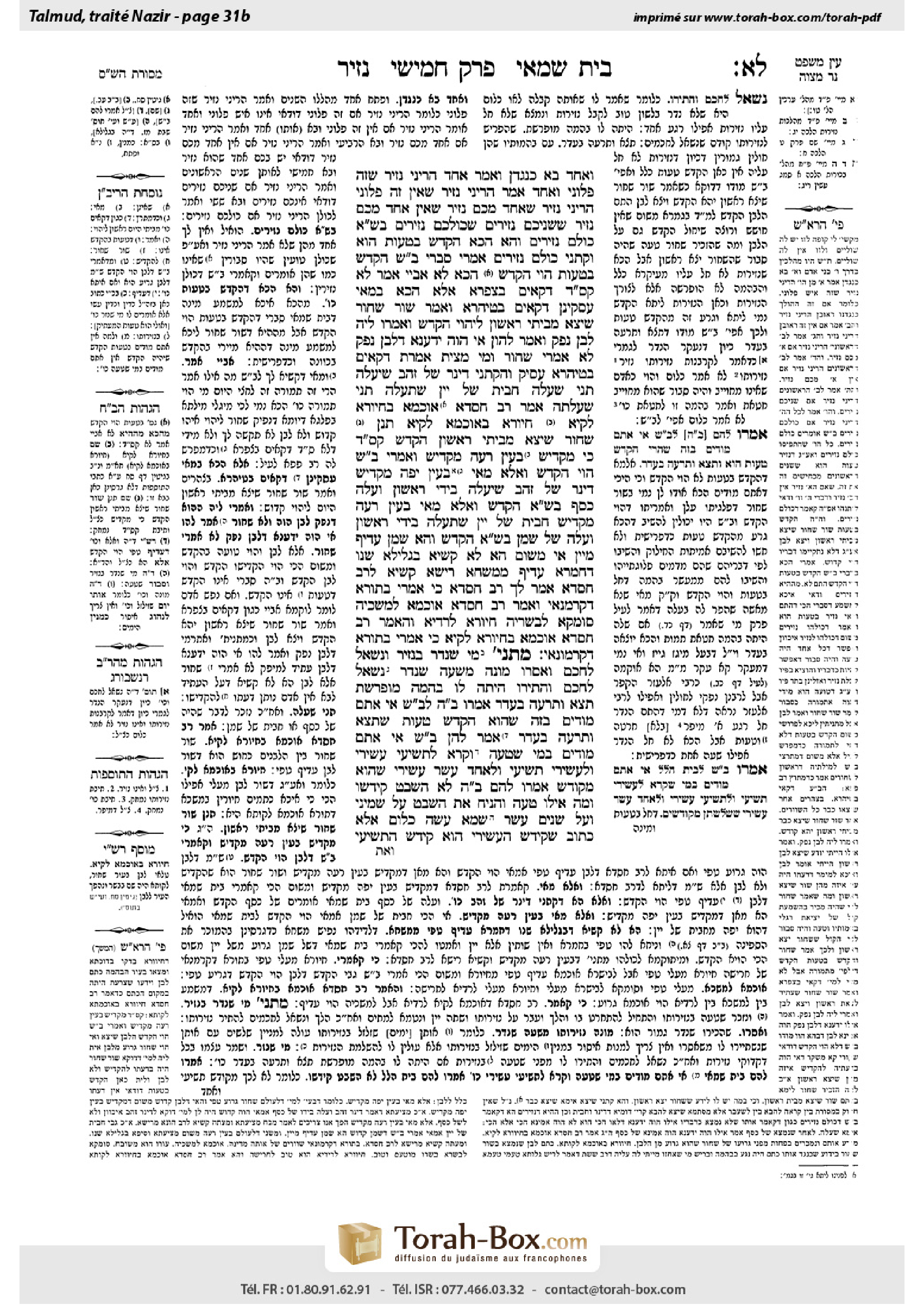
Nazir 31b: Talmud study for Daf Yomi
Daf Yomi is the daily study of one Talmud folio. Explore 37 tractates with scans, Hebrew text, Sefaria English and AI-generated French translations where annotated.
Passage selection and English or AI-generated French translation are available where the scan has annotations. Daf Study is independent of Torah-Box and Sefaria.
Browse Nazir · נזיר · All tractatesNazir 31b text and translations
This page of Nazir includes the Aramaic text, an English translation and an AI-generated French translation, alongside the scan above.
נזיר ל״א ב · Aramaic and Hebrew text
וְאֶחָד בָּא כְּנֶגְדָּן, וְאָמַר אֶחָד: ״הֲרֵינִי נָזִיר שֶׁזֶּה פְּלוֹנִי״, וְאֶחָד אָמַר: ״הֲרֵינִי נָזִיר שֶׁאֵין זֶה פְּלוֹנִי״, ״הֲרֵינִי נָזִיר שֶׁאֶחָד מִכֶּם נָזִיר״, ״שֶׁאֵין אֶחָד מִכֶּם נָזִיר״, ״שֶׁשְּׁנֵיכֶם נְזִירִים״, ״שֶׁכּוּלְּכֶם נְזִירִים״ — בֵּית שַׁמַּאי אוֹמְרִים: כּוּלָּם נְזִירִים.
וְהָא הָכָא הֶקְדֵּשׁ בְּטָעוּת הוּא, וְקָתָנֵי: כּוּלָּם נְזִירִים! אָמְרִי: סָבְרִי בֵּית שַׁמַּאי הֶקְדֵּשׁ בְּטָעוּת הָוֵי הֶקְדֵּשׁ, הָכָא לָא.
אַבָּיֵי אָמַר: לָא קָא סָלְקָא דַּעְתָּךְ דְּקָאֵים בְּצַפְרָא, אֶלָּא הָכָא בְּמַאי עָסְקִינַן, דְּקָאֵים בְּטִיהֲרָא, וְאָמַר: שׁוֹר שָׁחוֹר שֶׁיָּצָא מִבֵּיתִי רִאשׁוֹן לֶיהֱוֵי הֶקְדֵּשׁ. וַאֲמַרוּ לֵיהּ: לָבָן נְפַק. וַאֲמַר לְהוֹן: אִי הֲוָה יָדַעְנָא דְּלָבָן נְפַק לָא אֲמַרִי שָׁחוֹר.
וּמִי מָצֵית אָמְרַתְּ דְּקָאֵים בְּטִיהֲרָא עָסֵיק? וְהָקָתָנֵי: ״דִּינָר שֶׁל זָהָב שֶׁיַּעֲלֶה״! תְּנִי ״שֶׁעָלָה״. ״חָבִית שֶׁל יַיִן שֶׁתַּעֲלֶה״! תְּנִי ״שֶׁעָלְתָה״.
אָמַר רַב חִסְדָּא: אוּכָּמָא בְּחִיוָּרָא — לַקְיָא, חִיוָּרָא בְּאוּכָּמָא — לַקְיָא. תְּנַן: ״שָׁחוֹר שֶׁיֵּצֵא מִבֵּיתִי רִאשׁוֹן הֶקְדֵּשׁ״. קָא סָלְקָא דַּעְתִּין: כִּי מַקְדִּישׁ — בְּעַיִן רָעָה מַקְדִּישׁ, וְאָמְרִי בֵּית שַׁמַּאי הָוֵי הֶקְדֵּשׁ!
וְאֶלָּא מַאי, בְּעַיִן יָפָה מַקְדִּישׁ? ״דִּינָר שֶׁל זָהָב שֶׁיַּעֲלֶה בְּיָדִי רִאשׁוֹן״ וְעָלָה כֶּסֶף, בֵּית שַׁמַּאי אוֹמְרִים: הֶקְדֵּשׁ.
וְאֶלָּא מַאי — בְּעַיִן רָעָה מַקְדִּישׁ? חָבִית שֶׁל יַיִן שֶׁתַּעֲלֶה בְּיָדִי רִאשׁוֹן, וְעָלָה שֶׁל שֶׁמֶן, בֵּית שַׁמַּאי אוֹמְרִים: הֶקְדֵּשׁ. וְהָא שֶׁמֶן עָדִיף מִיַּיִן! אִי מִשּׁוּם הָא לָא קַשְׁיָא: בְּגָלִילָא שָׁנוּ, דְּחַמְרָא עָדִיף מִמִּשְׁחָא.
רֵישָׁא קַשְׁיָא לְרַב חִסְדָּא! אָמַר לְךָ רַב חִסְדָּא: כִּי אֲמַרִי — בְּתוֹרָא דְקַרְמְנָאֵי.
וְאָמַר רַב חִסְדָּא: אוּכָּמָא — לְמַשְׁכֵּיהּ, סוּמָּקָא — לְבִשְׂרֵיהּ, חִיוָּרָא — לְרִדְיָא. וְהָאָמַר רַב חִסְדָּא: אוּכָּמָא בְּחִיוָּרָא לַקְיָא! כִּי אֲמַרִי, בְּתוֹרָא דְקַרְמוֹנָאֵי.
מַתְנִי׳ מִי שֶׁנָּדַר בְּנָזִיר, וְנִשְׁאַל לְחָכָם וַאֲסָרוֹ — מוֹנֶה מִשָּׁעָה שֶׁנָּדַר. נִשְׁאַל לְחָכָם וְהִתִּירוֹ, הָיְתָה לוֹ בְּהֵמָה מוּפְרֶשֶׁת — תֵּצֵא וְתִרְעֶה בָּעֵדֶר.
אָמְרוּ בֵּית הִלֵּל לְבֵית שַׁמַּאי: אִי אַתֶּם מוֹדִים בָּזֶה שֶׁהוּא הֶקְדֵּשׁ טָעוּת שֶׁתֵּצֵא וְתִרְעֶה בָּעֵדֶר?! אָמַר לָהֶן בֵּית שַׁמַּאי: אִי אַתֶּם מוֹדִים בְּמִי שֶׁטָּעָה וְקָרָא לַתְּשִׁיעִי ״עֲשִׂירִי״, וְלָעֲשִׂירִי ״תְּשִׁיעִי״, וְלָאַחַד עָשָׂר ״עֲשִׂירִי״, שֶׁהוּא מְקוּדָּשׁ?
אָמְרוּ לָהֶם בֵּית הִלֵּל: לֹא הַשֵּׁבֶט קִידְּשׁוֹ. וּמָה אִילּוּ טָעָה וְהִנִּיחַ אֶת הַשֵּׁבֶט עַל שְׁמִינִי וְעַל שְׁנֵים עָשָׂר, שֶׁמָּא עָשָׂה כְּלוּם? אֶלָּא, כָּתוּב שֶׁקִּידֵּשׁ הָעֲשִׂירִי — הוּא קִידֵּשׁ הַתְּשִׁיעִי
Nazir 31b · English translation
and one other person was approaching them, and one of those walking said: I am hereby a nazirite if this person coming toward us is so-and-so. And another one of them said: I am hereby a nazirite if this is not so-and-so, while a third member of the group said: I am hereby a nazirite if one of you two is a nazirite, and a fourth said: I am hereby a nazirite if neither of you is a nazirite, and another added: I am hereby a nazirite if both of you are nazirites. Finally, the last person said: I am hereby a nazirite if all you who spoke before me are nazirites. Beit Shammai say that they are all nazirites, as by saying: I am hereby a nazirite, they have accepted naziriteship upon themselves even if their statement turns out to be incorrect.
The Gemara analyzes this mishna: But here, it is clearly a case of an erroneous act of consecration, as the statements of some of these individuals must have been incorrect, and yet the mishna teaches that Beit Shammai maintain that they are all nazirites. The Sages say in response: In fact, in general Beit Shammai hold that an erroneous act of consecration is considered consecration, as is evident from this halakha involving nazirites. However, the particular mishna here, concerning black and white bulls, is not based on that halakha. Rather, Rav Pappa’s explanation is the correct one.
Abaye said a different explanation of the mishna: It should not enter your mind that the mishna is dealing with one who was standing in the morning and referred to a future event, i.e., that an animal will emerge from the house. Rather, with what are we dealing here? With one who is standing at noon, after the bulls had already left the house, and said: The black bull that emerged first from my house first shall be consecrated. And people said to him: A white bull emerged first. And he said to them: Had I known that a white bull emerged, I would not have said black. Therefore, the consecration was erroneous.
The Gemara asks: How can you say that the mishna deals with one who is standing at noon and is speaking of a past event? But in a subsequent example the mishna teaches: A gold dinar that will come up in my hand first shall be consecrated, which is clearly referring to a future event. The Gemara answers: You should emend the mishna and teach: A gold dinar that came up, in the past tense. The Gemara continues to ask: Didn’t the mishna state: A barrel of wine that will come up in my hand first shall be consecrated, which is also referring to the future tense. The Gemara similarly answers that one should teach in the mishna: A barrel that already came up.
§ The Gemara quotes a statement related to the case in the mishna with regard to black and white bulls. Rav Ḥisda said: A black bull among white ones is deficient, as white bulls are superior in quality, and a white patch on a black bull is a deficiency. Having stated these assessments, the Gemara returns to discuss the mishna. We learned in the mishna that if one said: The black bull that will emerge from my house first is consecrated, and a white one emerged. It entered our minds to assume that when one consecrates property to the Temple treasury he consecrates sparingly, i.e., he does not give his property that is superior in quality or value, unless he expressly says so. And yet Beit Shammai say that the white bull in this case is consecrated, which indicates that the white one is inferior in quality, which contradicts the statement of Rav Ḥisda.
The Gemara examines this assumption: Rather, what then? Will you say that according to the opinion of Beit Shammai one typically consecrates generously and donates his property that is superior? However, the continuation of the mishna states that if one said: The gold dinar that will come up in my hand first, and a silver one came up, Beit Shammai say it is consecrated. If Beit Shammai hold that one would have in mind to consecrate only the superior property, why would the inferior silver coin be consecrated?
The Gemara counters: Rather, what then? Does a person consecrate sparingly? Yet the subsequent example of the mishna states that if one said: A barrel of wine that will come up in my hand first, and one of oil came up, Beit Shammai say it is consecrated. But oil is preferable to wine, so why is the oil consecrated? The Gemara answers: If the problem is due to that, this is not difficult, as this mishna was taught in the Galilee, where wine is preferable to oil. Olive trees are plentiful in the Galilee, and therefore oil is cheaper than wine. Therefore, the entire mishna can be explained in accordance with the opinion that people consecrate sparingly.
The Gemara comments: In any case, the first clause of the mishna poses a difficulty to the opinion of Rav Ḥisda, as it indicates that a white bull is less valuable than a black one. The Gemara answers that Rav Ḥisda could have said to you: When I said that a white one is superior, I was referring only to a Karmanian bull, a type of bull in which the white animals are superior in quality to the black ones. In all other cases black bulls are considered superior, and the mishna was referring to standard bulls.
The Gemara quotes another statement with regard to bulls: And Rav Ḥisda said with regard to bulls: A black bull is good for its hide; a red one is good for its meat; while a white bull is good for plowing. The Gemara asks: But didn’t Rav Ḥisda say: A black bull among white ones is deficient, which indicates that a black one is inferior in all regards? The Gemara again answers that Rav Ḥisda could reply: When I said that, I was referring only to a Karmanian bull, but not to other bulls.
MISHNA: With regard to one who took a vow of naziriteship, who then regretted his vow and stopped observing the prohibition against drinking wine, and later requested of a halakhic authority to dissolve his vow, and the authority ruled that he is bound by his vow, finding no reason to dissolve it, he counts the term of naziriteship from the time that he vowed, including the days when he acted as though the vow were dissolved. In a case where he requested of a halakhic authority to dissolve his vow and the authority dissolved it, if he had an animal separated as a nazirite offering it shall go out and graze among the flock.
On the basis of this halakha, and continuing their discussion in the previous mishna, Beit Hillel said to Beit Shammai: Don’t you concede with regard to this case that it is an erroneous act of consecration, and yet the halakha is that it shall go out and graze among the flock? This shows that you too accept the principle that an erroneous act of consecration does not take effect. Beit Shammai said to Beit Hillel: Don’t you concede with regard to one who was separating the animal tithe from his herd, i.e., passing his animals before him single file and consecrating every tenth one as a tithe, that if he erred and called the ninth animal: Tenth; and the tenth: Ninth; and the eleventh: Tenth, that each of them is consecrated? This proves that an erroneous act of consecration does take effect.
Beit Hillel said to them: It is not the rod that consecrates it. The touch of the rod does not consecrate the animal, nor does the fact that he said: Tenth, by mistake. Not all errors cause the tithe to be consecrated, and the proof is as follows: And what would be the halakha if he had erred and placed the rod on the eighth or on the twelfth, and labeled them: Tenth? Can it be suggested that perhaps he performed anything of consequence? The halakha is that the eighth or twelfth animal cannot be consecrated as tithe. Rather, why is the ninth or eleventh animal consecrated? There is a specific reason for this halakha, as the same verse that consecrated the tenth also consecrated the ninth
Nazir 31b · Traduction française (IA)
et une autre personne s’approchait d’eux. L’un de ceux qui marchaient dit : « Je suis désormais nazir si cette personne qui vient vers nous est untel. » Un autre dit : « Je suis désormais nazir si ce n’est pas untel. » Un troisième membre du groupe dit : « Je suis désormais nazir si l’un de vous deux est nazir. » Un quatrième dit : « Je suis désormais nazir si aucun de vous deux n’est nazir. » Un autre ajouta : « Je suis désormais nazir si vous êtes tous les deux nazir. » Enfin, le dernier dit : « Je suis désormais nazir si vous tous, qui avez parlé avant moi, êtes nazir. » Beit Chammaï disent qu’ils sont tous nazir, car, en disant « Je suis désormais nazir », ils ont accepté le naziréat sur eux-mêmes, même si leur déclaration se révèle inexacte.
La Guemara analyse cette Michna : Mais ici, il s’agit clairement d’un acte de consécration erroné, puisque les déclarations de certains de ces individus doivent être inexactes ; pourtant, la Michna enseigne que, selon Beit Chammaï, ils sont tous nazir. Les Sages répondent : En réalité, Beit Chammaï soutiennent généralement qu’un acte de consécration erroné est considéré comme une consécration, comme le montre cette halakha concernant les nazir. Cependant, la Michna en question, au sujet des taureaux noirs et blancs, ne repose pas sur cette halakha. C’est plutôt l’explication de Rav Pappa qui est correcte.
Abayé donne une autre explication de la Michna : Il ne faut pas penser que la Michna traite d’un homme qui, se tenant là le matin, évoquait un événement futur, à savoir qu’un animal sortirait de la maison. De quoi s’agit-il donc ici ? D’un homme qui se tient là à midi, après que les taureaux sont déjà sortis de la maison, et qui dit : « Le taureau noir qui est sorti le premier de ma maison sera consacré. » On lui dit alors : « C’est un taureau blanc qui est sorti le premier. » Il leur répond : « Si j’avais su qu’un taureau blanc était sorti, je n’aurais pas dit “noir”. » La consécration était donc erronée.
La Guemara demande : Comment peux-tu dire que la Michna traite d’un homme qui se tient là à midi et parle d’un événement passé ? Dans un exemple ultérieur, la Michna enseigne pourtant : « Le dinar d’or qui me viendra le premier en main sera consacré », ce qui fait clairement référence à un événement futur. La Guemara répond : Il faut corriger le texte de la Michna et enseigner : « Le dinar d’or qui m’est venu en main », au passé. La Guemara poursuit sa question : La Michna n’a-t-elle pas dit : « Le tonneau de vin qui me viendra le premier en main sera consacré », ce qui est également au futur ? La Guemara répond de même qu’il faut enseigner dans la Michna : « Un tonneau qui m’est déjà venu en main. »
§ La Guemara rapporte une déclaration liée au cas de la Michna concernant les taureaux noirs et blancs. Rav Ḥisda dit : Un taureau noir parmi des taureaux blancs est de qualité inférieure, car les taureaux blancs sont de meilleure qualité ; une tache blanche sur un taureau noir est également un défaut. Après avoir formulé ces appréciations, la Guemara revient à la Michna. Nous avons appris dans la Michna que si quelqu’un dit : « Le taureau noir qui sortira le premier de ma maison est consacré », et qu’un taureau blanc sort, nous avons d’abord supposé que, lorsqu’on consacre un bien au Trésor du Temple, on le fait avec parcimonie, c’est-à-dire qu’on ne donne pas un bien de qualité ou de valeur supérieure, sauf à le préciser expressément. Pourtant, Beit Chammaï disent que le taureau blanc est consacré dans ce cas, ce qui indique que le taureau blanc est de moindre qualité et contredit la déclaration de Rav Ḥisda.
La Guemara examine cette supposition : Que diras-tu alors ? Selon l’opinion de Beit Chammaï, les gens consacreraient-ils habituellement avec générosité et offriraient-ils leurs biens de meilleure qualité ? Pourtant, la suite de la Michna enseigne que si quelqu’un dit : « Le dinar d’or qui me viendra le premier en main », et qu’un dinar d’argent lui vient en main, Beit Chammaï disent qu’il est consacré. Si Beit Chammaï estiment que l’on a l’intention de ne consacrer que le bien de qualité supérieure, pourquoi la pièce d’argent, de moindre valeur, serait-elle consacrée ?
La Guemara objecte : Que diras-tu alors ? Les gens consacrent-ils avec parcimonie ? Pourtant, l’exemple suivant de la Michna enseigne que si quelqu’un dit : « Le tonneau de vin qui me viendra le premier en main », et qu’un tonneau d’huile lui vient en main, Beit Chammaï disent qu’il est consacré. Or, l’huile est préférable au vin ; pourquoi le tonneau d’huile serait-il donc consacré ? La Guemara répond : Si la difficulté tient à cela, elle n’est pas problématique, car cette Michna a été enseignée en Galilée, où le vin est préférable à l’huile. Les oliviers sont nombreux en Galilée et l’huile y est donc moins chère que le vin. Par conséquent, toute la Michna peut s’expliquer selon l’opinion que les gens consacrent avec parcimonie.
La Guemara fait remarquer : Quoi qu’il en soit, le premier passage de la Michna pose une difficulté à l’opinion de Rav Ḥisda, car il indique qu’un taureau blanc vaut moins qu’un taureau noir. La Guemara répond que Rav Ḥisda aurait pu te dire : Quand j’ai affirmé qu’un taureau blanc est de meilleure qualité, je ne parlais que d’un taureau karmanien, une espèce de taureau dont les bêtes blanches sont de meilleure qualité que les noires. Dans tous les autres cas, les taureaux noirs sont considérés comme supérieurs, et la Michna parlait de taureaux ordinaires.
La Guemara rapporte une autre déclaration concernant les taureaux. Rav Ḥisda dit à leur sujet : Un taureau noir est bon pour sa peau, un taureau roux est bon pour sa viande et un taureau blanc est bon pour le labour. La Guemara demande : Rav Ḥisda n’a-t-il pas dit : « Un taureau noir parmi des taureaux blancs est de qualité inférieure », ce qui indique qu’un taureau noir est inférieur à tous égards ? La Guemara répond de nouveau que Rav Ḥisda aurait pu répliquer : Quand j’ai dit cela, je ne parlais que d’un taureau karmanien, et non des autres taureaux.
MICHNA : Celui qui a fait vœu de naziréat, puis a regretté son vœu et a cessé de respecter l’interdiction de boire du vin, avant de demander ensuite à une autorité halakhique de délier son vœu, et à qui cette autorité a répondu qu’il reste lié par son vœu, faute de motif pour le délier, compte la période de naziréat à partir du moment où il a fait vœu, y compris les jours où il s’est comporté comme si son vœu avait été délié. Si, après avoir demandé à une autorité halakhique de délier son vœu, celle-ci le lui a effectivement délié, l’animal qu’il avait mis à part comme offrande de nazir sort et va paître avec le troupeau.
S’appuyant sur cette halakha et poursuivant leur discussion de la Michna précédente, Beit Hillel dirent à Beit Chammaï : « Ne reconnaissez-vous pas que, dans ce cas, il s’agit d’un acte de consécration erroné, et que pourtant la halakha veut que l’animal sorte et aille paître avec le troupeau ? Cela montre que vous aussi, vous acceptez le principe selon lequel un acte de consécration erroné ne prend pas effet. » Beit Chammaï répondirent à Beit Hillel : « Ne reconnaissez-vous pas que, lorsqu’on prélève la dîme animale de son troupeau, c’est-à-dire lorsqu’on fait passer ses animaux devant soi un à un et que l’on consacre chaque dixième animal comme dîme, si l’on se trompe et que l’on désigne le neuvième animal comme “dixième”, le dixième comme “neuvième” et le onzième comme “dixième”, chacun d’eux est consacré ? Cela prouve qu’un acte de consécration erroné prend effet. »
Beit Hillel leur dirent : « Ce n’est pas le bâton qui le consacre. Le contact du bâton ne consacre pas l’animal, pas plus que le fait de l’avoir désigné par erreur comme “dixième”. Toutes les erreurs n’entraînent pas la consécration de la dîme, comme le montre ce qui suit : Quelle serait la halakha s’il s’était trompé et avait posé le bâton sur le huitième ou le douzième animal, en le désignant comme “dixième” ? Peut-on dire qu’il a ainsi accompli quoi que ce soit qui ait un effet ? La halakha est que ni le huitième ni le douzième animal ne peuvent être consacrés comme dîme. Pourquoi donc le neuvième ou le onzième animal est-il consacré ? Il y a une raison précise à cette halakha, car le même verset qui a consacré le dixième a également consacré le neuvième
Traduction française générée par IA à partir de l’édition anglaise de Sefaria. Vérifie toujours un passage avec le texte source.
Text from Sefaria: William Davidson Edition - Vocalized Aramaic (CC BY NC); William Davidson Edition - English (CC BY NC).