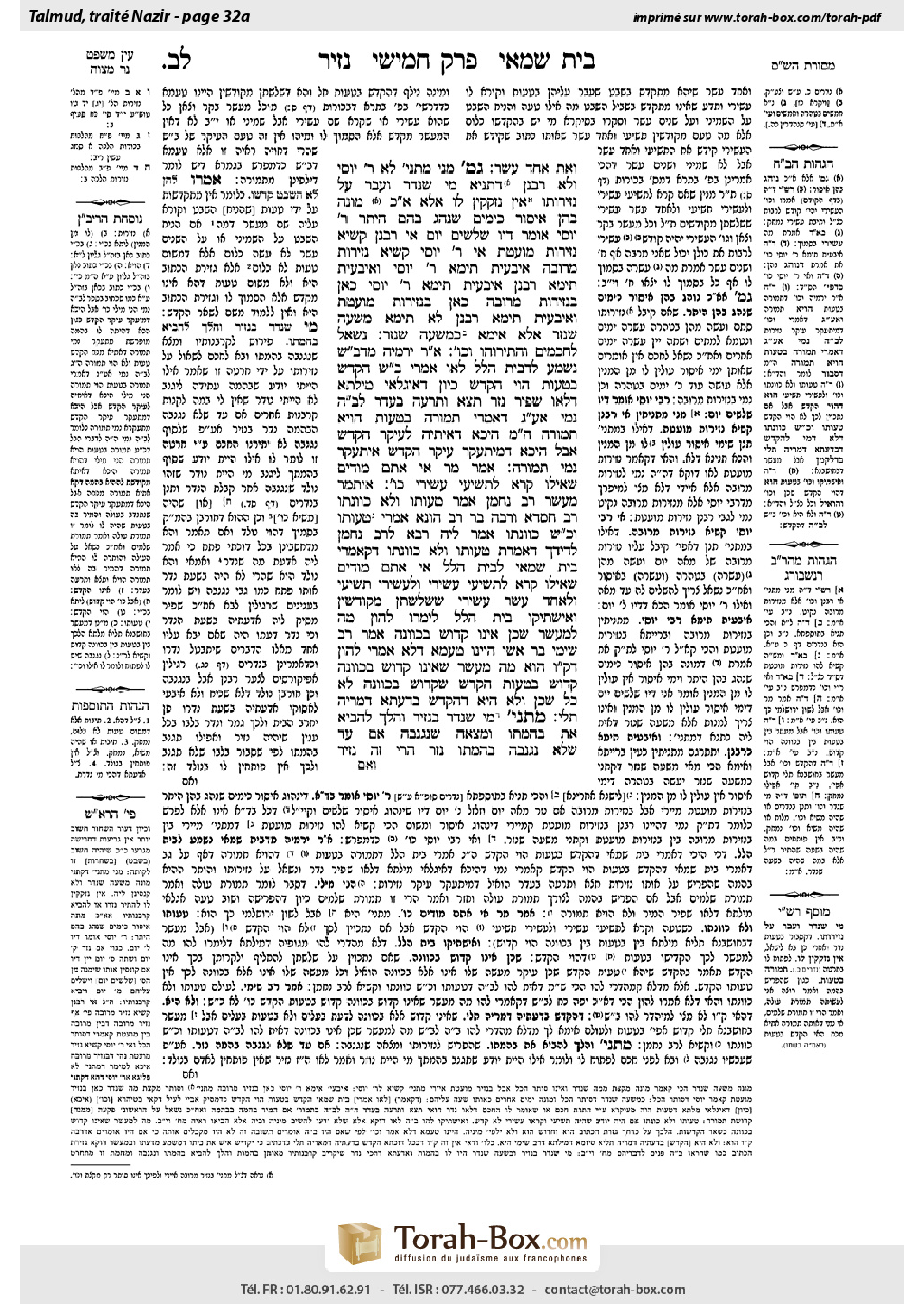
Nazir 32a: Talmud study for Daf Yomi
Daf Yomi is the daily study of one Talmud folio. Explore 37 tractates with scans, Hebrew text, Sefaria English and AI-generated French translations where annotated.
Passage selection and English or AI-generated French translation are available where the scan has annotations. Daf Study is independent of Torah-Box and Sefaria.
Browse Nazir · נזיר · All tractatesNazir 32a text and translations
This page of Nazir includes the Aramaic text, an English translation and an AI-generated French translation, alongside the scan above.
נזיר ל״ב א · Aramaic and Hebrew text
וְאֶת אַחַד עָשָׂר.
גְּמָ׳ מַנִּי מַתְנִיתִין? לָא רַבִּי יוֹסֵי וְלָא רַבָּנַן.
דְּתַנְיָא: מִי שֶׁנָּדַר וְעָבַר עַל נְזִירוּתוֹ — אֵין נִזְקָקִין לוֹ, אֶלָּא אִם כֵּן מוֹנֶה בָּהֶן אִיסּוּר כַּיָּמִים שֶׁנָּהַג בָּהֶם הֶיתֵּר. רַבִּי יוֹסֵי אוֹמֵר: דַּיּוֹ שְׁלֹשִׁים יוֹם.
אִי רַבָּנַן, קַשְׁיָא נְזִירוּת מוּעֶטֶת. אִי רַבִּי יוֹסֵי, קַשְׁיָא נְזִירוּת מְרוּבָּה!
אִיבָּעֵית תֵּימָא רַבִּי יוֹסֵי, וְאִיבָּעֵית תֵּימָא רַבָּנַן. אִיבָּעֵית תֵּימָא רַבִּי יוֹסֵי: כָּאן בִּנְזִירוּת מְרוּבָּה, כָּאן בִּנְזִירוּת מוּעֶטֶת.
וְאִיבָּעֵית תֵּימָא רַבָּנַן: לָא תֵּימָא מִשָּׁעָה שֶׁנָּזַר, אֶלָּא אֵימָא כְּמִשָּׁעָה שֶׁנָּזַר.
נִשְׁאַל לַחֲכָמִים וְהִתִּירוּהוּ וְכוּ׳. אָמַר רַבִּי יִרְמְיָה: מִדְּבֵית שַׁמַּאי נִשְׁמַע לִדְבֵית הִלֵּל. לָאו אָמְרִי בֵּית שַׁמַּאי הֶקְדֵּשׁ בְּטָעוּת הָוֵי הֶקְדֵּשׁ, כֵּיוָן דְּאִיגַּלַּאי מִילְּתָא דְּלָאו שַׁפִּיר נָזַר — תֵּצֵא וְתִרְעֶה בָּעֵדֶר.
לְבֵית הִלֵּל נָמֵי, אַף עַל גַּב דְּאָמְרִי תְּמוּרָה בְּטָעוּת הָוְיָא תְּמוּרָה — הָנֵי מִילֵּי הֵיכָא דְּאִיתֵיהּ לְעִיקַּר הֶקְדֵּשׁ. אֲבָל הֵיכָא דְּמִיתְעֲקַר עִיקַּר הֶקְדֵּשׁ — אִיתְעֲקַר נָמֵי תְּמוּרָה.
אָמַר מָר: אִי אַתֶּם מוֹדִים שֶׁאִילּוּ קָרָא לַתְּשִׁיעִי עֲשִׂירִי כּוּ׳. אִיתְּמַר: מַעֲשֵׂר, רַב נַחְמָן אָמַר: טָעוּתוֹ, וְלֹא כַּוּוֹנָתוֹ. רַב חִסְדָּא וְרַבָּה בַּר רַב הוּנָא אָמְרִי: טָעוּתוֹ, וְכׇל שֶׁכֵּן כַּוּוֹנָתוֹ.
אֲמַר לֵיהּ רָבָא לְרַב נַחְמָן: לְדִידָךְ דְּאָמְרַתְּ טָעוּתוֹ וְלֹא כַּוּוֹנָתוֹ, דְּקָאָמְרִי בֵּית שַׁמַּאי לְבֵית הִלֵּל: אִי אַתֶּם מוֹדִים שֶׁאִילּוּ קָרָא לַתְּשִׁיעִי עֲשִׂירִי, וְלָעֲשִׂירִי תְּשִׁיעִי, וְלָאַחַד עָשָׂר עֲשִׂירִי, שֶׁשְּׁלָשְׁתָּן מְקוּדָּשִׁין? וְאִישְׁתִּיקוּ בֵּית הִלֵּל.
לֵימְרוּ לְהוֹן: מָה לְמַעֲשֵׂר שֶׁכֵּן אֵינוֹ קָדוֹשׁ בְּכַוּוֹנָה.
אָמַר רַב שִׁימִי בַּר אָשֵׁי: הַיְינוּ טַעְמָא דְּלָא אָמְרִי לְהוֹן, דְּקַל וָחוֹמֶר הוּא: מָה מַעֲשֵׂר שֶׁאֵינוֹ קָדוֹשׁ בְּכַוּוֹנָה — קָדוֹשׁ בְּטָעוּת, הֶקְדֵּשׁ, שֶׁקָּדוֹשׁ בְּכַוּוֹנָה — לֹא כׇּל שֶׁכֵּן?!
וְלָא הִיא, דְּהֶקְדֵּשׁ בְּדַעְתָּא דְמָרֵיהּ תְּלֵי.
מַתְנִי׳ מִי שֶׁנָּדַר בְּנָזִיר, וְהָלַךְ לְהָבִיא אֶת בְּהֶמְתּוֹ, וּמְצָאָהּ שֶׁנִּגְנְבָה. אִם עַד שֶׁלֹּא נִגְנְבָה בְּהֶמְתּוֹ נָזַר — הֲרֵי זֶה נָזִיר.
Nazir 32a · English translation
and the eleventh. It is a Torah edict that the consecration takes effect with regard to those two animals. Therefore, one cannot infer from this case that an erroneous act of consecration takes effect.
GEMARA: The Gemara asks: Whose opinion is expressed in the mishna, when it rules that one whose request to dissolve his vow was rejected by a halakhic authority counts the duration of his naziriteship from the moment he took the vow, including the days on which he did not observe the halakhot of naziriteship in practice? The Gemara responds: It is neither the opinion of Rabbi Yosei, nor that of the Rabbis.
As it is taught in a baraita (Tosefta Nedarim 1:6): With regard to one who took a vow of naziriteship and later transgressed his vow of naziriteship by drinking wine, the halakhic authorities do not attend to his request to dissolve his vow, nor do they let him complete his term as a nazirite by sacrificing offerings, unless he counted, i.e., observed, days of the prohibitions of naziriteship for the same number of days in which he behaved with permissiveness concerning the restrictions of a nazirite. Only after he observes the prohibitions of naziriteship for the number of days that his observance lapsed will a halakhic authority hear his request for dissolution, or allow him to bring his offerings. Rabbi Yosei says: Thirty days is enough for him. He is required to observe additional days of naziriteship only if he transgressed his vow of naziriteship for thirty days or more.
The Gemara elaborates: Which of these opinions might correspond to that of the mishna? If it is that of the Rabbis, it is difficult with respect to a short naziriteship, i.e., a standard term of naziriteship, which lasts for thirty days. The Rabbis maintain that he cannot include all the days from the time he took the vow even if his naziriteship was short. They hold that he must add days corresponding to the days that he failed to observe the halakhot required of a nazirite. If it is that of Rabbi Yosei, although he agrees that one who transgresses his vow of naziriteship for a short period of less than thirty days need not add to his term, it is nevertheless difficult with regard to a lengthy naziriteship, as even Rabbi Yosei rules that in such a case the individual must observe naziriteship for additional days.
The Gemara answers: If you wish, you can say that the mishna is in accordance with the opinion of Rabbi Yosei, and if you wish, you can say it is in accordance with the opinion of the Rabbis. The Gemara explains: If you wish, you can say that the mishna is in accordance with Rabbi Yosei: Here, the baraita is speaking of a lengthy naziriteship; there, the mishna is referring to a short naziriteship. In other words, the mishna refers only to one who transgresses his vow of naziriteship for less than thirty days.
And if you wish, you can say that the mishna follows the opinion of the Rabbis, by emending its wording: Do not say that he must observe naziriteship from the time that he vowed; rather, say: Like from the time that he vowed. That is, he must count his naziriteship corresponding to the time that has elapsed since he took his vow, exactly as stated by the Rabbis.
§ The mishna taught that with regard to one who requested of the halakhic authorities and they dissolved the vow for him, and he had already separated an animal for a nazirite offering, it shall go out and graze among the flock. Rabbi Yirmeya said: From the ruling of Beit Shammai one can learn a halakha with regard to the opinion of Beit Hillel. Is it not the case that Beit Shammai say that an erroneous act of consecration is considered consecration, and yet once the matter is revealed that his vow of naziriteship was not right, i.e., it has been dissolved, the animal is considered non-sacred and shall go out and graze among the flock.
Rabbi Yirmeya continues: According to the opinion of Beit Hillel as well, even though they say that a substitution of a consecrated animal for another performed in error is a valid substitute, this applies only when the initial consecration, i.e., the consecration of the first animal, is in effect, in which case a substitution can take place. However, in a situation where the initial consecration has been uprooted, i.e., a halakhic authority dissolved the vow pertaining to the first consecration, the first animal is no longer consecrated, and therefore the substitute is also uprooted, i.e., the animal remains non-sacred.
§ The Master said in the mishna: Don’t you concede with regard to one who called the ninth animal: Tenth, that it is consecrated? It was stated that amora’im engaged in a dispute concerning this point. With regard to the animal tithe, Rav Naḥman said: It is consecrated in the above manner only if it resulted from his error, but not from his intentional declaration. If the owner was aware that it was the ninth animal and called it: Tenth, on purpose, his consecration is ineffective. Rav Ḥisda and Rabba bar Rav Huna say: His error consecrates the animal, and all the more so his intentional declaration, i.e., if he called the ninth or eleventh animals: Tenth, in full knowledge that they were not the tenth.
Rava said to Rav Naḥman: According to your opinion, that you say it is only his error that consecrates the ninth animal and not his intentional declaration, consider that Beit Shammai said the following to Beit Hillel in the mishna as proof that erroneous consecration is valid: Don’t you concede that if he called the ninth: Tenth; the tenth: Ninth; and the eleventh: Tenth, that all three are consecrated? And Beit Hillel were silent in face of this question.
However, according to your opinion, let Beit Hillel say to Beit Shammai: While it is correct that an erroneous act of consecration takes effect with regard to animal tithe, one cannot learn the halakha of other types of consecration from there, as what is unique about tithe is that it is not consecrated if his declaration concerning the wrong animal was intentional, whereas other types of consecration are typically the result of a purposeful act. Since other types of consecration take effect with intent, an erroneous act of consecration is not considered consecration.
Rav Shimi bar Ashi said: This is the reason that Beit Hillel did not say that answer to Beit Shammai, as one can argue in the opposite manner, by saying that it is an a fortiori inference: If tithe, which is not consecrated when he acts intentionally, is nevertheless consecrated if he acted erroneously; with regard to other types of consecration, which are consecrated intentionally, is it not all the more so that an act of erroneous consecration should render an item consecrated?
The Gemara rejects this argument: And this is not so, as this a fortiori inference is flawed, as consecration depends on the intention of the owner, and therefore it cannot apply when done in error. By contrast, the animal tithe is not consecrated through the intention of its owner but merely by counting, as every tenth animal is consecrated.
MISHNA: With regard to one who took a vow of naziriteship and went to bring his animal which he set aside for his nazirite offering and discovered that it was stolen, and due to the need to separate an additional animal now regrets having taken his vow, if he took a vow of naziriteship before his animal was stolen, he is a nazirite, as a vow cannot be dissolved as the result of a later event.
Nazir 32a · Traduction française (IA)
et le onzième. C’est un décret de la Torah que la consécration prenne effet pour ces deux animaux. On ne peut donc pas déduire de ce cas qu’un acte de consécration accompli par erreur prend effet.
GUEMARA : La Guemara demande : De qui la Michna exprime-t-elle l’opinion lorsqu’elle statue que celui dont la demande d’annulation de son vœu a été rejetée par une autorité halakhique compte la durée de son naziréat à partir du moment où il a prononcé le vœu, y compris les jours où, en pratique, il n’a pas observé les halakhot du naziréat ? La Guemara répond : Ce n’est ni l’opinion de Rabbi Yosei ni celle des Rabbins.
Comme il est enseigné dans une baraïta (Tossefta Nedarim 1:6) : Celui qui a fait vœu de naziréat puis a transgressé son vœu en buvant du vin, les autorités halakhiques ne donnent pas suite à sa demande d’annulation du vœu et ne lui permettent pas d’achever son naziréat en offrant des sacrifices, à moins qu’il n’ait observé les interdictions du naziréat pendant un nombre de jours égal à celui durant lequel il s’est permis d’en enfreindre les restrictions. Ce n’est qu’après avoir observé les interdictions du naziréat pendant autant de jours que ceux durant lesquels il a manqué à leur observance qu’une autorité halakhique entendra sa demande d’annulation ou lui permettra d’apporter ses sacrifices. Rabbi Yosei dit : Trente jours suffisent. Il ne doit observer des jours supplémentaires de naziréat que s’il a transgressé son vœu pendant trente jours ou plus.
La Guemara détaille : Laquelle de ces opinions pourrait correspondre à celle de la Michna ? S’il s’agit de celle des Rabbins, cela pose difficulté pour un naziréat court, c’est-à-dire un naziréat ordinaire, qui dure trente jours. Les Rabbins soutiennent qu’il ne peut compter tous les jours écoulés depuis le moment où il a fait son vœu, même si son naziréat était court. Selon eux, il doit ajouter des jours correspondant à ceux durant lesquels il n’a pas observé les halakhot imposées au nazir. S’il s’agit de celle de Rabbi Yosei, bien qu’il convienne que celui qui transgresse son vœu de naziréat pendant une courte période de moins de trente jours n’a pas à prolonger son naziréat, cela pose néanmoins difficulté pour un naziréat de longue durée, car même Rabbi Yosei statue que, dans ce cas, la personne doit observer des jours supplémentaires de naziréat.
La Guemara répond : Si tu veux, tu peux dire que la Michna est conforme à l’opinion de Rabbi Yosei ; et si tu veux, tu peux dire qu’elle est conforme à celle des Rabbins. La Guemara explique : Si tu veux, tu peux dire que la Michna est conforme à Rabbi Yosei : ici, la baraïta parle d’un naziréat de longue durée ; là, la Michna se réfère à un naziréat court. Autrement dit, la Michna ne parle que de celui qui a transgressé son vœu de naziréat pendant moins de trente jours.
Et si tu veux, tu peux dire que la Michna suit l’opinion des Rabbins, en corrigeant son libellé : ne dis pas qu’il doit observer le naziréat à partir du moment où il a fait son vœu ; dis plutôt : comme s’il avait observé le naziréat à partir du moment où il a fait son vœu. C’est-à-dire qu’il doit compter son naziréat en fonction du temps écoulé depuis qu’il a fait son vœu, exactement comme l’affirment les Rabbins.
§ La Michna a enseigné qu’au sujet de celui qui a sollicité les autorités halakhiques, qui ont annulé son vœu, et qui avait déjà mis de côté un animal pour son sacrifice de naziréat, l’animal doit être envoyé paître parmi le troupeau. Rabbi Yirmeya a dit : De la décision de Beit Shammaï, on peut tirer une halakha concernant l’opinion de Beit Hillel. N’est-il pas vrai que Beit Shammaï disent qu’un acte de consécration accompli par erreur est considéré comme une consécration, et pourtant, dès qu’il apparaît que son vœu de naziréat n’était pas valable, c’est-à-dire qu’il a été annulé, l’animal est considéré comme profane et doit être envoyé paître parmi le troupeau ?
Rabbi Yirmeya poursuit : Selon l’opinion de Beit Hillel également, bien qu’ils disent qu’un échange effectué par erreur d’un animal consacré contre un autre constitue un échange valide, cela ne s’applique que lorsque la consécration initiale, c’est-à-dire celle du premier animal, est en vigueur, auquel cas un échange peut avoir lieu. En revanche, lorsque la consécration initiale a été révoquée, c’est-à-dire qu’une autorité halakhique a annulé le vœu relatif à la première consécration, le premier animal n’est plus consacré et, par conséquent, l’échange est lui aussi annulé : l’animal reste profane.
§ Le maître a dit dans la Michna : Ne reconnaissez-vous pas que celui qui a appelé le neuvième animal « dixième » le consacre ? Il a été rapporté que des amoraïm étaient en désaccord sur ce point. Concernant la dîme animale, Rav Naḥman a dit : L’animal est consacré de cette manière uniquement si cela résulte d’une erreur, mais pas d’une déclaration délibérée. Si le propriétaire savait que c’était le neuvième animal et l’a appelé « dixième » intentionnellement, sa consécration est sans effet. Rav Ḥisda et Rabba bar Rav Huna disent : Son erreur consacre l’animal, et à plus forte raison sa déclaration intentionnelle, c’est-à-dire s’il a appelé « dixième » le neuvième ou le onzième animal en sachant parfaitement que ce n’était pas le dixième.
Rava dit à Rav Naḥman : Selon ton opinion, d’après laquelle tu dis que seule son erreur consacre le neuvième animal, et non sa déclaration intentionnelle, considère que Beit Shammaï ont dit à Beit Hillel dans la Michna, comme preuve qu’une consécration accomplie par erreur est valide : Ne reconnaissez-vous pas que s’il a appelé le neuvième « dixième », le dixième « neuvième » et le onzième « dixième », les trois sont consacrés ? Et Beit Hillel sont restés silencieux face à cette question.
Cependant, selon ton opinion, Beit Hillel auraient dû répondre à Beit Shammaï : Certes, un acte de consécration accompli par erreur prend effet dans le cas de la dîme animale, mais on ne peut en déduire la halakha concernant les autres types de consécration. En effet, la particularité de la dîme est que l’animal n’est pas consacré si la déclaration le désignant comme dixième est intentionnelle, tandis que les autres types de consécration résultent généralement d’un acte délibéré. Puisque les autres types de consécration prennent effet lorsqu’ils sont accomplis intentionnellement, un acte de consécration accompli par erreur n’est pas considéré comme une consécration.
Rav Shimi bar Ashi a dit : Voilà pourquoi Beit Hillel n’ont pas donné cette réponse à Beit Shammaï : on peut avancer l’argument inverse, sous forme de raisonnement a fortiori. Si l’animal de la dîme, qui n’est pas consacré lorsqu’il agit intentionnellement, est néanmoins consacré lorsqu’il agit par erreur, à plus forte raison un acte de consécration accompli par erreur doit-il rendre un objet consacré dans le cas des autres types de consécration, qui prennent effet lorsqu’ils sont accomplis intentionnellement.
La Guemara rejette cet argument : Il n’en est pas ainsi, car ce raisonnement a fortiori est défectueux : la consécration dépend de l’intention du propriétaire et ne peut donc prendre effet lorsqu’elle est accomplie par erreur. En revanche, la dîme animale ne dépend pas de l’intention de son propriétaire, mais simplement du comptage, puisque chaque dixième animal est consacré.
MICHNA : Celui qui a fait vœu de naziréat et s’est rendu pour apporter l’animal qu’il avait mis de côté pour son sacrifice de naziréat, mais a découvert qu’il avait été volé, et qui, parce qu’il doit en mettre un autre de côté, regrette maintenant d’avoir fait son vœu : s’il a fait vœu de naziréat avant que son animal soit volé, il est nazir, car un vœu ne peut être annulé à la suite d’un événement survenu ultérieurement.
Traduction française générée par IA à partir de l’édition anglaise de Sefaria. Vérifie toujours un passage avec le texte source.
Text from Sefaria: William Davidson Edition - Vocalized Aramaic (CC BY NC); William Davidson Edition - English (CC BY NC).