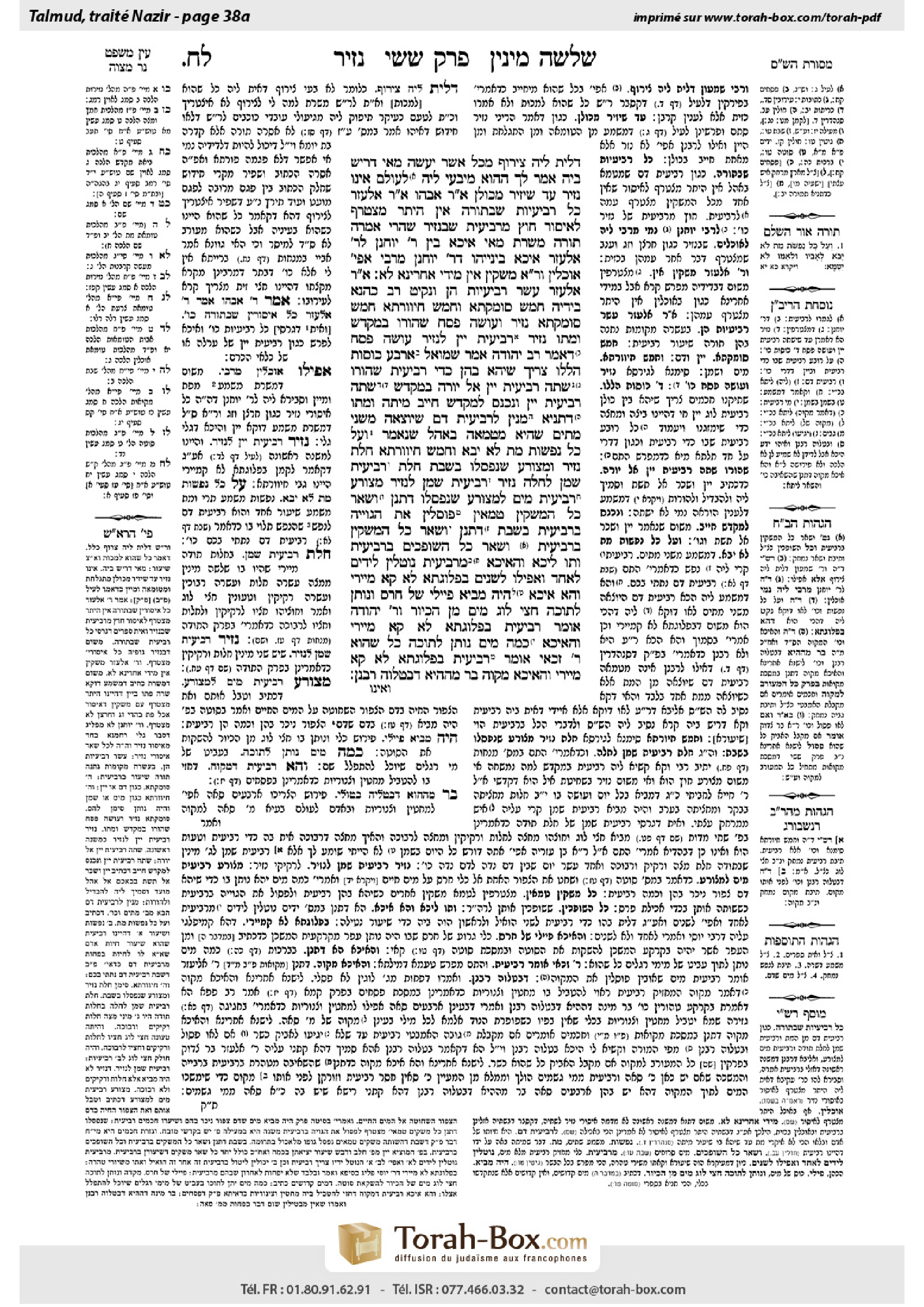
Nazir 38a: Talmud study for Daf Yomi
Daf Yomi is the daily study of one Talmud folio. Explore 37 tractates with scans, Hebrew text, Sefaria English and AI-generated French translations where annotated.
Passage selection and English or AI-generated French translation are available where the scan has annotations. Daf Study is independent of Torah-Box and Sefaria.
Browse Nazir · נזיר · All tractatesNazir 38a text and translations
This page of Nazir includes the Aramaic text, an English translation and an AI-generated French translation, alongside the scan above.
נזיר ל״ח א · Aramaic and Hebrew text
דְּלֵית לֵיהּ צֵירוּף, ״מִכֹּל אֲשֶׁר יֵעָשֶׂה״, מַאי דָּרֵישׁ בֵּיהּ? אָמַר לָךְ: הַהוּא מִיבְּעֵי לֵיהּ: לְעוֹלָם אֵינוֹ נָזִיר עַד שֶׁיַּזִּיר מִכּוּלָּן.
אָמַר רַבִּי אֲבָהוּ אָמַר רַבִּי אֶלְעָזָר: כׇּל רְבִיעִיּוֹת שֶׁבַּתּוֹרָה, אֵין הֶיתֵּר מִצְטָרֵף לְאִיסּוּר, חוּץ מֵרְבִיעִית שֶׁבַּנָּזִיר, שֶׁהֲרֵי אָמְרָה תּוֹרָה ״מִשְׁרַת״. מַאי אִיכָּא בֵּין רַבִּי יוֹחָנָן לְרַבִּי אֶלְעָזָר?
אִיכָּא בֵּינַיְיהוּ, דְּרַבִּי יוֹחָנָן מֵרַבִּי אֲפִילּוּ אוֹכָלִין, וְרַבִּי אֶלְעָזָר, מַשְׁקִין — אִין, מִידֵּי אַחֲרִינָא — לָא.
אָמַר רַבִּי אֶלְעָזָר: עֶשֶׂר רְבִיעִיּוֹת הֵן, וְנָקֵיט רַב כָּהֲנָא בִּידֵיהּ חֲמֵשׁ סוּמָּקָתָא וַחֲמֵשׁ חִיוּוֹרָתָא. חֲמֵשׁ סוּמָּקָתָא: ״נָזִיר וְעוֹשֵׂה פֶסַח שֶׁהוֹרוּ בַּמִּקְדָּשׁ וָמֵתוּ״.
״נָזִיר״ — רְבִיעִית יַיִן לְנָזִיר. ״עוֹשֵׂה פֶסַח״ — דְּאָמַר רַב יְהוּדָה אָמַר שְׁמוּאֵל: אַרְבַּע כּוֹסוֹת הַלָּלוּ צָרִיךְ שֶׁיְּהֵא בָּהֶן כְּדֵי רְבִיעִית. ״שֶׁהוֹרוּ״ — שָׁתָה רְבִיעִית יַיִן אַל יוֹרֶה. ״בַּמִּקְדָּשׁ״ — שָׁתָה רְבִיעִית יַיִן וְנִכְנַס לַמִּקְדָּשׁ חַיָּיב מִיתָה.
״וּמֵתוּ״ — דְּתַנְיָא: מִנַּיִן לִרְבִיעִית דָּם שֶׁיּוֹצְאָה מִשְּׁנֵי מֵתִים שֶׁהִיא מְטַמְּאָה בְּאֹהֶל, שֶׁנֶּאֱמַר: ״וְעַל כׇּל נַפְשׁוֹת מֵת לֹא יָבֹא״.
וַחֲמֵשׁ חִיוּוֹרָתָא: ״חַלַּת נָזִיר וּמְצוֹרָע שֶׁנִּפְסְלוּ בְּשַׁבָּת״. ״חַלַּת״ — רְבִיעִית שֶׁמֶן לְחַלָּה. ״נָזִיר״ — רְבִיעִית שֶׁמֶן לְנָזִיר. מְצוֹרָע — רְבִיעִית מַיִם לִמְצוֹרָע. ״שֶׁנִּפְסְלוּ״ — דִּתְנַן: וּשְׁאָר כׇּל הַמַּשְׁקִין טְמֵאִין פּוֹסְלִין אֶת הַגְּוִיָּיה בִּרְבִיעִית.
״בְּשַׁבָּת״ — דִּתְנַן: וּשְׁאָר כׇּל הַמַּשְׁקִין — בִּרְבִיעִית, וּשְׁאָר כׇּל הַשּׁוֹפְכִים — בִּרְבִיעִית.
וְתוּ לֵיכָּא? וְהָאִיכָּא: מֵרְבִיעִית נוֹטְלִין לַיָּדַיִם לְאֶחָד וַאֲפִילּוּ לִשְׁנַיִם. בִּפְלוּגְתָּא לָא קָא מַיְירֵי.
וְהָא אִיכָּא: הָיָה מֵבִיא פְּיָילֵי שֶׁל חֶרֶס וְנוֹתֵן לְתוֹכָהּ חֲצִי לוֹג מַיִם מִן הַכִּיּוֹר, וְרַבִּי יְהוּדָה אוֹמֵר: רְבִיעִית. בִּפְלוּגְתָּא לָא קָא מַיְירֵי.
וְהָאִיכָּא: כַּמָּה מַיִם נוֹתֵן לְתוֹכָהּ — כׇּל שֶׁהוּא, רַבִּי זַכַּאי אוֹמֵר: רְבִיעִית! בִּפְלוּגְתָּא לָא קָא מַיְירֵי. וְהָאִיכָּא מִקְוֶה! בַּר מֵהַהִיא, דְּבַטְּלוּהָ רַבָּנַן.
Nazir 38a · English translation
who is not of the opinion that the principle of combination is operative, as he renders one liable for consumption of forbidden substances of any amount (see Makkot 13a), what does he derive from the verse “anything that is made of the grapevine” (Numbers 6:4)? The Gemara answers: Rabbi Shimon could have said to you: That verse is necessary to teach that one is never considered a nazirite until he vows naziriteship from all of them. Rabbi Shimon maintains that if one vows to be a nazirite only with regard to one or two of the prohibitions of naziriteship, the vow does not take effect at all.
Rabbi Abbahu said that Rabbi Elazar said: With regard to every halakha that is in the Torah that involves a quarter-log, a permitted substance does not combine with a forbidden substance to complete this measure, apart from the quarter-log of a nazirite. In the case of a nazirite, permitted liquid combines with wine to render him liable, as the Torah stated: “Soaked” (Numbers 6:3). The Gemara asks: What difference is there between the opinion of Rabbi Yoḥanan, who stated (35b) that a permitted substance does not combine with a forbidden one with regard to any prohibition of the Torah apart from that of a nazirite, and that of Rabbi Elazar, who apparently says the same thing in different terms?
The Gemara answers: There is a difference between them, as Rabbi Yoḥanan amplifies the halakha to include even foods, i.e., he renders a nazirite liable for eating an olive-bulk of bread and grapes combined, and Rabbi Elazar maintains that with regard to liquids, yes, the permitted combines with the forbidden, but for other matters, i.e., solids, no, the different foods do not combine.
§ Apropos a quarter-log, the Gemara cites a statement that Rabbi Elazar says: There are ten applications of the quarter-log measurement in various areas of halakha, and Rav Kahana held in his hand the following mnemonic for them: Five are red and five are white. The Gemara elaborates: The five red ones of wine and blood are listed in the following mnemonic: A nazirite; and one who performs the ritual of the Paschal offering; who instructed; in the Temple; and they died.
The Gemara explains this mnemonic: A nazirite, this is referring to the quarter-log of wine for which a nazirite is liable for drinking. Who performs the ritual of the Paschal offering, this is as Rav Yehuda says that Shmuel says: It is a mitzva to drink these four cups at the Passover seder and they must each contain the amount of a quarter-log. Who instructed, this is referring to the following halakha: One who drank a quarter-log of wine may not issue rulings to others in matters of halakha, lest he err. In the Temple, this is referring to the halakha that one who drank a quarter-log of wine and entered the Temple is liable to receive the death penalty (see Leviticus 10:9).
And they died, this is as it is taught in a mishna (Oholot 2:10): From where is it derived with regard to a quarter-log of blood that emerges from two corpses, that it renders people and objects ritually impure in a tent, i.e., a house, meaning that one who enters that house contracts ritual impurity imparted by a corpse? As it is stated, with regard to the prohibition against ritual impurity for priests: “Neither shall he go in to any dead bodies” (Leviticus 21:11). The plural form indicates that the blood of two people joins together to form the minimum amount of a quarter-log for ritual impurity in a tent.
And the five white cases of oil and water are listed in this mnemonic: The loaf of, a nazirite, and a leper, which were disqualified, on Shabbat. The Gemara elaborates: The loaf of, this is referring to the quarter-log of oil added to the loaves of a thanks-offering. A nazirite, this is referring to the quarter-log of oil for the wafers of a nazirite, which were brought with his offering. A leper, this is referring to the quarter-log of spring water into which a bird is slaughtered for the ritual purification of a leper (see Leviticus 14:5).Which were disqualified, this is as we learned in a mishna (Me’ila 17b): And all other ritually impure liquids disqualify the body to the extent that one who drinks them may not eat teruma, if one drank the amount of one quarter-log.
On Shabbat, this is as we learned in a mishna which lists the minimum amounts of various liquids for which one is liable for violating the halakhot of Shabbat for carrying them from one domain to another. At the conclusion of this list, the mishna states (Shabbat 76b): And the measure that creates liability for carrying all other liquids, those not specified in the list, is a quarter-log, and the measure for carrying all waste water is likewise a quarter-log. This completes the list of ten halakhot that feature the quarter-log.
The Gemara asks: And are there no more than ten? But there is also the following mishna (Yadayim 1:1): With a quarter-log of water one can wash the hands of one person before eating bread, and this amount can be used even for two people, if they do so in the correct manner. The Gemara answers: Rabbi Elazar, who listed ten cases, does not deal with halakhot that are subject to a dispute, and some Sages disagree with the ruling that two people can wash their hands with a single quarter-log.
The Gemara further asks: But there is this halakha concerning a sota (Sota 15b): The priest who dealt with a sota would bring an earthenware vessel [pailei] and place in it a half-log of water from the basin in the Temple, and Rabbi Yehuda says it was a quarter-log. This is another case involving a quarter-log. The Gemara answers as before, that Rabbi Elazar does not deal with halakhot that are subject to a dispute, and this quarter-log applies only according to the opinion of Rabbi Yehuda.
The Gemara continues to ask. But there is the following halakha: How much water must one place in a vessel that contains urine, before he can pray nearby? Any quantity is sufficient. Rabbi Zakkai said: A quarter-log. The Gemara again answers that Rabbi Elazar does not deal with halakhot that are subject to a dispute. The Gemara suggests another example: But there is the case of a ritual bath, as it is taught that one may immerse extremely small vessels in a quarter-log of rainwater in the ground. The Gemara answers: His list excludes that case, as the Sages annulled that halakha by ruling that one must use a standard ritual bath of forty se’a even for extremely small vessels.
Nazir 38a · Traduction française (IA)
qui ne partage pas l’avis selon lequel le principe de combinaison s’applique, puisqu’il rend passible celui qui consomme une quantité, quelle qu’elle soit, de substances interdites (voir Makkot 13a), que déduit-il du verset : « tout ce qui est fait de la vigne » (Nombres 6:4) ? La Guemara répond : Rabbi Chimon aurait pu te répondre : ce verset est nécessaire pour enseigner qu’on n’est considéré comme nazir que si l’on fait vœu de naziréat en s’engageant à respecter toutes ces interdictions. Selon Rabbi Chimon, si quelqu’un fait vœu d’être nazir uniquement à l’égard d’une ou de deux des interdictions du naziréat, son vœu ne prend pas effet du tout.
Rabbi Abbahou a dit au nom de Rabbi Elazar : pour toute halakha de la Torah impliquant un quart de log, une substance permise ne se combine pas à une substance interdite pour compléter cette mesure, à l’exception du quart de log concernant le nazir. Dans le cas du nazir, un liquide permis se combine au vin pour le rendre passible, comme l’indique la Torah : « trempé » (Nombres 6:3). La Guemara demande : Quelle différence y a-t-il entre l’avis de Rabbi Yo’hanan, qui a déclaré (35b) qu’une substance permise ne se combine pas à une substance interdite pour les interdictions de la Torah, à l’exception de celle qui concerne le nazir, et celui de Rabbi Elazar, qui semble dire la même chose en d’autres termes ?
La Guemara répond : Il y a une différence entre eux : Rabbi Yo’hanan étend la halakha aux aliments, c’est-à-dire qu’il rend le nazir passible lorsqu’il consomme ensemble un volume d’olive de pain et de raisins. Rabbi Elazar soutient que, pour les liquides, oui, la substance permise se combine à la substance interdite, mais pas dans les autres cas, c’est-à-dire pour les solides : les différents aliments ne se combinent pas.
§ À propos d’un quart de log, la Guemara cite une déclaration de Rabbi Elazar : il existe dix applications de la mesure d’un quart de log dans différents domaines de la halakha, et Rav Kahana en retenait le moyen mnémotechnique suivant : cinq sont rouges et cinq sont blanches. La Guemara précise : les cinq cas rouges, qui concernent le vin et le sang, sont énumérés dans le moyen mnémotechnique suivant : un nazir ; celui qui accomplit le rituel de l’offrande pascale ; celui qui a donné un enseignement ; dans le Temple ; et ils moururent.
La Guemara explique ce moyen mnémotechnique : « Un nazir » désigne le quart de log de vin dont la consommation rend le nazir passible. « Celui qui accomplit le rituel de l’offrande pascale » renvoie à ce que Rav Yehouda a dit au nom de Chmouel : c’est une mitsva de boire ces quatre coupes lors du séder de Pessa’h, et chacune doit contenir un quart de log. « Celui qui a donné un enseignement » renvoie à la halakha selon laquelle celui qui a bu un quart de log de vin ne peut pas rendre de décisions à autrui en matière de halakha, de peur de se tromper. « Dans le Temple » renvoie à la halakha selon laquelle celui qui a bu un quart de log de vin et est entré dans le Temple est passible de la peine de mort (voir Lévitique 10:9).
« Et ils moururent » renvoie à ce qui est enseigné dans une Michna (Ohalot 2:10) : d’où déduit-on qu’un quart de log de sang provenant de deux cadavres rend impurs les êtres humains et les objets sous une tente, c’est-à-dire dans une maison, de sorte que celui qui y entre contracte l’impureté rituelle transmise par un cadavre ? Car il est dit, à propos de l’interdiction faite aux prêtres de se souiller : « Il ne s’approchera d’aucun corps mort » (Lévitique 21:11). La forme plurielle indique que le sang de deux personnes s’additionne pour atteindre la quantité minimale d’un quart de log requise pour transmettre l’impureté sous une tente.
Les cinq cas blancs, qui concernent l’huile et l’eau, sont énumérés dans le moyen mnémotechnique suivant : le pain de ; un nazir ; un lépreux ; qui furent invalidés ; le Chabbat. La Guemara précise : « Le pain de » renvoie au quart de log d’huile ajouté aux pains de l’offrande de gratitude. « Un nazir » renvoie au quart de log d’huile destiné aux galettes du nazir, apportées avec son offrande. « Un lépreux » renvoie au quart de log d’eau de source dans laquelle on égorge un oiseau pour la purification rituelle d’un lépreux (voir Lévitique 14:5). « Qui furent invalidés » renvoie à ce que nous avons appris dans une Michna (Meïla 17b) : tous les autres liquides rituellement impurs disqualifient le corps, si bien que celui qui en boit ne peut pas consommer de terouma, dès lors qu’il en a bu la quantité d’un quart de log.
« Le Chabbat » renvoie à ce que nous avons appris dans une Michna qui énumère les quantités minimales de divers liquides dont le transport d’un domaine à un autre rend passible d’avoir enfreint les halakhot du Chabbat. À la fin de cette liste, la Michna déclare (Chabbat 76b) : la mesure qui rend passible pour le transport de tous les autres liquides, ceux qui ne sont pas mentionnés dans la liste, est d’un quart de log ; la mesure pour le transport de toutes les eaux usées est également d’un quart de log. La liste des dix halakhot faisant intervenir un quart de log est ainsi complète.
La Guemara demande : N’y en a-t-il pas plus de dix ? Il y a aussi la Michna suivante (Yadaïm 1:1) : un quart de log d’eau permet de laver les mains d’une personne avant qu’elle mange du pain, et cette quantité peut même servir à deux personnes, si elles procèdent correctement. La Guemara répond : Rabbi Elazar ne traite pas des halakhot qui font l’objet d’une controverse, et certains Sages contestent la décision selon laquelle deux personnes peuvent se laver les mains avec un seul quart de log.
La Guemara demande encore : Mais il y a cette halakha concernant une sota (Sota 15b) : le prêtre qui s’occupait d’une sota apportait un récipient en terre cuite [pailei] et y versait un demi-log d’eau provenant du bassin du Temple, tandis que Rabbi Yehouda dit qu’il s’agissait d’un quart de log. Voilà un autre cas impliquant un quart de log. La Guemara répond comme précédemment : Rabbi Elazar ne traite pas des halakhot qui font l’objet d’une controverse, et ce quart de log ne s’applique que selon l’avis de Rabbi Yehouda.
La Guemara poursuit ses questions : Mais il y a la halakha suivante : quelle quantité d’eau faut-il mettre dans un récipient contenant de l’urine pour pouvoir prier à proximité ? N’importe quelle quantité suffit. Rabbi Zakkaï a dit : un quart de log. La Guemara répond de nouveau que Rabbi Elazar ne traite pas des halakhot qui font l’objet d’une controverse. La Guemara propose un autre exemple : Mais il y a le cas d’un mikvé, car il est enseigné qu’on peut immerger de très petits récipients dans un quart de log d’eau de pluie recueillie dans le sol. La Guemara répond : sa liste exclut ce cas, car les Sages ont annulé cette halakha en statuant qu’il faut utiliser un mikvé réglementaire de quarante séa, même pour de très petits récipients.
Traduction française générée par IA à partir de l’édition anglaise de Sefaria. Vérifie toujours un passage avec le texte source.
Text from Sefaria: William Davidson Edition - Vocalized Aramaic (CC BY NC); William Davidson Edition - English (CC BY NC).