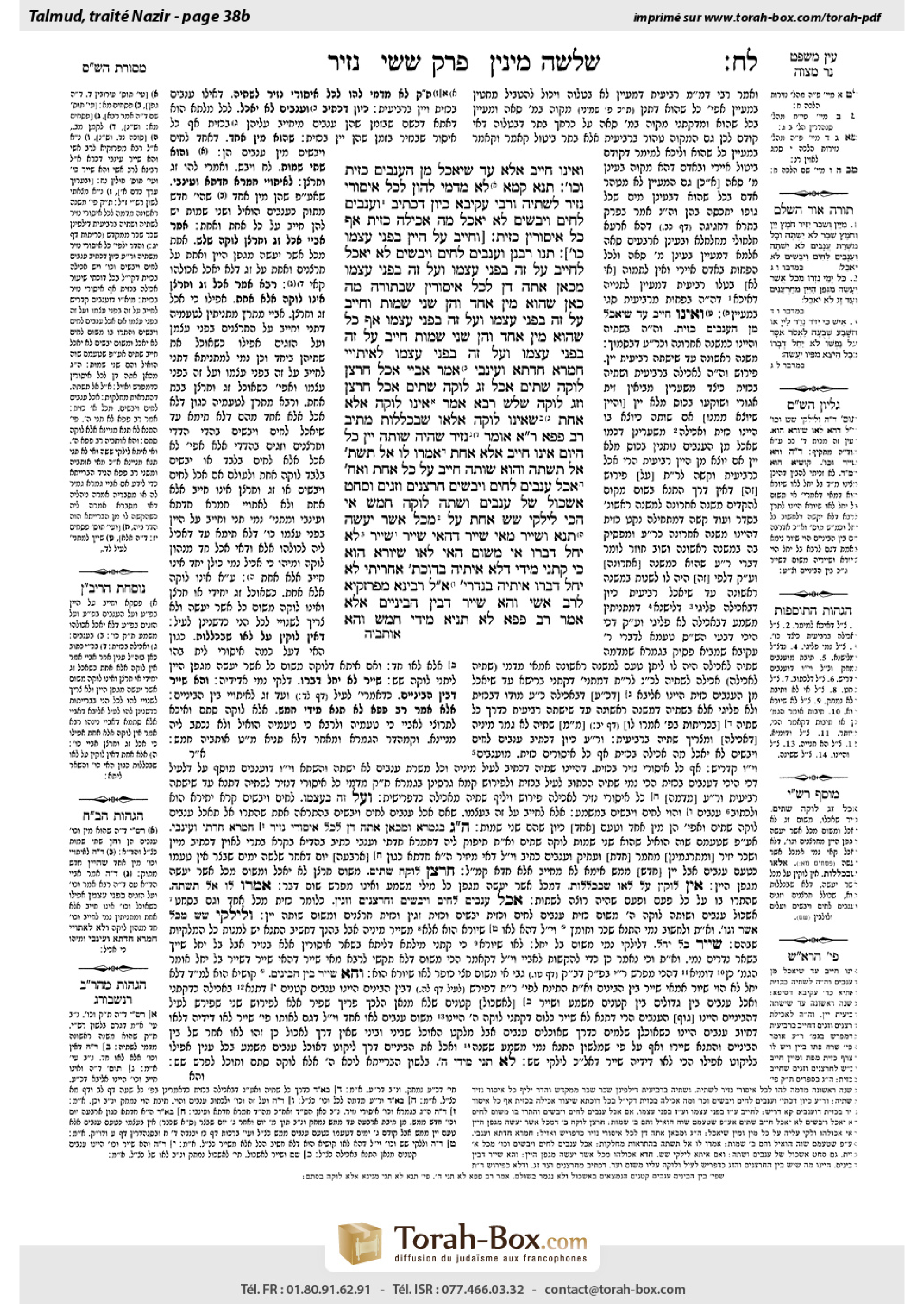
Nazir 38b: Talmud study for Daf Yomi
Daf Yomi is the daily study of one Talmud folio. Explore 37 tractates with scans, Hebrew text, Sefaria English and AI-generated French translations where annotated.
Passage selection and English or AI-generated French translation are available where the scan has annotations. Daf Study is independent of Torah-Box and Sefaria.
Browse Nazir · נזיר · All tractatesNazir 38b text and translations
This page of Nazir includes the Aramaic text, an English translation and an AI-generated French translation, alongside the scan above.
נזיר ל״ח ב · Aramaic and Hebrew text
וְאֵינוֹ חַיָּיב אֶלָּא עַד שֶׁיֹּאכַל מִן הָעֲנָבִים כְּזַיִת וְכוּ׳. תַּנָּא קַמָּא לָא מְדַמֵּי לְהוֹן לְכׇל אִיסּוּרֵי נָזִיר לִשְׁתִיָּה, וְרַבִּי עֲקִיבָא, כֵּיוָן דִּכְתִיב ״וַעֲנָבִים לַחִים וִיבֵשִׁים לֹא יֹאכֵל״, מָה אֲכִילָה כְּזַיִת — אַף כֹּל אִיסּוּרִין כְּזַיִת.
[וְחַיָּיב עַל הַיַּיִן בִּפְנֵי עַצְמוֹ כּוּ׳.] תָּנוּ רַבָּנַן: ״וַעֲנָבִים לַחִים וִיבֵשִׁים לֹא יֹאכֵל״, לְחַיֵּיב עַל זֶה בִּפְנֵי עַצְמוֹ וְעַל זֶה בִּפְנֵי עַצְמוֹ. מִכָּאן אַתָּה דָּן לְכׇל אִיסּוּרִין שֶׁבַּתּוֹרָה: מָה כָּאן שֶׁהוּא מִין אֶחָד, וְהֵן שְׁנֵי שֵׁמוֹת, וְחַיָּיב עַל זֶה בִּפְנֵי עַצְמוֹ וְעַל זֶה בִּפְנֵי עַצְמוֹ; אַף כֹּל שֶׁהוּא מִין אֶחָד, וְהֵן שְׁנֵי שֵׁמוֹת — חַיָּיב עַל זֶה בִּפְנֵי עַצְמוֹ וְעַל זֶה בִּפְנֵי עַצְמוֹ.
לְאֵיתוֹיֵי חַמְרָא חַדְתָּא וְעִינְבֵי.
אָמַר אַבָּיֵי: אָכַל חַרְצָן — לוֹקֶה שְׁתַּיִם. אָכַל זָג — לוֹקֶה שְׁתַּיִם. אָכַל חַרְצָן וְזָג — לוֹקֶה שָׁלֹשׁ. רָבָא אָמַר: אֵינוֹ לוֹקֶה אֶלָּא אַחַת, שֶׁאֵינוֹ לוֹקֶה אַלָּאו שֶׁבִּכְלָלוֹת.
מֵתִיב רַב פָּפָּא, רַבִּי אֱלִיעֶזֶר אוֹמֵר: נָזִיר שֶׁהָיָה שׁוֹתֶה יַיִן כׇּל הַיּוֹם אֵינוֹ חַיָּיב אֶלָּא אַחַת. אָמְרוּ לוֹ: ״אַל תִּשְׁתֶּה״ ״אַל תִּשְׁתֶּה״, וְהוּא שׁוֹתֶה — חַיָּיב עַל כׇּל אַחַת וְאַחַת. אָכַל עֲנָבִים לַחִים וִיבֵשִׁים, חַרְצַנִּים וְזַגִּים, וְסָחַט אֶשְׁכּוֹל שֶׁל עֲנָבִים וְשָׁתָה — לוֹקֶה חָמֵשׁ. אִי הָכִי — לִילְקֵי שֵׁשׁ, אַחַת עַל ״מִכׇּל אֲשֶׁר יַעֲשֶׂה״.
תְּנָא וְשַׁיַּיר. מַאי שַׁיֵּיר דְּהַאי שַׁיַּיר? שַׁיַּיר ״לֹא יַחֵל דְּבָרוֹ״.
אִי מִשּׁוּם הַאי — לָאו שִׁיּוּרָא הוּא, כִּי קָתָנֵי מִידֵּי דְּלָא אִיתֵיהּ בְּדוּכְתָּא אַחֲרִיתִי, ״לֹא יַחֵל דְּבָרוֹ״ אִיתֵיהּ בִּנְדָרִים.
אֲמַר לֵיהּ רָבִינָא מִפַּרְזִקְיָא לְרַב אָשֵׁי: וְהָא שַׁיַּיר דְּבֵין הַבֵּינַיִים. אֶלָּא אָמַר רַב פָּפָּא: לָא תַּנְיָא מִידֵּי חָמֵשׁ. וְהָא
Nazir 38b · English translation
§ The mishna taught: And he is liable to receive lashes only if he eats an olive-bulk of the grapes. The mishna continues by noting that with regard to drinking, the first tanna holds that a nazirite is liable for a quarter-log, whereas Rabbi Akiva maintains that the amount of an olive-bulk applies to liquids as well. The Gemara explains this dispute: The first tanna does not liken all the other prohibitions of a nazirite to the prohibition of drinking wine, and therefore the measurements for eating and drinking are the same as for prohibitions in other contexts: An olive-bulk of food and a quarter-log of drink. And Rabbi Akiva maintains that since it is written: “Nor eat fresh grapes or dried” (Numbers 6:3), this verse teaches that just as eating is measured by the amount of an olive-bulk, so too, all the prohibitions of a nazirite are measured by an olive-bulk.
§ The mishna further taught: And he is liable for consuming wine by itself, and for grapes by themselves, and for grape seeds by themselves, and for grape skins by themselves. The Sages taught: The verse: “Nor eat fresh grapes or dried” (Numbers 6:3), serves to render him liable for this by itself and for that by itself, i.e., that he need not consume all of the grape products listed in the verses. From here you derive the halakha with regard to all prohibitions of the Torah: Just as here there is one type of food, grapes, which are called by two names, fresh or dried, and he is liable for this by itself and for that by itself, so too, in all cases where there is one type and they are called by two names, one is liable for this by itself and for that by itself.
The Gemara adds that in the case of a nazirite this principle serves to include new wine, i.e., grape juice, and grapes. Although these are apparently a single type, as the juice, before fermenting, is merely grapes in liquid form, nevertheless one is liable for grape juice and grapes separately, as they have different names.
§ Abaye says: A nazirite who ate a grape seed is flogged twice, i.e., two sets of thirty-nine lashes, one set for the specific prohibition stated with regard to grape seeds, and the other for the general prohibition “anything that is made of the grapevine” (Numbers 6:4). Likewise, if he ate a grape skin he is flogged twice. If he ate a grape seed and a grape skin he is flogged three times, for the seed, for the skin, and for the prohibition “anything that is made of the grapevine.” Rava says: He is flogged only once if he ate a seed or a skin. He is not flogged for “anything that is made of the grapevine,” because one is not flogged for violating a general prohibition. One is not liable to receive lashes for violation of a single prohibition that includes many items or cases.
Rav Pappa raised an objection to Abaye’s statement. Rabbi Eliezer says: A nazirite who was drinking wine all day is liable to receive only one set of lashes. If two witnesses said to him in warning: Do not drink, do not drink, and he continued drinking, he is liable for each and every one of the warnings that was followed by an act of drinking. If he ate grapes and raisins, grape seeds and grape skins, and squeezed a cluster of grapes and drank the juice, he is flogged five times. The difficulty for Abaye is as follows: If so, that Abaye’s opinion is accepted, let him be flogged six times, to include one more for transgressing the verse “anything that is made of the grapevine” (Numbers 6:4).
Abaye responded: Rabbi Eliezer taught certain prohibitions and omitted others. He did not include all the prohibitions for which one is liable to be flogged. The Gemara asks: What else did he omit that he omitted this? He would not have listed all relevant prohibitions less one. The Gemara answers: He also omitted the additional prohibition of “He shall not profane his word” (Numbers 30:3), as the nazirite profaned his word by violating his vow of naziriteship.
The Gemara retorts: If it is due to that verse, this is not an omission, as when Rabbi Eliezer teaches and lists the lashes which a nazirite is liable to receive, he includes only matters that are not found elsewhere, i.e., he mentions only prohibitions that apply exclusively to a nazirite. The prohibition “He shall not profane his word” is relevant to vows in general, and therefore he omitted it. Consequently, Rabbi Eliezer should have mentioned the prohibition “anything that is made of the grapevine,” and the fact that he did not do so presents a difficulty for the opinion of Abaye.
Ravina from Parzakya said to Rav Ashi: But he omitted the case of in between. Rabbi Eliezer could have added that a nazirite is liable not only for the seed and skin of a grape but also for the substances in between them, as the verse: “From pits to grape skin” (Numbers 6:4), comes to include all that is in between the two (see 34b). Rather, Rav Pappa said: Actually, Rabbi Eliezer did not teach anything about five sets of lashes, but merely stated that he is flogged for all those actions, without enumerating the precise number. Therefore, this source does not present a difficulty for Abaye. The Gemara asks: But
Nazir 38b · Traduction française (IA)
§ La Michna a enseigné : Il n’est passible de flagellation que s’il mange le volume d’une olive de raisin. La Michna poursuit en précisant qu’en ce qui concerne la boisson, le premier tanna estime qu’un nazir est passible de flagellation à partir d’un quart de log, tandis que Rabbi Akiva soutient que le volume d’une olive s’applique également aux liquides. La Guemara explique cette controverse : le premier tanna n’assimile pas toutes les autres interdictions du nazir à l’interdiction de boire du vin ; les mesures applicables à la nourriture et à la boisson sont donc les mêmes que pour les interdictions dans d’autres contextes : le volume d’une olive pour un aliment et un quart de log pour une boisson. Rabbi Akiva estime, quant à lui, que puisque l’Écriture dit : « Il ne mangera pas non plus de raisins frais ni de raisins secs » (Nombres 6, 3), ce verset enseigne que, de même que la consommation est mesurée au volume d’une olive, toutes les interdictions du nazir sont elles aussi mesurées au volume d’une olive.
§ La Michna a également enseigné : Il est passible de flagellation pour avoir consommé du vin seul, des raisins seuls, des pépins de raisin seuls et des peaux de raisin seules. Les Sages ont enseigné : Le verset « Il ne mangera pas non plus de raisins frais ni de raisins secs » (Nombres 6, 3) le rend passible de flagellation pour l’un séparément et pour l’autre séparément, c’est-à-dire qu’il n’a pas besoin de consommer tous les produits du raisin énumérés dans les versets. On en déduit la halakha concernant toutes les interdictions de la Torah : de même qu’ici, il s’agit d’un seul type d’aliment, le raisin, désigné par deux noms, frais ou sec, et qu’il est passible de flagellation pour l’un séparément et pour l’autre séparément, de même, dans tous les cas où il s’agit d’un seul type désigné par deux noms, on est passible de flagellation pour l’un séparément et pour l’autre séparément.
La Guemara ajoute que, dans le cas du nazir, ce principe inclut le vin nouveau, c’est-à-dire le jus de raisin, et les raisins. Bien qu’il s’agisse apparemment d’un seul type, puisque le jus, avant de fermenter, n’est que du raisin sous forme liquide, on est néanmoins passible séparément pour le jus de raisin et pour les raisins, car ils portent des noms différents.
§ Abayé dit : Un nazir qui a mangé un pépin de raisin reçoit deux séries de flagellation, c’est-à-dire deux séries de trente-neuf coups : l’une pour l’interdiction spécifique énoncée à propos des pépins de raisin, et l’autre pour l’interdiction générale « tout ce qui est fait de la vigne » (Nombres 6, 4). De même, s’il a mangé une peau de raisin, il reçoit deux séries de flagellation. S’il a mangé un pépin et une peau de raisin, il reçoit trois séries de flagellation : pour le pépin, pour la peau et pour l’interdiction « tout ce qui est fait de la vigne ». Rava dit : Il ne reçoit qu’une seule série de flagellation s’il a mangé un pépin ou une peau. Il ne reçoit pas de flagellation pour « tout ce qui est fait de la vigne », car on ne reçoit pas de flagellation pour la violation d’une interdiction générale. On n’est pas passible de flagellation pour la violation d’une interdiction unique qui englobe de nombreux éléments ou cas.
Rav Pappa souleva une objection contre l’énoncé d’Abayé. Rabbi Eliezer dit : Un nazir qui a bu du vin toute la journée n’est passible que d’une seule série de flagellation. Si deux témoins l’ont averti en lui disant : « Ne bois pas, ne bois pas », et qu’il a continué à boire, il est passible de flagellation pour chacun des avertissements suivis d’un acte de consommation. S’il a mangé des raisins et des raisins secs, des pépins de raisin et des peaux de raisin, puis a pressé une grappe de raisin et en a bu le jus, il reçoit cinq séries de flagellation. La difficulté pour Abayé est la suivante : si l’opinion d’Abayé est retenue, qu’il reçoive donc six séries de flagellation, en ajoutant une série pour avoir transgressé le verset « tout ce qui est fait de la vigne » (Nombres 6, 4).
Abayé répondit : Rabbi Eliezer a enseigné certaines interdictions et en a omis d’autres. Il n’a pas inclus toutes les interdictions pour lesquelles on est passible de flagellation. La Guemara demande : Qu’a-t-il donc omis d’autre pour qu’il ait omis celle-ci ? Il n’aurait pas énuméré toutes les interdictions pertinentes sauf une. La Guemara répond : Il a également omis l’interdiction supplémentaire « Il ne profanera pas sa parole » (Nombres 30, 3), car le nazir a profané sa parole en violant son vœu de naziréat.
La Guemara réplique : Si l’on invoque ce verset, il ne s’agit pas d’une omission, car lorsque Rabbi Eliezer enseigne et énumère les flagellations auxquelles un nazir est passible, il ne retient que les éléments qui ne se trouvent pas ailleurs, c’est-à-dire qu’il ne mentionne que les interdictions qui s’appliquent exclusivement au nazir. L’interdiction « Il ne profanera pas sa parole » concerne les vœux en général ; il l’a donc omise. Par conséquent, Rabbi Eliezer aurait dû mentionner l’interdiction « tout ce qui est fait de la vigne » ; le fait qu’il ne l’ait pas fait constitue une difficulté pour l’opinion d’Abayé.
Ravina de Parzakya dit à Rav Ashi : Mais il a omis le cas de ce qui se trouve entre les deux. Rabbi Eliezer aurait pu ajouter qu’un nazir est passible de flagellation non seulement pour le pépin et la peau du raisin, mais aussi pour les substances qui se trouvent entre eux, car le verset « des pépins à la peau du raisin » (Nombres 6, 4) vient inclure tout ce qui se trouve entre les deux (voir 34b). Rav Pappa dit plutôt : En réalité, Rabbi Eliezer n’a rien enseigné au sujet de cinq séries de flagellation ; il a simplement déclaré qu’il est passible de flagellation pour toutes ces actions, sans en préciser le nombre exact. Par conséquent, cette source ne pose pas de difficulté à Abayé. La Guemara demande : Mais
Traduction française générée par IA à partir de l’édition anglaise de Sefaria. Vérifie toujours un passage avec le texte source.
Text from Sefaria: William Davidson Edition - Vocalized Aramaic (CC BY NC); William Davidson Edition - English (CC BY NC).