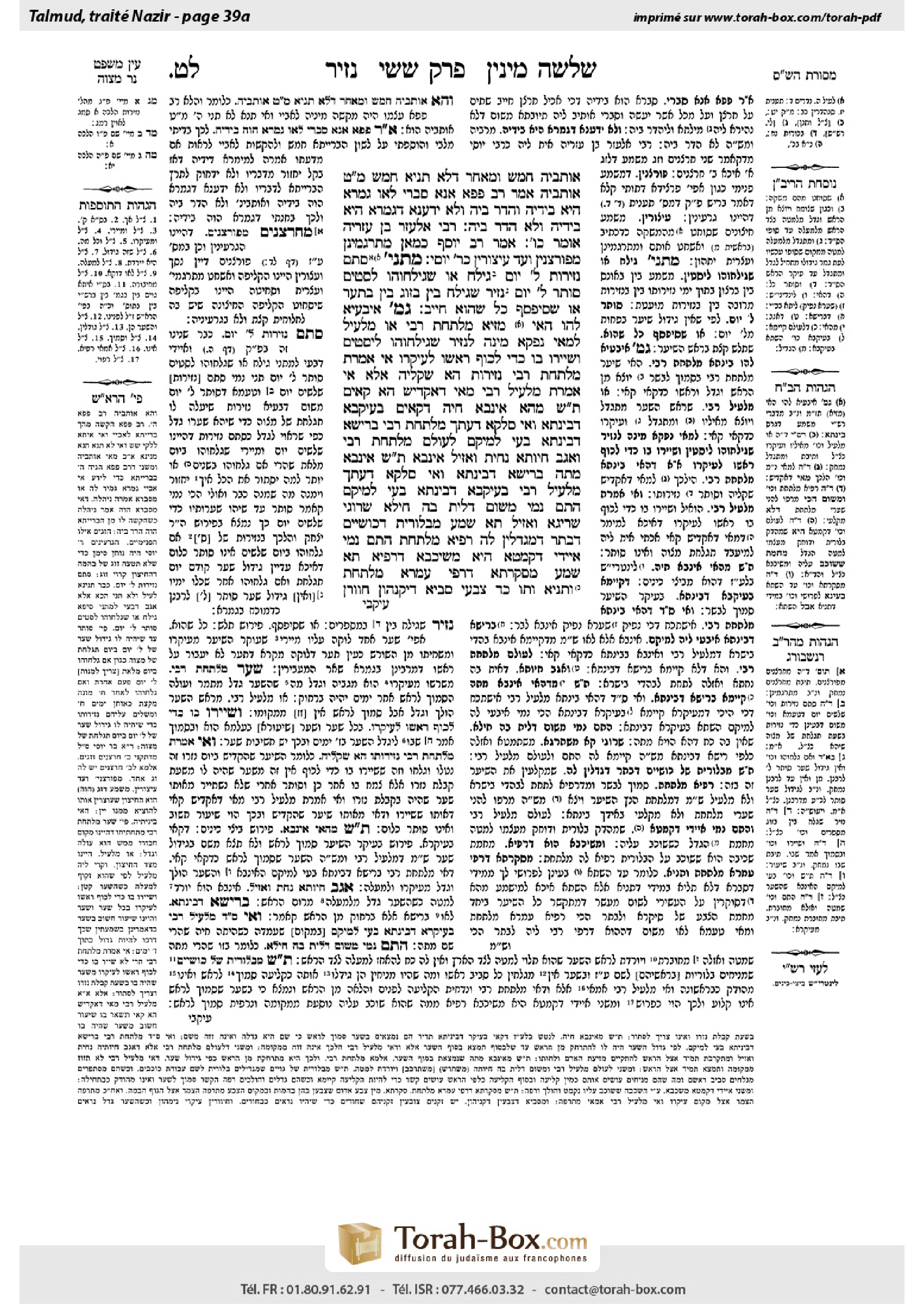
Nazir 39a: Talmud study for Daf Yomi
Daf Yomi is the daily study of one Talmud folio. Explore 37 tractates with scans, Hebrew text, Sefaria English and AI-generated French translations where annotated.
Passage selection and English or AI-generated French translation are available where the scan has annotations. Daf Study is independent of Torah-Box and Sefaria.
Browse Nazir · נזיר · All tractatesNazir 39a text and translations
This page of Nazir includes the Aramaic text, an English translation and an AI-generated French translation, alongside the scan above.
נזיר ל״ט א · Aramaic and Hebrew text
אוֹתְבֵיהּ חָמֵשׁ, וּמֵאַחַר דְּלָא תַּנְיָא חָמֵשׁ, מַאי טַעְמָא אוֹתְבֵיהּ? אָמַר רַב פָּפָּא: אֲנָא סְבַרִי לָאו גְּמָרָא הִיא בִּידֵיהּ, וְהָדַר בֵּיהּ. וְלָא יָדַעְנָא דִּגְמָרָא הִיא בִּידֵיהּ, וְלָא הָדַר בֵּיהּ.
רַבִּי אֶלְעָזָר בֶּן עֲזַרְיָה אוֹמֵר כּוּ׳. אָמַר רַב יוֹסֵף: כְּמַאן מְתַרְגְּמִינַן ״מִפּוּרְצְנִין וְעַד עִיצּוּרִין״ — כְּרַבִּי יוֹסֵי.
מַתְנִי׳ סְתַם נְזִירוּת — שְׁלֹשִׁים יוֹם. גִּילַּח אוֹ שֶׁגִּילְּחוּהוּ לִסְטִים — סוֹתֵר שְׁלֹשִׁים יוֹם. נָזִיר שֶׁגִּילַּח בֵּין בְּזוּג בֵּין בְּתַעַר, אוֹ שֶׁסִּיפְסֵף כׇּל שֶׁהוּא — חַיָּיב.
גְּמָ׳ אִיבַּעְיָא לְהוּ: הַאי מַזְיָא מִלְּתַחַת רָבֵי אוֹ מִלְּעֵיל? לְמַאי נָפְקָא מִינַּהּ? לְנָזִיר שֶׁגִּילְּחוּהוּ לִיסְטִים וְשִׁיְּירוּ בּוֹ כְּדֵי לָכוֹף רֹאשׁוֹ לְעִיקָּרוֹ.
אִי אָמְרַתְּ מִלְּתַחַת רָבֵי — נְזִירוּת הָא שַׁקְלֵיהּ. אֶלָּא אִי אָמְרַתְּ מִלְּעֵיל רָבֵי — מַאי דְּאַקְדֵּישׁ הָא קָאֵים.
תָּא שְׁמַע מֵהָא אִינְבָּא חַיָּה דְּקָאֵים בְּעִיקְבָּא דְבִינְתָּא, וְאִי סָלְקָא דַעְתָּךְ מִלְּתַחַת רָבֵי — בְּרֵישָׁא דְבִינְתָּא בָּעֵי לְמֵיקַם. לְעוֹלָם מִלְּתַחַת רָבֵי וְאַגַּב חַיּוּתָא נָחֵית וְאָזֵיל אִינְבָּא.
תָּא שְׁמַע אִינְבָּא מֵתָה בְּרֵישָׁא דְבִינְתָּא, וְאִי סָלְקָא דַעְתָּךְ מִלְּעֵיל רָבֵי — בְּעִיקְבָּא דְבִינְתָּא בָּעֵי לְמֵיקַם. הָתָם נָמֵי, מִשּׁוּם דְּלֵית בַּהּ חֵילָא שָׂרוֹגֵי שָׂרֵיגָא וְאָזֵיל.
תָּא שְׁמַע מִבְּלוֹרִית דְּכוּשִׁיִּים, דְּבָתַר דִּמְגַדְּלִין לַהּ רָפְיָא מִלְּתַחַת. הָתָם נָמֵי, אַיְּידֵי דְּקָמְטָא הִיא מִשִּׁיכְבָא דְּרָפְיָא.
תָּא שְׁמַע מִסְּקַרְתָּא, דְּרָפֵי עַמְרָא מִלְּתַחַת, וְתַנְיָא. וְתוּ: כַּד צָבְעִי סָבַיָּא דִּיקְנְהוֹן חָוְורָן
Nazir 39a · English translation
Rav Pappa himself raised his objection to Abaye’s opinion based on the premise that the tanna taught five sets of lashes, and since in the baraita it is not taught five sets of lashes, what is the reason that Rav Pappa raised his objection to Abaye’s opinion? Rav Pappa said: I held that it is not a tradition in Abaye’s hand that a nazirite is also flogged for “anything that is made of the grapevine,” but merely his own opinion, and therefore I assumed that were I to cite a baraita that explicitly contradicts his opinion he would retract his opinion. Consequently, I myself changed the wording of the baraita to see how Abaye would respond. But I did not know that this halakha is a tradition in Abaye’s hand and that therefore he did not retract his opinion.
§ The mishna taught: Rabbi Elazar ben Azarya says: He is liable only if he eats at least two ḥartzannim and one zag that together form the volume of an olive-bulk. The mishna then cites two opinions as to whether ḥartzan is a grape seed and zag is the skin, or the reverse. Rav Yosef said: In accordance with whose opinion do we translate the verse “from ḥartzannim to zag” (Numbers 6:4) as: From the seeds [purtzanin] to the skins [itzurin]? He explains: This translation is in accordance with the opinion of Rabbi Yosei.
MISHNA: A naziriteship of unspecified length lasts for thirty days. If a nazirite shaved his hair during that period, or if he was shaved by bandits [listim] against his will, this negates thirty days of his naziriteship, which he must count afresh. With regard to a nazirite who shaved his hair, whether he did so with scissors or with a razor, or if he pulled out [sifsef ] any amount, he is liable.
GEMARA: A dilemma was raised before the Sages: Does this hair that grows on the body grow from the bottom or from the top? Which part of the hair is new? The Gemara explains: What is the difference between these possibilities? The Gemara answers: It is relevant for the case of a nazirite who was shaved by bandits or shaved himself, but his head was not entirely shaved. Rather, they left part of it, so that the hair is long enough to bend its end to its root.
The Gemara explains the two sides of the dilemma: If you say that hair grows from the bottom, he has removed the hair of the naziriteship, which is the hair he vowed not to shave, and therefore he must add extra days to his term of naziriteship to allow for its proper growth. But if you say that it grows from the top, that hair which he sanctified still exists in part. Consequently, he may conclude his naziriteship and perform the mitzva of shaving.
The Gemara suggests: Come and hear a solution to this dilemma from an examination of this live louse [inba], which is always found in the root of the hair. And if it should enter your mind that hair grows from the bottom, the louse should be situated on the end of the hair, as it would be pushed up with the hair’s growth. The Gemara rejects this suggestion: Actually, one could say that hair grows from the bottom, and because it is alive the louse continuously descends, as it is always crawling toward the scalp from where it draws its nourishment.
The Gemara suggests another proof: Come and hear from the fact that a dead louse is invariably found on the end of the hair. And if it should enter your mind that hair grows from on top, it should be situated on the root of the hair. The Gemara rejects this: There too, one could say that because it has no strength it is caught where it was when it died and goes up with the growing hair.
The Gemara proposes a different proof: Come and hear from an examination of the long hair [belorit] of gentiles, which is grown for idolatrous purposes, by braiding the ends of the hair. As, after they braid it, it becomes loose underneath, which suggests that hair grows from below. The Gemara rejects this: There too, since it crumples from the effect of the person who lies upon it, it becomes loose underneath.
The Gemara offers an additional suggestion: Come and hear from the dye used on sheep, as the dyed wool becomes loose underneath. This shows that hair grows from the bottom. The Gemara adds: And this case of dyeing sheep is not merely anecdotal, as it was taught with regard to the halakhot of animal tithe. And furthermore, when old men dye their beards, we see that the beards turn white
Nazir 39a · Traduction française (IA)
Rav Pappa lui-même souleva son objection à l’opinion d’Abayé en partant du principe que le tanna enseignait cinq séries de coups de fouet. Or, puisque la baraïta ne mentionne pas cinq séries de coups de fouet, pourquoi Rav Pappa souleva-t-il cette objection à l’opinion d’Abayé ? Rav Pappa répondit : Je pensais que l’idée selon laquelle un nazirite est également passible de coups de fouet pour « tout ce qui est fait de la vigne » n’était pas une tradition transmise à Abayé, mais seulement son opinion personnelle. J’ai donc supposé que, si je citais une baraïta qui contredisait explicitement son opinion, il reviendrait sur celle-ci. C’est pourquoi j’ai moi-même modifié le texte de la baraïta pour voir comment Abayé réagirait. Mais je ne savais pas que cette halakha était une tradition transmise à Abayé et que, par conséquent, il ne reviendrait pas sur son opinion.
§ La Michna enseignait : Rabbi Elazar ben Azarya dit : Il n’est passible que s’il mange au moins deux ḥartzannim et un zag, dont le volume total équivaut à celui d’une olive. La Michna cite ensuite deux opinions quant à savoir si ḥartzan désigne un pépin de raisin et zag la peau, ou l’inverse. Rav Yosef dit : Selon l’opinion de qui traduit-on le verset « des ḥartzannim jusqu’au zag » (Nombres 6:4) par « des pépins [purtzanin] aux peaux [itzurin] » ? Il explique : Cette traduction correspond à l’opinion de Rabbi Yosei.
MICHNA : Un naziréat de durée indéterminée dure trente jours. Si un nazirite s’est rasé les cheveux durant cette période, ou si des brigands [listim] l’ont rasé contre son gré, cela annule trente jours de son naziréat, qu’il doit compter à nouveau. Quant au nazirite qui s’est rasé les cheveux, qu’il l’ait fait avec des ciseaux ou un rasoir, ou qu’il ait arraché [sifsef] ne serait-ce qu’un peu de cheveux, il est passible.
GUEMARA : Les Sages soulevèrent la question suivante : les cheveux qui poussent sur le corps poussent-ils par le bas ou par le haut ? Quelle partie du cheveu est nouvelle ? La Guemara explique : Quelle différence cela fait-il ? Elle répond : Cela a une incidence dans le cas d’un nazirite rasé par des brigands ou qui s’est rasé lui-même, mais dont la tête n’a pas été entièrement rasée. Une partie des cheveux a été laissée, de sorte qu’ils sont assez longs pour que leur extrémité puisse être ramenée jusqu’à leur racine.
La Guemara expose les deux possibilités : si l’on dit que les cheveux poussent par le bas, le nazirite a supprimé les cheveux de son naziréat, c’est-à-dire ceux qu’il avait fait vœu de ne pas raser. Il doit donc ajouter des jours à la durée de son naziréat pour leur permettre de repousser correctement. Mais si l’on dit que les cheveux poussent par le haut, une partie des cheveux qu’il a consacrés subsiste encore. Par conséquent, il peut achever son naziréat et accomplir la mitsva de se raser.
La Guemara propose : Viens et entends la réponse à cette question tirée de l’observation de ce pou vivant [inba], que l’on trouve toujours à la racine des cheveux. En effet, si l’on devait penser que les cheveux poussent par le bas, le pou devrait se trouver à l’extrémité du cheveu, puisqu’il serait repoussé vers le haut avec la pousse du cheveu. La Guemara rejette cette proposition : en réalité, on pourrait dire que les cheveux poussent par le bas et que, comme le pou est vivant, il descend continuellement, car il rampe sans cesse vers le cuir chevelu, d’où il tire sa nourriture.
La Guemara propose une autre preuve : viens et entends ceci, à savoir qu’on trouve invariablement un pou mort à l’extrémité du cheveu. En effet, si l’on devait penser que les cheveux poussent par le haut, le pou devrait se trouver à la racine du cheveu. La Guemara rejette cette preuve : là aussi, on pourrait dire que, comme le pou n’a plus de force, il reste là où il se trouvait lorsqu’il est mort et monte avec la pousse du cheveu.
La Guemara propose une autre preuve : viens et entends ceci, à propos des longues mèches [belorit] des non-Juifs, qu’ils laissent pousser à des fins idolâtres en tressant l’extrémité des cheveux. Après le tressage, elles se relâchent par-dessous, ce qui suggère que les cheveux poussent par le bas. La Guemara rejette cette preuve : là aussi, elles se relâchent par-dessous parce qu’elles sont écrasées par la personne qui s’allonge dessus.
La Guemara propose une autre preuve : viens et entends ceci, à propos de la teinture utilisée sur les moutons : la laine teinte se relâche par-dessous. Cela montre que les cheveux poussent par le bas. La Guemara ajoute que ce cas de teinture des moutons n’est pas une simple anecdote, car il a été enseigné à propos des lois de la dîme des animaux. En outre, lorsque des vieillards teignent leur barbe, on voit que leurs poils deviennent blancs
Traduction française générée par IA à partir de l’édition anglaise de Sefaria. Vérifie toujours un passage avec le texte source.
Text from Sefaria: William Davidson Edition - Vocalized Aramaic (CC BY NC); William Davidson Edition - English (CC BY NC).