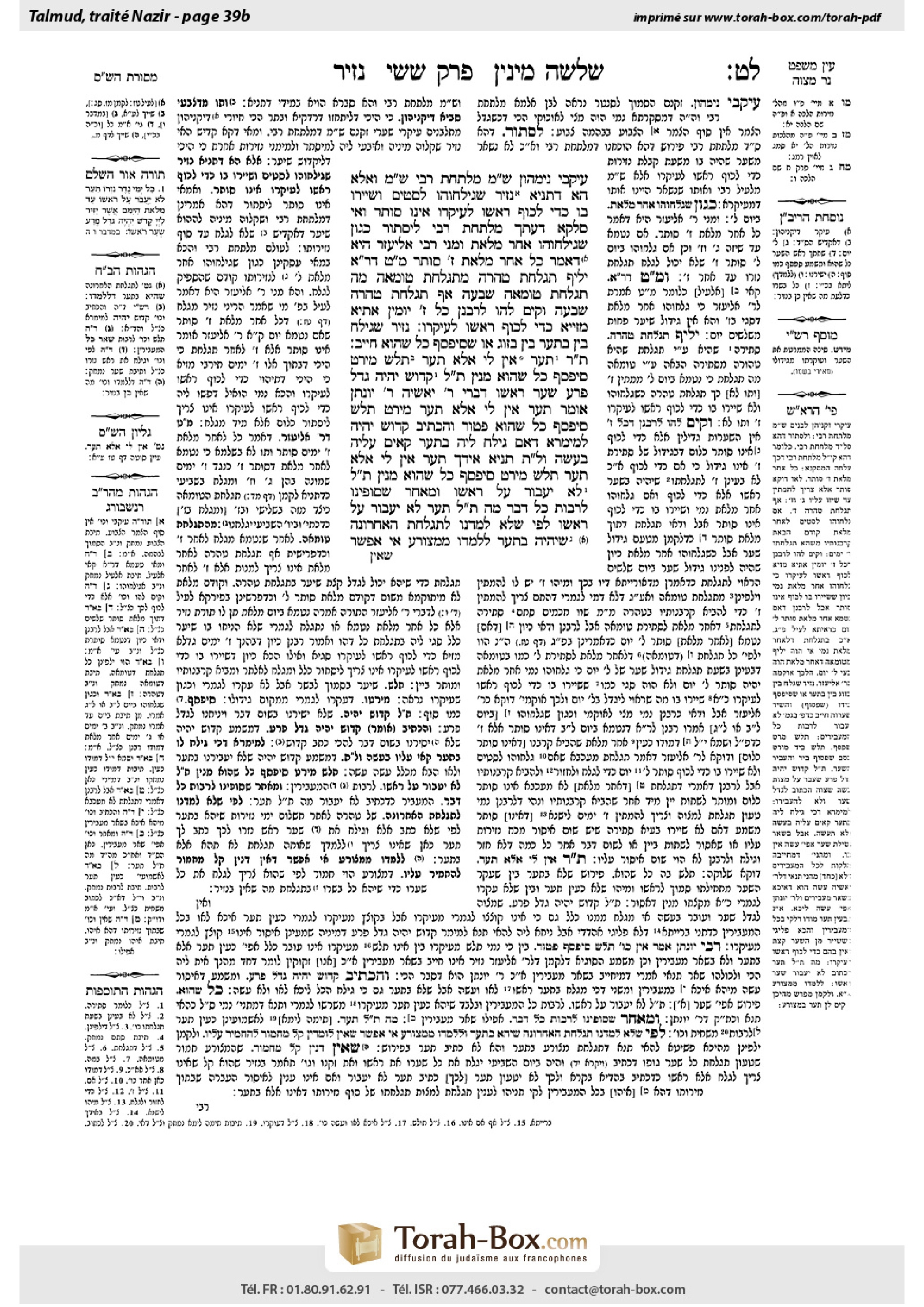
Nazir 39b: Talmud study for Daf Yomi
Daf Yomi is the daily study of one Talmud folio. Explore 37 tractates with scans, Hebrew text, Sefaria English and AI-generated French translations where annotated.
Passage selection and English or AI-generated French translation are available where the scan has annotations. Daf Study is independent of Torah-Box and Sefaria.
Browse Nazir · נזיר · All tractatesNazir 39b text and translations
This page of Nazir includes the Aramaic text, an English translation and an AI-generated French translation, alongside the scan above.
נזיר ל״ט ב · Aramaic and Hebrew text
עִיקְבֵי נִימְהוֹן, שְׁמַע מִינַּהּ מִלְּתַחַת רָבֵי. שְׁמַע מִינַּהּ.
וְאֶלָּא הָא דְּתַנְיָא: נָזִיר שֶׁגִּילְּחוּהוּ לִסְטִים, וְשִׁיְּירוּ בּוֹ כְּדֵי לָכוֹף רֹאשׁוֹ לְעִיקָּרוֹ — אֵינוֹ סוֹתֵר. וְאִי סָלְקָא דַעְתָּךְ מִלְּתַחַת רָבֵי, לִיסְתּוֹר! כְּגוֹן שֶׁגִּילְּחוּהוּ אַחַר מְלֹאת. וּמַנִּי — רַבִּי אֱלִיעֶזֶר הִיא, דְּאָמַר: כׇּל אַחַר מְלֹאת שִׁבְעָה סוֹתֵר.
מַאי טַעְמָא דְּרַבִּי אֱלִיעֶזֶר? יָלֵיף תִּגְלַחַת טׇהֳרָה מִתִּגְלַחַת טוּמְאָה. מַה תִּגְלַחַת טוּמְאָה שִׁבְעָה, אַף תִּגְלַחַת טׇהֳרָה — שִׁבְעָה.
וְקִים לְהוּ לְרַבָּנַן כׇּל שִׁבְעָה יוֹמִין אָתְיָא מַזְיָיא כְּדֵי לָכוֹף רֹאשׁוֹ לְעִיקָּרוֹ.
נָזִיר שֶׁגִּילַּח בֵּין בְּתַעַר בֵּין בְּזוּג, אוֹ שֶׁסִּיפְסֵף כׇּל שֶׁהוּא — חַיָּיב. תָּנוּ רַבָּנַן: ״תַּעַר״, אֵין לִי אֶלָּא תַּעַר. תָּלַשׁ, מֵירַט, סִיפְסֵף כׇּל שֶׁהוּא, מִנַּיִן — תַּלְמוּד לוֹמַר: ״קָדוֹשׁ יִהְיֶה גַּדֵּל פֶּרַע שְׂעַר רֹאשׁוֹ״, דִּבְרֵי רַבִּי יֹאשִׁיָּה.
רַבִּי יוֹנָתָן אוֹמֵר: ״תַּעַר״, אֵין לִי אֶלָּא תַּעַר. מֵירַט, תָּלַשׁ, סִיפְסֵף כׇּל שֶׁהוּא — פָּטוּר. וְהָכְתִיב ״קָדוֹשׁ יִהְיֶה״! מֵימְרָא דְּאִם גִּילַּח לֵיהּ בְּתַעַר — קָאֵים עֲלֵיהּ בַּעֲשֵׂה וְלֹא תַעֲשֶׂה.
תַּנְיָא אִידַּךְ: ״תַּעַר״, אֵין לִי אֶלָּא תַּעַר. תָּלַשׁ, מֵירַט, סִיפְסֵף כׇּל שֶׁהוּא, מִנַּיִן — תַּלְמוּד לוֹמַר: ״לֹא יַעֲבוֹר עַל רֹאשׁוֹ״. וּמֵאַחַר שֶׁסּוֹפֵינוּ לְרַבּוֹת כֹּל דָּבָר, מָה תַּלְמוּד לוֹמַר ״תַּעַר לֹא יַעֲבוֹר עַל רֹאשׁוֹ״?
לְפִי שֶׁלֹּא לָמַדְנוּ לְתִגְלַחַת הָאַחֲרוֹנָה שֶׁיִּהְיֶה בְּתַעַר. לְלַמְּדוֹ מִמְּצוֹרָע — אִי אֶפְשָׁר,
Nazir 39b · English translation
at the roots of their hair. You can learn from it that hair grows from the bottom, as the new hair is not dyed. The Gemara concludes: Indeed, learn from it that it is so.
The Gemara asks: But what about this halakha that is taught in a baraita: With regard to a nazirite who was shaved by bandits, and they left him with enough hair to bend its end to its root, this does not negate the days of his naziriteship. And if it should enter your mind that hair grows from the bottom, let it negate the days of his naziriteship in that case as well, as the remaining hair grew only after his acceptance of naziriteship. The Gemara answers: This is referring to a case where they shaved him after the completion of his naziriteship but before he sacrificed his offerings, and whose opinion is expressed in this baraita? It is the opinion of Rabbi Eliezer, who says: With regard to any nazirite who became ritually impure after the completion of his term, this negates only seven days.
The Gemara asks: What is the reason of Rabbi Eliezer? The Gemara answers: He derives the halakha of the shaving of ritual purity at the end of his term of naziriteship (see Numbers 6:18) from the shaving of impurity (see Numbers 6:9): Just as with the shaving of impurity, if he became impure on the day of the completion of his term he must wait seven days, at which point he is purified from the impurity imparted by a corpse and shaves his hair, so too with the shaving of purity; if he was shaved before he brought his offerings, he negates only seven days.
And the Sages, including Rabbi Eliezer, have an accepted tradition that every seven days hair grows enough to bend its end to its root. Consequently, if this amount of hair remained after he was shaved on the day of the completion of his naziriteship, he does not forfeit any days and need not wait any longer.
§ The mishna taught: With regard to a nazirite who shaved his hair, whether he did so with scissors or with a razor, or if he pulled out any amount, he is liable. The Sages taught: The Torah states with regard to a nazirite: “A razor shall not come upon his head” (Numbers 6:5). I have derived only a razor; from where do I derive that he is liable if he tore out, uprooted, or pulled out any amount of his hair? The verse states: “He shall be holy, he shall let the locks of the hair of his head grow long” (Numbers 6:5). This is the statement of Rabbi Yoshiya.
Rabbi Yonatan says a different interpretation: From “razor” I have derived only a razor, whereas if he tore out, uprooted, or pulled out any amount of his hair, he is exempt. The Gemara asks: But isn’t it written: “He shall be holy”? The Gemara answers: That is to say that if he shaved his hair with a razor he stands liable for violating both a positive mitzva and a prohibition. By shaving with a razor he also transgresses the positive mitzva of: “He shall be holy, he shall let the locks of the hair of his head grow long” (Numbers 6:5).
It is taught in another baraita: From “razor” I have derived only a razor; from where do I derive that he is also liable if he tore out, uprooted, or pulled out any amount of it? The verse states: “A razor shall not come upon his head” (Numbers 6:5), indicating that he may not remove his hair in any manner. The baraita asks: And since we eventually include everything that removes hair, what is the meaning when the verse states: “A razor shall not come upon his head”? Why does the verse mention a razor, when other implements are equally forbidden?
The baraita answers: It is because we have not learned that the last shaving, i.e., the nazirite’s shaving of ritual purity, must be performed specifically with a razor, as the verse merely states: “He shall shave his head” (Numbers 6:18), without specifying an implement. It is impossible to learn this requirement from the halakha that a leper must use a razor (see Leviticus 14:9),
Nazir 39b · Traduction française (IA)
à la racine de leurs cheveux. On peut en déduire que les cheveux poussent depuis la racine, puisque les nouveaux cheveux ne sont pas teints. La Guemara conclut : En effet, apprends-en qu’il en est ainsi.
La Guemara demande : Mais qu’en est-il de cette halakha enseignée dans une baraïta : un nazir qui a été rasé par des brigands, lesquels lui ont laissé suffisamment de cheveux pour qu’il puisse en plier la pointe jusqu’à la racine, ne voit pas les jours de son naziréat annulés. Et si tu devais penser que les cheveux poussent depuis la racine, les jours de son naziréat devraient également être annulés dans ce cas, puisque les cheveux restants n’ont poussé qu’après qu’il eut accepté le naziréat. La Guemara répond : Il s’agit d’un cas où ils l’ont rasé après l’achèvement de son naziréat, mais avant qu’il n’apporte ses offrandes. Et de qui cette baraïta exprime-t-elle l’opinion ? De Rabbi Eliezer, qui dit : Tout nazir devenu rituellement impur après l’achèvement de sa période ne voit que sept jours annulés.
La Guemara demande : Quelle est la raison de Rabbi Eliezer ? La Guemara répond : Il déduit la halakha du rasage de purification, à la fin de la période de naziréat (voir Nombres 6:18), de celle du rasage d’impureté (voir Nombres 6:9) : de même que, dans le cas du rasage d’impureté, s’il est devenu impur le jour où sa période s’achevait, il doit attendre sept jours, au terme desquels il est purifié de l’impureté due à un cadavre et se rase les cheveux, de même, dans le cas du rasage de purification, s’il a été rasé avant d’apporter ses offrandes, il ne voit que sept jours annulés.
Les Sages, Rabbi Eliezer compris, ont reçu par tradition que les cheveux poussent suffisamment en sept jours pour que leur pointe puisse être pliée jusqu’à la racine. Par conséquent, si cette longueur de cheveux lui est restée après qu’il a été rasé le jour où son naziréat s’achevait, il ne perd aucun jour et n’a pas besoin d’attendre davantage.
§ La Michna enseignait : Un nazir qui s’est rasé les cheveux, que ce soit avec des ciseaux ou avec un rasoir, ou qui en a arraché une quantité quelconque, est passible. Les Sages ont enseigné : À propos du nazir, la Torah dit : « Le rasoir ne passera pas sur sa tête » (Nombres 6:5). Je n’ai déduit de là que le cas du rasoir ; d’où déduis-je qu’il est passible s’il a déchiré, déraciné ou arraché une quantité quelconque de ses cheveux ? Le verset dit : « Il sera saint ; il laissera pousser les mèches de ses cheveux » (Nombres 6:5). Telle est la déclaration de Rabbi Yoshiya.
Rabbi Yonatan donne une autre interprétation : Du mot « rasoir », je n’ai déduit que le cas du rasoir ; en revanche, s’il a déchiré, déraciné ou arraché une quantité quelconque de ses cheveux, il est exempt. La Guemara demande : Mais n’est-il pas écrit : « Il sera saint » ? La Guemara répond : Cela signifie que s’il s’est rasé les cheveux avec un rasoir, il est passible à la fois pour la violation d’une mitsva positive et d’une interdiction. En se rasant avec un rasoir, il transgresse également la mitsva positive : « Il sera saint ; il laissera pousser les mèches de ses cheveux » (Nombres 6:5).
Une autre baraïta enseigne : Du mot « rasoir », je n’ai déduit que le cas du rasoir ; d’où déduis-je qu’il est également passible s’il a déchiré, déraciné ou arraché une quantité quelconque de ses cheveux ? Le verset dit : « Le rasoir ne passera pas sur sa tête » (Nombres 6:5), ce qui indique qu’il ne peut retirer ses cheveux d’aucune manière. La baraïta demande : Et puisque nous incluons finalement tout ce qui retire les cheveux, que signifie alors la formulation du verset : « Le rasoir ne passera pas sur sa tête » ? Pourquoi le verset mentionne-t-il un rasoir, alors que les autres instruments sont tout autant interdits ?
La baraïta répond : C’est parce que nous n’avons pas appris que le dernier rasage, c’est-à-dire le rasage de purification du nazir, doit être effectué précisément avec un rasoir ; le verset dit seulement : « Il rasera sa tête » (Nombres 6:18), sans préciser l’instrument. Il est impossible de déduire cette exigence de la halakha selon laquelle un lépreux doit utiliser un rasoir (voir Lévitique 14:9),
Traduction française générée par IA à partir de l’édition anglaise de Sefaria. Vérifie toujours un passage avec le texte source.
Text from Sefaria: William Davidson Edition - Vocalized Aramaic (CC BY NC); William Davidson Edition - English (CC BY NC).