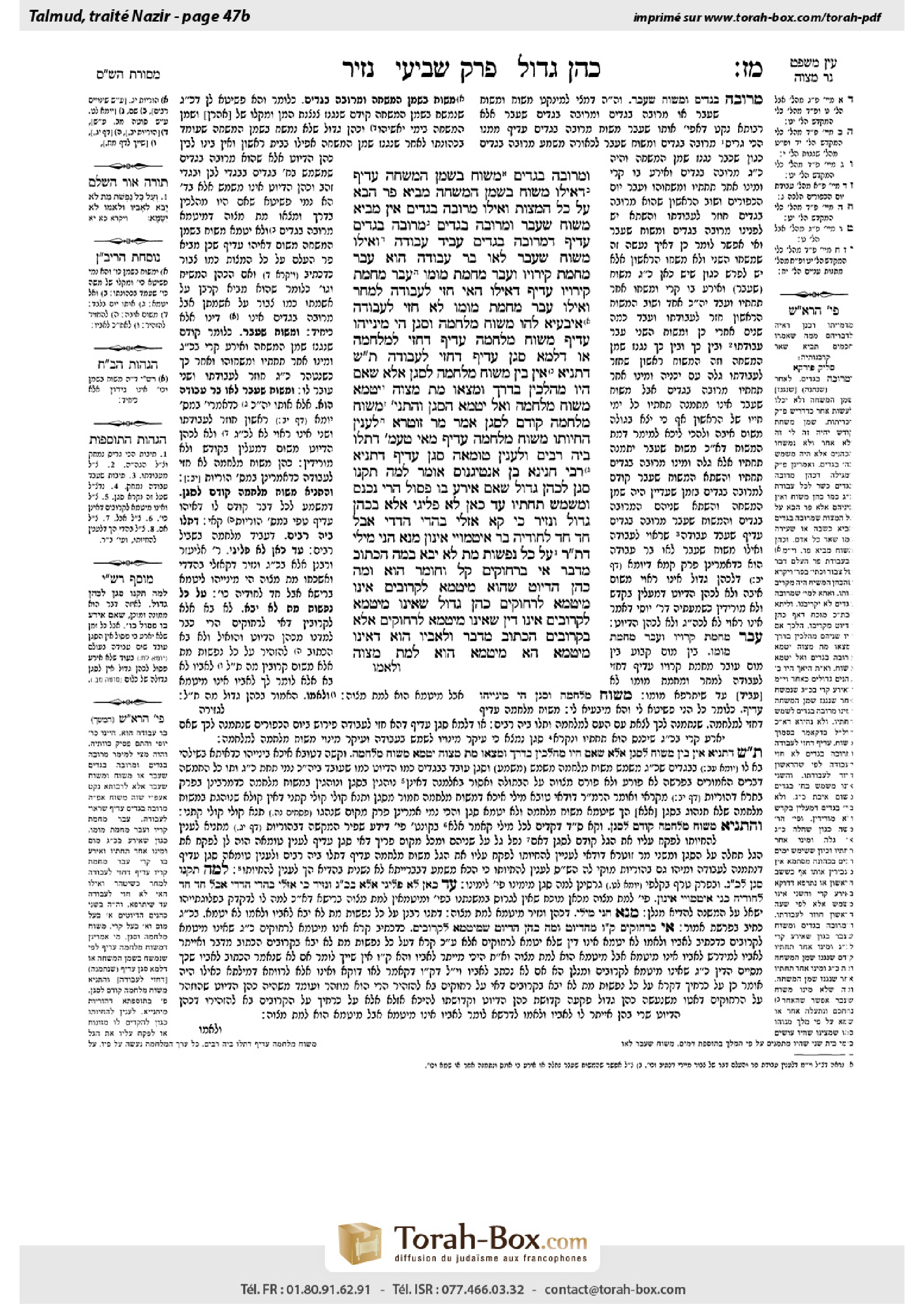
Nazir 47b: Talmud study for Daf Yomi
Daf Yomi is the daily study of one Talmud folio. Explore 37 tractates with scans, Hebrew text, Sefaria English and AI-generated French translations where annotated.
Passage selection and English or AI-generated French translation are available where the scan has annotations. Daf Study is independent of Torah-Box and Sefaria.
Browse Nazir · נזיר · All tractatesNazir 47b text and translations
This page of Nazir includes the Aramaic text, an English translation and an AI-generated French translation, alongside the scan above.
נזיר מ״ז ב · Aramaic and Hebrew text
וּמְרוּבֵּה בְגָדִים — מָשׁוּחַ בְּשֶׁמֶן הַמִּשְׁחָה עָדִיף, דְּאִילּוּ מָשׁוּחַ בְּשֶׁמֶן הַמִּשְׁחָה — מֵבִיא פַּר הַבָּא עַל כׇּל הַמִּצְוֹת, וְאִילּוּ מְרוּבֵּה בְגָדִים — אֵין מֵבִיא.
מָשׁוּחַ שֶׁעָבַר וּמְרוּבֵּה בְגָדִים — מְרוּבֵּה בְגָדִים עָדִיף, דִּמְרוּבֵּה בְגָדִים — עָבֵיד עֲבוֹדָה, וְאִילּוּ מָשׁוּחַ שֶׁעָבַר — לָאו בַּר עֲבוֹדָה הוּא.
עָבַר מֵחֲמַת קֵירוּיוֹ וְעָבַר מֵחֲמַת מוּמוֹ — עָבַר מֵחֲמַת קֵירוּיוֹ עָדִיף, דְּאִילּוּ הַאי חֲזִי לַעֲבוֹדָה לְמָחָר, וְאִילּוּ עָבַר מֵחֲמַת מוּמוֹ לֹא חֲזִי לָעֲבוֹדָה.
אִיבַּעְיָא לְהוּ: מְשׁוּחַ מִלְחָמָה וּסְגָן, הֵי מִינַּיְיהוּ עֲדִיף? מְשׁוּחַ מִלְחָמָה עֲדִיף — דַּחֲזֵי לְמִלְחָמָה, אוֹ דִּלְמָא סְגָן עֲדִיף — דַּחֲזֵי לַעֲבוֹדָה?
תָּא שְׁמַע, דְּתַנְיָא: אֵין בֵּין מְשׁוּחַ מִלְחָמָה לִסְגָן, אֶלָּא שֶׁאִם הָיוּ מְהַלְּכִין בְּדֶרֶךְ וּמָצְאוּ מֵת מִצְוָה — יִטַּמֵּא מְשׁוּחַ מִלְחָמָה וְאַל יִטַּמֵּא הַסְּגָן.
וְהָתַנְיָא: מְשׁוּחַ מִלְחָמָה קוֹדֵם לִסְגָן! אָמַר מָר זוּטְרָא: לְעִנְיַן הַחֲיוֹתוֹ — מְשׁוּחַ מִלְחָמָה עֲדִיף, מַאי טַעְמָא — דִּתְלוּ בֵּיהּ רַבִּים,
וּלְעִנְיַן טוּמְאָה סְגָן עֲדִיף. דְּתַנְיָא, רַבִּי חֲנִינָא בֶּן אַנְטִיגְנוֹס אוֹמֵר: לָמָּה תִּקְּנוּ סְגָן לְכֹהֵן גָּדוֹל — שֶׁאִם אֵירַע בּוֹ פְּסוּל הֲרֵי נִכְנָס וּמְשַׁמֵּשׁ תַּחְתָּיו.
עַד כָּאן לָא פְּלִיגִי אֶלָּא בְּכֹהֵן גָּדוֹל וְנָזִיר כִּי קָא אָזְלִי בַּהֲדֵי הֲדָדֵי, אֲבָל חַד חַד לְחוֹדֵיהּ בַּר אִיטַּמּוֹיֵי אִינּוּן. מְנָא הָנֵי מִילֵּי?
דְּתָנוּ רַבָּנַן: ״עַל כׇּל נַפְשׁוֹת מֵת לֹא יָבֹא״, בַּמָּה הַכָּתוּב מְדַבֵּר? אִי בִּרְחוֹקִים — קַל וָחוֹמֶר הוּא: וּמָה כֹּהֵן הֶדְיוֹט שֶׁהוּא מִיטַּמֵּא לִקְרוֹבִים אֵינוֹ מִיטַּמֵּא לִרְחוֹקִים, כֹּהֵן גָּדוֹל שֶׁאֵינוֹ מִיטַּמֵּא לִקְרוֹבִים, אֵינוֹ דִּין שֶׁאֵינוֹ מִיטַּמֵּא לִרְחוֹקִים? אֶלָּא בִּקְרוֹבִים הַכָּתוּב מְדַבֵּר.
וּלְאָבִיו הוּא דְּאֵינוֹ מִיטַּמֵּא, הָא מִיטַּמֵּא הוּא לְמֵת מִצְוָה.
Nazir 47b · English translation
and a High Priest of many garments, i.e., one who was not anointed with oil but who was sanctified by wearing the eight garments of a High Priest, it is preferable that the one who was anointed with the anointing oil remain ritually pure. The Gemara explains: As a High Priest anointed with the anointing oil brings the bull brought for all the mitzvot, i.e., if an anointed priest ruled erroneously with regard to a prohibition that if a Jew transgressed it he would be liable to bring a sin-offering, he brings a bull for his sin-offering (see Leviticus 4:3–12), while a High Priest of many garments does not bring a bull.
In a case where a former anointed High Priest, i.e., a priest who had temporarily substituted for a High Priest, is walking together with one of many garments, it is preferable that the one who wears many garments remain ritually pure. The reason is that a High Priest of many garments still performs the service, whereas a former anointed High Priest is no longer able to perform the service.
In a case where an anointed High Priest who temporarily left his role due to his seminal emission is walking with a former anointed High Priest who left his role due to his blemish, it is preferable that the former High Priest who left due to his seminal emission remain ritually pure, as this one, the High Priest who experienced an emission, is fit for the Temple service the following day, while the former anointed High Priest who left due to his blemish is no longer fit for the service at all (see Leviticus 21:16–24).
§ The above cases are all easily resolved and are mentioned merely to introduce the following inquiries, for which there are no obvious answers. A dilemma was raised before the Sages. For which of these two is it preferable that he remain ritually pure: A priest anointed for war, who was anointed with oil and appointed to admonish the troops before battle (see Deuteronomy 20:2) or the deputy [segan] High Priest? Is it preferable that the priest anointed for war remain ritually pure, as he is fit for war? Or, perhaps it is preferable that the deputy High Priest remain ritually pure, as he is fit for service in the Temple in place of the High Priest.
The Gemara suggests: Come and hear a resolution, as it is taught in a baraita: The difference between a priest anointed for war and a deputy High Priest is only that if they were walking along the way and found a met mitzva, the ruling is: Let the one anointed for war become impure, and do not let the deputy become impure.
The Gemara asks: But isn’t it taught in a different baraita: A priest anointed for war takes precedence over the deputy High Priest? Mar Zutra said: This is not difficult. With regard to preserving his life and rescuing him from captivity or from a dangerous situation, it is preferable to preserve the one anointed for war. What is the reason for this? The reason is that the public depends on him in a time of war.
But with regard to ritual impurity, it is preferable that the deputy High Priest remain ritually pure, as it is taught in a baraita that Rabbi Ḥanina ben Antigonus says: Why did the Sages institute a deputy for the High Priest? So that if a disqualification befalls the High Priest, his deputy can enter the Temple and serve in his stead. The deputy High Priest cannot fulfill this function if he is allowed to become ritually impure.
The Gemara turns its attention to the halakha of the mishna. Rabbi Eliezer and the Rabbis disagree only with regard to a High Priest and a nazirite who are walking together and find a met mitzva, in which case one of them must become impure. However, it is evident that if each of them is walking separately, they are able, i.e., they are required, to become impure. From where are these matters derived? From where is it learned that a High Priest and a nazirite, who are prohibited from becoming impure even to bury their relatives, must nevertheless become impure to bury a met mitzva?
It is as the Sages taught: The verse states with regard to a High Priest: “Neither shall he go in to any dead bodies; nor defile himself for his father or for his mother” (Leviticus 21:11). With regard to what bodies is the verse speaking? If it is referring to distant people, i.e., non-relatives, that halakha can be derived by an a fortiori inference: And if a common priest, who becomes impure to bury his close family members, may not become impure to bury distant people, then with regard to a High Priest, who does not become impure even to bury close members of his family, is it not logical that he does not become impure to bury distant people? Rather, the verse is speaking of close family members, and it prohibits a High Priest from becoming impure to bury any person, even his relatives.
The Gemara comments: With regard to the rest of the verse: “Nor defile himself for his father or for his mother” (Leviticus 21:11), each of these clauses must serve to teach a novel halakha. And the phrase “for his father” teaches: It is to bury his father that he may not become ritually impure, from which it may be inferred that he becomes impure to bury a met mitzva.
Nazir 47b · Traduction française (IA)
Et, entre un grand prêtre aux nombreux vêtements, c’est-à-dire un grand prêtre qui n’a pas été oint d’huile, mais sanctifié par le port des huit vêtements du grand prêtre, et un grand prêtre oint d’huile, il est préférable que celui qui a été oint d’huile demeure en état de pureté rituelle. La Guemara explique : le grand prêtre oint d’huile apporte le taureau prévu pour toutes les mitsvot : si un prêtre oint statue par erreur au sujet d’une interdiction dont la transgression par un Juif entraîne l’obligation d’apporter un sacrifice expiatoire, il apporte un taureau en sacrifice expiatoire (voir Lévitique 4, 3-12), tandis qu’un grand prêtre aux nombreux vêtements n’apporte pas de taureau.
Dans le cas où un ancien grand prêtre oint — c’est-à-dire un prêtre qui a temporairement remplacé un grand prêtre — marche avec un grand prêtre aux nombreux vêtements, il est préférable que celui qui porte les nombreux vêtements demeure en état de pureté rituelle. En effet, un grand prêtre aux nombreux vêtements accomplit encore le service, tandis qu’un ancien grand prêtre oint n’est plus en mesure de l’accomplir.
Dans le cas où un grand prêtre oint qui a temporairement quitté ses fonctions à la suite d’une émission séminale marche avec un ancien grand prêtre oint qui a quitté ses fonctions en raison d’un défaut corporel, il est préférable que le premier, qui a quitté ses fonctions à la suite de son émission séminale, demeure en état de pureté rituelle. En effet, le grand prêtre qui a eu une émission est apte au service du Temple dès le lendemain, tandis que l’ancien grand prêtre oint qui a quitté ses fonctions en raison de son défaut corporel n’est plus du tout apte au service (voir Lévitique 21, 16-24).
§ Tous les cas précédents se résolvent aisément et ne sont mentionnés que pour introduire les questions suivantes, auxquelles il n’existe pas de réponse évidente. Les Sages posèrent un dilemme : lequel des deux est-il préférable de maintenir en état de pureté rituelle : le prêtre oint pour la guerre, qui a été oint d’huile et chargé d’exhorter les troupes avant la bataille (voir Deutéronome 20, 2), ou le grand prêtre adjoint [segan] ? Est-il préférable que le prêtre oint pour la guerre demeure en état de pureté rituelle, puisqu’il est apte à la guerre ? Ou bien est-il préférable que le grand prêtre adjoint demeure en état de pureté rituelle, puisqu’il est apte à accomplir le service du Temple à la place du grand prêtre ?
La Guemara propose : « Viens et entends » une réponse, car il est enseigné dans une baraïta : la seule différence entre un prêtre oint pour la guerre et un grand prêtre adjoint est que, s’ils cheminaient et trouvaient un met mitsva, la règle est la suivante : que le prêtre oint pour la guerre devienne impur, mais que le grand prêtre adjoint ne devienne pas impur.
La Guemara demande : Mais n’est-il pas enseigné dans une autre baraïta qu’un prêtre oint pour la guerre a priorité sur le grand prêtre adjoint ? Mar Zutra dit : Il n’y a pas de contradiction. Lorsqu’il s’agit de préserver sa vie et de le délivrer de la captivité ou d’une situation dangereuse, il est préférable de préserver le prêtre oint pour la guerre. Pourquoi ? Parce que le public dépend de lui en temps de guerre.
Mais en matière d’impureté rituelle, il est préférable que le grand prêtre adjoint demeure en état de pureté rituelle, comme il est enseigné dans une baraïta que Rabbi Ḥanina ben Antigonus dit : « Pourquoi les Sages ont-ils institué un adjoint pour le grand prêtre ? Afin que, si le grand prêtre est frappé d’une incapacité, son adjoint puisse entrer dans le Temple et officier à sa place. » Le grand prêtre adjoint ne peut remplir cette fonction si on le laisse devenir impur rituellement.
La Guemara revient à la halakha de la Michna. Rabbi Eliezer et les Sages ne sont en désaccord que dans le cas où un grand prêtre et un nazir cheminent ensemble et trouvent un met mitsva : l’un d’eux doit alors devenir impur. Cependant, il est évident que, si chacun d’eux chemine séparément, ils peuvent — c’est-à-dire qu’ils doivent — devenir impurs. De quoi ces règles sont-elles déduites ? D’où apprend-on qu’un grand prêtre et un nazir, à qui il est interdit de devenir impurs même pour enterrer leurs proches, doivent néanmoins devenir impurs pour enterrer un met mitsva ?
C’est ainsi que les Sages l’ont enseigné : au sujet du grand prêtre, le verset dit : « Il n’ira auprès d’aucun mort et ne se rendra pas impur pour son père ni pour sa mère » (Lévitique 21, 11). De quels morts le verset parle-t-il ? S’il s’agit de personnes éloignées, c’est-à-dire de personnes qui ne sont pas parentes, cette halakha peut se déduire par un raisonnement a fortiori : si un prêtre ordinaire, qui devient impur pour enterrer les membres proches de sa famille, ne peut devenir impur pour enterrer des personnes éloignées, alors, à plus forte raison, un grand prêtre, qui ne devient même pas impur pour enterrer les membres proches de sa famille, ne peut-il devenir impur pour enterrer des personnes éloignées. Le verset parle donc des membres proches de la famille et interdit au grand prêtre de devenir impur pour enterrer qui que ce soit, même ses proches.
La Guemara commente : Dans la suite du verset, « ni ne se rendra impur pour son père ni pour sa mère » (Lévitique 21, 11), chacune de ces expressions doit enseigner une halakha nouvelle. L’expression « pour son père » enseigne que c’est pour enterrer son père qu’il ne peut devenir impur rituellement ; on peut en déduire qu’il devient impur pour enterrer un met mitsva.
Traduction française générée par IA à partir de l’édition anglaise de Sefaria. Vérifie toujours un passage avec le texte source.
Text from Sefaria: William Davidson Edition - Vocalized Aramaic (CC BY NC); William Davidson Edition - English (CC BY NC).