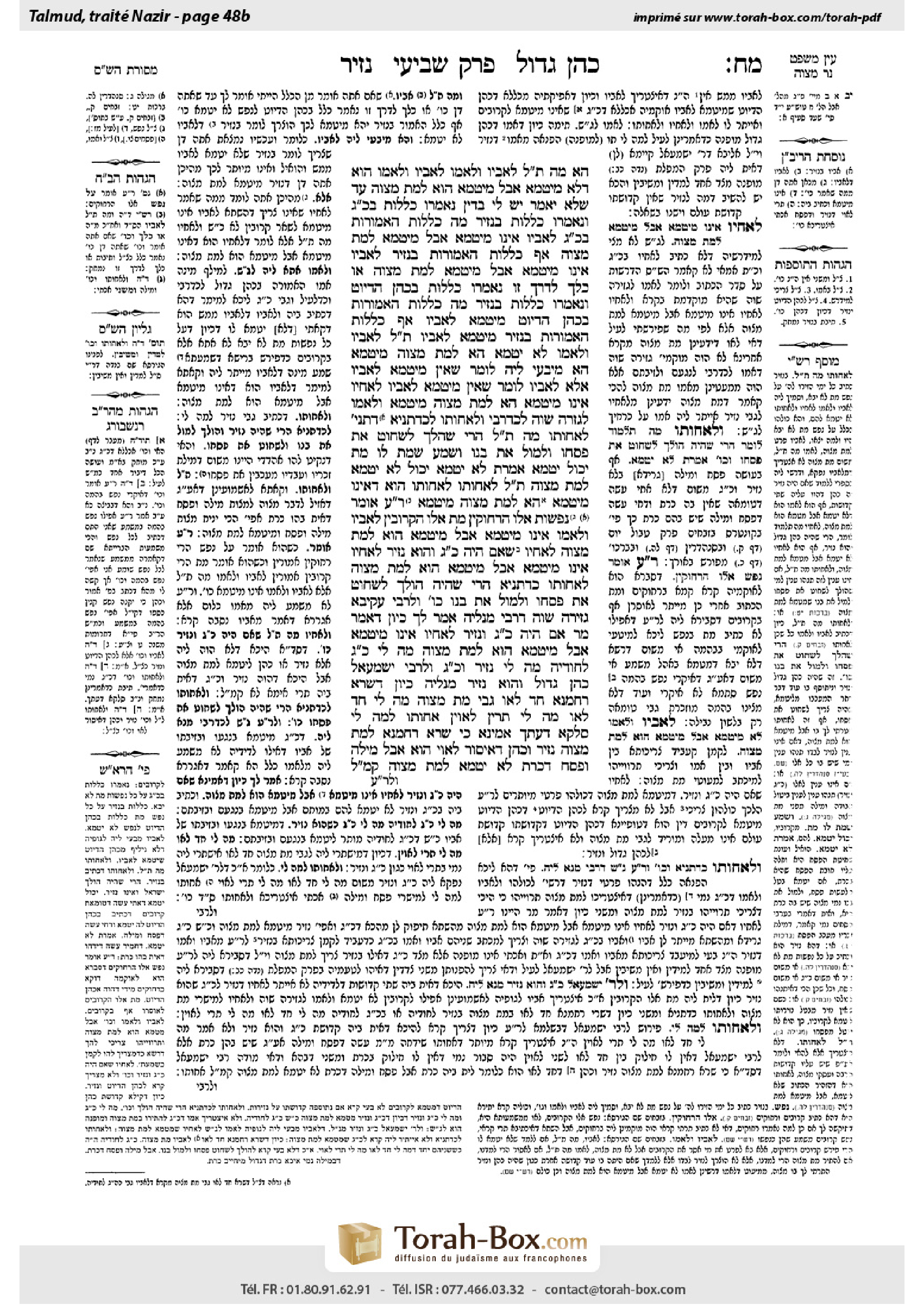
Nazir 48b: Talmud study for Daf Yomi
Daf Yomi is the daily study of one Talmud folio. Explore 37 tractates with scans, Hebrew text, Sefaria English and AI-generated French translations where annotated.
Passage selection and English or AI-generated French translation are available where the scan has annotations. Daf Study is independent of Torah-Box and Sefaria.
Browse Nazir · נזיר · All tractatesNazir 48b text and translations
This page of Nazir includes the Aramaic text, an English translation and an AI-generated French translation, alongside the scan above.
נזיר מ״ח ב · Aramaic and Hebrew text
הָא מָה תַּלְמוּד לוֹמַר ״לְאָבִיו וּלְאִמּוֹ״, לְאָבִיו וּלְאִמּוֹ הוּא דְּלֹא מִיטַּמֵּא, אֲבָל מִיטַּמֵּא הוּא לְמֵת מִצְוָה.
עַד שֶׁלֹּא יֵאָמֵר יֵשׁ לִי בַּדִּין: נֶאֶמְרוּ כְּלָלוֹת בְּכֹהֵן גָּדוֹל, וְנֶאֶמְרוּ כְּלָלוֹת בְּנָזִיר. מָה כְּלָלוֹת הָאֲמוּרוֹת בְּכֹהֵן גָּדוֹל — לְאָבִיו אֵינוֹ מִיטַּמֵּא, אֲבָל מִיטַּמֵּא לְמֵת מִצְוָה, אַף כְּלָלוֹת הָאֲמוּרוֹת בְּנָזִיר — לְאָבִיו אֵינוֹ מִיטַּמֵּא, אֲבָל מִיטַּמֵּא לְמֵת מִצְוָה.
אוֹ כְּלָךְ לְדֶרֶךְ זוֹ: נֶאֶמְרוּ כְּלָלוֹת בְּכֹהֵן הֶדְיוֹט, וְנֶאֶמְרוּ כְּלָלוֹת בְּנָזִיר. מָה כְּלָלוֹת הָאֲמוּרוֹת בְּכֹהֵן הֶדְיוֹט — מִיטַּמֵּא לְאָבִיו, אַף כְּלָלוֹת הָאֲמוּרוֹת בְּנָזִיר — מִיטַּמֵּא לְאָבִיו.
תַּלְמוּד לוֹמַר: ״לְאָבִיו וּלְאִמּוֹ לֹא יִטַּמָּא״, הָא לְמֵת מִצְוָה מִיטַּמֵּא. הָא מִיבְּעֵי לֵיהּ לוֹמַר שֶׁאֵין מִיטַּמֵּא לְאָבִיו?
אֶלָּא: ״לְאָבִיו״ — לוֹמַר שֶׁאֵין מִיטַּמֵּא לְאָבִיו. ״לְאָחִיו״ אֵינוֹ מִיטַּמֵּא — הָא לְמֵת מִצְוָה מִיטַּמֵּא. ״וּלְאִמּוֹ״ — לִגְזֵרָה שָׁוָה, לְכִדְרַבִּי.
״וּלְאַחוֹתוֹ״, לְכִדְתַנְיָא. דְּתַנְיָא: ״לְאַחוֹתוֹ״ מָה תַּלְמוּד לוֹמַר?
הֲרֵי שֶׁהָלַךְ לִשְׁחוֹט אֶת פִּסְחוֹ וְלָמוּל אֶת בְּנוֹ, וְשָׁמַע שֶׁמֵּת לוֹ מֵת — יָכוֹל יִטַּמֵּא? אָמַרְתָּ: ״לֹא יִטַּמֵּא״.
יָכוֹל לֹא יִטַּמֵּא לְמֵת מִצְוָה, תַּלְמוּד לוֹמַר: ״לְאַחוֹתוֹ״ — לַאֲחוֹתוֹ הוּא דְּאֵינוֹ מִיטַּמֵּא, הָא לְמֵת מִצְוָה — מִיטַּמֵּא.
רַבִּי עֲקִיבָא אוֹמֵר: ״נְפָשׁוֹת״ — אֵלּוּ הָרְחוֹקִין, ״מֵת״ — אֵלּוּ הַקְּרוֹבִין, ״לְאָבִיו וּלְאִמּוֹ״ אֵינוֹ מִיטַּמֵּא, אֲבָל מִיטַּמֵּא הוּא לְמֵת מִצְוָה.
״לְאָחִיו״ — שֶׁאִם הָיָה כֹּהֵן גָּדוֹל וְהוּא נָזִיר, לְאָחִיו אֵינוֹ מִיטַּמֵּא, אֲבָל מִיטַּמֵּא הוּא לְמֵת מִצְוָה. ״לְאַחוֹתוֹ״, כִּדְתַנְיָא: הֲרֵי שֶׁהָיָה הוֹלֵךְ לִשְׁחוֹט אֶת פִּסְחוֹ וְלָמוּל אֶת בְּנוֹ כּוּ׳.
וּלְרַבִּי עֲקִיבָא, גְּזֵירָה שָׁוָה דְּרַבִּי, מְנָלֵיהּ?
אָמַר לָךְ: כֵּיוָן דְּאָמַר מָר אִם הָיָה כֹּהֵן גָּדוֹל וְנָזִיר, לְאָחִיו אֵינוֹ מִיטַּמֵּא, אֲבָל מִיטַּמֵּא הוּא לְמֵת מִצְוָה — מָה לִי כֹּהֵן גָּדוֹל לְחוֹדֵיהּ, מָה לִי נָזִיר וְכֹהֵן גָּדוֹל.
וּלְרַבִּי יִשְׁמָעֵאל, כֹּהֵן גָּדוֹל וְהוּא נָזִיר מְנָלֵיהּ? כֵּיוָן דִּשְׁרָא רַחֲמָנָא חַד לָאו גַּבֵּי מֵת מִצְוָה — מָה לִי חַד לָאו, מָה לִי תְּרֵין לָאוִין.
״אַחוֹתוֹ״ לְמָה לִי? סָלְקָא דַּעְתָּךְ אָמֵינָא כִּי שְׁרָא רַחֲמָנָא לְמֵת מִצְוָה — נָזִיר וְכֹהֵן, דְּאִיסּוּר לָאוֵי הוּא. אֲבָל מִילָה וּפֶסַח, דְּכָרֵת — לֹא יִטַּמֵּא לְמֵת מִצְוָה, קָא מַשְׁמַע לַן.
Nazir 48b · English translation
If so, what is the meaning when the verse states: “For his father, or for his mother” (Numbers 6:7)? It emphasizes that it is to bury his father and to bury his mother that he may not become impure; however, he may become impure to bury a met mitzva.
The baraita questions the need for this derivation: Even if the verse had not stated this halakha, I have a way of deriving it by right, i.e., logically, with an a fortiori inference: General prohibitions are stated in the Torah with regard to a High Priest contracting impurity from a corpse, i.e., “neither shall he go in to any dead bodies” (Leviticus 21:11), and similar general prohibitions are stated with regard to a nazirite: “He shall not come near to a dead body” (Numbers 6:6). The baraita explains: Just as the general prohibitions stated with regard to a High Priest teach that it is to bury his father that he may not become impure, but he may become impure to bury a met mitzva, so too, the general prohibitions stated with regard to a nazirite indicate that it is for his father that he may not become impure, but he may become impure to bury a met mitzva. Accordingly, there is no need for the derivation from the phrase “for his father or for his mother.”
The baraita refutes this proof: Or perhaps you can go this way and accept a different interpretation: General prohibitions are stated with regard to a common priest contracting impurity imparted by a corpse, i.e., “there shall none defile himself for the dead among his people” (Leviticus 21:1), and general prohibitions are stated with regard to a nazirite. Just as the general prohibitions stated with regard to a common priest teach that he may become impure to bury his father (Leviticus 21:2), so too, the general prohibitions stated with regard to a nazirite say that he may become impure to bury his father. Perhaps a nazirite is compared to a common priest, not a High Priest.
Since one cannot learn from the general prohibitions, one must revert to the previous derivation: The verse states with regard to a nazirite: “He shall not become defiled for his father, or for his mother” (Numbers 6:7), which indicates that he may become impure to bury a met mitzva. The baraita raises a difficulty with this last proof: One requires this verse for the halakha itself, to say that a nazirite, unlike a common priest, may not become impure to bury his father. How, then, can one learn from here that he may become impure to bury a met mitzva?
Rather, the baraita explains as follows: The superfluous phrase “for his father” serves to say that he may not become impure to bury his father, and all the more so for his other relatives. The phrase “for his brother” teaches that he may not become impure to bury his brother but he may become impure to bury a met mitzva. “And for his mother”; this phrase is for a verbal analogy in accordance with the opinion of Rabbi Yehuda HaNasi, that a nazirite may contract ritual impurity of types other than a corpse.
As for the phrase “and for his sister,” it is used for that which is taught in a baraita, as it is taught in a baraita: “And for his sister”; what is the meaning when the verse states this with regard to a nazirite? This detail is apparently superfluous, as the halakha that a nazirite may not become impure to bury a relative has already been derived.
The baraita continues: Rather, the term “and for his sister” teaches the following: If someone went to slaughter his Paschal offering or to circumcise his son, which are particularly stringent positive mitzvot, as their neglect is punished by karet, and he hears that a relative of his had died, one might have thought that he should become impure to bury his dead relative and abandon his performance of the mitzva. You can say in response that he may not become impure, as one is not permitted to neglect the obligation of the Paschal offering or circumcision, even to bury a close relative.
The baraita continues: One might have thought that he may not become impure even to bury a met mitzva. The verse states: “For his sister.” It is only for his sister or another close relative that the nazirite may not become impure, but he does become impure to bury a met mitzva. Since the verse had already taught that a nazirite may not become impure to bury a relative but does become impure to bury a met mitzva in an ordinary circumstance, the additional term “and for his sister” teaches that the same halakha applies even when he is going to perform an important mitzva.
Rabbi Akiva says that this verse dealing with a nazirite should be explained differently. “He shall not come near to a dead body” (Numbers 6:6) teaches the following: “Body”; these are the distant people. “Dead”; these are the close relatives. The subsequent verse stresses that “for his father or for his mother” he may not become impure; however, he does become impure to bury a met mitzva.
The next term in the verse, “for his brother,” indicates that even if he was a High Priest and he was also a nazirite, he may not become impure to bury his brother, but he may become impure to bury a met mitzva. As for the term “for his sister,” this is used to teach that which is taught in a baraita: If one was going to slaughter his Paschal offering or to circumcise his son and encountered a met mitzva, the obligation to bury the corpse takes precedence over the other important mitzva.
The Gemara asks: And according to the derivation of Rabbi Akiva, from where does he derive the halakha of the verbal analogy of Rabbi Yehuda HaNasi that a High Priest may contract impurities other than the impurity of a corpse? How does Rabbi Akiva derive this halakha?
The Gemara answers: Rabbi Akiva could have said to you: Since the Master said that if someone was a High Priest and also a nazirite, it is to bury his brother that he may not become impure but he does become impure to bury a met mitzva, one can therefore argue: What difference is it to me if he was only a High Priest, and what difference is it to me if he was both a nazirite and a High Priest? Once the Torah has stated that a nazirite may contract other forms of ritual impurity, the same halakha applies equally to a nazirite who is also a High Priest.
The Gemara asks: And according to the derivation of Rabbi Yishmael, from where does he derive that a High Priest who is also a nazirite must become impure to bury a met mitzva? The Gemara answers: Since the Merciful One permits one prohibition with regard to a met mitzva, either that of a High Priest or that of a nazirite, what difference is it to me if one prohibition is permitted, and what difference is it to me if two prohibitions are permitted? Once the Torah has permitted both a High Priest and a nazirite to contract ritual impurity to bury a met mitzva, it makes no difference if a single prohibition or two prohibitions are involved.
The Gemara asks further: If so, why do I need the term “his sister”? The Gemara answers: It might enter your mind to say that when the Merciful One permits the contracting of impurity to bury a met mitzva, this is in the case of a nazirite and a priest, each of which involves a negative prohibition not to become impure. However, with regard to circumcision and the Paschal offering, whose neglect entails the punishment of karet, perhaps one should not become impure to bury a met mitzva. The verse therefore teaches us that one must become impure even if this forces him to neglect a mitzva whose neglect is punishable by karet.
Nazir 48b · Traduction française (IA)
Si tel est le cas, que signifie la formule du verset : « Pour son père ou pour sa mère » (Nombres 6,7) ? Elle souligne qu’il ne peut pas se rendre impur pour enterrer son père ou sa mère ; en revanche, il peut se rendre impur pour enterrer un met mitsva.
La baraïta conteste la nécessité de cette déduction : même si le verset n’avait pas énoncé cette halakha, je pourrais la déduire logiquement, par un raisonnement a fortiori. La Torah énonce des interdictions générales concernant l’impureté contractée par le Grand Prêtre au contact d’un mort, à savoir : « Il ne s’approchera d’aucun corps mort » (Lévitique 21,11), et des interdictions générales analogues concernant le nazir : « Il ne s’approchera pas d’un corps mort » (Nombres 6,6). La baraïta explique : de même que les interdictions générales énoncées à propos du Grand Prêtre enseignent qu’il ne peut pas se rendre impur pour enterrer son père, mais qu’il peut se rendre impur pour enterrer un met mitsva, de même les interdictions générales énoncées à propos du nazir indiquent qu’il ne peut pas se rendre impur pour enterrer son père, mais qu’il peut se rendre impur pour enterrer un met mitsva. Il n’est donc pas nécessaire de tirer cette déduction de la formule « pour son père ou pour sa mère ».
La baraïta réfute cette preuve : peut-être peut-on procéder ainsi et retenir une autre interprétation. La Torah énonce des interdictions générales concernant l’impureté transmise par un mort à un prêtre ordinaire, à savoir : « Aucun d’eux ne se rendra impur, parmi son peuple, à cause d’un mort » (Lévitique 21,1), et des interdictions générales concernant le nazir. De même que les interdictions générales énoncées à propos du prêtre ordinaire enseignent qu’il peut se rendre impur pour enterrer son père (Lévitique 21,2), de même les interdictions générales énoncées à propos du nazir indiqueraient qu’il peut se rendre impur pour enterrer son père. Peut-être le nazir est-il comparé à un prêtre ordinaire, et non à un Grand Prêtre.
Puisqu’on ne peut pas déduire cette halakha des interdictions générales, il faut revenir à la déduction précédente : le verset dit à propos du nazir : « Il ne se rendra pas impur pour son père ou pour sa mère » (Nombres 6,7), ce qui indique qu’il peut se rendre impur pour enterrer un met mitsva. La baraïta soulève une difficulté concernant cette dernière preuve : ce verset est nécessaire pour établir la halakha elle-même, à savoir que le nazir, contrairement au prêtre ordinaire, ne peut pas se rendre impur pour enterrer son père. Comment peut-on donc en déduire qu’il peut se rendre impur pour enterrer un met mitsva ?
La baraïta explique plutôt ainsi : la formule superflue « pour son père » enseigne qu’il ne peut pas se rendre impur pour enterrer son père, et à plus forte raison pour enterrer ses autres proches. La formule « pour son frère » enseigne qu’il ne peut pas se rendre impur pour enterrer son frère, mais qu’il peut se rendre impur pour enterrer un met mitsva. Quant à « et pour sa mère », cette formule sert à établir une analogie verbale, conformément à l’opinion de Rabbi Yehouda HaNassi, selon laquelle un nazir peut contracter des impuretés rituelles autres que celle transmise par un mort.
Quant à la formule « et pour sa sœur », elle sert à enseigner ce qui est enseigné dans une baraïta : « Et pour sa sœur » ; pourquoi le verset précise-t-il cela à propos du nazir ? Ce détail semble superflu, puisque la halakha selon laquelle le nazir ne peut pas se rendre impur pour enterrer un proche a déjà été déduite.
La baraïta poursuit : la formule « et pour sa sœur » enseigne plutôt ceci : si quelqu’un est allé abattre son sacrifice pascal ou circoncire son fils — des mitsvot positives particulièrement contraignantes, dont la négligence est punie de retranchement — et apprend qu’un de ses proches est mort, on aurait pu penser qu’il doit se rendre impur pour enterrer son proche décédé et renoncer à accomplir la mitsva. On peut répondre qu’il ne doit pas se rendre impur, car il n’est pas permis de négliger l’obligation d’offrir le sacrifice pascal ou de circoncire son fils, même pour enterrer un proche.
La baraïta poursuit : on aurait pu penser qu’il ne peut pas se rendre impur, même pour enterrer un met mitsva. Le verset dit : « Pour sa sœur ». Le nazir ne peut pas se rendre impur uniquement pour sa sœur ou un autre proche ; en revanche, il se rend impur pour enterrer un met mitsva. Puisque le verset avait déjà enseigné qu’en temps ordinaire le nazir ne peut pas se rendre impur pour enterrer un proche, mais qu’il peut se rendre impur pour enterrer un met mitsva, la formule supplémentaire « et pour sa sœur » enseigne que la même halakha s’applique même lorsqu’il est en chemin pour accomplir une mitsva importante.
Rabbi Akiva dit que ce verset concernant le nazir doit être expliqué autrement. « Il ne s’approchera pas d’un corps mort » (Nombres 6,6) enseigne ceci : « corps » désigne les personnes éloignées ; « mort » désigne les proches. Le verset suivant souligne qu’il ne peut pas se rendre impur « pour son père ou pour sa mère » ; en revanche, il se rend impur pour enterrer un met mitsva.
La formule suivante du verset, « pour son frère », indique que même s’il était Grand Prêtre et également nazir, il ne peut pas se rendre impur pour enterrer son frère, mais qu’il peut se rendre impur pour enterrer un met mitsva. Quant à la formule « pour sa sœur », elle sert à enseigner ce qui est enseigné dans une baraïta : si quelqu’un était en chemin pour abattre son sacrifice pascal ou circoncire son fils et rencontrait un met mitsva, l’obligation d’enterrer le mort prime sur l’autre mitsva importante.
La Guemara demande : selon la déduction de Rabbi Akiva, d’où tire-t-il la halakha de l’analogie verbale de Rabbi Yehouda HaNassi, selon laquelle un Grand Prêtre peut contracter des impuretés autres que celle transmise par un mort ? Comment Rabbi Akiva déduit-il cette halakha ?
La Guemara répond : Rabbi Akiva aurait pu vous dire ceci : puisque le Maître a dit que si quelqu’un était à la fois Grand Prêtre et nazir, il ne peut pas se rendre impur pour enterrer son frère, mais qu’il peut se rendre impur pour enterrer un met mitsva, on peut raisonner ainsi : qu’importe qu’il soit seulement Grand Prêtre ou qu’il soit à la fois nazir et Grand Prêtre ? Dès lors que la Torah a dit qu’un nazir peut contracter d’autres formes d’impureté rituelle, la même halakha s’applique également au nazir qui est aussi Grand Prêtre.
La Guemara demande : selon la déduction de Rabbi Yishmaël, d’où tire-t-il qu’un Grand Prêtre qui est également nazir doit se rendre impur pour enterrer un met mitsva ? La Guemara répond : puisque le Miséricordieux permet de transgresser une interdiction dans le cas d’un met mitsva, qu’il s’agisse de celle imposée au Grand Prêtre ou de celle imposée au nazir, qu’importe qu’une seule interdiction soit levée ou que deux le soient ? Dès lors que la Torah a permis tant au Grand Prêtre qu’au nazir de contracter l’impureté rituelle pour enterrer un met mitsva, peu importe qu’il s’agisse d’une seule interdiction ou de deux.
La Guemara demande encore : si tel est le cas, pourquoi faut-il la formule « sa sœur » ? La Guemara répond : on aurait pu penser que lorsque le Miséricordieux permet de contracter l’impureté pour enterrer un met mitsva, cela concerne le nazir et le prêtre, chacun étant soumis à une interdiction de se rendre impur. Mais, dans le cas de la circoncision et du sacrifice pascal, dont la négligence entraîne la peine de retranchement, peut-être ne doit-on pas se rendre impur pour enterrer un met mitsva. Le verset nous enseigne donc qu’il faut se rendre impur même si cela oblige à négliger une mitsva dont la négligence est punie de retranchement.
Traduction française générée par IA à partir de l’édition anglaise de Sefaria. Vérifie toujours un passage avec le texte source.
Text from Sefaria: William Davidson Edition - Vocalized Aramaic (CC BY NC); William Davidson Edition - English (CC BY NC).