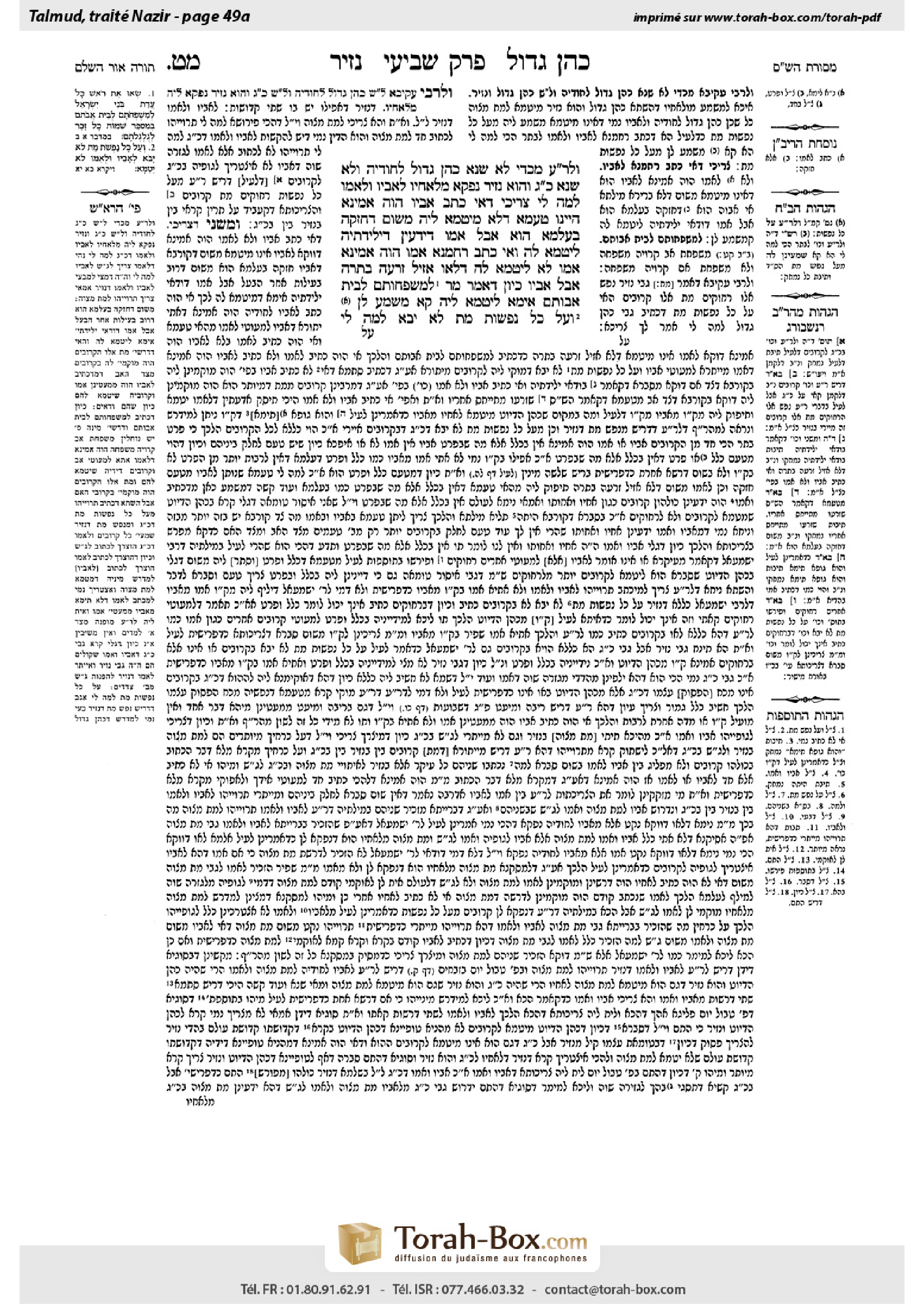
Nazir 49a: Talmud study for Daf Yomi
Daf Yomi is the daily study of one Talmud folio. Explore 37 tractates with scans, Hebrew text, Sefaria English and AI-generated French translations where annotated.
Passage selection and English or AI-generated French translation are available where the scan has annotations. Daf Study is independent of Torah-Box and Sefaria.
Browse Nazir · נזיר · All tractatesNazir 49a text and translations
This page of Nazir includes the Aramaic text, an English translation and an AI-generated French translation, alongside the scan above.
נזיר מ״ט א · Aramaic and Hebrew text
וּלְרַבִּי עֲקִיבָא, מִכְּדֵי לָא שְׁנָא כֹּהֵן גָּדוֹל לְחוֹדֵיהּ וְלָא שְׁנָא כֹּהֵן גָּדוֹל וְהוּא נָזִיר, נָפְקָא מִ״לְּאָחִיו״, ״לְאָבִיו וּלְאִמּוֹ״ לְמָה לִי?
צְרִיכִי: דְּאִי כְּתַב ״אָבִיו״, הֲוָה אָמֵינָא: הַיְינוּ טַעְמָא דְּלָא מִיטַּמֵּא לֵיהּ — מִשּׁוּם דַּחֲזָקָה בְּעָלְמָא הוּא. אֲבָל אִמּוֹ דְּיָדְעִין דִּילֵידְתֵּיהּ — לִיטַמֵּא לַהּ.
וְאִי כְּתַב רַחֲמָנָא ״אִמּוֹ״, הֲוָה אָמֵינָא: אִמּוֹ לָא לִיטַמֵּא לַהּ, דְּלָאו אָזֵיל זַרְעַהּ בָּתְרַהּ. אֲבָל אָבִיו, כֵּיוָן דְּאָמַר מָר ״לְמִשְׁפְּחוֹתָם לְבֵית אֲבוֹתָם״, אֵימָא לִיטַמֵּא לֵיהּ — קָא מַשְׁמַע לַן.
״וְעַל כׇּל נַפְשׁוֹת מֵת לֹא יָבֹא״, לְמָה לִי?
Nazir 49a · English translation
The Gemara asks: And according to the derivation of Rabbi Akiva, now consider, it is no different whether the individual was a High Priest alone, and it is no different if he was a High Priest who was also a nazirite; the halakha that he must become impure to bury a met mitzva is derived from the phrase “for his brother,” stated with regard to a nazirite (Numbers 6:7). But if so, why do I need the expression “for his father, or for his mother” (Numbers 6:7)? The general prohibition against contracting impurity from any corpse should suffice.
The Gemara answers: Both are necessary, as had the verse written only “for his father,” I would say that this is the reason that a nazirite may not become impure for his father: Because it is merely a presumption that he is his father, as one cannot be absolutely sure of the identity of one’s father. However, with regard to his mother, whom we know gave birth to him, perhaps let him become impure to bury her. The verse therefore states: “His mother.”
And conversely, had the Merciful One written only “for his mother,” I would say that it is solely to bury his mother that he may not become impure, as her seed does not follow her, i.e., a man’s lineage is determined by his father, not his mother. However, with regard to his father, since the Master said with regard to the verse “by their families, by their fathers’ house” (Numbers 1:2) that one’s family ancestry follows his father, you might say: Let him become impure to bury him. The verse therefore teaches us that a nazirite may not become impure to bury his father either.
The Gemara asks: According to the derivation of Rabbi Akiva, why do I need the words “neither shall he go in to any dead bodies” (Leviticus 21:11), stated with regard to a High Priest?
Nazir 49a · Traduction française (IA)
La Guemara demande : Selon la déduction de Rabbi Akiva, considérons maintenant que cela ne fait aucune différence que l’individu soit grand prêtre seul ou qu’il soit à la fois grand prêtre et nazir. La halakha selon laquelle il doit se rendre impur pour ensevelir un met mitsva est déduite de l’expression « pour son frère », énoncée à propos du nazir (Nombres 6:7). Mais, dans ce cas, pourquoi faut-il l’expression « pour son père ou pour sa mère » (Nombres 6:7) ? L’interdiction générale de se rendre impur au contact d’un mort devrait suffire.
La Guemara répond : Les deux expressions sont nécessaires. En effet, si le verset avait seulement écrit « pour son père », j’aurais dit que le nazir ne peut pas se rendre impur pour son père parce qu’il n’est que présumé être son père, puisqu’on ne peut pas connaître avec une certitude absolue l’identité de son père. Mais, en ce qui concerne sa mère, dont nous savons qu’elle lui a donné naissance, peut-être pourrait-il se rendre impur pour l’ensevelir. Le verset précise donc : « sa mère ».
Et inversement, si le Miséricordieux avait écrit seulement « pour sa mère », j’aurais dit que c’est uniquement pour ensevelir sa mère qu’il ne peut pas se rendre impur, car sa descendance ne se rattache pas à elle, c’est-à-dire que la filiation d’un homme est déterminée par son père, et non par sa mère. Mais, en ce qui concerne son père, puisque le Maître a dit, à propos du verset « selon leurs familles, selon la maison de leurs pères » (Nombres 1:2), que l’ascendance familiale d’une personne se rattache à son père, on aurait pu dire : qu’il se rende impur pour l’ensevelir. Le verset nous enseigne donc qu’un nazir ne peut pas non plus se rendre impur pour ensevelir son père.
La Guemara demande : Selon la déduction de Rabbi Akiva, pourquoi faut-il les mots « et il ne s’approchera d’aucun corps mort » (Lévitique 21:11), énoncés à propos du grand prêtre ?
Traduction française générée par IA à partir de l’édition anglaise de Sefaria. Vérifie toujours un passage avec le texte source.
Text from Sefaria: William Davidson Edition - Vocalized Aramaic (CC BY NC); William Davidson Edition - English (CC BY NC).