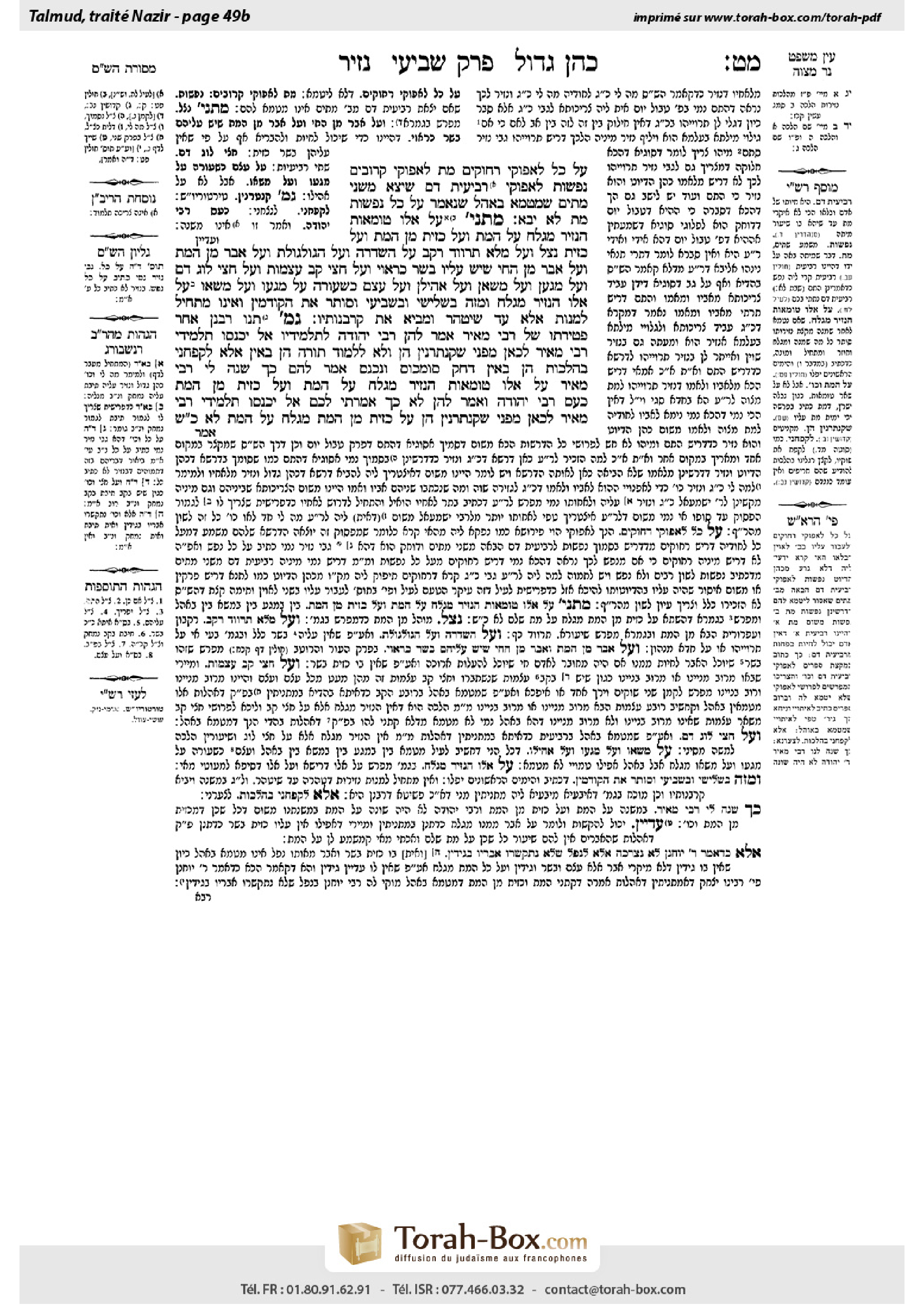
Nazir 49b: Talmud study for Daf Yomi
Daf Yomi is the daily study of one Talmud folio. Explore 37 tractates with scans, Hebrew text, Sefaria English and AI-generated French translations where annotated.
Passage selection and English or AI-generated French translation are available where the scan has annotations. Daf Study is independent of Torah-Box and Sefaria.
Browse Nazir · נזיר · All tractatesNazir 49b text and translations
This page of Nazir includes the Aramaic text, an English translation and an AI-generated French translation, alongside the scan above.
נזיר מ״ט ב · Aramaic and Hebrew text
״עַל כׇּל״ — לְאַפּוֹקֵי רְחוֹקִים, ״מֵת״ — לְאַפּוֹקֵי קְרוֹבִים, ״נַפְשׁוֹת״ — לְאַפּוֹקֵי רְבִיעִית דָּם שֶׁיָּצָא מִשְּׁנֵי מֵתִים, שֶׁמְּטַמֵּא בְּאֹהֶל, שֶׁנֶּאֱמַר: ״עַל כׇּל נַפְשׁוֹת מֵת לֹא יָבֹא״.
מַתְנִי׳ עַל אֵלּוּ טוּמְאוֹת הַנָּזִיר מְגַלֵּחַ: עַל הַמֵּת, וְעַל כְּזַיִת מִן הַמֵּת, וְעַל כְּזַיִת נֶצֶל, וְעַל מְלֹא תַּרְווֹד רָקָב. עַל הַשִּׁדְרָה, וְעַל הַגּוּלְגּוֹלֶת, וְעַל אֵבֶר מִן הַמֵּת, וְעַל אֵבֶר מִן הַחַי שֶׁיֵּשׁ עָלָיו בָּשָׂר כָּרָאוּי, וְעַל חֲצִי קַב עֲצָמוֹת, וְעַל חֲצִי לוֹג דָּם.
וְעַל מַגָּעָן וְעַל מַשָּׂאָן וְעַל אֲהִילָן. וְעַל עֶצֶם כִּשְׂעוֹרָה עַל מַגָּעוֹ וְעַל מַשָּׂאוֹ.
עַל אֵלּוּ הַנָּזִיר מְגַלֵּחַ, וּמַזֶּה בַּשְּׁלִישִׁי וּבַשְּׁבִיעִי וְסוֹתֵר אֶת הַקּוֹדְמִין, וְאֵינוֹ מַתְחִיל לִמְנוֹת אֶלָּא עַד שֶׁיִּטְהַר וּמֵבִיא אֶת קׇרְבְּנוֹתָיו.
גְּמָ׳ תָּנוּ רַבָּנַן: אַחַר פְּטִירָתוֹ שֶׁל רַבִּי מֵאִיר אָמַר לָהֶן רַבִּי יְהוּדָה לְתַלְמִידָיו: אַל יִכָּנְסוּ תַּלְמִידֵי רַבִּי מֵאִיר לְכָאן, מִפְּנֵי שֶׁקַּנְתְּרָנִין הֵן, וְלֹא לִלְמוֹד תּוֹרָה הֵן בָּאִין, אֶלָּא לְקַפְּחֵנִי בַּהֲלָכוֹת הֵן בָּאִין. דָּחַק סוֹמְכוֹס וְנִכְנַס.
אָמַר לָהֶם, כָּךְ שָׁנָה לִי רַבִּי מֵאִיר: עַל אֵלּוּ טוּמְאוֹת הַנָּזִיר מְגַלֵּחַ: עַל הַמֵּת, וְעַל כַּזַּיִת מִן הַמֵּת. כָּעַס רַבִּי יְהוּדָה וְאָמַר לָהֶן, לֹא כָּךְ אָמַרְתִּי לָכֶם: אַל יִכָּנְסוּ תַּלְמִידֵי רַבִּי מֵאִיר לְכָאן, מִפְּנֵי שֶׁקַּנְתְּרָנִין הֵן? עַל כַּזַּיִת מִן הַמֵּת מְגַלֵּחַ — עַל הַמֵּת לֹא כׇּל שֶׁכֵּן?!
Nazir 49b · English translation
“In to any” serves to exclude contracting impurity to bury distant people, for whom a High Priest may not become impure; “dead” comes to exclude relatives; “bodies” comes to exclude a quarter-log of blood that emerges from two corpses, for it renders people and objects impure in a tent, as it is stated: “Neither shall he go in to any dead bodies” (Leviticus 21:11). The plural “bodies” teaches that the blood of two people combines to form the minimum quantity for ritual impurity.
MISHNA: A nazirite shaves for having become impure from these following sources of ritual impurity: For having become impure with impurity imparted by a corpse; and for impurity imparted by an olive-bulk of a corpse; and for impurity imparted by an olive-bulk of fluid [netzel] from a corpse; and for impurity imparted by a full ladle [tarvad] of dust from a corpse; and for impurity imparted by the spine; and for impurity imparted by the skull; and for impurity imparted by a limb from a corpse or for impurity imparted by a limb severed from a living person, upon either of which there is a fitting quantity of flesh; and for impurity imparted by a half-kav of bones from a corpse; and for impurity imparted by a half-log of blood.
And a nazirite shaves in each of these cases for becoming impure by coming into contact with them; and for becoming impure by carrying them; and for becoming impure by their tent, i.e., if he was positioned like a tent over them, or if he entered a tent that contains them, or if they served as a tent over him. And as for a bone that is a barley-grain-bulk, he shaves for becoming impure by coming into contact with it and by carrying it. However, he is not rendered impure with the impurity imparted in a tent, i.e., by being under the same roof as the bone.
For all of these occurrences, a nazirite shaves, and a priest sprinkles the ashes of the red heifer on him on the third and on the seventh days to purify him from the impurity imparted by a corpse. And he negates all the previous days he counted toward his naziriteship, and he begins counting his term of naziriteship again only after he becomes pure and brings his offerings.
GEMARA: The Sages taught: After Rabbi Meir’s death, Rabbi Yehuda said to his students: Do not let the students of Rabbi Meir enter here, into the house of study, because they are vexatious and they do not come to study Torah, but they come to overwhelm me with their halakhot. Nevertheless, Sumakhos, a student of Rabbi Meir, forced his way and entered the house of study.
When they reached the topic of the mishna, Sumakhos said to them: Rabbi Meir taught me like this: A nazirite shaves for becoming impure from these following sources of ritual impurity: For impurity imparted by a corpse and for impurity imparted by an olive-bulk from a corpse. Rabbi Yehuda grew angry and said to his disciples: Didn’t I say to you like this: Do not let the students of Rabbi Meir enter here because they are vexatious? He explained his annoyance. The clause: For a corpse, is unnecessary, as, if a nazirite must shave for impurity imparted by an olive-bulk from a corpse, is it not all the more so that he must shave for impurity imparted by an entire corpse?
Nazir 49b · Traduction française (IA)
« À aucun » vient exclure le cas où l’on contracterait l’impureté en enterrant des morts éloignés, auprès desquels un grand prêtre n’a pas le droit de se rendre impur ; « mort » vient exclure les proches ; « corps » vient exclure un quart de log de sang provenant de deux cadavres, car il rend impurs les personnes et les objets sous une tente, comme il est dit : « Il ne s’approchera d’aucun corps mort » (Lévitique 21,11). Le pluriel « corps » enseigne que le sang de deux personnes s’additionne pour atteindre la quantité minimale requise pour l’impureté rituelle.
MICHNA : Un nazir se rase lorsqu’il contracte l’impureté provenant de l’une des sources suivantes : un cadavre ; un volume d’olive d’un cadavre ; un volume d’olive de liquide [netzel] provenant d’un cadavre ; une pleine cuiller [tarvad] de poussière provenant d’un cadavre ; la colonne vertébrale ; le crâne ; un membre d’un cadavre ou un membre amputé d’une personne vivante, si l’un ou l’autre porte une quantité suffisante de chair ; un demi-kav d’ossements provenant d’un cadavre ; et un demi-log de sang.
Dans chacun de ces cas, le nazir se rase s’il contracte l’impureté en touchant ces éléments, en les transportant ou par leur tente, c’est-à-dire s’il se trouve au-dessus d’eux comme une tente, s’il entre dans une tente qui les contient, ou s’ils forment une tente au-dessus de lui. Quant à un os de la taille d’un grain d’orge, il se rase s’il contracte l’impureté en le touchant ou en le transportant. Toutefois, il ne contracte pas l’impureté sous une tente, c’est-à-dire en se trouvant sous le même toit que cet os.
Dans tous ces cas, le nazir se rase, et un prêtre l’asperge des cendres de la vache rousse les troisième et septième jours, afin de le purifier de l’impureté provenant d’un cadavre. Il annule tous les jours qu’il avait déjà comptés pour son naziréat et ne recommence à compter la durée de son naziréat qu’après être devenu pur et avoir apporté ses offrandes.
GUEMARA : Les Sages ont enseigné : Après la mort de Rabbi Meïr, Rabbi Yehouda dit à ses élèves : « Ne laissez pas entrer ici, dans la maison d’étude, les élèves de Rabbi Meïr, car ils sont querelleurs et ne viennent pas étudier la Torah ; ils viennent m’accabler de leurs halakhot. » Malgré cela, Soumakhos, un élève de Rabbi Meïr, s’imposa et entra dans la maison d’étude.
Lorsqu’ils abordèrent le sujet de la Michna, Soumakhos leur dit : « Rabbi Meïr m’a enseigné ceci : Un nazir se rase lorsqu’il contracte l’impureté provenant de l’une des sources suivantes : un cadavre et un volume d’olive provenant d’un cadavre. » Rabbi Yehouda se mit en colère et dit à ses disciples : « Ne vous avais-je pas dit de ne pas laisser entrer ici les élèves de Rabbi Meïr, car ils sont querelleurs ? » Il expliqua ce qui le contrariait : la clause « un cadavre » est superflue, car si un nazir doit se raser pour l’impureté provenant d’un volume d’olive d’un cadavre, ne doit-il pas, à plus forte raison, se raser pour l’impureté provenant d’un cadavre entier ?
Traduction française générée par IA à partir de l’édition anglaise de Sefaria. Vérifie toujours un passage avec le texte source.
Text from Sefaria: William Davidson Edition - Vocalized Aramaic (CC BY NC); William Davidson Edition - English (CC BY NC).