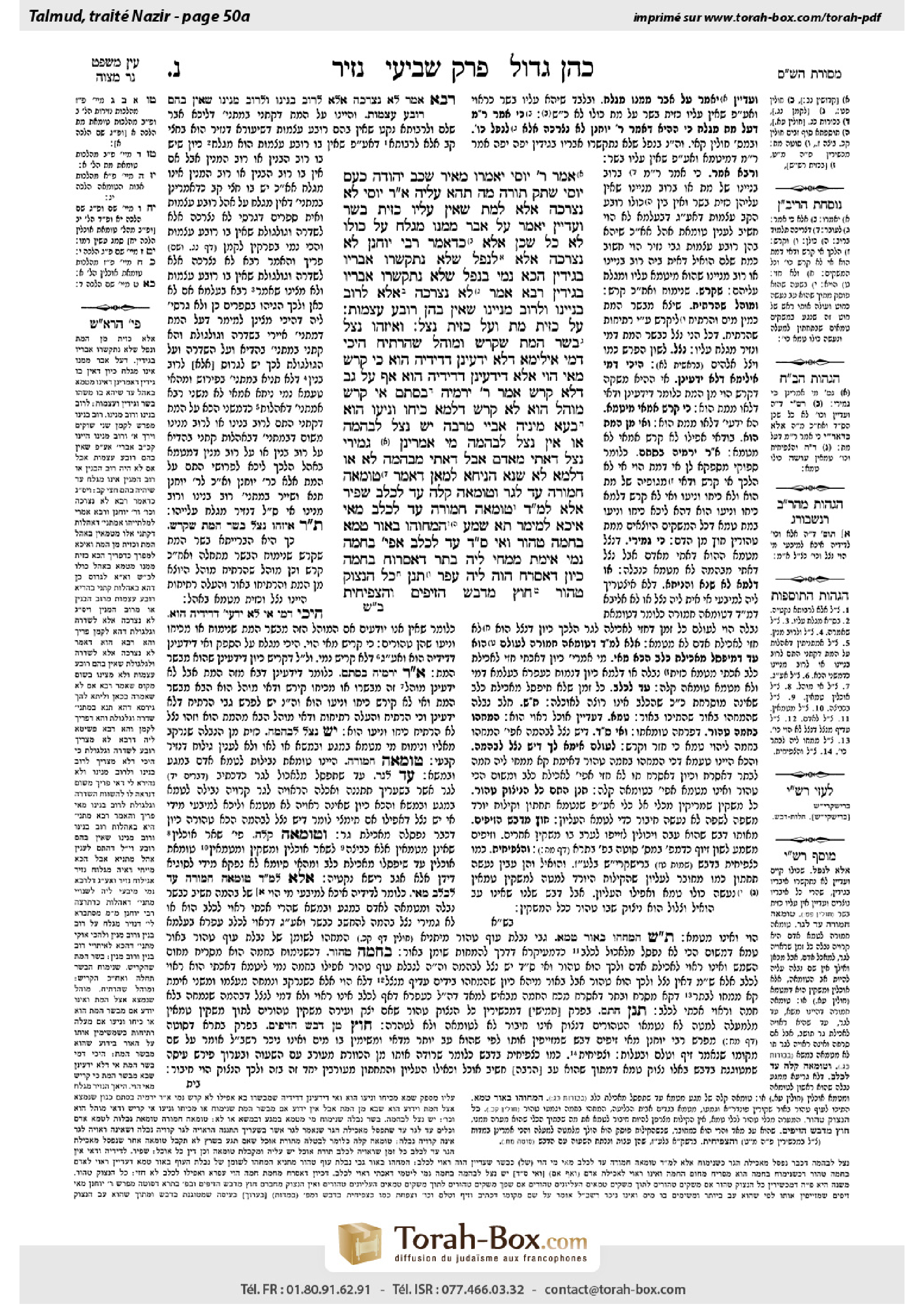
Nazir 50a: Talmud study for Daf Yomi
Daf Yomi is the daily study of one Talmud folio. Explore 37 tractates with scans, Hebrew text, Sefaria English and AI-generated French translations where annotated.
Passage selection and English or AI-generated French translation are available where the scan has annotations. Daf Study is independent of Torah-Box and Sefaria.
Browse Nazir · נזיר · All tractatesNazir 50a text and translations
This page of Nazir includes the Aramaic text, an English translation and an AI-generated French translation, alongside the scan above.
נזיר נ׳ א · Aramaic and Hebrew text
אָמַר רַבִּי יוֹסֵי: יֹאמְרוּ מֵאִיר שָׁכַב, יְהוּדָה כָּעַס, יוֹסֵי שָׁתַק — תּוֹרָה מַה תְּהֵא עָלֶיהָ? אָמַר רַבִּי יוֹסֵי: לֹא נִצְרְכָה אֶלָּא לְמֵת שֶׁאֵין עָלָיו כְּזַיִת בָּשָׂר. וַעֲדַיִין יֹאמַר: עַל אֵבֶר מִמֶּנּוּ מְגַלֵּחַ, עַל כּוּלּוֹ לֹא כׇּל שֶׁכֵּן?!
אֶלָּא, כִּדְאָמַר רַבִּי יוֹחָנָן: לֹא נִצְרְכָה אֶלָּא לְנֵפֶל שֶׁלֹּא נִתְקַשְּׁרוּ אֵבָרָיו בְּגִידִין. הָכָא נָמֵי: בְּנֵפֶל שֶׁלֹּא נִתְקַשְּׁרוּ אֵבָרָיו בְּגִידִין.
רָבָא אָמַר: לֹא נִצְרְכָה אֶלָּא לְרוֹב בִּנְיָינוֹ וּלְרוֹב מִנְיָינוֹ, שֶׁאֵין בָּהֶן רוֹבַע עֲצָמוֹת.
עַל כְּזַיִת מֵת וְעַל כְּזַיִת נֶצֶל. וְאֵיזֶהוּ נֶצֶל — בְּשַׂר הַמֵּת שֶׁקָּרַשׁ, וּמוֹהַל שֶׁהִרְתִּיחַ.
הֵיכִי דָּמֵי? אִילֵּימָא דְּלָא יָדְעִינַן דְּדִידֵיהּ הוּא, כִּי קָרַשׁ מַאי הָוֵי? אֶלָּא דְּיָדְעִינַן דְּדִידֵיהּ הוּא, אַף עַל גַּב דְּלֹא קָרַשׁ!
אָמַר רַבִּי יִרְמְיָה: בִּסְתָם. אִי קָרַשׁ — מוֹהֵל הוּא, לֹא קָרַשׁ — דִּלְמָא כִּיחוֹ וְנִיעוֹ הוּא.
בְּעָא מִינֵּיהּ אַבָּיֵי מֵרַבָּה: יֵשׁ נֶצֶל לִבְהֵמָה אוֹ אֵין נֶצֶל לִבְהֵמָה? מִי אָמְרִינַן גְּמִירִי נֶצֶל דְּאָתֵי מֵאָדָם, אֲבָל דְּאָתֵי מִבְּהֵמָה — לָא. אוֹ דִלְמָא לָא שְׁנָא?
הָנִיחָא לְמַאן דְּאָמַר טוּמְאָה חֲמוּרָה עַד לְגֵר, וְטוּמְאָה קַלָּה עַד לְכֶלֶב — שַׁפִּיר.
אֶלָּא לְמַאן דְּאָמַר טוּמְאָה חֲמוּרָה עַד לְכֶלֶב, מַאי אִיכָּא לְמֵימַר?
תָּא שְׁמַע: הִמְחוּהוּ בָּאוּר — טָמֵא, בַּחַמָּה — טָהוֹר. וְאִי סָלְקָא דַעְתָּךְ עַד לְכֶלֶב, אֲפִילּוּ בַּחַמָּה נָמֵי!
אֵימַת מַמְחֵי לֵיהּ — בָּתַר דְּאַסְרַח בְּחַמָּה, כֵּיוָן דְּאַסְרַח — הָוֵה לֵיהּ עָפָר.
תְּנַן: כׇּל הַנִּצּוֹק — טָהוֹר.
חוּץ מִדְּבַשׁ הַזִּיפִים וְהַצַּפִּיחִית.
Nazir 50a · English translation
Rabbi Yosei said: Now they will say: Meir is dead, Yehuda is angry, and Yosei remained silent and did not respond. If so, what will become of the Torah? Rabbi Yosei therefore said: It is not necessary to teach that a nazirite must shave for impurity imparted by a corpse, but only that he must shave even for impurity imparted by a corpse upon which there is not an olive-bulk of flesh. The Gemara asks: But one could still say: If he must shave for impurity imparted by a limb from a corpse, even if it is less than an olive-bulk, as stated in the mishna, is it not all the more so that he must shave for impurity imparted by all of a corpse, even if it does not contain an olive-bulk of flesh?
Rather, the mishna should be explained as Rabbi Yoḥanan said, with regard to a different issue: It is necessary only for a miscarried fetus whose limbs had not yet become joined to its sinews. Here too, one can say that the mishna’s statement that a nazirite must shave for impurity imparted by a corpse is referring to a miscarried fetus whose limbs had not yet become joined to its sinews. Although it does not impart impurity through one of its limbs, as the limbs lack sinews and bones, this corpse itself does impart impurity.
Rava said a different explanation: This ruling is necessary only for the majority of the structure or the majority of the number of bones of a very small corpse, despite the fact that together they do not contain a quarter-kav of bones. Since these bones comprise the majority of the structure or the majority of the number of bones of a corpse, they have the status of a whole body. This halakha could not have been derived from the measure of impurity of part of the body, as this corpse is very small.
§ The mishna taught: A nazirite shaves for impurity imparted by an olive-bulk of a corpse and for impurity imparted by an olive-bulk of fluid. The Gemara explains: And what is fluid? This is referring to flesh of the corpse that liquefied and subsequently congealed, and liquid [mohal] from the corpse that began to boil and then hardened.
The Gemara asks: What are the circumstances in which the congealment is a determinative factor in the imparting of impurity? If we say that we do not know that the substance with which the nazirite came into contact is from the corpse, even if it congealed, what of it? Rather, you will say that we know that it came from the corpse. But then the nazirite should be impure even though it has not congealed.
Rabbi Yirmeya said that this is referring to an unspecified substance that is definitely from the corpse but is not necessarily a substance that imparts impurity. One therefore examines the substance: If the substance eventually congeals, it is liquid from the corpse, which imparts impurity; if it does not congeal, perhaps it is his phlegm and his spittle, which do not impart impurity.
§ With regard to the impurity of fluids from a corpse, Abaye raised a dilemma before Rabba: Is there the category of fluid with regard to animals, or is there no category of fluid with regard to animals? In other words, does fluid from an animal carcass impart impurity like the animal carcass itself or not? The Gemara explains the two sides of the dilemma: Do we say that it is learned as a tradition that fluid that comes from a person is impure but fluid that comes from an animal is not impure? Or perhaps it is no different, as fluid from a corpse is always considered like the flesh itself?
The Gemara comments: This works out well according to the one who says that a carcass imparts impurity by a severe impurity, through contact and carrying, only until the carcass becomes inedible for a stranger, i.e., in order impart impurity it must be fit for human consumption. And the carcass imparts impurity by a light impurity that imparts impurity on food through contact until the carcass become inedible for a dog. According to this opinion, it is well, as the halakha of fluid certainly does not apply to an animal, since meat that has liquefied is no longer fit for human consumption.
However, according to the one who says that a carcass imparts impurity by a severe impurity until it becomes inedible for a dog, what is there to say? Since fluids from an animal carcass are presumably fit to be eaten by a dog, the above dilemma as to whether it is impure remains pertinent.
The Gemara answers: Come and hear a resolution from the Tosefta (Zavim 5:9): The fat of an animal carcass that someone liquefied in fire is still impure. However, if it melted in the sun, which impairs its taste, it is pure. And if it enters your mind that according to the opinion that a carcass imparts impurity until it becomes inedible for a dog the impurity of fluids does apply to an animal carcass, if so, even fat that dissolved in the sun should also be impure. Even if its taste is spoiled, it remains edible for a dog.
The Gemara answers: When does this fat liquefy? After it has putrefied, which is why it was thrown out, at which point it melted in the sun. However, once it putrefied, it had already become like dust and lost any status of ritual impurity it once had. Once it has melted, it is no longer edible for a dog. Consequently, this source provides no proof.
§ The Gemara discusses a related issue. We learned in a mishna (Makhshirin 5:9): Anything that is poured remains ritually pure. In other words, if one pours liquid from one vessel into another, the stream of liquid is not considered to connect the two vessels. Consequently, if the upper vessel and its contents are pure, they do not become impure even if the lower vessel into which the liquid is poured is impure. The stream of liquid does not link them in this manner.
The mishna adds: This is the case for all liquids except for zifim honey, a very thick type of honey, and batter, e.g., flour mixed with honey. Since these substances are highly viscous, they are not considered liquids. Rather, they are a kind of soft solid food, which means that they are a single unit that links the two vessels with regard to impurity.
Nazir 50a · Traduction française (IA)
Rabbi Yosei dit : « À présent, ils diront : “Meïr est mort, Yehouda est en colère, et Yosei est resté silencieux sans répondre.” Si tel est le cas, que deviendra la Torah ? » Rabbi Yosei dit donc : Il n’est pas nécessaire d’enseigner qu’un nazir doit se raser en raison de l’impureté transmise par un cadavre ; il suffit d’enseigner qu’il doit se raser même en raison de l’impureté transmise par un cadavre qui ne contient pas un volume d’olive de chair. La Guemara demande : Mais pourrait-on encore dire : s’il doit se raser en raison de l’impureté transmise par un membre provenant d’un cadavre, même si celui-ci représente moins qu’un volume d’olive, comme l’enseigne la Michna, à plus forte raison doit-il se raser en raison de l’impureté transmise par le cadavre entier, même si celui-ci ne contient pas un volume d’olive de chair ?
Il faut plutôt expliquer la Michna comme l’a dit Rabbi Yoḥanan, à propos d’un autre sujet : cela concerne uniquement un fœtus mort-né dont les membres n’étaient pas encore reliés à leurs tendons. Ici aussi, on peut dire que l’affirmation de la Michna selon laquelle un nazir doit se raser en raison de l’impureté transmise par un cadavre se rapporte à un fœtus mort-né dont les membres n’étaient pas encore reliés à leurs tendons. Bien qu’il ne transmette pas l’impureté par l’un de ses membres, puisque ceux-ci sont dépourvus de tendons et d’os, le cadavre lui-même transmet l’impureté.
Rava donne une autre explication : cette règle concerne uniquement la majorité de la structure osseuse ou la majorité du nombre d’os d’un très petit cadavre, même si ces os ne totalisent pas un quart de kav. Comme ces os constituent la majorité de la structure osseuse ou la majorité du nombre d’os d’un cadavre, ils ont le statut d’un corps entier. Cette halakha n’aurait pas pu être déduite de la mesure d’impureté applicable à une partie du corps, car ce cadavre est très petit.
§ La Michna enseignait : Un nazir se rase en raison de l’impureté transmise par un volume d’olive de cadavre et par un volume d’olive de liquide. La Guemara explique : Et qu’est-ce que ce liquide ? Il s’agit de chair du cadavre qui s’est liquéfiée puis a coagulé, ainsi que du liquide [mohal] provenant du cadavre, qui a commencé à bouillir puis a durci.
La Guemara demande : Dans quelles circonstances la coagulation est-elle déterminante pour la transmission de l’impureté ? Si l’on dit que nous ne savons pas si la substance avec laquelle le nazir est entré en contact provient du cadavre, qu’importe qu’elle ait coagulé ? Il faut plutôt dire que nous savons qu’elle provient du cadavre. Mais alors le nazir devrait être impur même si elle n’a pas coagulé.
Rabbi Yirmeya dit qu’il s’agit d’une substance indéterminée qui provient certainement du cadavre, mais qui n’est pas nécessairement une substance transmettant l’impureté. On examine donc la substance : si elle finit par coaguler, c’est un liquide provenant du cadavre, qui transmet l’impureté ; si elle ne coagule pas, il s’agit peut-être de son mucus ou de sa salive, qui ne transmettent pas l’impureté.
§ À propos de l’impureté des liquides provenant d’un cadavre, Abaye posa une question à Rabba : Existe-t-il une catégorie de liquides pour les animaux, ou non ? Autrement dit, les liquides provenant d’une carcasse animale transmettent-ils l’impureté comme la carcasse elle-même, ou non ? La Guemara expose les deux termes de la question : Doit-on dire que la tradition enseigne que les liquides provenant d’un être humain sont impurs, mais que ceux provenant d’un animal ne le sont pas ? Ou bien n’y a-t-il pas de différence, puisque les liquides provenant d’un cadavre sont toujours considérés comme sa chair ?
La Guemara remarque : Cela s’explique bien selon celui qui dit qu’une carcasse transmet une impureté grave — par contact et par portage — uniquement jusqu’à ce qu’elle devienne impropre à la consommation humaine, c’est-à-dire que, pour transmettre cette impureté, elle doit être propre à la consommation humaine. La carcasse transmet aussi une impureté légère, qui rend les aliments impurs par contact, jusqu’à ce qu’elle devienne impropre à la consommation d’un chien. Selon cette opinion, cela s’explique bien : la règle relative aux liquides ne s’applique certainement pas à un animal, puisque la chair liquéfiée n’est plus propre à la consommation humaine.
Cependant, selon celui qui dit qu’une carcasse transmet une impureté grave jusqu’à ce qu’elle devienne impropre à la consommation d’un chien, que peut-on répondre ? Puisque les liquides provenant d’une carcasse animale sont vraisemblablement propres à être consommés par un chien, la question précédente — de savoir s’ils sont impurs — reste pertinente.
La Guemara répond : Viens et entends une résolution tirée de la Tossefta (Zavim 5:9) : la graisse d’une carcasse animale que quelqu’un a liquéfiée au feu reste impure. En revanche, si elle a fondu au soleil, ce qui altère son goût, elle est pure. Or, si tu pensais que, selon l’opinion d’après laquelle une carcasse transmet l’impureté jusqu’à ce qu’elle devienne impropre à la consommation d’un chien, la règle relative aux liquides s’applique aussi à une carcasse animale, alors même la graisse fondue au soleil devrait être impure. Même si son goût est altéré, elle reste propre à la consommation d’un chien.
La Guemara répond : Quand cette graisse se liquéfie-t-elle ? Après s’être putréfiée, ce qui explique qu’on l’ait jetée ; c’est alors qu’elle a fondu au soleil. Cependant, une fois putréfiée, elle était déjà devenue comme de la poussière et avait perdu tout statut d’impureté rituelle qu’elle avait pu avoir. Une fois fondue, elle n’est plus propre à la consommation d’un chien. Par conséquent, cette source n’apporte aucune preuve.
§ La Guemara aborde une question connexe. Nous avons appris dans une Michna (Makhshirin 5:9) : Tout ce qui est versé reste rituellement pur. Autrement dit, si l’on verse un liquide d’un récipient dans un autre, le filet de liquide n’est pas considéré comme reliant les deux récipients. Par conséquent, si le récipient supérieur et son contenu sont purs, ils ne deviennent pas impurs, même si le récipient inférieur dans lequel le liquide est versé est impur. Le filet de liquide ne les relie pas de cette manière.
La Michna ajoute : Cela vaut pour tous les liquides, à l’exception du miel de Zifim, un miel très épais, et de la pâte, par exemple de la farine mélangée à du miel. Comme ces substances sont très visqueuses, elles ne sont pas considérées comme des liquides. Ce sont plutôt des sortes d’aliments solides et mous, qui constituent une seule unité reliant les deux récipients en matière d’impureté.
Traduction française générée par IA à partir de l’édition anglaise de Sefaria. Vérifie toujours un passage avec le texte source.
Text from Sefaria: William Davidson Edition - Vocalized Aramaic (CC BY NC); William Davidson Edition - English (CC BY NC).