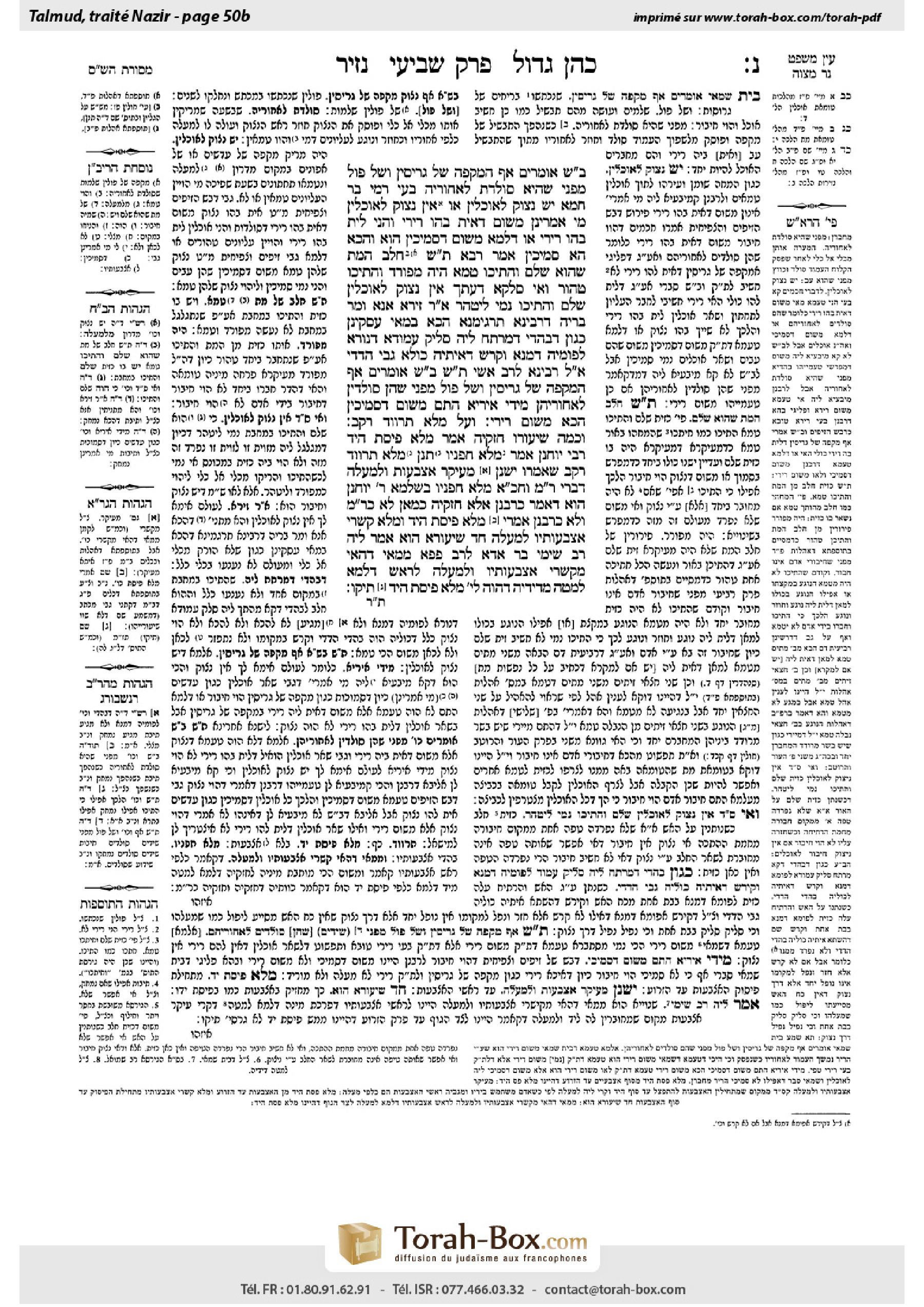
Nazir 50b: Talmud study for Daf Yomi
Daf Yomi is the daily study of one Talmud folio. Explore 37 tractates with scans, Hebrew text, Sefaria English and AI-generated French translations where annotated.
Passage selection and English or AI-generated French translation are available where the scan has annotations. Daf Study is independent of Torah-Box and Sefaria.
Browse Nazir · נזיר · All tractatesNazir 50b text and translations
This page of Nazir includes the Aramaic text, an English translation and an AI-generated French translation, alongside the scan above.
נזיר נ׳ ב · Aramaic and Hebrew text
בֵּית שַׁמַּאי אוֹמְרִים: אַף הַמִּקְפָּה שֶׁל גְּרִיסִין וְשֶׁל פּוֹל, מִפְּנֵי שֶׁהִיא סוֹלֶדֶת לַאֲחוֹרֶיהָ.
בָּעֵי רָמֵי בַּר חָמָא: יֵשׁ נִצּוֹק לָאוֹכָלִין, אוֹ אֵין נִצּוֹק לָאוֹכָלִין. מִי אָמְרִינַן מִשּׁוּם דְּאִית בְּהוּ רִירֵי, וְהָנֵי לֵית בְּהוּ רִירֵי. אוֹ דִּלְמָא מִשּׁוּם דִּסְמִיכִין הוּא, וְהָכָא הָא סְמִיכִין?
אָמַר רָבָא, תָּא שְׁמַע: חֵלֶב הַמֵּת שֶׁהוּא שָׁלֵם וְהִתִּיכוֹ — טָמֵא, הָיָה מְפוֹרָד וְהִתִּיכוֹ — טָהוֹר. וְאִי סָלְקָא דַעְתָּךְ אֵין נִצּוֹק לָאוֹכָלִין, שָׁלֵם וְהִתִּיכוֹ נָמֵי לִיטְהַר!
אָמַר רַבִּי זֵירָא: אֲנָא וּמָר בְּרֵיהּ דְּרָבִינָא תַּרְגֵּימְנָא: הָכָא בְּמַאי עָסְקִינַן — כְּגוֹן דְּבַהֲדֵי דְּמַרְתַּח לֵיהּ, סָלֵיק עַמּוּדָא דְנוּרָא לְפוּמֵּיהּ דְּמָנָא וְקָרֵשׁ, דְּאִיתֵיהּ כּוּלֵּא גַּבֵּי הֲדָדֵי.
אֲמַר לֵיהּ רָבִינָא לְרַב אָשֵׁי, תָּא שְׁמַע: בֵּית שַׁמַּאי אוֹמְרִים: אַף הַמִּקְפָּה שֶׁל גְּרִיסִין וְשֶׁל פּוֹל — מִפְּנֵי שֶׁהֵן סוֹלְדִין לַאֲחוֹרֵיהֶן. מִידֵּי אִירְיָא? הָתָם, מִשּׁוּם דִּסְמִיכִין. הָכָא, מִשּׁוּם רִירֵי.
וְעַל מְלֹא תַּרְווֹד רָקָב. וְכַמָּה שִׁיעוּרוֹ? חִזְקִיָּה אָמַר: מְלֹא פִּיסַּת הַיָּד, רַבִּי יוֹחָנָן אָמַר: מְלֹא חׇפְנָיו. תְּנַן: מְלֹא תַּרְווֹד רָקָב שֶׁאָמְרוּ, יֶשְׁנָן מֵעִיקַּר אֶצְבָּעוֹת וּלְמַעְלָה, דִּבְרֵי רַבִּי מֵאִיר. וַחֲכָמִים אוֹמְרִים: מְלֹא חׇפְנָיו.
בִּשְׁלָמָא רַבִּי יוֹחָנָן הוּא דְּאָמַר כְּרַבָּנַן. אֶלָּא חִזְקִיָּה כְּמַאן? לָא כְּרַבִּי מֵאִיר וְלָא כְּרַבָּנַן! אָמְרִי: מְלֹא פִּיסַּת הַיָּד וּמְלֹא קִשְׁרֵי אֶצְבְּעוֹתָיו לְמַעְלָה — חַד שִׁיעוּרָא הוּא.
אֲמַר לֵיהּ רַב שִׁימִי בַּר אַדָּא לְרַב פָּפָּא: מִמַּאי דְּהַאי מִקִּשְׁרֵי אֶצְבְּעוֹתָיו וּלְמַעְלָה לְרֹאשׁ? דִּלְמָא לְמַטָּה מִדִּידֵיהּ, דְּהָוֵה לֵיהּ מְלֹא פִּיסַּת הַיָּד? תֵּיקוּ.
Nazir 50b · English translation
Beit Shammai say: Even the stream of a stew made of crushed and broken beans or of whole beans also connects two items because it returns backward. When one stops pouring this stew, part of the dish reverts to its place of origin, and therefore the stream is considered a single unit.
§ Rami bar Ḥama raises a dilemma: According to the opinion of the Rabbis that in general, poured liquid does not serve to connect, is there a stream for food, or is there not a stream for food? If one pours melted food into an impure vessel, does the food which one is pouring become impure? The Gemara explains the two sides of the dilemma: Do we say that zifim honey and batter connect different items because they have a flow that returns backward, and these regular foods do not have a flow that returns backward? Or, perhaps the reason why zifim honey and batter connect is because they are viscous, and here the melted foodstuffs are also viscous.
Rava said: Come and hear a resolution from the Tosefta (Oholot 4:3): If there was fat of a corpse that was whole and contained an olive-bulk, and one melted it, it is ritually impure. If from the outset the fat was separated into pieces smaller than an olive-bulk, which do not impart impurity, and one melted it, so that it combined into an olive-bulk in its melted state, it is pure. And if it enters your mind that there is no stream for food, even if it was whole and one melted it, it should also be pure, as it became liquid and spread throughout the pan. Consequently, each part should be considered separate, which means the food is not the size of an olive-bulk.
Rabbi Zeira said: I and Mar, son of Ravina, explained it: With what are we dealing here? With a case where as he was heating it, the column of fire rose from under the pan to the mouth of the vessel, and the fat congealed there, so that it was all present together, i.e., there was no stream at all.
Ravina said to Rav Ashi: Come and hear a resolution from the mishna to the question of whether food is considered a stream. Beit Shammai say: Even the stream of a stew made of crushed and broken beans or of whole beans also connects two items because it returns backward. This indicates that the dispute in the mishna is whether or not stew meets the criteria of returning backward, and the Rabbis hold that honey and anything like it, which return backward, are considered a stream. Rav Ashi replied: Are the cases comparable? There, in the case of honey, one might suggest it is a stream because it is viscous. Here, with regard to the stew, the reason Beit Shammai rule stringently is due to the flow, which returns backward. The Rabbis do not agree that this is a factor at all.
§ The mishna taught: And for impurity imparted by a full ladle of dust. The Gemara inquires: And how much is this measure of a full ladle of dust? Ḥizkiyya said: A full palm of the hand. Rabbi Yoḥanan said: His handfuls, i.e., the amount that can be held in the whole hand, including the fingers. The Gemara cites a relevant source. We learned in the Tosefta (Oholot 2:2): The full ladle of dust that the Sages spoke of includes all that can be contained from the base of the fingers and above; this is the statement of Rabbi Meir. And the Rabbis say: His handfuls.
Granted, Rabbi Yoḥanan spoke in accordance with the opinion of the Rabbis. But in accordance with whose opinion did Ḥizkiyya state his opinion? His ruling is neither in accordance with the opinion of Rabbi Meir nor in accordance with that of the Rabbis. The Rabbis require his handfuls, Rabbi Meir refers only to the amount contained in the fingers themselves, while Ḥizkiyya rules that it is the amount that can rest on the palm of a hand. The Sages say in response that Ḥizkiyya’s amount of a full palm of his hand and Rabbi Meir’s measurement of a full amount of his finger joints from the palm of the hand and above are one and the same measure.
The Gemara raises a difficulty with regard to the basis of the question directed toward the opinion of Ḥizkiyya. Rav Shimi bar Adda said to Rav Pappa: From where do we know that this amount specified by Rabbi Meir: From his finger joints and above, means toward the ends of the fingers? Perhaps it is referring to below it, toward the arm, in which case it is exactly the same as Ḥizkiyya’s amount: A full palm of the hand. If so, this baraita presents no difficulty to Ḥizkiyya at all. No answer was found, and the Gemara says that the question shall stand unresolved.
Nazir 50b · Traduction française (IA)
Beit Shammaï disent : Même le filet d’une bouillie faite de fèves écrasées et brisées, ou de fèves entières, relie également deux éléments, car il revient en arrière. Lorsqu’on cesse de verser cette bouillie, une partie du plat retourne à son point de départ ; le filet est donc considéré comme une unité.
§ Rami bar Ḥama soulève un dilemme : selon l’opinion des Rabbins, pour qui, de manière générale, un liquide versé ne sert pas à relier, existe-t-il un filet pour les aliments, ou non ? Si l’on verse un aliment fondu dans un récipient impur, l’aliment que l’on verse devient-il impur ? La Guemara explique les deux aspects du dilemme : faut-il dire que le miel de Zifim et la pâte relient des éléments distincts parce qu’ils forment un filet qui revient en arrière, contrairement à ces aliments ordinaires, qui ne forment pas un tel filet ? Ou bien le miel de Zifim et la pâte relient-ils des éléments parce qu’ils sont visqueux, auquel cas les aliments fondus le sont eux aussi ?
Rava dit : Viens et entends une réponse tirée de la Tosefta (Oholot 4:3) : si de la graisse de cadavre était entière et avait le volume d’une olive, et qu’on l’a fait fondre, elle est rituellement impure. Si, dès le départ, la graisse était divisée en morceaux d’un volume inférieur à celui d’une olive, qui ne transmettent pas l’impureté, et qu’on l’a fait fondre, de sorte qu’elle a formé un volume d’une olive à l’état fondu, elle est pure. Or, si tu penses qu’il n’existe pas de filet pour les aliments, même si la graisse était entière et qu’on l’a fait fondre, elle devrait aussi être pure, puisqu’elle est devenue liquide et s’est répandue dans la poêle. Par conséquent, chaque partie devrait être considérée comme distincte, ce qui signifie que l’aliment n’a pas le volume d’une olive.
Rabbi Zeïra dit : Mar, fils de Ravina, et moi avons expliqué cela : de quoi s’agit-il ici ? D’un cas où, pendant qu’on la chauffait, une colonne de feu montait du dessous de la poêle jusqu’à l’ouverture du récipient, et où la graisse s’y solidifiait, de sorte qu’elle était présente tout entière en même temps ; autrement dit, il n’y avait pas du tout de filet.
Ravina dit à Rav Ashi : Viens et entends une réponse tirée de la Michna à la question de savoir si les aliments sont considérés comme formant un filet. Beit Shammaï disent : Même le filet d’une bouillie faite de fèves écrasées et brisées, ou de fèves entières, relie également deux éléments, car il revient en arrière. Cela indique que le désaccord dans la Michna porte sur la question de savoir si la bouillie répond ou non au critère du retour en arrière, et que les Rabbins considèrent comme un filet le miel et tout ce qui lui ressemble, qui revient en arrière. Rav Ashi répondit : Les cas sont-ils comparables ? Dans le cas du miel, on pourrait suggérer qu’il forme un filet parce qu’il est visqueux. Ici, à propos de la bouillie, Beit Shammaï statuent avec rigueur en raison de son écoulement, qui revient en arrière. Les Rabbins ne reconnaissent pas du tout ce facteur.
§ La Michna enseignait : Et pour l’impureté transmise par une pleine poignée de poussière. La Guemara demande : Quelle est la mesure d’une pleine poignée de poussière ? Ḥizkiyya dit : une paume pleine. Rabbi Yoḥanan dit : ses poignées, c’est-à-dire la quantité que l’on peut tenir dans toute la main, doigts compris. La Guemara cite une source pertinente. Nous avons appris dans la Tosefta (Oholot 2:2) : La pleine poignée de poussière dont les Sages ont parlé comprend tout ce qui peut être contenu à partir de la base des doigts et au-dessus ; telle est la déclaration de Rabbi Meïr. Et les Rabbins disent : ses poignées.
Il est entendu que Rabbi Yoḥanan parle conformément à l’opinion des Rabbins. Mais conformément à l’opinion de qui Ḥizkiyya a-t-il énoncé la sienne ? Sa décision n’est conforme ni à l’opinion de Rabbi Meïr ni à celle des Rabbins. Les Rabbins exigent ses poignées ; Rabbi Meïr ne retient que la quantité contenue dans les doigts eux-mêmes, tandis que Ḥizkiyya statue qu’il s’agit de la quantité qui peut reposer sur la paume de la main. Les Sages répondent que la mesure de Ḥizkiyya — une paume pleine — et celle de Rabbi Meïr — une pleine mesure à partir de la base des doigts et au-dessus — sont identiques.
La Guemara soulève une difficulté quant au fondement de la question posée au sujet de l’opinion de Ḥizkiyya. Rav Shimi bar Adda dit à Rav Pappa : D’où savons-nous que cette mesure précisée par Rabbi Meïr — « à partir des articulations des doigts et au-dessus » — désigne la direction des extrémités des doigts ? Peut-être désigne-t-elle ce qui se trouve en dessous, vers le bras, auquel cas elle est exactement identique à la mesure de Ḥizkiyya : une paume pleine. Si tel est le cas, cette baraïta ne pose aucune difficulté à Ḥizkiyya. Aucune réponse ne fut trouvée, et la Guemara dit que la question reste sans solution.
Traduction française générée par IA à partir de l’édition anglaise de Sefaria. Vérifie toujours un passage avec le texte source.
Text from Sefaria: William Davidson Edition - Vocalized Aramaic (CC BY NC); William Davidson Edition - English (CC BY NC).