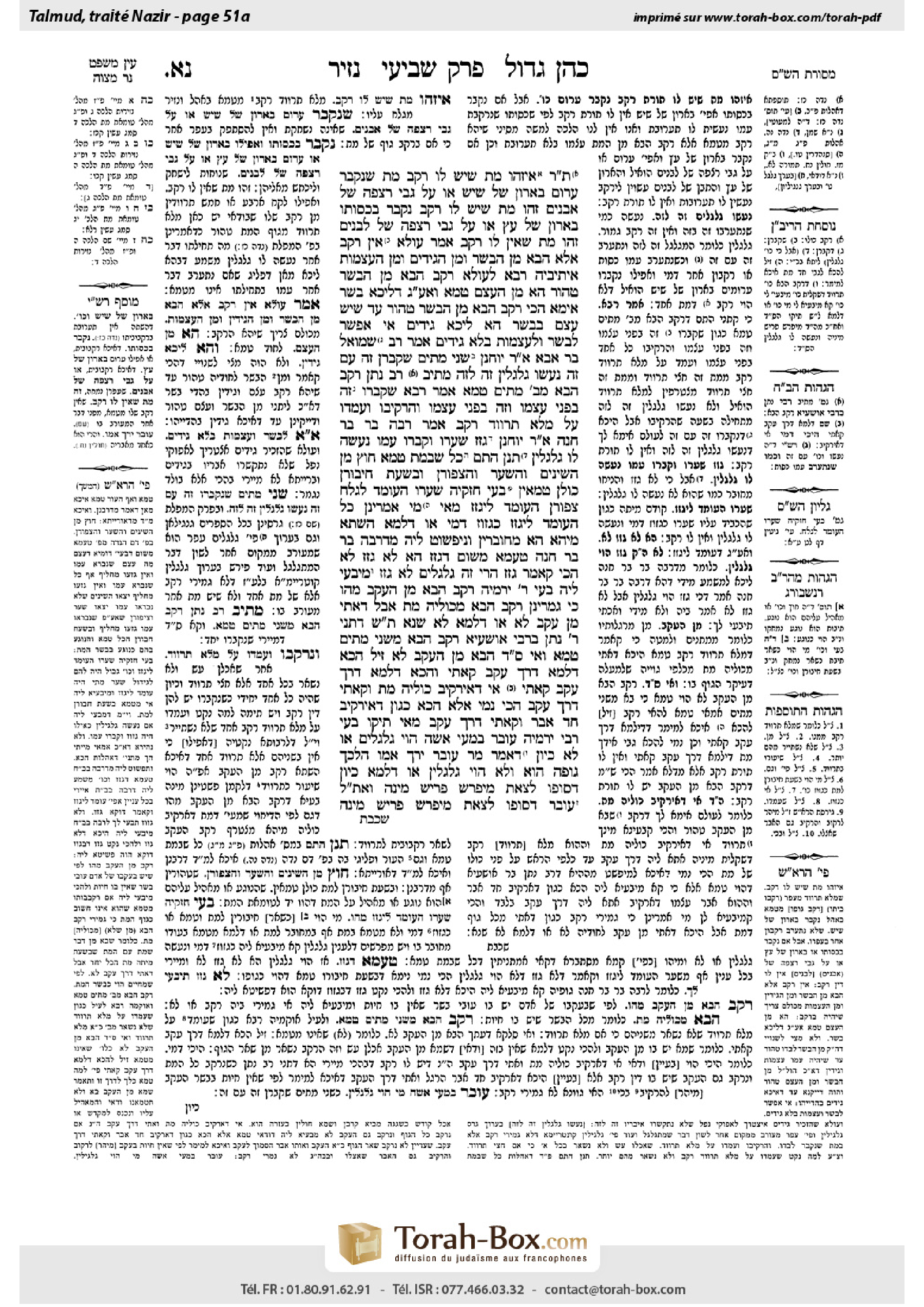
Nazir 51a: Talmud study for Daf Yomi
Daf Yomi is the daily study of one Talmud folio. Explore 37 tractates with scans, Hebrew text, Sefaria English and AI-generated French translations where annotated.
Passage selection and English or AI-generated French translation are available where the scan has annotations. Daf Study is independent of Torah-Box and Sefaria.
Browse Nazir · נזיר · All tractatesNazir 51a text and translations
This page of Nazir includes the Aramaic text, an English translation and an AI-generated French translation, alongside the scan above.
נזיר נ״א א · Aramaic and Hebrew text
תָּנוּ רַבָּנַן: אֵיזֶהוּ מֵת שֶׁיֵּשׁ לוֹ רָקָב? מֵת שֶׁנִּקְבַּר עָרוֹם בְּאָרוֹן שֶׁל שַׁיִשׁ אוֹ עַל גַּבֵּי רִצְפָּה שֶׁל אֲבָנִים — זֶהוּ מֵת שֶׁיֵּשׁ לוֹ רָקָב. נִקְבַּר בִּכְסוּתוֹ, בְּאָרוֹן שֶׁל עֵץ, אוֹ עַל גַּבֵּי רִצְפָּה שֶׁל לְבֵנִים — זֶהוּ מֵת שֶׁאֵין לוֹ רָקָב.
אָמַר עוּלָּא: אֵין רָקָב, אֶלָּא הַבָּא מִן הַבָּשָׂר וּמִן הַגִּידִים וּמִן הָעֲצָמוֹת. אֵיתִיבֵיהּ רָבָא לְעוּלָּא: רָקָב הַבָּא מִן הַבָּשָׂר טָהוֹר. הָא מִן הָעֶצֶם — טָמֵא, וְאַף עַל גַּב דְּלֵיכָּא בָּשָׂר! אֵימָא הָכִי: רָקָב הַבָּא מִן הַבָּשָׂר — טָהוֹר, עַד שֶׁיֵּשׁ עֶצֶם בַּבָּשָׂר.
הָא לֵיכָּא גִּידִים! אִי אֶפְשָׁר לְבָשָׂר וְלַעֲצָמוֹת בְּלֹא גִּידִים.
אָמַר רַב שְׁמוּאֵל בַּר אַבָּא אָמַר רַבִּי יוֹחָנָן: שְׁנֵי מֵתִים שֶׁקְּבָרָן זֶה עִם זֶה — נַעֲשׂוּ גַּלְגַּלִּין זֶה לָזֶה. מֵתִיב רַב נָתָן: רָקָב הַבָּא מִשְּׁנֵי מֵתִים — טָמֵא!
אָמַר רָבָא: שֶׁקָּבְרוּ זֶה בִּפְנֵי עַצְמוֹ וְזֶה בִּפְנֵי עַצְמוֹ, וְהִרְקִיבוּ, וְעָמְדוּ עַל מְלֹא תַּרְווֹד רָקָב.
אָמַר רַבָּה בַּר בַּר חָנָה אָמַר רַבִּי יוֹחָנָן: גָּזַז שְׂעָרוֹ וּקְבָרוֹ עִמּוֹ — נַעֲשָׂה לוֹ גַּלְגַּלִּין. תְּנַן הָתָם: כׇּל שֶׁבַּמֵּת טָמֵא, חוּץ מִן הַשִּׁינַּיִם וְהַשֵּׂעָר וְהַצִּפּוֹרֶן. וּבִשְׁעַת חִיבּוּרָן — כּוּלָּן טְמֵאִין.
בָּעֵי חִזְקִיָּה: שְׂעָרוֹ הָעוֹמֵד לְגַלֵּחַ, צִפּוֹרֶן הָעוֹמֵד לִיגָּזֵז, מַאי? מִי אָמְרִינַן: כׇּל הָעוֹמֵד לִיגָּזֵז כְּגָזוּז דָּמֵי, אוֹ דִלְמָא הַשְׁתָּא מִיהָא הָא מְחוּבָּרִין?
וְנִיפְשׁוֹט לֵיהּ מִדְּרַבָּה בַּר בַּר חָנָה: טַעְמָא מִשּׁוּם דְּגָזַז, הָא לֹא גָּזַז — לָא! הָכִי קָאָמַר: גָּזַז — הֲרֵי זֶה גַּלְגַּלִּים. לֹא גָּזַז — מִיבְּעֵי לֵיהּ.
בָּעֵי רַבִּי יִרְמְיָה: רָקָב הַבָּא מִן הֶעָקֵב מַהוּ? כִּי גָּמְרִינַן רָקָב הַבָּא מִכּוּלֵּיהּ מֵת, אֲבָל דְּאָתֵי מִן עָקֵב — לָא, אוֹ דִלְמָא לָא שְׁנָא?
תָּא שְׁמַע, דְּתָנֵי רַבִּי נָתָן בְּרַבִּי אוֹשַׁעְיָא: רָקָב הַבָּא מִשְּׁנֵי מֵתִים — טָמֵא. וְאִי סָלְקָא דַעְתָּךְ הַבָּא מִן הֶעָקֵב לָא, זִיל הָכָא — דִּלְמָא דֶּרֶךְ עָקֵב קָאָתֵי, וְהָכָא — דִּלְמָא דֶּרֶךְ עָקֵב קָאָתֵי?
אִי דְּאִירְקִיב כּוּלֵּיהּ מֵת וְקָאָתֵי דֶּרֶךְ עָקֵב — הָכִי נָמֵי. אֶלָּא הָכָא כְּגוֹן דְּאִירְקִיב חַד אֵבֶר, וְקָאָתֵי דֶּרֶךְ עָקֵב. מַאי? תֵּיקוּ.
בָּעֵי רַבִּי יִרְמְיָה: עוּבָּר בִּמְעֵי אִשָּׁה, הָוֵי גַּלְגַּלִּים, אוֹ לָא? כֵּיוָן דְּאָמַר מָר עוּבָּר יֶרֶךְ אִמּוֹ — הִלְכָּךְ גּוּפַהּ הוּא, וְלָא הָוֵי גַּלְגַּלִּין, אוֹ דִלְמָא כֵּיוָן דְּסוֹפוֹ לָצֵאת — מִיפְרָשׁ פָּרֵישׁ מִינַּהּ. וְאִם תִּמְצֵי לוֹמַר עוּבָּר דְּסוֹפוֹ לָצֵאת מִיפְרָשׁ פָּרֵישׁ מִינַּהּ,
Nazir 51a · English translation
§ The mishna taught that one of the sources of ritual impurity for which a nazirite must shave is a full ladle of dust from a corpse. The Sages taught (Tosefta, Oholot 2:3): Which is a corpse that has the halakha of dust, i.e., whose dust imparts impurity? A corpse that was buried naked in a marble coffin or on a stone floor; this is a corpse that has the halakha of dust that imparts impurity. Any dust found there must have come from the corpse. However, if it was buried in its cloak, or in a wooden coffin, or on a brick floor, this is a corpse that does not have the halakha of dust that imparts impurity. In the latter cases it is assumed that the dust from the corpse includes particles from the clothes, wood, or bricks that disintegrated, and there is a tradition that the impurity of dust applies only to dust that comes solely from the corpse, not to a mixture from different sources.
With regard to the same issue, Ulla said: Dust is only that which comes from the flesh and from the sinews and from the bones of the corpse together, but not if it came from one of these alone. Rava raised an objection to Ulla from the following baraita: Dust that comes from the flesh is pure. It can be inferred from here that if it comes from the bone it is impure, even though there is no dust of flesh mixed with it. Ulla replied: You should say and infer like this: Dust that comes from the flesh is pure, unless there is bone in the flesh.
Rava continued to question Ulla’s opinion: Even if one interprets the baraita in this manner, there is no mention of sinews here at all, and Ulla maintains that sinews must also contribute to the makeup of part of the dust. Ulla replied that there is no need to mention sinews explicitly, as it is impossible for there to be flesh and bones without sinews. Once it is established that the dust is from bones and flesh, it necessarily includes sinews as well.
§ The Gemara continues to discuss the dust of a corpse. Rav Shmuel bar Abba said that Rabbi Yoḥanan said: Two corpses that were buried with one another become a mixture [galgallin] with one another. Their dust is considered mixed together and does not impart the impurity of the dust from a single corpse. Rav Natan raises an objection to this opinion: But it is taught that dust that comes from two corpses is impure.
Rava said: That baraita is referring to a case where they buried this corpse by itself and that corpse by itself, and they decayed separately, and they both stood at, i.e., yielded the amount of, a full ladle of dust. In this situation, the dust imparts impurity despite the fact that it is not from a single corpse, as the status of dust from a corpse initially applied to each corpse. However, if the corpses decayed together they are considered to be mixed together, which means that their dust does not impart impurity.
The Gemara cites a further statement with regard to dust of a corpse. Rabba bar bar Ḥana said that Rabbi Yoḥanan said: If one cut the hair of a corpse and buried the hair with it, the hair becomes part of the mixture for the dust, and it does not impart impurity. In relation to the above, the Gemara states: We learned in a mishna there (Oholot 3:3): Everything that is in a corpse is impure, except for the teeth, the hair, and the nails, which do not impart impurity as part of the body. But when they are attached to the corpse, they are all impure.
With regard to this halakha, Ḥizkiyya raised a dilemma: If hair of a corpse is ready to be shaved, or its nail is ready to be cut, what is the halakha? Do we say that anything that is ready to be cut is considered cut, and therefore these are considered detached from the body and do not impart impurity? Or, perhaps now, in any event, they are attached, and therefore they should impart impurity?
The Gemara asks: And let Ḥizkiyya resolve this dilemma from the aforementioned statement of Rabba bar bar Ḥana, that hair buried with a corpse forms a mixture with the corpse. The inference is as follows: The reason that it forms a mixture is because he cut the hair, from which it may be inferred if he did not cut the hair it would not form a mixture, even if it was ready to be cut. The Gemara rejects this argument: One can respond that this is what Rabba bar bar Ḥana is saying: If he cut it, it definitely forms a mixture; if he did not cut it, Rabba bar bar Ḥana is unsure as to the halakha and he raises this case as a dilemma.
§ Rabbi Yirmeya raised another dilemma concerning the dust of a corpse: With regard to dust that comes from the heel, what is the halakha? The Gemara explains the two sides of the dilemma: Do we say that when we learn this halakha through tradition, is it only in reference to dust that comes from all of a corpse, but with regard to dust that comes from its heel, no, this halakha does not apply; or perhaps it is no different?
The Gemara suggests a resolution of this dilemma: Come and hear, as Rabbi Natan, son of Rabbi Oshaya, taught: Dust that comes from two corpses is impure. And if it enters your mind that dust that comes from the heel does not impart impurity, go here and consider that perhaps the dust came from the heel, and go here too and consider that perhaps it came from the heel. The fact that the dust is considered definitely impure shows that dust from the heel imparts impurity as well.
The Gemara rejects this argument: If the entire corpse decayed and the dust came from the heel, so too, it is all impure, as the dust of the heel is not considered to be a foreign substance. Rather, here Rabbi Natan is referring to a case where one limb decayed and the dust came from the heel. It was with regard to this situation that Rabbi Yirmeya asked: What is its halakha? Does this dust impart impurity or not? No answer was found, and therefore the Gemara states that the dilemma shall stand unresolved.
§ Rabbi Yirmeya raised yet another dilemma: Does a dead fetus in its dead mother’s womb form a mixture with regard to her, so that the bodies are considered like two corpses buried together, or not? The Gemara explains the two sides of the dilemma: Do we say that since the Master said that a fetus is considered as the thigh of its mother, it is therefore like her body and it does not form a mixture with it? Or perhaps one should maintain: Since in most cases a fetus will ultimately emerge from the womb at birth, it is already considered separated from her, and it is like any other corpse buried with the woman. And if you say that a fetus, which will ultimately emerge, is considered separated from her and is not part of her body, one must still ask this question
Nazir 51a · Traduction française (IA)
§ La Michna enseignait que l’une des sources d’impureté rituelle pour lesquelles un nazir doit se raser est une pleine pelle de poussière provenant d’un cadavre. Les Sages enseignèrent (Tosefta, Oholot 2:3) : Quel cadavre relève de la halakha de la poussière, c’est-à-dire dont la poussière transmet l’impureté ? Un cadavre enterré nu dans un cercueil de marbre ou sur un sol de pierre : voilà un cadavre qui relève de la halakha de la poussière transmettant l’impureté. Toute poussière trouvée là doit provenir du cadavre. En revanche, s’il a été enterré dans son manteau, dans un cercueil en bois ou sur un sol de briques, ce cadavre ne relève pas de la halakha de la poussière transmettant l’impureté. Dans ces derniers cas, on suppose que la poussière du cadavre comprend des particules provenant des vêtements, du bois ou des briques qui se sont désagrégés ; or, une tradition enseigne que l’impureté de la poussière ne s’applique qu’à la poussière provenant exclusivement du cadavre, et non à un mélange de sources différentes.
À propos de la même question, Oulla dit : La poussière n’est considérée comme telle que si elle provient ensemble de la chair, des tendons et des os du cadavre, mais non si elle provient d’un seul de ces éléments. Rava soulève une objection contre Oulla à partir de la baraïta suivante : La poussière provenant de la chair est pure. On peut en déduire que si elle provient de l’os, elle est impure, même si aucune poussière de chair n’y est mêlée. Oulla répond : Il faut comprendre et déduire ainsi : la poussière provenant de la chair est pure, sauf si l’os est mêlé à la chair.
Rava poursuit sa contestation de l’opinion d’Oulla : même si l’on interprète la baraïta de cette manière, les tendons n’y sont pas mentionnés du tout, alors qu’Oulla soutient que les tendons doivent également contribuer à la composition de la poussière. Oulla répond qu’il n’est pas nécessaire de mentionner explicitement les tendons, car il est impossible qu’il y ait de la chair et des os sans tendons. Dès lors qu’il est établi que la poussière provient des os et de la chair, elle comprend nécessairement aussi des tendons.
§ La Guemara poursuit son examen de la poussière d’un cadavre. Rav Shmuel bar Abba dit au nom de Rabbi Yoḥanan : Deux cadavres enterrés ensemble se mélangent [galgallin] l’un à l’autre. Leur poussière est considérée comme mêlée et ne transmet pas l’impureté propre à la poussière d’un seul cadavre. Rav Natan soulève une objection contre cette opinion : Pourtant, il est enseigné que la poussière provenant de deux cadavres est impure.
Rava dit : Cette baraïta parle d’un cas où l’on a enterré ce cadavre séparément et cet autre cadavre séparément, où ils se sont décomposés chacun de leur côté et où chacun a produit une pleine pelle de poussière. Dans cette situation, la poussière transmet l’impureté bien qu’elle ne provienne pas d’un seul cadavre, car le statut de poussière provenant d’un cadavre s’appliquait initialement à chaque cadavre. En revanche, si les cadavres se sont décomposés ensemble, ils sont considérés comme mêlés, ce qui signifie que leur poussière ne transmet pas l’impureté.
La Guemara cite une autre déclaration concernant la poussière d’un cadavre. Rabba bar bar Ḥana dit au nom de Rabbi Yoḥanan : Si l’on a coupé les cheveux d’un cadavre et enterré ces cheveux avec lui, les cheveux entrent dans le mélange avec la poussière et ne transmettent pas l’impureté. À ce propos, la Guemara énonce : Nous avons appris dans une Michna (Oholot 3:3) : Tout ce qui se trouve dans un cadavre est impur, à l’exception des dents, des cheveux et des ongles, qui ne transmettent pas l’impureté en tant que parties du corps. Toutefois, lorsqu’ils sont attachés au cadavre, ils sont tous impurs.
À propos de cette halakha, Ḥizkiyya soulève une question : Quel est le statut des cheveux d’un cadavre prêts à être rasés, ou de son ongle prêt à être coupé ? Dit-on que tout ce qui est prêt à être coupé est considéré comme déjà coupé, et que ces éléments sont donc considérés comme détachés du corps et ne transmettent pas l’impureté ? Ou peut-être sont-ils, à présent, en tout état de cause encore attachés, et doivent-ils donc transmettre l’impureté ?
La Guemara demande : Ḥizkiyya ne pourrait-il pas résoudre cette question à partir de la déclaration précitée de Rabba bar bar Ḥana, selon laquelle des cheveux enterrés avec un cadavre se mêlent à celui-ci ? On pourrait en déduire que s’ils se mêlent, c’est parce qu’il a coupé les cheveux ; on peut donc en inférer que, s’il ne les a pas coupés, ils ne se mêlent pas, même s’ils étaient prêts à être coupés. La Guemara rejette cet argument : On peut répondre que voici ce que dit Rabba bar bar Ḥana : s’il les a coupés, ils se mêlent certainement ; s’il ne les a pas coupés, Rabba bar bar Ḥana ne sait pas quelle est la halakha et soulève ce cas comme une question.
§ Rabbi Yirmeya soulève une autre question concernant la poussière d’un cadavre : Quel est le statut de la poussière provenant du talon ? La Guemara explique les deux aspects de la question : Dit-on que, lorsque nous apprenons cette halakha par tradition, elle ne concerne que la poussière provenant de l’ensemble du cadavre, mais que, s’agissant de la poussière provenant de son talon, cette halakha ne s’applique pas ; ou bien n’y a-t-il aucune différence ?
La Guemara propose de résoudre cette question : Viens et entends, car Rabbi Natan, fils de Rabbi Oshaya, enseigna : La poussière provenant de deux cadavres est impure. Et si tu penses que la poussière provenant du talon ne transmet pas l’impureté, considère ici que la poussière pourrait provenir du talon, et considère également là que la poussière pourrait provenir du talon. Le fait que cette poussière soit tenue pour certainement impure montre que la poussière du talon transmet également l’impureté.
La Guemara rejette cet argument : Si le cadavre entier s’est décomposé et que la poussière provient du talon, elle est également entièrement impure, car la poussière du talon n’est pas considérée comme une substance étrangère. Rabbi Natan parle plutôt ici d’un cas où un seul membre s’est décomposé et où la poussière provient du talon. C’est à propos de cette situation que Rabbi Yirmeya a demandé : Quel est son statut ? Cette poussière transmet-elle l’impureté ou non ? Aucune réponse n’a été trouvée ; la Guemara indique donc que la question demeure sans résolution.
§ Rabbi Yirmeya soulève encore une autre question : Un fœtus mort dans le ventre de sa mère morte se mêle-t-il à elle, de sorte que les deux corps soient considérés comme deux cadavres enterrés ensemble, ou non ? La Guemara explique les deux aspects de la question : Dit-on que, puisque le Maître a dit qu’un fœtus est considéré comme la cuisse de sa mère, il est donc comme une partie de son corps et ne se mêle pas à elle ? Ou bien faut-il soutenir que, puisque, dans la plupart des cas, un fœtus finira par sortir du ventre à la naissance, il est déjà considéré comme séparé de sa mère et équivaut à tout autre cadavre enterré avec elle ? Et si tu dis qu’un fœtus, qui finira par sortir, est considéré comme séparé de sa mère et ne fait pas partie de son corps, il faut encore poser cette question
Traduction française générée par IA à partir de l’édition anglaise de Sefaria. Vérifie toujours un passage avec le texte source.
Text from Sefaria: William Davidson Edition - Vocalized Aramaic (CC BY NC); William Davidson Edition - English (CC BY NC).