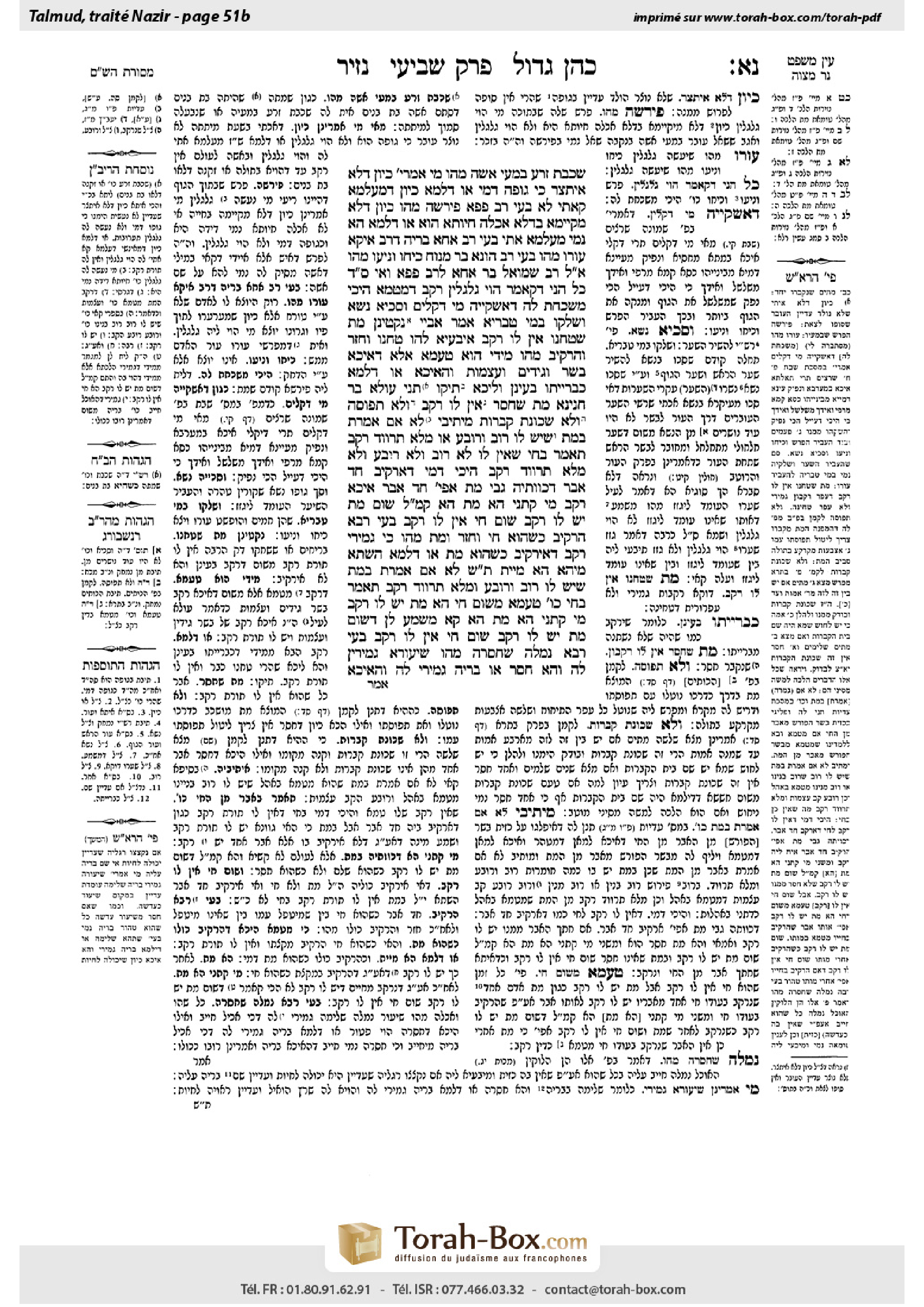
Nazir 51b: Talmud study for Daf Yomi
Daf Yomi is the daily study of one Talmud folio. Explore 37 tractates with scans, Hebrew text, Sefaria English and AI-generated French translations where annotated.
Passage selection and English or AI-generated French translation are available where the scan has annotations. Daf Study is independent of Torah-Box and Sefaria.
Browse Nazir · נזיר · All tractatesNazir 51b text and translations
This page of Nazir includes the Aramaic text, an English translation and an AI-generated French translation, alongside the scan above.
נזיר נ״א ב · Aramaic and Hebrew text
שִׁכְבַת זֶרַע בִּמְעֵי אִשָּׁה, מַהוּ? מִי אָמְרִינַן כֵּיוָן דְּלָא אִיתְּצַר — כִּי גוּפַהּ דָּמֵי, אוֹ דִלְמָא כֵּיוָן דְּמֵעָלְמָא קָאָתֵי — לָא?
בָּעֵי רַב פָּפָּא: פִּירְשָׁהּ, מַהוּ? כֵּיוָן דְּלָא מִקַּיְימָא בִּדְלָא אָכְלָה — חַיּוּתָא הוּא, אוֹ דִלְמָא הָא נָמֵי מֵעָלְמָא אָתֵי? בָּעֵי רַב אַחָא בְּרֵיהּ דְּרַב אִיקָא: עוֹרוֹ מַהוּ? בָּעֵי רַב הוּנָא בַּר מָנוֹחַ: כִּיחוֹ וְנִיעוֹ מַהוּ?
אֲמַר לֵיהּ רַב שְׁמוּאֵל בַּר אַחָא לְרַב פָּפָּא: וְאִי סָלְקָא דַעְתָּךְ כׇּל הָנֵי דְּקָאָמַר הָוֵי גַּלְגַּלִּין, רָקָב דִּמְטַמֵּא הֵיכִי מַשְׁכַּחַתְּ לַהּ! דְּאַשְׁקְיֵיהּ מֵי דְקָלִים, וְסַכְיֵא נָשָׁא, וּשְׁלָקוֹ בְּמֵי טְבֶרְיָא.
אָמַר אַבָּיֵי, נָקְטִינַן: מֵת שֶׁטְּחָנוֹ — אֵין לוֹ רָקָב. אִיבַּעְיָא לְהוּ: טְחָנוֹ וְחָזַר וְהִרְקִיב, מַהוּ? מִידֵּי הוּא טַעְמָא אֶלָּא דְּאִיכָּא בָּשָׂר וְגִידִים וַעֲצָמוֹת, וְהָאִיכָּא. אוֹ דִּלְמָא כִּבְרִיָּיתוֹ בָּעִינַן, וְלֵיכָּא? תֵּיקוּ.
תָּנֵי עוּלָּא בַּר חֲנִינָא: מֵת שֶׁחָסַר — אֵין לוֹ רָקָב וְלֹא תְּפוּסָה וְלֹא שְׁכוּנַת קְבָרוֹת.
מֵיתִיבִי: לֹא, אִם אָמַרְתָּ בְּמֵת שֶׁיֵּשׁ לוֹ רוֹב וְרוֹבַע אוֹ מְלֹא תַרְווֹד רָקָב — תֹּאמַר בְּחַי, שֶׁאֵין לוֹ לֹא רוֹב, וְלֹא רוֹבַע, וְלֹא מְלֹא תַרְווֹד רָקָב?!
הֵיכִי דָּמֵי — דְּאַרְקִיב חַד אֵבֶר, דִּכְווֹתֵיהּ גַּבֵּי מֵת: אֲפִילּוּ חַד אֵבֶר אִיכָּא רָקָב! מִי קָתָנֵי הָא מֵת? הָא קָא מַשְׁמַע לַן: שׁוּם מֵת — יֵשׁ לוֹ רָקָב, שׁוּם חַי — אֵין לוֹ רָקָב.
בָּעֵי רָבָא: הִרְקִיב כְּשֶׁהוּא חַי, וְחָזַר וּמֵת, מַהוּ? כִּי גְּמִירִי רָקָב, דְּאִירְקִיב כְּשֶׁהוּא מֵת. אוֹ דִלְמָא הַשְׁתָּא מִיהָא הָא מָיֵית?
תָּא שְׁמַע: לֹא אִם אָמַרְתָּ בְּמֵת שֶׁיֵּשׁ לוֹ רוֹב וְרוֹבַע וּמְלֹא תַרְווֹד רָקָב, תֹּאמַר בְּחַי כּוּ׳.
טַעְמָא מִשּׁוּם חַי, הָא מֵת יֵשׁ לוֹ רָקָב! מִי קָתָנֵי הָא מֵת? הָא קָא מַשְׁמַע לַן דְּשׁוּם מֵת — יֵשׁ לוֹ רָקָב, שׁוּם חַי — אֵין לוֹ רָקָב.
בָּעֵי רָבָא: נְמָלָה שֶׁחָסְרָה, מַהוּ? שִׁיעוּרָא גְּמִירִין לַהּ — וְהָא חֲסַר. אוֹ בְּרִיָּה גְּמִירִי לַהּ — וְהָאִיכָּא.
Nazir 51b · English translation
with regard to semen in a dead woman’s womb. What is the halakha in this case? Does it form a mixture with respect to the woman’s body? The Gemara explains the two sides of this dilemma: Do we say that since no fetus was formed from the semen, it is considered like her body? Or, perhaps one should argue that since it comes from outside, it is not considered part of her body.
Rav Pappa raised a similar dilemma: With regard to her excrement, the food waste that remains in a woman’s intestines, what is the halakha? Once again, the Gemara explains the two sides of this dilemma: Do we say that since she cannot subsist without food it is considered her life, which means that the food left inside her body is part of her and does not form a mixture with the corpse? Or perhaps this too comes from outside and is therefore not part of her body, and does form a mixture with her corpse. Similarly, Rav Aḥa, son of Rav Ika, raised a dilemma concerning a corpse: With regard to its skin, what is the halakha? Rav Huna bar Manoaḥ likewise raised a dilemma: With regard to its phlegm and its spittle, what is the halakha?
Rav Shmuel bar Aḥa said to Rav Pappa: But if it enters your mind that all these cases of which they spoke form a mixture, under what circumstances do you find this case of dust that imparts impurity? Dust from a corpse will always include some components of the aforementioned elements. The Gemara answers: It is possible. For example, if someone was given palm water [mei dekalim], a powerful laxative, to drink before he died, and was rubbed with a depilatory agent to remove his hair, and was boiled after death in the hot waters of Tiberias until the skin came off, this would remove all matter that is not part of the corpse itself.
Abaye said: We have a tradition that a corpse that was ground into small pieces has no halakha of dust. A dilemma was raised before the Sages: If a corpse was ground after death and the remains later decayed, what is the halakha? The Gemara clarifies the two sides of the dilemma: Is the halakha of dust of a corpse only due to the fact that there is flesh and sinews and bones, and all these are present in this case, so it is impure? Or perhaps, we require the corpse to have decayed from its initial state, before it was ground, and this is not the situation here. As was the case with regard to the previous inquiries, no answer was found, and the Gemara says that the dilemma shall stand unresolved.
§ Ulla bar Ḥanina teaches: A corpse that lacks a part does not have the halakha of dust, which imparts ritual impurity in the amount of a full ladle, nor the halakha of earth that is caught [tefusa] and considered part of a corpse. If a deficient corpse is moved, the surrounding earth is not considered part of it and need not be moved together with the body, as must be performed for a whole corpse. Nor does the halakha of a graveyard apply. If three corpses are discovered in close proximity and one of them is deficient in some way, one need not search for more bodies out of concern that the location might have been a cemetery, as must be done if three intact corpses are found. Rather, the bodies are considered isolated corpses.
The Gemara raises an objection from a mishna (Eduyyot 6:3) that addresses the question of whether an olive-bulk of flesh that came from a living person imparts ritual impurity as it would were it to come from a corpse: No, if you say that an olive-bulk of flesh imparts impurity with regard to a corpse, whose halakhot of impurity are stringent, as the majority of its structure or the majority of the number of its bones, or a quarter-kav of its bones, or even a full ladle of its dust impart impurity, shall you also say that it imparts impurity with regard to a living person, who does not have the halakha of the majority of structure or the majority of the number of its bones, nor a quarter-kav, nor a full ladle of dust?
The Gemara analyzes this passage: What are the circumstances of that mishna that deals with a limb from a living person? If you say that one limb of a living person decayed, and the mishna is indicating that in the corresponding situation with regard to a corpse, there is dust even from one limb. This shows that the halakha of dust applies to a corpse that is missing a limb and not just to a complete corpse. The Gemara rejects this argument: Did the mishna teach that this corpse in that particular case of an isolated limb has the halakha of dust? That is merely an inference, as it is not stated explicitly in the mishna itself. Rather, the mishna teaches us this: The name, i.e., the category, of a corpse has dust. However, the name of a living person does not have dust.
Rava raised a dilemma: If a limb of a body decayed when he was alive, and that individual subsequently died, what is the halakha? Do we say that when this is learned as a tradition that dust imparts ritual impurity, this applies only if the body decayed when he was dead, but not when he was alive, and therefore this corpse is considered deficient and its dust does not impart impurity? Or perhaps, now in any event he is dead, and his whole body has decomposed, and consequently its dust does impart impurity.
The Gemara suggests: Come and hear the aforementioned mishna: No, if you say that an olive-bulk of flesh imparts impurity with regard to a corpse, whose halakhot of impurity are stringent, as the majority of its structure or the majority of the number of its bones, or a quarter-kav of its bones, or even a full ladle of its dust imparts impurity, shall you also say that it imparts impurity with regard to a living person, who does not have the halakha of the majority of structure or the majority of the number of its bones, nor a quarter-kav, nor a full ladle of dust.
The Gemara infers from this passage: The reason the olive-bulk of flesh does not impart impurity is due to the fact that it is from a living person, from which it may be inferred that in a corresponding situation involving a corpse, the corpse has the halakha of dust, even if the limb had decomposed during the deceased’s lifetime. The Gemara rejects this contention as above: Did the mishna teach that this corpse in that particular case of an isolated limb has the halakha of dust? That is merely an inference, as it is not stated explicitly in the mishna itself. Rather, the mishna teaches us this: The name, i.e., the category, of a corpse has dust. However, the name of a living person does not have dust.
§ In relation to the above discussion concerning a body without a limb, Rava raised a dilemma: If someone eats an entire ant, even if it is less than an olive-bulk in volume, he is liable for eating a creeping animal because it is a whole creature. Rava’s dilemma was as follows: If one eats an ant that lacks a part, e.g., a leg, what is the halakha? Is this individual liable to receive lashes? The two possibilities are as follows: Is it learned as tradition that the amount for which one is liable is a whole ant, and this one is lacking? Or did we learn that he is punished for a viable entity, and there is a viable entity here, despite the missing limb?
Nazir 51b · Traduction française (IA)
à propos du sperme dans l’utérus d’une femme morte. Quelle est la halakha dans ce cas ? Se mêle-t-il au corps de la femme ? La Guemara expose les deux aspects de cette interrogation : dit-on que, puisqu’aucun fœtus ne s’est formé à partir du sperme, celui-ci est considéré comme faisant partie de son corps ? Ou bien peut-on soutenir que, puisqu’il vient de l’extérieur, il n’est pas considéré comme faisant partie de son corps ?
Rav Pappa souleva une interrogation similaire : concernant ses excréments, c’est-à-dire les déchets alimentaires qui restent dans les intestins d’une femme, quelle est la halakha ? Là encore, la Guemara expose les deux aspects de cette interrogation : dit-on que, puisqu’elle ne peut subsister sans nourriture, celle-ci est considérée comme sa vie, ce qui signifie que les aliments restés dans son corps font partie d’elle et ne se mêlent pas au cadavre ? Ou bien cela aussi vient-il de l’extérieur et ne fait-il donc pas partie de son corps, de sorte que cela se mêle à son cadavre ? De même, Rav Aḥa, fils de Rav Ika, souleva une interrogation au sujet d’un cadavre : concernant sa peau, quelle est la halakha ? Rav Huna bar Manoaḥ souleva également une interrogation : concernant son flegme et sa salive, quelle est la halakha ?
Rav Shmuel bar Aḥa dit à Rav Pappa : Mais si tu considères que tous les éléments mentionnés dans ces cas se mêlent au cadavre, dans quelles circonstances trouve-t-on le cas de poussière qui transmet l’impureté ? La poussière provenant d’un cadavre contiendra toujours certains des éléments mentionnés précédemment. La Guemara répond : C’est possible. Par exemple, si l’on a fait boire à quelqu’un de l’eau de palmier [mei dekalim], un puissant laxatif, avant sa mort, qu’on l’a frotté avec un produit dépilatoire pour lui enlever les poils, puis qu’après sa mort on l’a fait bouillir dans les eaux chaudes de Tibériade jusqu’à ce que la peau se détache, toute matière ne faisant pas partie du cadavre lui-même aurait ainsi été éliminée.
Abaye dit : Nous avons une tradition selon laquelle un cadavre réduit en petits morceaux n’a pas le statut de poussière. Les Sages soulevèrent une interrogation : si un cadavre a été broyé après la mort et que ses restes se sont ensuite décomposés, quelle est la halakha ? La Guemara précise les deux aspects de cette interrogation : le statut de poussière du cadavre tient-il uniquement au fait qu’il y a de la chair, des tendons et des os, tous présents dans ce cas, de sorte qu’il est impur ? Ou bien faut-il que le cadavre se soit décomposé à partir de son état initial, avant d’être broyé, ce qui n’est pas le cas ici ? Comme pour les interrogations précédentes, aucune réponse n’a été trouvée, et la Guemara indique que la question reste sans solution.
§ Ulla bar Ḥanina enseigne : Un cadavre auquel il manque une partie n’a ni le statut de poussière, qui transmet l’impureté à partir d’une pleine louche, ni celui de terre saisie [tefusa] et considérée comme faisant partie d’un cadavre. Si l’on déplace un cadavre incomplet, la terre qui l’entoure n’est pas considérée comme faisant partie de celui-ci et il n’est pas nécessaire de la déplacer avec le corps, comme on doit le faire pour un cadavre entier. Le statut de cimetière ne s’applique pas non plus. Si l’on découvre trois cadavres à proximité les uns des autres et que l’un d’eux est incomplet à certains égards, il n’est pas nécessaire de rechercher d’autres corps par crainte que l’endroit ait été un cimetière, comme il faut le faire lorsqu’on trouve trois cadavres intacts. Ces corps sont plutôt considérés comme des cadavres isolés.
La Guemara soulève une objection à partir d’une Michna (Eduyyot 6:3), qui traite de la question de savoir si un volume de chair équivalant à une olive provenant d’une personne vivante transmet l’impureté comme il le ferait s’il provenait d’un cadavre : Non. Si tu dis qu’un volume de chair équivalant à une olive transmet l’impureté dans le cas d’un cadavre, dont les lois d’impureté sont rigoureuses, puisque la majorité de sa structure, ou la majorité du nombre de ses os, ou un quart de kav de ses os, voire une pleine louche de sa poussière, transmet l’impureté, diras-tu également qu’il transmet l’impureté dans le cas d’une personne vivante, qui n’est soumise ni à la règle de la majorité de sa structure ou de la majorité du nombre de ses os, ni à celle d’un quart de kav, ni à celle d’une pleine louche de poussière ?
La Guemara analyse ce passage : dans quelles circonstances cette Michna traite-t-elle d’un membre provenant d’une personne vivante ? Si tu dis qu’un membre d’une personne vivante s’est décomposé et que la Michna indique que, dans la situation correspondante concernant un cadavre, il y a de la poussière même provenant d’un seul membre, cela montre que le statut de poussière s’applique à un cadavre auquel il manque un membre, et pas seulement à un cadavre complet. La Guemara rejette cet argument : La Michna a-t-elle enseigné que, dans ce cas précis d’un membre isolé, ce cadavre a le statut de poussière ? Ce n’est qu’une déduction, car cela n’est pas énoncé explicitement dans la Michna elle-même. La Michna nous enseigne plutôt ceci : la catégorie du cadavre comporte de la poussière. En revanche, la catégorie de la personne vivante ne comporte pas de poussière.
Rava souleva une interrogation : si un membre du corps s’est décomposé du vivant de la personne, puis que celle-ci est morte, quelle est la halakha ? Dit-on que, selon la tradition d’après laquelle la poussière transmet l’impureté, cela ne s’applique que si le corps s’est décomposé après la mort, mais pas du vivant de la personne ; ce cadavre est donc considéré comme incomplet et sa poussière ne transmet pas l’impureté ? Ou bien, puisqu’à présent la personne est morte et que son corps tout entier s’est décomposé, sa poussière transmet-elle l’impureté ?
La Guemara suggère : Venons et entendons la Michna citée précédemment : Non. Si tu dis qu’un volume de chair équivalant à une olive transmet l’impureté dans le cas d’un cadavre, dont les lois d’impureté sont rigoureuses, puisque la majorité de sa structure, ou la majorité du nombre de ses os, ou un quart de kav de ses os, voire une pleine louche de sa poussière, transmet l’impureté, diras-tu également qu’il transmet l’impureté dans le cas d’une personne vivante, qui n’est soumise ni à la règle de la majorité de sa structure ou de la majorité du nombre de ses os, ni à celle d’un quart de kav, ni à celle d’une pleine louche de poussière ?
La Guemara déduit de ce passage que si un volume de chair équivalant à une olive ne transmet pas l’impureté, c’est parce qu’il provient d’une personne vivante. On peut en déduire que, dans une situation correspondante concernant un cadavre, celui-ci a le statut de poussière, même si le membre s’était décomposé du vivant du défunt. La Guemara rejette cette affirmation comme précédemment : La Michna a-t-elle enseigné que, dans ce cas précis d’un membre isolé, ce cadavre a le statut de poussière ? Ce n’est qu’une déduction, car cela n’est pas énoncé explicitement dans la Michna elle-même. La Michna nous enseigne plutôt ceci : la catégorie du cadavre comporte de la poussière. En revanche, la catégorie de la personne vivante ne comporte pas de poussière.
§ À propos de la discussion précédente concernant un corps auquel il manque un membre, Rava souleva une interrogation : si quelqu’un mange une fourmi entière, même si son volume est inférieur à celui d’une olive, il est passible pour avoir mangé un animal rampant, puisqu’il s’agit d’une créature entière. L’interrogation de Rava était la suivante : si quelqu’un mange une fourmi à laquelle il manque une partie, par exemple une patte, quelle est la halakha ? Cet individu est-il passible de flagellation ? Les deux possibilités sont les suivantes : a-t-on appris par tradition que la quantité entraînant la responsabilité est une fourmi entière, alors que celle-ci est incomplète ? Ou bien a-t-on appris qu’il est puni pour avoir mangé une entité viable, et qu’il y a ici une entité viable malgré le membre manquant ?
Traduction française générée par IA à partir de l’édition anglaise de Sefaria. Vérifie toujours un passage avec le texte source.
Text from Sefaria: William Davidson Edition - Vocalized Aramaic (CC BY NC); William Davidson Edition - English (CC BY NC).