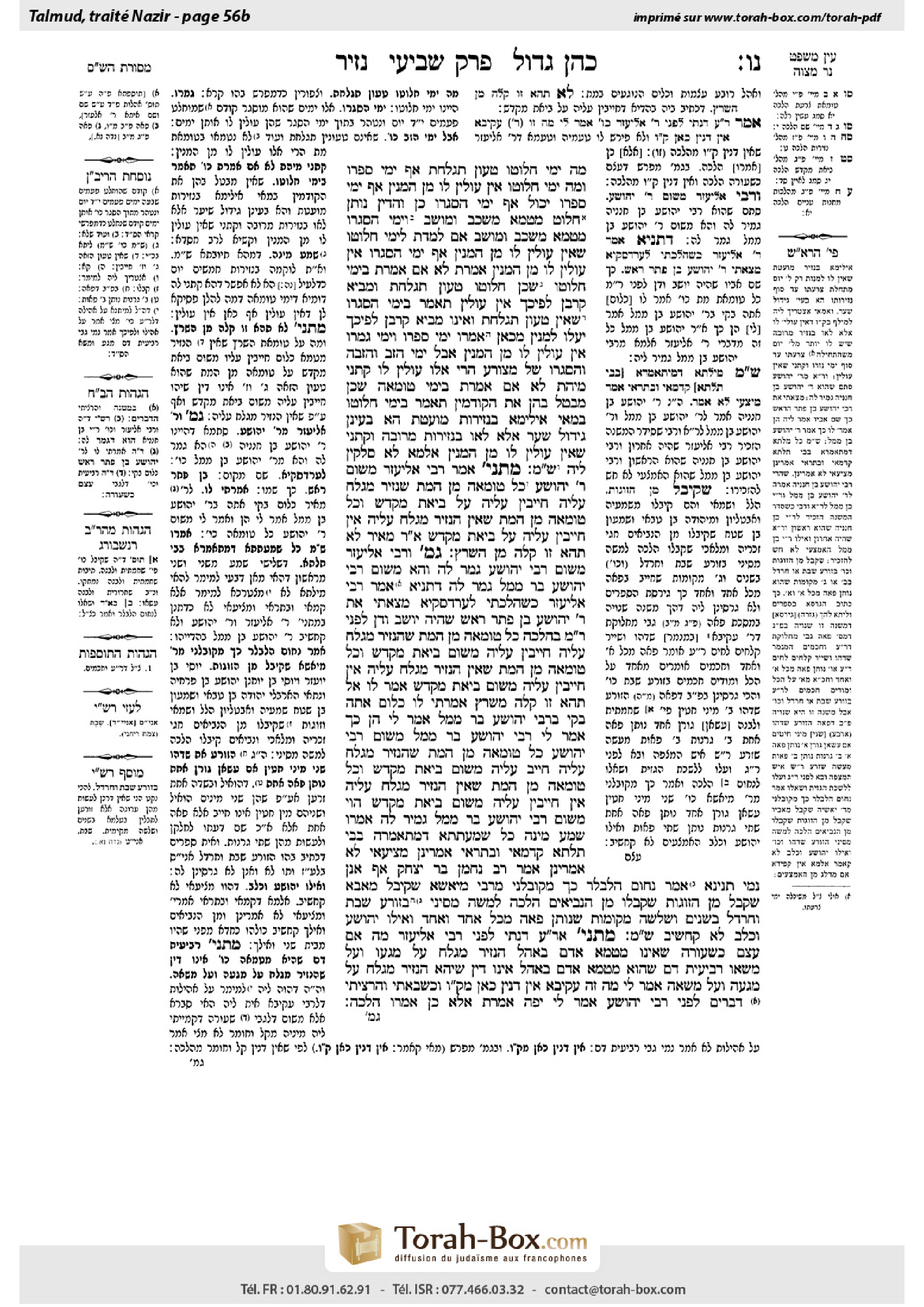
Nazir 56b: Talmud study for Daf Yomi
Daf Yomi is the daily study of one Talmud folio. Explore 37 tractates with scans, Hebrew text, Sefaria English and AI-generated French translations where annotated.
Passage selection and English or AI-generated French translation are available where the scan has annotations. Daf Study is independent of Torah-Box and Sefaria.
Browse Nazir · נזיר · All tractatesNazir 56b text and translations
This page of Nazir includes the Aramaic text, an English translation and an AI-generated French translation, alongside the scan above.
נזיר נ״ו ב · Aramaic and Hebrew text
מָה יְמֵי חִלּוּטוֹ טָעוּן תִּגְלַחַת — אַף יְמֵי סְפָרוֹ. וּמָה יְמֵי חִלּוּטוֹ אֵין עוֹלִין לוֹ מִן הַמִּנְיָן — אַף יְמֵי סְפָרוֹ.
יָכוֹל אַף יְמֵי הֶסְגֵּרוֹ כֵּן? וְהַדִּין נוֹתֵן: חָלוּט מְטַמֵּא מִשְׁכָּב וּמוֹשָׁב, וִימֵי הֶסְגֵּרוֹ מְטַמֵּא מִשְׁכָּב וּמוֹשָׁב. אִם לָמַדְתָּ לִימֵי חִלּוּטוֹ שֶׁאֵין עוֹלִין לוֹ מִן הַמִּנְיָן — אַף יְמֵי הֶסְגֵּרוֹ אֵין עוֹלִין לוֹ מִן הַמִּנְיָן.
אָמַרְתָּ: לֹא, אִם אָמַרְתָּ בִּימֵי חִלּוּטוֹ, שֶׁכֵּן חִלּוּטוֹ טָעוּן תִּגְלַחַת וּמֵבִיא קׇרְבָּן, לְפִיכָךְ אֵין עוֹלִין. תֹּאמַר בִּימֵי הֶסְגֵּרוֹ, שֶׁאֵין טָעוּן תִּגְלַחַת, וְאֵינוֹ מֵבִיא קׇרְבָּן, לְפִיכָךְ יַעֲלוּ לַמִּנְיָן.
מִכָּאן אָמְרוּ: יְמֵי סְפָרוֹ וִימֵי גְמָרוֹ — אֵין עוֹלִין לוֹ מִן הַמִּנְיָן. אֲבָל יְמֵי הַזָּב וְהַזָּבָה וְהֶסְגֵּרוֹ שֶׁל מְצוֹרָע — הֲרֵי אֵלּוּ עוֹלִין לוֹ.
קָתָנֵי מִיהַת: לָא, אִם אָמַרְתָּ בִּימֵי טוּמְאָה שֶׁכֵּן מְבַטֵּל בָּהֶן אֶת הַקּוֹדְמִין, תֹּאמַר בִּימֵי חִלּוּטוֹ. בְּמַאי? אִילֵימָא בִּנְזִירוּת מוּעֶטֶת, הָא בָּעִינַן גִּידּוּל שֵׂעָר.
אֶלָּא לָאו בִּנְזִירוּת מְרוּבָּה, וְקָתָנֵי שֶׁאֵין עוֹלִין לוֹ מִן הַמִּנְיָן. אַלְמָא לָא סָלְקִין לֵיהּ! שְׁמַע מִינַּהּ.
מַתְנִי׳ אָמַר רַבִּי אֱלִיעֶזֶר מִשּׁוּם רַבִּי יְהוֹשֻׁעַ: כׇּל טוּמְאָה מִן הַמֵּת שֶׁנָּזִיר מְגַלֵּחַ עָלֶיהָ — חַיָּיבִין עָלֶיהָ עַל בִּיאַת מִקְדָּשׁ. וְכׇל טוּמְאָה מִן הַמֵּת שֶׁאֵין הַנָּזִיר מְגַלֵּחַ עָלֶיהָ — אֵין חַיָּיבִין עָלֶיהָ עַל בִּיאַת מִקְדָּשׁ.
אָמַר רַבִּי מֵאִיר: לֹא תְּהֵא זוֹ קַלָּה מִן הַשֶּׁרֶץ.
גְּמָ׳ וְרַבִּי אֱלִיעֶזֶר מִשּׁוּם רַבִּי יְהוֹשֻׁעַ גְּמַר לַהּ? וְהָא מִשּׁוּם רַבִּי יְהוֹשֻׁעַ בַּר מֶמֶל גְּמַר לָהּ. דְּתַנְיָא, אָמַר רַבִּי אֱלִיעֶזֶר: כְּשֶׁהָלַכְתִּי לְעַרְדַּסְקִיָּא, מָצָאתִי אֶת רַבִּי יְהוֹשֻׁעַ בֶּן פֵּתֶר רֹאשׁ שֶׁהָיָה יוֹשֵׁב וְדָן לִפְנֵי רַבִּי מֵאִיר בַּהֲלָכָה: כׇּל טוּמְאָה מִן הַמֵּת שֶׁהַנָּזִיר מְגַלֵּחַ עָלֶיהָ — חַיָּיבִין עָלֶיהָ מִשּׁוּם בִּיאַת מִקְדָּשׁ. וְכׇל טוּמְאָה מִן הַמֵּת שֶׁאֵין הַנָּזִיר מְגַלֵּחַ עָלֶיהָ — אֵין חַיָּיבִין עָלֶיהָ מִשּׁוּם בִּיאַת מִקְדָּשׁ. אָמַר לוֹ: אַל תְּהֵא זוֹ קַלָּה מִשֶּׁרֶץ.
אָמַרְתִּי לוֹ: כְּלוּם אַתָּה בָּקִי בְּרַבִּי יְהוֹשֻׁעַ בַּר מֶמֶל? אָמַר לִי: הֵן. כָּךְ אָמַר לִי רַבִּי יְהוֹשֻׁעַ בַּר מֶמֶל מִשּׁוּם רַבִּי יְהוֹשֻׁעַ: כׇּל טוּמְאָה מִן הַמֵּת שֶׁהַנָּזִיר מְגַלֵּחַ עָלֶיהָ — חַיָּיב עָלֶיהָ מִשּׁוּם בִּיאַת מִקְדָּשׁ, וְכׇל טוּמְאָה מִן הַמֵּת שֶׁאֵין הַנָּזִיר מְגַלֵּחַ עָלֶיהָ — אֵין חַיָּיבִין עָלֶיהָ מִשּׁוּם בִּיאַת מִקְדָּשׁ. הֱוֵי מִשּׁוּם רַבִּי יְהוֹשֻׁעַ בַּר מֶמֶל גְּמִיר לַהּ!
אָמְרוּ, שְׁמַע מִינַּהּ: כֹּל שְׁמַעְתְּתָא דְּמִתְאַמְרָה בְּבֵי תְּלָתָא, קַדְמָאֵי וּבָתְרָאֵי — אָמְרִינַן, מְצִיעָאֵי — לָא אָמְרִינַן.
אָמַר רַב נַחְמָן בַּר יִצְחָק: אַף אֲנַן נָמֵי תְּנֵינָא, אָמַר נַחוּם הַלַּבְלָר: כָּךְ מְקּוּבְּלַנִי מֵרַבִּי מְיָאשָׁא שֶׁקִּיבֵּל מֵאַבָּא, שֶׁקִּבֵּל מִן הַזּוּגוֹת, שֶׁקִּבְּלוּ מִן הַנְּבִיאִים: הֲלָכָה לְמֹשֶׁה מִסִּינַי בְּזוֹרֵעַ שֶׁבֶת וְחַרְדָּל בִּשְׁנַיִם וּשְׁלֹשָׁה מְקוֹמוֹת, שֶׁנּוֹתֵן פֵּאָה מִכׇּל אֶחָד וְאֶחָד.
וְאִילּוּ יְהוֹשֻׁעַ וְכָלֵב לָא קָחָשֵׁיב. שְׁמַע מִינַּהּ.
מַתְנִי׳ אָמַר רַבִּי עֲקִיבָא, דַּנְתִּי לִפְנֵי רַבִּי אֱלִיעֶזֶר: מָה אִם עֶצֶם כִּשְׂעוֹרָה, שֶׁאֵינוֹ מְטַמֵּא אָדָם בְּאֹהֶל — הַנָּזִיר מְגַלֵּחַ עַל מַגָּעוֹ וְעַל מַשָּׂאוֹ, רְבִיעִית דָּם, שֶׁהוּא מְטַמֵּא אָדָם בְּאֹהֶל — אֵינוֹ דִּין שֶׁיְּהֵא הַנָּזִיר מְגַלֵּחַ עַל מַגָּעָהּ וְעַל מַשָּׂאָהּ?
אָמַר לִי: מָה זֶה עֲקִיבָא?! אֵין דָּנִין כָּאן מִקַּל וָחוֹמֶר. וּכְשֶׁבָּאתִי וְהִרְצֵיתִי דְּבָרִים לִפְנֵי רַבִּי יְהוֹשֻׁעַ, אָמַר לִי: יָפֶה אָמַרְתָּ, אֶלָּא כֵּן אָמְרוּ: הֲלָכָה.
Nazir 56b · English translation
Just as the days of his confirmed leprosy require shaving, so too, the days of his counting require shaving; and just as the days of his confirmed leprosy do not count as part of his tally of naziriteship, so too, the days of his counting should not count toward his term of naziriteship?
One might have thought that even his days of quarantine as a leper should share the same halakha and not be counted. And it is logical that those days should not count for him either, as the two states are comparable: A confirmed leper renders items ritually impure through lying or sitting, and a leper in the days of his quarantine also renders items impure through lying or sitting. Consequently, if you learned with regard to the days of confirmed leprosy that they do not count as part of his tally, so too, the days of quarantine should not count as part of his tally either.
The Gemara rejects this argument: You can say in response: No, if you said this halakha with regard to the days of confirmed leprosy, the reason is that his confirmed state of leprosy requires him to shave after he is healed and to bring an offering before he can commence his naziriteship. Therefore, these days do not count toward his naziriteship. However, will you say the same with regard to the days of his quarantine, which do not require shaving and for which he does not bring an offering? Therefore, perhaps they should count toward his tally.
From here they stated: The days of a leper’s counting and the days of his confirmed leprosy, when he is a full-fledged leper, do not count as part of his tally of his term of naziriteship. However, the days of the impurity of the zav and the zava and the days of a leper’s quarantine do count as part of his tally of his term of naziriteship.
With regard to the issue at hand, in any event the baraita teaches: No, if you say that this is true with regard to his days of impurity, which negate the previous days, shall you also say that this is the case with regard to his days of confirmed leprosy, which do not negate the previous ones? The Gemara analyzes this argument: To what does this statement refer? If we say it is referring to a short naziriteship of thirty days, this cannot be the case, as we require hair growth of thirty days after his purification.
Rather, is it not the case that it is referring to a lengthy naziriteship, and nevertheless the baraita teaches that they do not count as part of his tally. Apparently, his days as a full-fledged leper do not count toward his term of naziriteship, which contradicts Rav Ḥisda’s ruling. The Gemara concludes: Learn from this that Rav Ḥisda’s opinion should be rejected.
MISHNA: Rabbi Eliezer said in the name of Rabbi Yehoshua: With regard to any ritual impurity from a corpse for which a nazirite must shave, one is liable due to the prohibition of entering the Temple after contracting that impurity. If someone who became impure from one of those sources of impurity enters the Temple, he violates the prohibition against an impure individual entering the sacred space. And with regard to any impurity from a corpse for which a nazirite does not shave, one is likewise not liable due to the prohibition of entering the Temple after contracting it.
Rabbi Meir said: This impurity from a corpse that does not obligate a nazirite to shave should not be more lenient than the impurity of a creeping animal. The Torah clearly states that one rendered impure from a creeping animal is prohibited from entering the Temple (see Leviticus 5:2–3).
GEMARA: The Gemara asks: And did Rabbi Eliezer learn this halakha in the name of Rabbi Yehoshua ben Ḥananya? But didn’t he learn it in the name of Rabbi Yehoshua bar Memel? As it is taught in a baraita that Rabbi Eliezer said: When I went to a place called Ardaskeya, I found Rabbi Yehoshua ben Petter Rosh sitting and discussing the following halakha before Rabbi Meir: With regard to any ritual impurity from a corpse for which a nazirite must shave, one is liable due to the prohibition of entering the Temple after contracting it. And with regard to any impurity from a corpse for which a nazirite does not shave, one is not liable due to the prohibition of entering the Temple after contracting it. Rabbi Meir said to him: This impurity of a corpse that does not obligate a nazirite to shave should not be more lenient than the impurity of a creeping animal.
Rabbi Eliezer continued: I said to Rabbi Meir: Are you at all familiar with Rabbi Yehoshua bar Memel? He said to me: Yes. I continued: Rabbi Yehoshua bar Memel said this to me in the name of Rabbi Yehoshua ben Ḥananya: With regard to any ritual impurity from a corpse for which a nazirite must shave, one is liable due to the prohibition of entering the Temple after contracting it. And with regard to any impurity from a corpse for which a nazirite does not shave, one is not liable due to the prohibition of entering the Temple after contracting it. This concludes the baraita. The Gemara comments: This is proof that Rabbi Eliezer learned this halakha in the name of Rabbi Yehoshua bar Memel, not directly from Rabbi Yehoshua ben Ḥananya.
They said: Learn from this case the following principle: With regard to any statement of halakha that was stated as a tradition of three scholars, we say the first and the last names in the chain but we do not say the middle one. Therefore, the mishna mentions the name of Rabbi Eliezer, the last link in the tradition, and Rabbi Yehoshua ben Ḥananya, the first scholar, but it omits that of Rabbi Yehoshua bar Memel, the middle scholar in the chain.
Rav Naḥman bar Yitzḥak said: We, too, learn in a mishna (Pe’a 2:6): Naḥum the Scribe [lavlar] said: This is the tradition that I received from Rabbi Meyasha, who received it from father, who received it from the pairs of Sages who served during the period of the Second Temple, who received it from the Prophets: It is a halakha transmitted to Moses from Sinai with regard to one who sows the plants of dill and mustard in two or three separate locations in a single field, that he leaves a corner to the poor for each and every one of these plots on its own, rather than one corner for all of them.
The Gemara explains the proof from this source: And yet Naḥum the Scribe does not mention the names of Joshua and Caleb, despite the fact that they were the Elders who passed down this halakha from Moses to the Prophets. Learn from this that the middle links in a tradition are not necessarily listed.
MISHNA: The mishna continues to address the sources of ritual impurity for which a nazirite must shave. Rabbi Akiva said: I discussed this matter before Rabbi Eliezer and suggested the following a fortiori inference: If, with regard to a bone that is a barley-grain-bulk, which does not render a person impure in a tent, a nazirite must nevertheless shave for touching it or carrying it, then in the case of a quarter-log of blood, which is more stringent in that it renders a person impure in a tent, is it not logical that a nazirite should shave for touching it or carrying it?
Rabbi Eliezer said to me: What is this, Akiva? One cannot argue by means of an a fortiori inference here, in this particular case. However, Rabbi Eliezer did not provide a reason for this response. Rabbi Akiva continued: And when I came and presented these matters before Rabbi Yehoshua, he said to me: You spoke well, i.e., your logic is flawless, but they indeed said that this is a halakha transmitted to Moses from Sinai, which cannot be refuted by means of an a fortiori inference.
Nazir 56b · Traduction française (IA)
De même que les jours où sa lèpre est confirmée exigent qu’il se rase, de même les jours de son décompte l’exigent ; et de même que les jours où sa lèpre est confirmée ne sont pas comptés dans la durée de son naziréat, les jours de son décompte ne devraient-ils pas non plus être comptés dans la durée de son naziréat ?
On aurait pu penser que les jours de quarantaine du lépreux suivent eux aussi cette halakha et ne sont pas comptés. Il est logique que ces jours ne soient pas comptés non plus pour lui, car les deux états sont comparables : un lépreux dont la lèpre est confirmée rend rituellement impurs les objets sur lesquels on s’allonge ou s’assied, et un lépreux en période de quarantaine rend lui aussi impurs les objets sur lesquels on s’allonge ou s’assied. Par conséquent, si l’on a appris que les jours où la lèpre est confirmée ne sont pas comptés dans son décompte, les jours de quarantaine ne devraient pas non plus y être comptés.
La Guemara rejette cet argument : on peut répondre : Non. Si l’on a dit cela au sujet des jours où sa lèpre est confirmée, c’est parce que, une fois guéri, il doit se raser et apporter un sacrifice avant de pouvoir commencer son naziréat. Ces jours ne sont donc pas comptés dans la durée de son naziréat. Mais peut-on en dire autant des jours de sa quarantaine, qui n’exigent ni rasage ni sacrifice ? Peut-être devraient-ils donc être comptés dans son décompte.
C’est de là qu’ils ont enseigné : les jours du décompte du lépreux et les jours où sa lèpre est confirmée, lorsqu’il est lépreux à part entière, ne sont pas comptés dans la durée de son naziréat. En revanche, les jours d’impureté du zav et de la zava, ainsi que les jours de quarantaine du lépreux, sont comptés dans la durée de son naziréat.
Pour ce qui est de la question en discussion, la baraïta enseigne en tout cas : « Non. Si l’on dit cela de ses jours d’impureté, qui annulent les jours précédents, peut-on également le dire de ses jours où la lèpre est confirmée, qui n’annulent pas les jours précédents ? » La Guemara analyse cet argument : à quoi cette déclaration fait-elle référence ? Si l’on dit qu’elle concerne un naziréat court de trente jours, cela ne peut pas être le cas, car il faut trente jours de repousse des cheveux après sa purification.
Il s’agit donc, n’est-ce pas, d’un naziréat long ? Pourtant, la baraïta enseigne qu’ils ne sont pas comptés dans son décompte. Il apparaît que les jours où il est lépreux à part entière ne sont pas comptés dans la durée de son naziréat, ce qui contredit la décision de Rav Ḥisda. La Guemara conclut : déduis-en qu’il faut rejeter l’avis de Rav Ḥisda.
MICHNA : Rabbi Eliezer a dit au nom de Rabbi Yehoshua : Pour toute impureté due à un cadavre qui oblige un nazir à se raser, on est passible de la peine prévue pour l’interdiction d’entrer dans le Temple après avoir contracté cette impureté. Si quelqu’un qui a contracté l’une de ces impuretés entre dans le Temple, il transgresse l’interdiction faite à une personne impure d’entrer dans le lieu sacré. Et pour toute impureté due à un cadavre qui n’oblige pas un nazir à se raser, on n’est pas non plus passible de cette peine pour être entré dans le Temple après l’avoir contractée.
Rabbi Meïr a dit : Cette impureté due à un cadavre qui n’oblige pas un nazir à se raser ne devrait pas être considérée comme moins grave que l’impureté due à un animal rampant. La Torah écrite indique clairement que celui qui est rendu impur par un animal rampant n’a pas le droit d’entrer dans le Temple (voir Lévitique 5, 2-3).
GUEMARA : La Guemara demande : Rabbi Eliezer a-t-il appris cette halakha au nom de Rabbi Yehoshua ben Ḥananya ? Ne l’a-t-il pas plutôt apprise au nom de Rabbi Yehoshua bar Memel ? Car il est enseigné dans une baraïta que Rabbi Eliezer a dit : « Quand je suis allé dans un lieu appelé Ardaskeya, j’ai trouvé Rabbi Yehoshua ben Petter Rosh assis et exposant la halakha suivante devant Rabbi Meïr : Pour toute impureté due à un cadavre qui oblige un nazir à se raser, on est passible de la peine prévue pour l’interdiction d’entrer dans le Temple après l’avoir contractée. Et pour toute impureté due à un cadavre qui n’oblige pas un nazir à se raser, on n’est pas passible de cette peine pour être entré dans le Temple après l’avoir contractée. » Rabbi Meïr lui a dit : « Cette impureté due à un cadavre qui n’oblige pas un nazir à se raser ne devrait pas être considérée comme moins grave que l’impureté due à un animal rampant. »
Rabbi Eliezer a poursuivi : « J’ai demandé à Rabbi Meïr : “Connais-tu Rabbi Yehoshua bar Memel ?” Il m’a répondu : “Oui.” J’ai poursuivi : “Rabbi Yehoshua bar Memel m’a dit, au nom de Rabbi Yehoshua ben Ḥananya : Pour toute impureté due à un cadavre qui oblige un nazir à se raser, on est passible de la peine prévue pour l’interdiction d’entrer dans le Temple après l’avoir contractée. Et pour toute impureté due à un cadavre qui n’oblige pas un nazir à se raser, on n’est pas passible de cette peine pour être entré dans le Temple après l’avoir contractée.” » La baraïta s’achève ici. La Guemara fait remarquer : cela prouve que Rabbi Eliezer a appris cette halakha au nom de Rabbi Yehoshua bar Memel, et non directement de Rabbi Yehoshua ben Ḥananya.
Ils ont dit : déduis de ce cas le principe suivant : pour toute déclaration de halakha transmise par une chaîne de trois sages, on cite les noms du premier et du dernier, mais pas celui du sage intermédiaire. La Michna mentionne donc Rabbi Eliezer, dernier maillon de la transmission, et Rabbi Yehoshua ben Ḥananya, le premier sage, mais omet Rabbi Yehoshua bar Memel, le sage situé au milieu de la chaîne.
Rav Naḥman bar Yitzḥak a dit : Nous aussi, nous l’apprenons d’une Michna (Pe’a 2, 6) : Naḥum le Scribe [lavlar] a dit : « Voici la tradition que j’ai reçue de Rabbi Meyasha, qui l’a reçue de son père, qui l’a reçue des paires de sages ayant servi à l’époque du Second Temple, lesquelles l’ont reçue des Prophètes : c’est une halakha transmise à Moïse au Sinaï concernant celui qui sème de l’aneth et de la moutarde en deux ou trois endroits distincts dans un même champ : il réserve un coin aux pauvres pour chacun de ces emplacements, séparément, plutôt qu’un seul coin pour l’ensemble. »
La Guemara explique ce que prouve cette source : pourtant, Naḥum le Scribe ne mentionne pas les noms de Josué et de Caleb, bien qu’ils aient été les Anciens qui ont transmis cette halakha de Moïse aux Prophètes. Déduis-en que les maillons intermédiaires d’une transmission ne sont pas nécessairement mentionnés.
MICHNA : La Michna poursuit l’examen des sources d’impureté rituelle qui obligent un nazir à se raser. Rabbi Akiva a dit : « J’ai discuté de cette question devant Rabbi Eliezer et lui ai proposé le raisonnement a fortiori suivant : si, pour un os de la taille d’un grain d’orge, qui ne rend pas une personne impure sous une tente, un nazir doit néanmoins se raser après l’avoir touché ou porté, alors, dans le cas d’un quart de log de sang, qui est plus grave en ce qu’il rend une personne impure sous une tente, n’est-il pas logique qu’un nazir doive se raser après l’avoir touché ou porté ? »
Rabbi Eliezer m’a dit : « Qu’est-ce que cela, Akiva ? On ne peut pas, dans ce cas précis, raisonner par a fortiori. » Rabbi Eliezer n’a toutefois pas donné la raison de cette réponse. Rabbi Akiva a poursuivi : « Lorsque je suis allé exposer ces arguments à Rabbi Yehoshua, il m’a dit : “Tu as bien parlé”, c’est-à-dire que ton raisonnement est irréprochable, “mais ils ont effectivement dit qu’il s’agit d’une halakha transmise à Moïse au Sinaï”, laquelle ne peut être réfutée par un raisonnement a fortiori.
Traduction française générée par IA à partir de l’édition anglaise de Sefaria. Vérifie toujours un passage avec le texte source.
Text from Sefaria: William Davidson Edition - Vocalized Aramaic (CC BY NC); William Davidson Edition - English (CC BY NC).