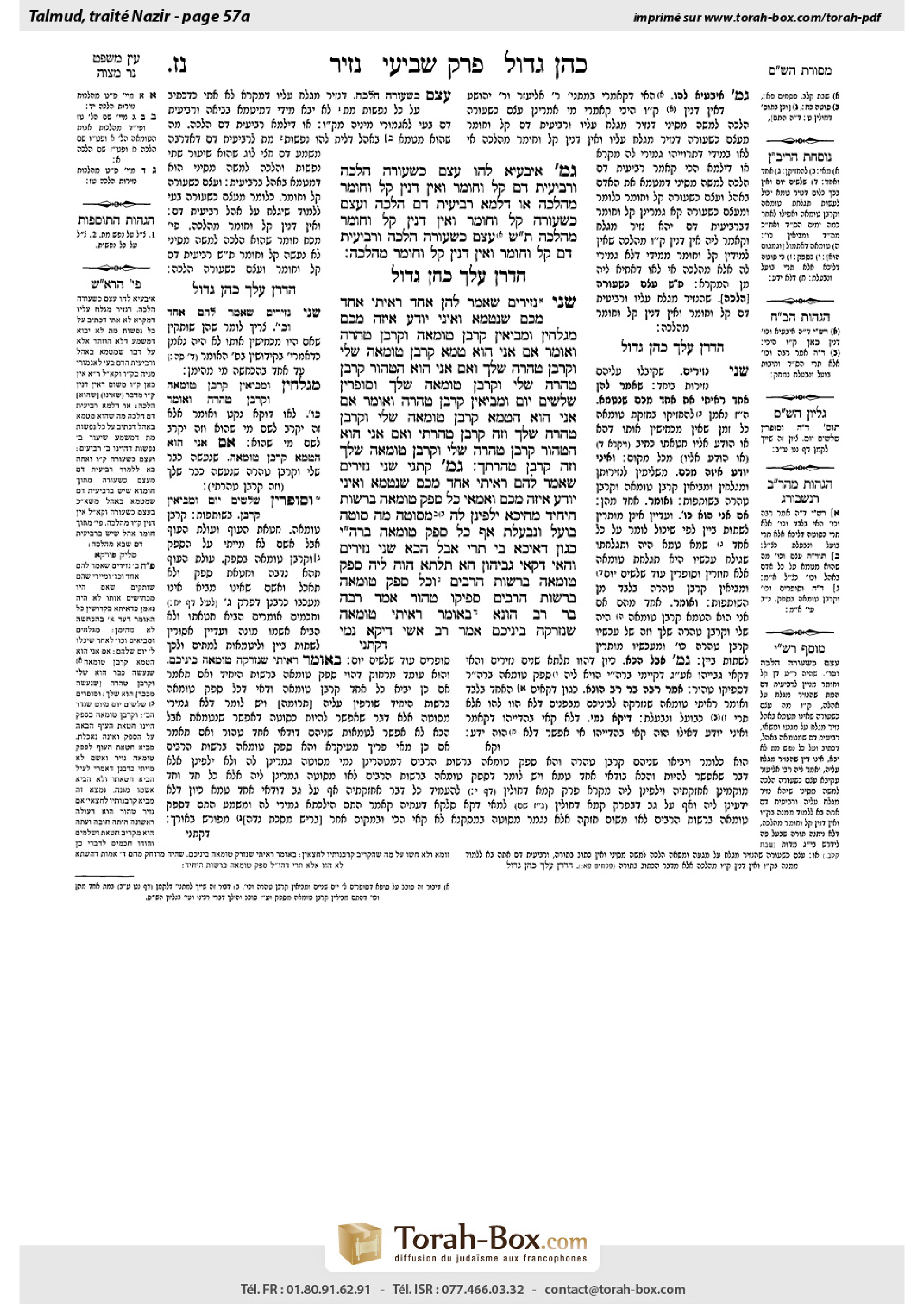
Nazir 57a: Talmud study for Daf Yomi
Daf Yomi is the daily study of one Talmud folio. Explore 37 tractates with scans, Hebrew text, Sefaria English and AI-generated French translations where annotated.
Passage selection and English or AI-generated French translation are available where the scan has annotations. Daf Study is independent of Torah-Box and Sefaria.
Browse Nazir · נזיר · All tractatesNazir 57a text and translations
This page of Nazir includes the Aramaic text, an English translation and an AI-generated French translation, alongside the scan above.
נזיר נ״ז א · Aramaic and Hebrew text
גְּמָ׳ אִיבַּעְיָא לְהוּ: עֶצֶם כִּשְׂעוֹרָה — הֲלָכָה, וּרְבִיעִית דָּם — קַל וָחוֹמֶר, וְאֵין דָּנִין קַל וָחוֹמֶר מֵהֲלָכָה.
אוֹ דִלְמָא: רְבִיעִית דָּם — הֲלָכָה, וְעֶצֶם כִּשְׂעוֹרָה — קַל וָחוֹמֶר, וְאֵין דָּנִין קַל וָחוֹמֶר מֵהֲלָכָה? תָּא שְׁמַע: עֶצֶם כִּשְׂעוֹרָה — הֲלָכָה, וּרְבִיעִית דָּם — קַל וָחוֹמֶר, וְאֵין דָּנִין קַל וָחוֹמֶר מֵהֲלָכָה.
הֲדַרַן עֲלָךְ כֹּהֵן גָּדוֹל
שְׁנֵי נְזִירִים שֶׁאָמַר לָהֶן אֶחָד ״רָאִיתִי אֶחָד מִכֶּם שֶׁנִּטְמָא, וְאֵינִי יוֹדֵעַ אֵיזֶה מִכֶּם״ — מְגַלְּחִין, וּמְבִיאִין קׇרְבַּן טוּמְאָה וְקׇרְבַּן טׇהֳרָה. וְאוֹמֵר: אִם אֲנִי הוּא טָמֵא — קׇרְבַּן טוּמְאָה שֶׁלִּי וְקׇרְבַּן טׇהֳרָה שֶׁלְּךָ, וְאִם אֲנִי הוּא הַטָּהוֹר — קׇרְבַּן טׇהֳרָה שֶׁלִּי וְקׇרְבַּן טוּמְאָה שֶׁלְּךָ.
וְסוֹפְרִין שְׁלֹשִׁים יוֹם, וּמְבִיאִין קׇרְבַּן טׇהֳרָה, וְאוֹמֵר: אִם אֲנִי הוּא הַטָּמֵא — קׇרְבַּן טוּמְאָה שֶׁלִּי וְקׇרְבַּן טׇהֳרָה שֶׁלְּךָ, וְזֶה קׇרְבַּן טׇהֳרָתִי. וְאִם אֲנִי הוּא הַטָּהוֹר — קׇרְבַּן טׇהֳרָה שֶׁלִּי וְקׇרְבַּן טוּמְאָה שֶׁלְּךָ, וְזֶה קׇרְבַּן טׇהֳרָתְךָ.
גְּמָ׳ קָתָנֵי: שְׁנֵי נְזִירִים שֶׁאָמַר לָהֶם ״רָאִיתִי אֶחָד מִכֶּם שֶׁנִּטְמָא, וְאֵינִי יוֹדֵעַ אֵיזֶה מִכֶּם״. וְאַמַּאי? כֹּל סְפֵק טוּמְאָה בִּרְשׁוּת הַיָּחִיד מֵהֵיכָא יָלְפִינַן לֵהּ — מִסּוֹטָה.
מָה סוֹטָה, בּוֹעֵל וְנִבְעֶלֶת, אַף כֹּל סְפֵק טוּמְאָה בִּרְשׁוּת הַיָּחִיד, כְּגוֹן דְּאִיכָּא בֵּי תְרֵי. אֲבָל הָכָא, שְׁנֵי נְזִירִים וְהַאי דְּקָאֵי גַּבֵּיהוֹן — הָא תְּלָתָא, הָוֵה לֵיהּ סְפֵק טוּמְאָה בִּרְשׁוּת הָרַבִּים, וְכֹל סְפֵק טוּמְאָה בִּרְשׁוּת הָרַבִּים — סְפֵיקוֹ טָהוֹר!
אָמַר רַבָּה בַּר רַב הוּנָא: בְּאוֹמֵר ״רָאִיתִי טוּמְאָה שֶׁנִּזְרְקָה בֵּינֵיכֶם״. אָמַר רַב אָשֵׁי: דַּיְקָא נָמֵי
Nazir 57a · English translation
GEMARA: A dilemma was raised before the Sages with regard to the halakha transmitted to Moses from Sinai mentioned in the mishna: Is the halakha that a nazirite must shave for a bone that is a barley-grain-bulk a halakha transmitted to Moses from Sinai, and it was the status of a quarter-log of blood that Rabbi Akiva sought to derive as an a fortiori inference, and with regard to this claim they said: One does not derive an a fortiori inference from a halakha transmitted to Moses from Sinai?
Or perhaps the ruling that a quarter-log of blood imparts ritual impurity in a tent is the halakha transmitted to Moses from Sinai, and Rabbi Akiva sought to use the case of a bone that is a barley-grain-bulk as the source of an a fortiori inference that a nazirite must shave for a quarter-log as well, to which the Sages replied that one does not derive an a fortiori inference from a halakha transmitted to Moses from Sinai. The Gemara answers: Come and hear the unequivocal statement of a baraita: A bone that is a barley-grain-bulk is a halakha, and a quarter-log of blood is an a fortiori inference, and one does not derive an a fortiori inference from a halakha.
MISHNA: With regard to two nazirites, where one other person said to them: I saw one of you become impure, but I do not know which one of you it was, they must each complete their naziriteship terms, shave their hair, and both together bring an offering of ritual impurity and an offering of purity, due to the uncertainty. And one of them says to the other: If I am the impure one, the offering of impurity is mine and the offering of purity is yours; and if I am the pure one, the offering of purity is mine and the offering of impurity is yours.
And because of the uncertainty they each count a further thirty days of naziriteship and both together bring an offering of purity. And one of them says: If I am the previously impure one, that offering of impurity sacrificed earlier was mine, and the offering of purity was yours; and this offering sacrificed now is my offering of purity. And if I am the previously pure one, the offering of purity brought earlier was mine, and the offering of impurity was yours; and this current offering is your offering of purity.
GEMARA: The mishna teaches with regard to two nazirites, that if one other person said to them: I saw one of you become impure, but I do not know which one of you it was, they must bring an offering of ritual impurity and an offering of purity. The Gemara expresses surprise at this case: But why should they be defined as having uncertain impurity? After all, the general principle that any uncertain impurity in a private domain is considered impure, from where do we derive this? From the case of a sota.
Yet this situation is not similar to that of a sota, as just as the case of a sota involves only an adulterer and an adulteress, so too any uncertain impurity in a private domain is considered impure only in a case where there are no more than two people present. However, in the mishna here there are two nazirites and this other individual who is standing alongside them, who witnessed one of them become impure, which makes a total of three. Consequently, this is an uncertain impurity in the public domain, as three people are sufficient for the place to be considered a public domain with regard to this halakha, and the halakha with regard to any uncertain impurity in the public domain is that its uncertainty is considered pure.
Rabba bar Rav Huna said that the mishna is referring to one who says: From a distance I saw an impure item thrown between you. Since he was not with them when one of the nazirites became impure, there were only two people present and therefore this is a case of uncertain impurity in a private domain. Rav Ashi said: The language of the mishna is also precise,
Nazir 57a · Traduction française (IA)
GUEMARA : Une question fut posée aux Sages au sujet de la halakha transmise à Moïse depuis le Sinaï mentionnée dans la Michna : la halakha selon laquelle un nazir doit se raser à cause d’un os du volume d’un grain d’orge est-elle une halakha transmise à Moïse depuis le Sinaï, tandis que Rabbi Akiva cherchait à déduire par raisonnement a fortiori le statut d’un quart de log de sang ? Et est-ce à propos de cette affirmation qu’ils ont dit : « On ne déduit pas de raisonnement a fortiori d’une halakha transmise à Moïse depuis le Sinaï » ?
Ou peut-être la règle selon laquelle un quart de log de sang transmet l’impureté rituelle sous une tente est-elle la halakha transmise à Moïse depuis le Sinaï, et Rabbi Akiva a-t-il cherché à prendre le cas d’un os du volume d’un grain d’orge comme fondement d’un raisonnement a fortiori, afin d’établir qu’un nazir doit également se raser à cause d’un quart de log ? Les Sages lui auraient alors répondu qu’on ne déduit pas de raisonnement a fortiori d’une halakha transmise à Moïse depuis le Sinaï. La Guemara répond : « Viens et entends » la déclaration explicite d’une baraïta : un os du volume d’un grain d’orge relève d’une halakha, et un quart de log de sang relève d’un raisonnement a fortiori ; or on ne déduit pas de raisonnement a fortiori d’une halakha.
MICHNA : Dans le cas de deux nazirim, si une autre personne leur dit : « J’ai vu l’un de vous devenir impur, mais je ne sais pas lequel », chacun doit achever sa période de naziréat et se raser les cheveux. En raison du doute, tous deux apportent ensemble un sacrifice d’impureté et un sacrifice de pureté. L’un dit à l’autre : « Si c’est moi qui suis impur, le sacrifice d’impureté est le mien et le sacrifice de pureté est le tien ; et si c’est moi qui suis pur, le sacrifice de pureté est le mien et le sacrifice d’impureté est le tien. »
En raison du doute, chacun compte une nouvelle période de trente jours de naziréat, et tous deux apportent ensemble un sacrifice de pureté. L’un d’eux dit : « Si c’est moi qui étais impur auparavant, le sacrifice d’impureté offert précédemment était le mien, et le sacrifice de pureté était le tien ; ce sacrifice offert maintenant est mon sacrifice de pureté. Et si c’est moi qui étais pur auparavant, le sacrifice de pureté offert précédemment était le mien, et le sacrifice d’impureté était le tien ; ce sacrifice offert maintenant est ton sacrifice de pureté. »
GUEMARA : La Michna enseigne qu’au sujet de deux nazirim, si une autre personne leur dit : « J’ai vu l’un de vous devenir impur, mais je ne sais pas lequel », ils doivent apporter un sacrifice d’impureté et un sacrifice de pureté. La Guemara s’étonne à propos de ce cas : pourquoi les considère-t-on comme relevant d’une impureté incertaine ? En effet, d’où déduisons-nous le principe général selon lequel toute impureté incertaine dans un domaine privé est considérée comme impure ? Du cas de la sota.
Pourtant, cette situation ne ressemble pas à celle d’une sota. De même que le cas de la sota implique seulement un adultère et une femme soupçonnée d’adultère, de même, toute impureté incertaine dans un domaine privé n’est considérée comme impure que s’il n’y a pas plus de deux personnes présentes. Or, dans la Michna, il y a deux nazirim et cette autre personne qui se tient près d’eux et a vu l’un d’eux devenir impur, soit trois personnes au total. Il s’agit donc d’une impureté incertaine dans le domaine public, car trois personnes suffisent pour que le lieu soit considéré comme un domaine public au regard de cette halakha. Or, toute impureté incertaine dans le domaine public est considérée comme pure.
Rabba bar Rav Houna dit que la Michna parle de quelqu’un qui dit : « De loin, j’ai vu un objet impur être jeté entre vous. » Puisqu’il ne se trouvait pas avec eux au moment où l’un des nazirim est devenu impur, seules deux personnes étaient présentes ; il s’agit donc d’un cas d’impureté incertaine dans un domaine privé. Rav Ashi dit : la formulation de la Michna est également précise,
Traduction française générée par IA à partir de l’édition anglaise de Sefaria. Vérifie toujours un passage avec le texte source.
Text from Sefaria: William Davidson Edition - Vocalized Aramaic (CC BY NC); William Davidson Edition - English (CC BY NC).