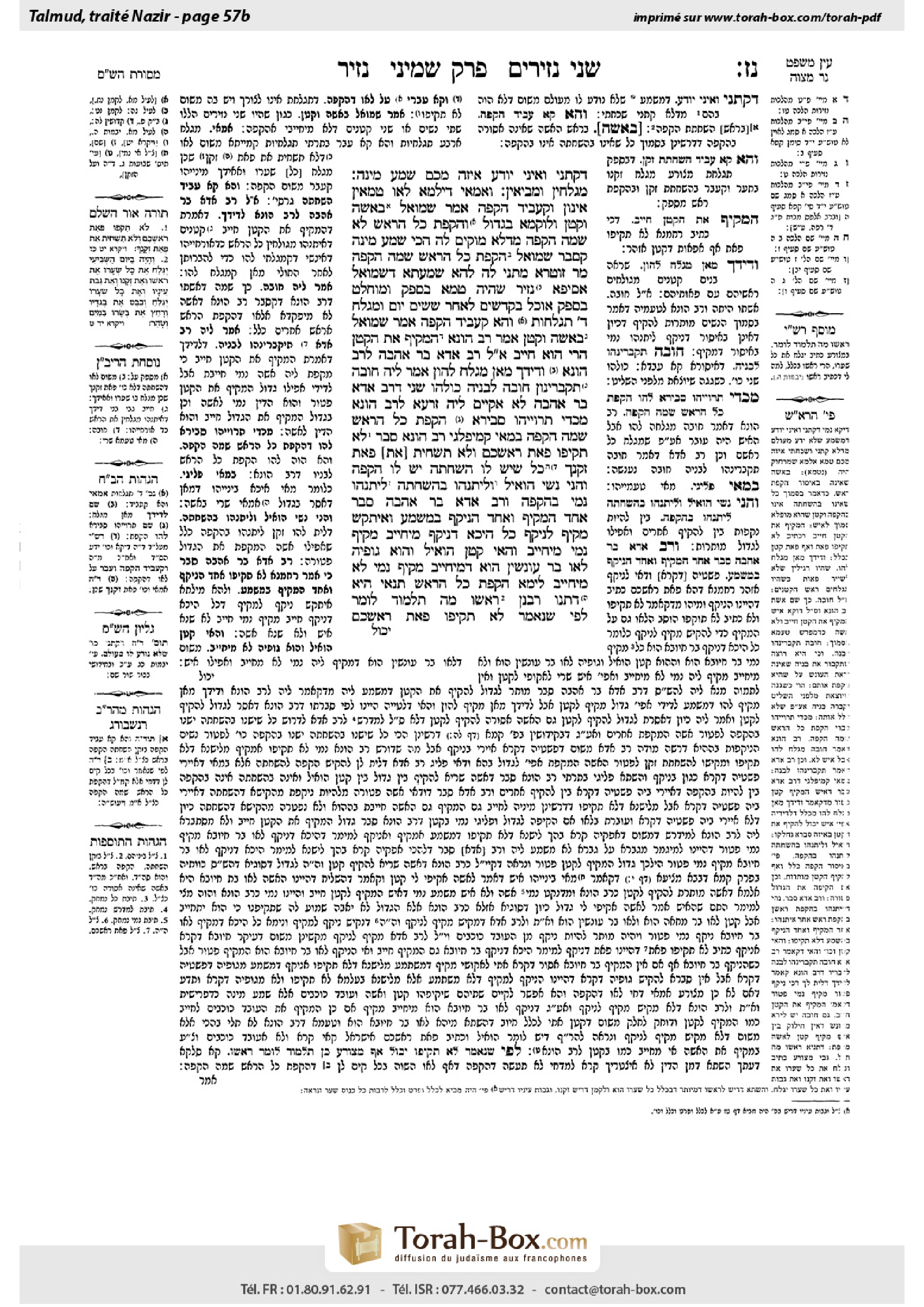
Nazir 57b: Talmud study for Daf Yomi
Daf Yomi is the daily study of one Talmud folio. Explore 37 tractates with scans, Hebrew text, Sefaria English and AI-generated French translations where annotated.
Passage selection and English or AI-generated French translation are available where the scan has annotations. Daf Study is independent of Torah-Box and Sefaria.
Browse Nazir · נזיר · All tractatesNazir 57b text and translations
This page of Nazir includes the Aramaic text, an English translation and an AI-generated French translation, alongside the scan above.
נזיר נ״ז ב · Aramaic and Hebrew text
דְּקָתָנֵי ״וְאֵינִי יוֹדֵעַ אֵיזֶה מִכֶּם״. שְׁמַע מִינַּהּ.
מְגַלְּחִין וּמְבִיאִין. וְאַמַּאי? דִּילְמָא לָאו טְמֵאִין אִינּוּן, וְקָעָבֵיד הַקָּפָה! אָמַר שְׁמוּאֵל: בְּאִשָּׁה וְקָטָן.
וְלוֹקְמָא בְּגָדוֹל, וְהַקָּפַת כׇּל הָרֹאשׁ — לֹא שְׁמָהּ הַקָּפָה! מִדְּלָא מוֹקֵים לַהּ הָכִי, שְׁמַע מִינַּהּ קָסָבַר שְׁמוּאֵל: הַקָּפַת כׇּל הָרֹאשׁ — שְׁמָהּ הַקָּפָה.
מָר זוּטְרָא מַתְנֵי לַהּ לְהָא שְׁמַעְתָּא דִּשְׁמוּאֵל אַסֵּיפָא: נָזִיר שֶׁהָיָה טָמֵא בְּסָפֵק וּמוּחְלָט בְּסָפֵק — אוֹכֵל בְּקָדָשִׁים לְאַחַר שִׁשִּׁים יוֹם, וּמְגַלֵּחַ אַרְבַּע תִּגְלָחוֹת. וְהָא קָעָבֵיד הַקָּפָה! אָמַר שְׁמוּאֵל: בְּאִשָּׁה וְקָטָן.
אָמַר רַב הוּנָא: הַמַּקִּיף אֶת הַקָּטָן הֲרֵי הוּא חַיָּיב. אֲמַר לֵיהּ רַב אַדָּא בַּר אַהֲבָה לְרַב הוּנָא: וְדִידָךְ מַאן מְגַלַּח לְהוֹן? אֲמַר לֵיהּ: חוֹבָה. תִּקְבְּרִינּוּן חוֹבָה לִבְנַיהּ. כּוּלְּהוּ שְׁנֵי דְּרַב אַדָּא בַּר אַהֲבָה לָא אִקַּיַּים לֵיהּ זַרְעָא לְרַב הוּנָא.
מִכְּדִי תַּרְוַיְיהוּ סְבִירָא הַקָּפַת כׇּל הָרֹאשׁ שְׁמָהּ הַקָּפָה, בְּמַאי קָמִיפַּלְגִי? רַב הוּנָא, סָבַר ״לֹא תַקִּפוּ פְּאַת רֹאשְׁכֶם וְלֹא תַשְׁחִית [אֵת] פְּאַת זְקָנֶךָ״. כֹּל שֶׁיֵּשׁ לוֹ הַשְׁחָתָה — יֵשׁ לוֹ הַקָּפָה, וְהָנֵי נְשֵׁי, הוֹאִיל וְלֵיתַנְהוּ בְּהַשְׁחָתָה — לֵיתַנְהוּ נָמֵי בְּהַקָּפָה.
וְרַב אַדָּא בַּר אַהֲבָה סָבַר: אֶחָד הַמַּקִּיף וְאֶחָד הַנִּיקָּף בַּמַּשְׁמָע. וְאִיתַּקַּשׁ מַקִּיף לְנִיקָּף: כׇּל הֵיכָא דְּנִיקַּף מִיחַיַּיב — מַקִּיף נָמֵי מִיחַיַּיב. וְהַאי קָטָן, הוֹאִיל וְהוּא גּוּפֵיהּ לָאו בַּר עוּנְשִׁין הוּא דְּמִיחַיַּיב, מַקִּיף נָמֵי לָא מִיחַיַּיב.
לֵימָא הַקָּפַת כׇּל הָרֹאשׁ תַּנָּאֵי הִיא, דְּתָנוּ רַבָּנַן: ״רֹאשׁוֹ״, מָה תַּלְמוּד לוֹמַר? לְפִי שֶׁנֶּאֱמַר ״לֹא תַקִּפוּ פְּאַת רֹאשְׁכֶם״,
Nazir 57b · English translation
as it teaches: But I do not know which one of you. This indicates that the third individual was too far away to detect which of them became impure. The Gemara says: Conclude from the inference from the mishna that it is so.
§ The mishna taught that the two nazirites shave and cut their hair and bring an offering of impurity and an offering of purity. The Gemara asks: But why are they permitted to shave? Perhaps both of them are not impure, and therefore one of them violates the prohibition against rounding the head, i.e., shaving the hair on the sides of the head (see Leviticus 19:27), when he shaves his hair unnecessarily. Since one of them does not need to shave, he thereby transgresses a mitzva by Torah law. Shmuel said: The mishna is referring to a case where each nazirite was a woman, who is not prohibited from rounding the hair of her head, or a minor boy, who is not obligated in the observance of mitzvot.
The Gemara analyzes Shmuel’s answer: And let Shmuel establish the mishna as referring to a male who reached majority, and the reason it is permitted is because rounding the entire head, not merely its corners, is not called rounding as prohibited by the Torah. From the fact that he does not establish the mishna in this manner, conclude from it that Shmuel maintains that rounding the entire head is called rounding.
Mar Zutra taught this halakha of Shmuel with regard to the latter clause of the following mishna (59b): A nazirite who has uncertain impurity and whose status as a confirmed leper is uncertain may eat sacrificial food after sixty days and shaves four times. One shaving is for his uncertain status as an impure nazirite, one is at the end of his term of naziriteship, and two are due to his status as a leper. A similar problem arose: But as he is not definitely obligated to shave, he violates the prohibition against rounding the head. Shmuel said: The mishna is referring to a woman or a minor boy, who are not prohibited from rounding their heads.
With regard to the same issue, Rav Huna said: An adult who rounds the head of a minor boy is liable to receive lashes, despite the fact that the child himself is not obligated to observe mitzvot. Rav Adda bar Ahava, who disputed this ruling, said to Rav Huna: And with regard to your sons, who shaves them and rounds the corners of their heads? After all, you maintain that an adult may not round the head of a minor. Rav Huna said to him: Ḥova my wife does it, as she is not prohibited from rounding their heads. Rav Adda bar Ahava exclaimed in anger: Ḥova should bury her sons if she acts in this manner. The Gemara reports: During the years that Rav Adda bar Ahava was alive, Rav Huna’s children did not survive. His children died due to the curse pronounced by Rav Adda.
The Gemara asks: Since both Rav Huna and Rav Adda maintain that rounding the entire head is called rounding, with regard to what do they disagree? What is the reason for their respective rulings? The Gemara explains: Rav Huna, who prohibits an adult male from rounding the head of a minor but permits a woman to do so, maintains that the association between the two prohibitions in the verse: “You shall not round the corners of your heads, neither shall you destroy the corners of your beard” (Leviticus 19:27), teaches: Whoever has the prohibition of the destruction of the beard also has the prohibition of rounding. And these women, since they are not included in the prohibition of destruction, as they do not have beards, they are not included in the prohibition of rounding either.
And Rav Adda bar Ahava, who permits anyone to shave a minor boy’s head, maintains: Both one who rounds and one who is rounded are included in the phrase “you shall not round,” which is stated in the plural. And in this manner the verse juxtaposes one who rounds to one who is rounded: Wherever one who is rounded is liable, the one who rounds is also liable; and with regard to this minor boy, since he himself is not liable to be punished for this transgression, an adult who rounds his head is also not liable due to this action.
The Gemara asks: Shall we say that the issue of whether one who rounds the entire head is considered to have rounded its corners is a dispute between tanna’im? As the Sages taught in a baraita, with regard to a verse that deals with the shaving of a leper: “He shall shave all his hair; his head and his beard and his eyebrows, even all his hair he shall shave off” (Leviticus 14:9). Why must the verse state: “His head,” after it has already stated: “All his hair”? The baraita explains that since it is stated: “You shall not round the corners of your heads” (Leviticus 19:27),
Nazir 57b · Traduction française (IA)
comme l’enseigne la Michna : « Mais je ne sais pas lequel d’entre vous. » Cela indique que le troisième individu était trop éloigné pour discerner lequel d’entre eux était devenu impur. La Guemara dit : Déduis de l’inférence tirée de la Michna qu’il en est ainsi.
§ La Michna enseignait que les deux naziréens se rasent les cheveux et apportent un sacrifice pour l’impureté et un sacrifice pour la pureté. La Guemara demande : Mais pourquoi leur est-il permis de se raser ? Peut-être qu’aucun des deux n’est impur ; l’un d’eux enfreint donc l’interdiction d’arrondir la tête, c’est-à-dire de raser les cheveux sur les côtés de la tête (voir Lévitique 19,27), en se rasant inutilement. Puisqu’il n’a pas besoin de se raser, il transgresse ainsi une mitsva selon la Torah. Chmouel dit : La Michna parle d’un cas où chaque naziréen était une femme, qui n’est pas soumise à l’interdiction d’arrondir les cheveux de sa tête, ou un garçon mineur, qui n’est pas tenu d’observer les mitsvot.
La Guemara examine la réponse de Chmouel : Que Chmouel établisse donc que la Michna parle d’un homme ayant atteint la majorité, et que la raison pour laquelle cela est permis est que raser toute la tête, et non seulement ses angles, n’est pas considéré comme l’arrondir au sens de l’interdiction de la Torah. Puisqu’il n’établit pas la Michna ainsi, déduis-en que Chmouel estime que raser toute la tête est considéré comme l’arrondir.
Mar Zoutra enseigna cette halakha de Chmouel à propos de la dernière partie de la Michna suivante (59b) : Un naziréen dont l’impureté est incertaine et dont le statut de lépreux avéré est incertain peut consommer des aliments consacrés après soixante jours et se raser quatre fois. Un rasage est dû à son statut incertain de naziréen impur, un autre a lieu à la fin de son vœu de naziréat, et deux sont dus à son statut de lépreux. Un problème similaire se pose : puisqu’il n’est pas certainement tenu de se raser, il enfreint l’interdiction d’arrondir la tête. Chmouel dit : La Michna parle d’une femme ou d’un garçon mineur, qui ne sont pas soumis à l’interdiction d’arrondir leur tête.
À propos de la même question, Rav Houna dit : Un adulte qui arrondit la tête d’un garçon mineur est passible de flagellation, bien que l’enfant lui-même ne soit pas tenu d’observer les mitsvot. Rav Adda bar Ahava, qui contestait cette décision, dit à Rav Houna : Et quant à tes fils, qui les rase et en arrondit les angles de la tête ? Après tout, tu estimes qu’un adulte ne peut pas arrondir la tête d’un mineur. Rav Houna lui dit : C’est mon épouse ‘Hova qui le fait, car elle n’est pas soumise à l’interdiction d’arrondir leur tête. Rav Adda bar Ahava s’exclama avec colère : « Que ‘Hova enterre ses fils si elle agit ainsi ! » La Guemara rapporte : Tant que Rav Adda bar Ahava fut en vie, les enfants de Rav Houna ne survécurent pas. Ils moururent à cause de la malédiction prononcée par Rav Adda.
La Guemara demande : Puisque Rav Houna et Rav Adda estiment tous deux que raser toute la tête est considéré comme l’arrondir, sur quoi sont-ils en désaccord ? Quelle est la raison de leurs décisions respectives ? La Guemara explique : Rav Houna, qui interdit à un homme adulte d’arrondir la tête d’un mineur mais le permet à une femme, estime que le rapprochement des deux interdictions dans le verset « Vous n’arrondirez pas les angles de vos têtes et vous ne détruirez pas les angles de votre barbe » (Lévitique 19,27) enseigne que quiconque est soumis à l’interdiction de détruire la barbe est également soumis à celle d’arrondir la tête. Or ces femmes, puisqu’elles ne sont pas concernées par l’interdiction de détruire la barbe, car elles n’en ont pas, ne sont pas non plus concernées par l’interdiction d’arrondir la tête.
Quant à Rav Adda bar Ahava, qui permet à quiconque de raser la tête d’un garçon mineur, il estime que celui qui arrondit et celui dont la tête est arrondie sont tous deux inclus dans l’expression « vous n’arrondirez pas », formulée au pluriel. Ainsi, le verset met en parallèle celui qui arrondit et celui dont la tête est arrondie : partout où celui dont la tête est arrondie est passible de sanction, celui qui arrondit l’est également ; mais dans le cas de ce garçon mineur, puisqu’il ne peut lui-même être puni pour cette transgression, un adulte qui lui arrondit la tête n’est pas non plus passible de sanction pour cet acte.
La Guemara demande : Faut-il dire que la question de savoir si celui qui rase toute la tête est considéré comme en ayant arrondi les angles fait l’objet d’un désaccord entre les tannaïm ? En effet, les Sages ont enseigné dans une baraïta, à propos d’un verset qui traite du rasage d’un lépreux : « Il rasera tous ses poils ; sa tête, sa barbe et ses sourcils, il rasera tous ses poils » (Lévitique 14,9). Pourquoi le verset doit-il préciser « sa tête » après avoir déjà dit « tous ses poils » ? La baraïta explique que, puisqu’il est dit : « Vous n’arrondirez pas les angles de vos têtes » (Lévitique 19,27),
Traduction française générée par IA à partir de l’édition anglaise de Sefaria. Vérifie toujours un passage avec le texte source.
Text from Sefaria: William Davidson Edition - Vocalized Aramaic (CC BY NC); William Davidson Edition - English (CC BY NC).