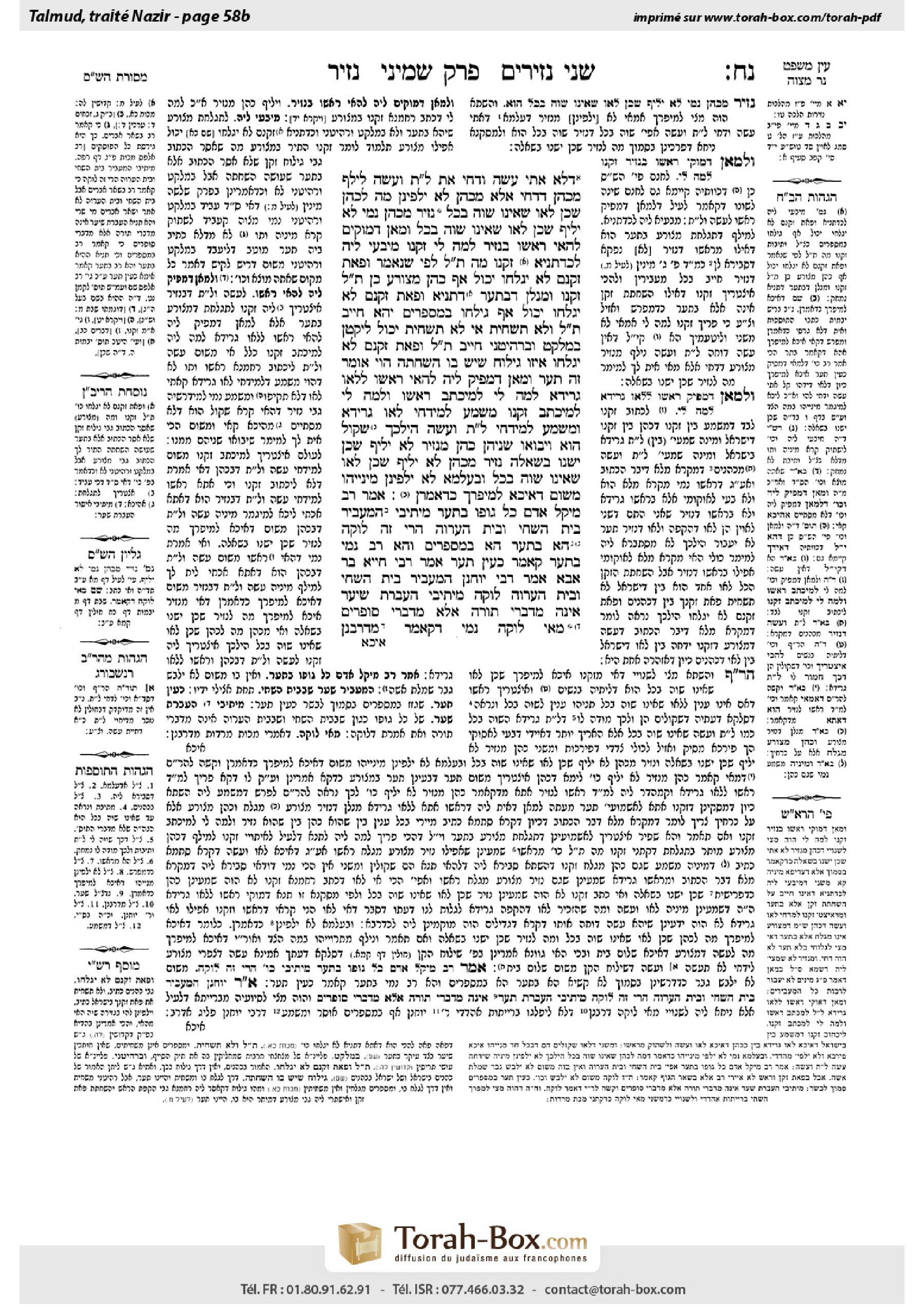
Nazir 58b: Talmud study for Daf Yomi
Daf Yomi is the daily study of one Talmud folio. Explore 37 tractates with scans, Hebrew text, Sefaria English and AI-generated French translations where annotated.
Passage selection and English or AI-generated French translation are available where the scan has annotations. Daf Study is independent of Torah-Box and Sefaria.
Browse Nazir · נזיר · All tractatesNazir 58b text and translations
This page of Nazir includes the Aramaic text, an English translation and an AI-generated French translation, alongside the scan above.
נזיר נ״ח ב · Aramaic and Hebrew text
דְּלָא אָתֵי עֲשֵׂה וְדָחֵי אֶת לֹא תַעֲשֶׂה וַעֲשֵׂה, לֵילַף מִכֹּהֵן, דְּדָחֵי!
אֶלָּא, מִכֹּהֵן לָא יָלְפִינַן: מָה לְכֹהֵן שֶׁכֵּן לָאו שֶׁאֵינוֹ שָׁוֶה בַּכֹּל. נָזִיר מִכֹּהֵן נָמֵי לָא יָלֵיף, שֶׁכֵּן לָאו שֶׁאֵינוֹ שָׁוֶה בַּכֹּל.
וּמַאן דְּמוֹקֵים לְהַאי ״רֹאשׁוֹ״ בְּנָזִיר, לְמָה לִי ״זְקָנוֹ״?
מִיבְּעֵי לֵיהּ, לְכִדְתַנְיָא: ״זְקָנוֹ״ מָה תַּלְמוּד לוֹמַר? לְפִי שֶׁנֶּאֱמַר ״וּפְאַת זְקָנָם לֹא יְגַלֵּחוּ״, יָכוֹל אַף כֹּהֵן מְצוֹרָע כֵּן, תַּלְמוּד לוֹמַר: ״זְקָנוֹ״.
וּמְנָלַן דִּבְתַעַר — דְּתַנְיָא: ״וּפְאַת זְקָנָם לֹא יְגַלֵּחוּ״, יָכוֹל אַף גִּילְּחוֹ בְּמִסְפָּרַיִם יְהֵא חַיָּיב, תַּלְמוּד לוֹמַר: ״וְלֹא תַשְׁחִית״. אִי לֹא תַשְׁחִית, יָכוֹל לִיקְּטָן בְּמַלְקֵט וּבְרָהִיטְנֵי חַיָּיב —
תַּלְמוּד לוֹמַר: ״וּפְאַת זְקָנָם לֹא יְגַלֵּחוּ״. אֵיזוֹ גִּילּוּחַ שֶׁיֵּשׁ בּוֹ הַשְׁחָתָה — הֱוֵי אוֹמֵר: זֶה תַּעַר.
וּמַאן דְּמַפֵּיק לֵיהּ לְהַאי ״רֹאשׁוֹ״ לְלָאו גְּרֵידָא, לְמָה לִי לְמִיכְתַּב ״רֹאשׁוֹ״, וּלְמָה לִי לְמִיכְתַּב ״זְקָנוֹ״?
מַשְׁמַע לְמִידְחֵי לָאו גְּרֵידָא, וּמַשְׁמַע לְמִידְחֵי לֹא תַעֲשֶׂה וַעֲשֵׂה. הִילְכָּךְ שָׁקוּל הוּא וְיָבוֹאוּ שְׁנֵיהֶן.
כֹּהֵן מִנָּזִיר לָא יָלֵיף, שֶׁכֵּן יֶשְׁנוֹ בִּשְׁאֵלָה. נָזִיר מִכֹּהֵן לָא יָלֵיף, שֶׁכֵּן לָאו שֶׁאֵינוֹ שָׁוֶה בַּכֹּל. וּבְעָלְמָא לָא יָלְפִינַן מִינַּיְיהוּ, מִשּׁוּם דְּאִיכָּא לְמִיפְרַךְ כְּדַאֲמַרַן.
אָמַר רַב: מֵיקֵל אָדָם כׇּל גּוּפוֹ בְּתַעַר. מֵיתִיבִי: הַמַּעֲבִיר בֵּית הַשֶּׁחִי וּבֵית הָעֶרְוָה — הֲרֵי זֶה לוֹקֶה!
הָא בְּתַעַר, הָא בַּמִּסְפָּרַיִם. וְהָא רַב נָמֵי בְּתַעַר קָאָמַר! כְּעֵין תַּעַר.
אָמַר רַבִּי חִיָּיא בַּר אַבָּא אָמַר רַבִּי יוֹחָנָן: הַמַּעֲבִיר בֵּית הַשֶּׁחִי וּבֵית הָעֶרְוָה לוֹקֶה. מֵיתִיבִי: הַעֲבָרַת שֵׂיעָר אֵינָהּ מִדִּבְרֵי תוֹרָה, אֶלָּא מִדִּבְרֵי סוֹפְרִים. מַאי ״לוֹקֶה״ נָמֵי דְּקָאָמַר — מִדְּרַבָּנַן.
Nazir 58b · English translation
that a positive mitzva does not come and override a prohibition and a positive mitzva, let him derive from the fact that a leprous priest must shave that this mitzva does override a prohibition and another positive mitzva.
Rather, he would explain that we do not derive other cases of the Torah from the halakha of a priest, for the following reason: What is different about the prohibition of a priest is that it is a prohibition that is not equally applicable to all, i.e., the prohibitions of a priest do not apply to Israelites. For the same reason, the case of a nazirite also cannot be derived from that of a priest, as the prohibition of a priest is a prohibition that is not equally applicable to all, in contrast to that of a nazirite. Consequently, the derivation from “his head” is necessary to teach that the shaving of a leper overrides the prohibition stated with regard to a nazirite.
The Gemara turns its attention to the other opinion: And according to the one who establishes this verse: “He shall shave all his hair; his head and his beard” (Leviticus 14:9), as referring to a nazirite, i.e., he derives from this verse the principle that in certain cases, including that of a leprous priest, a positive mitzva overrides a prohibition and a positive mitzva, why do I need the term “his beard”?
The Gemara answers: He requires it for that which is taught in a baraita with regard to the shaving of a leper, which must be performed with a razor: Why must the verse state: “His beard,” as it already stated that he shaves all his hair? Since it is stated: “Neither shall they shave off the corners of their beard” (Leviticus 21:5), one might have thought that even a priest who is a leper is included in the prohibition against shaving. The verse therefore states: “His beard,” to teach that a leprous priest must shave his beard as well.
And from where do we derive that a leper must shave with a razor? As it is taught in a baraita: “Neither shall they shave off the corners of their beard” (Leviticus 21:5). One might have thought that priests should be liable even if they shaved their beards with scissors. The verse states: “And you shall not destroy the corners of your beard” (Leviticus 19:27), which teaches that the prohibition applies only to the destruction of the beard from its roots. If the sole criterion is the phrase “you shall not destroy,” one might have thought that if he extracted his hair with tweezers or removed his hair with a carpenter’s plane, he should likewise be liable due to the prohibition against destroying his hair.
The verse therefore states: “Neither shall they shave off the corners of their beard.” Together the two verses lead to the following conclusion: Which is the type of shaving [giluaḥ] that involves destruction [hashḥata]? You must say it is a razor. The fact that it was necessary for the Torah to permit a leper to shave his beard with a razor, notwithstanding the prohibition against using this implement, proves that the positive mitzva overrides this prohibition, as derived from the term “his beard.”
The Gemara continues to inquire: And according to the one who derives from the term “his head” the principle that a positive mitzva overrides only a prohibition, why do I need the verse to write: “His head,” and why do I also need the same verse to write: “His beard”? Once is it derived from the phrase “his beard” that a positive mitzva overrides a positive mitzva and a prohibition, the same should certainly apply to a prohibition by itself.
The Gemara answers: Both the term “his head” and the term “his beard” could come to teach the overriding of only a prohibition, and they also could teach the overriding of a prohibition and a positive mitzva. Since the verse is formulated in general terms, it includes a priest or a nazirite. Therefore, as it cannot be determined to which case the Torah is referring, it is even, i.e., equally balanced, and consequently let both terms come and teach this principle, one with regard to a nazirite, and the other with regard to a priest.
The Gemara adds that both terms are necessary, as the halakha of a priest cannot be derived from that of a nazirite, as the case of a nazirite is lenient in that it is possible to dissolve naziriteship by request from a halakhic authority. Likewise, the halakha of a nazirite cannot be derived from that of a priest, as the case of a priest involves a prohibition that is not equally applicable to all. The Gemara comments: And generally, with regard to other halakhot, we cannot derive from these two cases that a positive mitzva overrides a prohibition and a positive mitzva, due to the fact that this argument can be refuted as we said here.
§ Rav said: A person who is not a nazirite may lighten his burden by removing all the hair of his body with a razor. One who feels he has too much hair may shave all of it off with a razor, apart from his beard and the corners of his head. The Gemara raises an objection against this from a baraita: A man who removes the hair of the armpit or the pubic hair is flogged for transgressing the prohibition: “A man shall not put on a woman’s garment” (Deuteronomy 22:5), as this behavior is the manner of women.
The Gemara answers: In this case he is flogged because he shaved with a razor, whereas in that case Rav said it is permitted because he was referring to one who removes hair with scissors, an act that is not considered a prohibition. The Gemara raises a difficulty: But Rav said it is permitted with a razor as well. The Gemara answers: He did not mean an actual razor; rather, he said that one may use an implement that is similar to a razor, i.e., scissors that cut very close to the skin, in the manner of a razor.
Rabbi Ḥiyya bar Abba said that Rabbi Yoḥanan said: A man who removes the hair of the armpit or the pubic hair is flogged. The Gemara raises an objection against this ruling: The removal of hair is not prohibited by Torah law but by rabbinic law. Why, then, is he liable to receive lashes? The Gemara explains: What does it mean that Rabbi Yoḥanan says that he is flogged? This means that he is flogged by rabbinic law, a punishment known as lashes for rebelliousness, for disobeying a rabbinic decree.
Nazir 58b · Traduction française (IA)
Puisqu’une mitsva positive ne peut écarter une interdiction accompagnée d’une mitsva positive, qu’il le déduise du fait qu’un prêtre lépreux doit se raser : cette mitsva écarte donc une interdiction et une autre mitsva positive.
Il expliquerait plutôt que nous ne déduisons pas d’autres cas de la Torah de la halakha concernant un prêtre, pour la raison suivante : en quoi l’interdiction concernant un prêtre est-elle différente ? C’est une interdiction qui ne s’applique pas également à tous, c’est-à-dire que les interdictions visant un prêtre ne s’appliquent pas aux Israélites. Pour la même raison, on ne peut pas non plus déduire le cas d’un nazir de celui d’un prêtre, car l’interdiction concernant un prêtre ne s’applique pas également à tous, contrairement à celle qui concerne un nazir. Par conséquent, la déduction tirée des mots « sa tête » est nécessaire pour enseigner que le rasage du lépreux écarte l’interdiction énoncée à propos du nazir.
La Guemara se tourne vers l’autre opinion : et selon celui qui interprète ce verset — « Il se rasera tous les poils ; sa tête et sa barbe » (Lévitique 14:9) — comme faisant référence à un nazir, c’est-à-dire qui déduit de ce verset que, dans certains cas, notamment celui d’un prêtre lépreux, une mitsva positive écarte une interdiction et une mitsva positive, pourquoi le verset mentionne-t-il « sa barbe » ?
La Guemara répond : il en a besoin pour enseigner ce qui est rapporté dans une baraïta au sujet du rasage du lépreux, qui doit être effectué au rasoir : pourquoi le verset doit-il préciser « sa barbe », alors qu’il a déjà indiqué qu’il se rase tous les poils ? Puisqu’il est dit : « Ils ne se raseront pas les coins de leur barbe » (Lévitique 21:5), on aurait pu penser qu’un prêtre lépreux est lui aussi inclus dans l’interdiction de se raser. Le verset précise donc « sa barbe », pour enseigner qu’un prêtre lépreux doit également se raser la barbe.
Et d’où déduisons-nous qu’un lépreux doit se raser au rasoir ? Comme il est enseigné dans une baraïta : « Ils ne se raseront pas les coins de leur barbe » (Lévitique 21:5). On aurait pu penser que les prêtres seraient passibles même s’ils se rasaient la barbe aux ciseaux. Le verset dit : « Tu ne détruiras pas les coins de ta barbe » (Lévitique 19:27), ce qui enseigne que l’interdiction ne s’applique qu’à la destruction de la barbe jusqu’à la racine. Si le seul critère était l’expression « tu ne détruiras pas », on aurait pu penser que celui qui arrache ses poils à la pince à épiler ou les enlève avec un rabot de menuisier serait lui aussi passible, au titre de l’interdiction de détruire ses poils.
Le verset dit donc : « Ils ne se raseront pas les coins de leur barbe. » Les deux versets réunis permettent de conclure : quel type de rasage [giluaḥ] implique une destruction [hashḥata] ? Il faut dire qu’il s’agit du rasage au rasoir. Le fait que la Torah ait dû permettre à un lépreux de se raser la barbe au rasoir, malgré l’interdiction d’utiliser cet instrument, prouve que la mitsva positive écarte cette interdiction, comme on le déduit des mots « sa barbe ».
La Guemara poursuit son examen : et selon celui qui déduit des mots « sa tête » qu’une mitsva positive écarte seulement une interdiction, pourquoi le verset mentionne-t-il « sa tête », et pourquoi mentionne-t-il aussi « sa barbe » ? Dès lors qu’on déduit de l’expression « sa barbe » qu’une mitsva positive écarte une interdiction accompagnée d’une mitsva positive, cela devrait à plus forte raison s’appliquer à une interdiction seule.
La Guemara répond : les mots « sa tête » comme les mots « sa barbe » pourraient enseigner qu’une mitsva positive écarte seulement une interdiction, ou qu’elle écarte une interdiction accompagnée d’une mitsva positive. Le verset étant formulé en termes généraux, il inclut un prêtre ou un nazir. Par conséquent, puisqu’on ne peut déterminer à quel cas la Torah fait référence, les deux possibilités sont à égalité ; que les deux expressions viennent donc enseigner ce principe, l’une à propos d’un nazir et l’autre à propos d’un prêtre.
La Guemara ajoute que les deux expressions sont nécessaires, car on ne peut pas déduire la halakha concernant un prêtre de celle concernant un nazir, puisque le cas du nazir est plus indulgent en ce qu’il est possible de faire annuler le naziréat en en faisant la demande à une autorité halakhique. De même, on ne peut pas déduire la halakha concernant un nazir de celle concernant un prêtre, puisque le cas du prêtre implique une interdiction qui ne s’applique pas également à tous. La Guemara fait remarquer : en général, pour les autres halakhot, nous ne pouvons pas déduire de ces deux cas qu’une mitsva positive écarte une interdiction accompagnée d’une mitsva positive, car cet argument peut être réfuté, comme nous l’avons dit ici.
§ Rav dit : une personne qui n’est pas nazir peut alléger sa charge en enlevant au rasoir tous les poils de son corps. Celui qui estime avoir trop de poils peut tous les raser au rasoir, à l’exception de sa barbe et des coins de sa tête. La Guemara soulève une objection à partir d’une baraïta : un homme qui enlève les poils des aisselles ou du pubis est flagellé pour avoir transgressé l’interdiction : « Un homme ne portera pas le vêtement d’une femme » (Deutéronome 22:5), car cette conduite est propre aux femmes.
La Guemara répond : dans ce cas, il est flagellé parce qu’il s’est rasé au rasoir, tandis que, dans l’autre cas, Rav a dit que c’était permis parce qu’il parlait de celui qui enlève les poils aux ciseaux, acte qui n’est pas considéré comme une transgression. La Guemara soulève une difficulté : mais Rav a dit que c’était également permis au rasoir. La Guemara répond : il ne parlait pas d’un véritable rasoir ; il a plutôt dit qu’on peut utiliser un instrument semblable à un rasoir, c’est-à-dire des ciseaux qui coupent très près de la peau, à la manière d’un rasoir.
Rabbi Ḥiyya bar Abba a dit que Rabbi Yoḥanan a dit : un homme qui enlève les poils des aisselles ou du pubis est flagellé. La Guemara soulève une objection à cette décision : l’épilation n’est pas interdite par la Torah, mais par la loi rabbinique. Pourquoi est-il donc passible de flagellation ? La Guemara explique : que signifie l’affirmation de Rabbi Yoḥanan selon laquelle il est flagellé ? Cela signifie qu’il est flagellé en vertu de la loi rabbinique : il s’agit des coups de flagellation pour rébellion, infligés pour avoir désobéi à un décret rabbinique.
Traduction française générée par IA à partir de l’édition anglaise de Sefaria. Vérifie toujours un passage avec le texte source.
Text from Sefaria: William Davidson Edition - Vocalized Aramaic (CC BY NC); William Davidson Edition - English (CC BY NC).