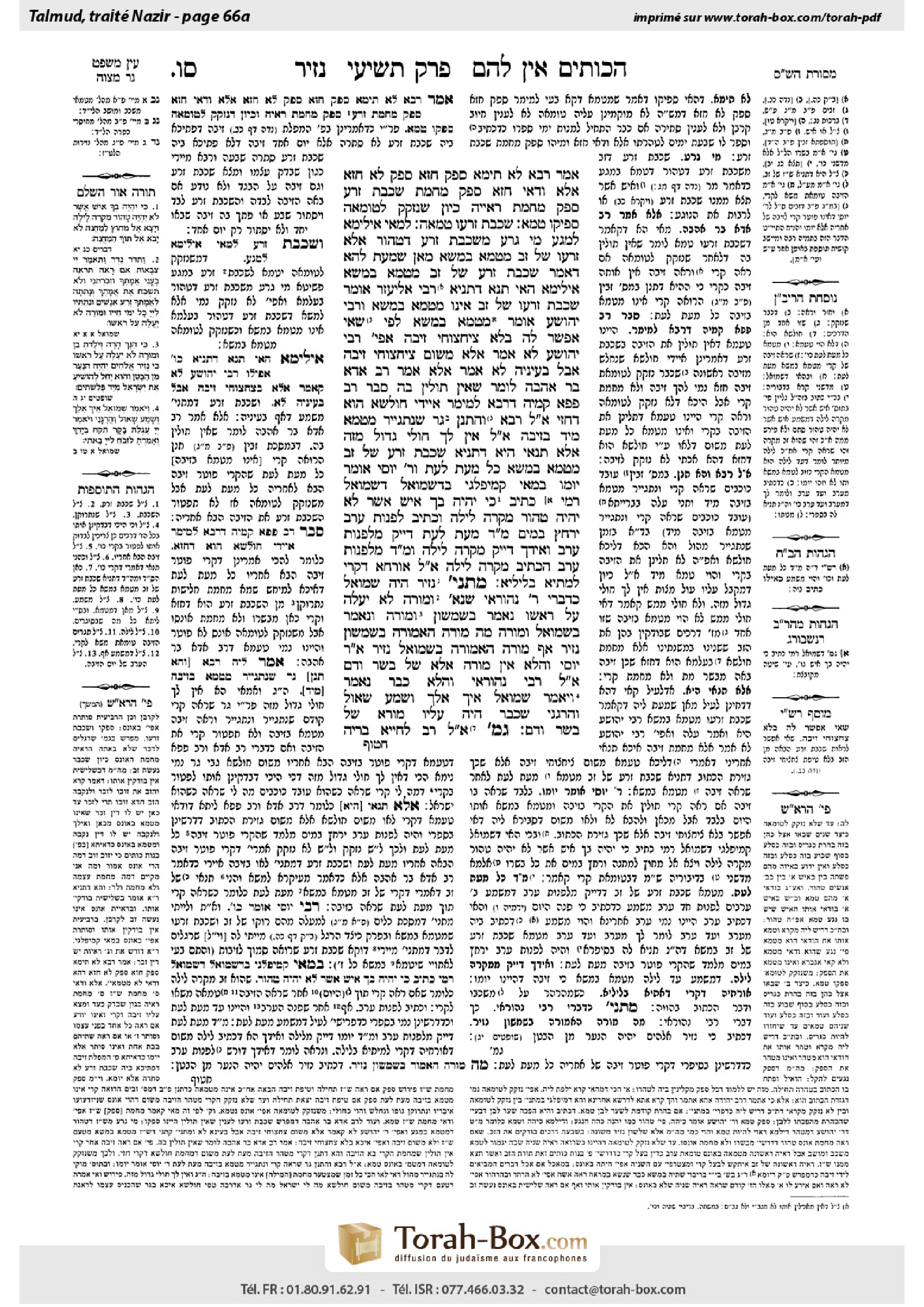
Nazir 66a: Talmud study for Daf Yomi
Daf Yomi is the daily study of one Talmud folio. Explore 37 tractates with scans, Hebrew text, Sefaria English and AI-generated French translations where annotated.
Passage selection and English or AI-generated French translation are available where the scan has annotations. Daf Study is independent of Torah-Box and Sefaria.
Browse Nazir · נזיר · All tractatesNazir 66a text and translations
This page of Nazir includes the Aramaic text, an English translation and an AI-generated French translation, alongside the scan above.
נזיר ס״ו א · Aramaic and Hebrew text
אָמַר רָבָא: לָא תֵּימָא סָפֵק חֲזָא סָפֵק לָא חֲזָא. אֶלָּא וַדַּאי חֲזָא, סָפֵק מֵחֲמַת שִׁכְבַת זֶרַע, סָפֵק מֵחֲמַת רְאִיָּיה. כֵּיוָן שֶׁנִּזְקַק לְטוּמְאָה — סְפֵיקוֹ טָמֵא.
שִׁכְבַת זַרְעוֹ טְמֵאָה. לְמַאי? אִילֵימָא לְמַגָּע — מִי גָּרַע מִשִּׁכְבַת זֶרַע דְּטָהוֹר? אֶלָּא זַרְעוֹ שֶׁל זָב מְטַמֵּא בְּמַשָּׂא.
מַאן שָׁמְעַתְּ לְהָא דְּאָמַר שִׁכְבַת זֶרַע שֶׁל זָב מְטַמֵּא בְּמַשָּׂא? אִילֵּימָא הַאי תַּנָּא, דְּתַנְיָא, רַבִּי אֱלִיעֶזֶר אוֹמֵר: שִׁכְבַת זַרְעוֹ שֶׁל זָב אֵינוֹ מְטַמֵּא בְּמַשָּׂא, וְרַבִּי יְהוֹשֻׁעַ אוֹמֵר: מְטַמֵּא בְּמַשָּׂא, לְפִי שֶׁאִי אֶפְשָׁר לָהּ בְּלֹא צִיחְצוּחֵי זִיבָה. אֲפִילּוּ רַבִּי יְהוֹשֻׁעַ לָא אָמַר אֶלָּא מִשּׁוּם צִיחְצוּחֵי זִיבָה, אֲבָל בְּעֵינֵיהּ, לָא אָמַר!
אֶלָּא אָמַר רַב אַדָּא בַּר אַהֲבָה: לוֹמַר שֶׁאֵין תּוֹלִין בָּהּ.
סְבַר רַב פָּפָּא קַמֵּיהּ דְּרָבָא לְמֵימַר אַיְּידֵי חוּלְשָׁא הוּא דְּחָזֵי. אָמַר לֵיהּ רָבָא, וְהָתְנַן: גֵּר שֶׁנִּתְגַּיֵּיר מְטַמֵּא מִיָּד בְּזִיבָה! אֲמַר לֵיהּ: אֵין לְךָ חוֹלִי גָּדוֹל מִזֶּה.
אֶלָּא, תַּנָּאֵי הִיא. דְּתַנְיָא: שִׁכְבַת זֶרַע שֶׁל זָב מְטַמֵּא בְּמַשָּׂא כׇּל מֵעֵת לְעֵת. וְרַבִּי יוֹסֵי אוֹמֵר: יוֹמוֹ.
בְּמַאי קָמִיפַּלְגִי? בְּדִשְׁמוּאֵל. דִּשְׁמוּאֵל רָמֵי: כְּתִיב: ״כִּי יִהְיֶה בְךָ אִישׁ אֲשֶׁר לֹא יִהְיֶה טָהוֹר מִקְּרֵה לָיְלָה״. וּכְתִיב: ״לִפְנוֹת עֶרֶב יִרְחַץ בַּמָּיִם״.
מַאן דְּאָמַר מֵעֵת לְעֵת דָּיֵיק מִ״לִּפְנוֹת עֶרֶב״, וְאִידַּךְ דָּיֵיק ״מִקְּרֵה לָיְלָה״.
וּמַאן דְּאָמַר מִ״לִּפְנוֹת עֶרֶב״, הָכְתִיב ״מִקְּרֵה לָיְלָה״! אָמַר לָךְ, אוֹרְחָא דְקֶרִי לֵמֵתֵיא בְּלֵילְיָא.
מַתְנִי׳ נָזִיר הָיָה שְׁמוּאֵל, כְּדִבְרֵי רַבִּי נְהוֹרַאי, שֶׁנֶּאֱמַר ״וּמוֹרָה לֹא יַעֲלֶה עַל רֹאשׁוֹ״. נֶאֱמַר בְּשִׁמְשׁוֹן ״וּמוֹרָה״, וְנֶאֱמַר בִּשְׁמוּאֵל ״וּמוֹרָה״. מָה ״מוֹרָה״ הָאֲמוּרָה בְּשִׁמְשׁוֹן — נָזִיר, אַף ״מוֹרָה״ הָאֲמוּרָה בִּשְׁמוּאֵל — נָזִיר.
אָמַר רַבִּי יוֹסֵי: וַהֲלֹא אֵין מוֹרָה אֶלָּא שֶׁל בָּשָׂר וָדָם! אֲמַר לֵיהּ רַבִּי נְהוֹרַאי: וַהֲלֹא כְּבָר נֶאֱמַר ״וַיֹּאמֶר שְׁמוּאֵל אֵיךְ אֵלֵךְ וְשָׁמַע שָׁאוּל וַהֲרָגָנִי״, שֶׁכְּבָר הָיָה עָלָיו מוֹרָא שֶׁל בָּשָׂר וָדָם.
גְּמָ׳ אֲמַר לֵיהּ רַב לְחִיָּיא בְּרֵיהּ:
Nazir 66a · English translation
Rava said: Do not say that it is uncertain whether he saw a discharge and uncertain whether he did not see one. The uncertainty is not with regard to whether he experienced a discharge at all. Rather, he certainly saw a discharge, but it is uncertain whether the discharge was due to, i.e., defined as, an emission of semen, and it is uncertain whether the discharge was due to the sighting of ziva. In this case, once he has been confirmed as being ritually impure as a zav, his uncertain case is also impure.
§ The mishna taught that his semen is impure. The Gemara asks: With regard to what halakha is the mishna stating that the semen of a zav is impure? If we say that this is referring to the impurity of contact, i.e., this semen renders one who touches it impure, there is no need to teach this halakha. Is it any worse than the semen of a pure man, which also imparts impurity through contact? Rather, the mishna is teaching that the semen of a zav renders people impure even by carrying, like the impurity of ziva.
The Gemara asks: Who did you hear that said that the semen of a zav renders one impure by carrying? If we say it is this tanna, as it is taught in a baraita that Rabbi Eliezer says: The semen of a zav does not render one impure by carrying, and Rabbi Yehoshua says: It does render one impure by carrying, because it is impossible for his semen to be without droplets of ziva; yet this source is no proof, as even Rabbi Yehoshua said that this semen imparts impurity by carrying only due to the droplets of ziva it contains. However, he did not say that semen in its unadulterated form renders people impure.
Rather, Rav Adda bar Ahava said: The mishna does not mean that the semen of a zav itself renders one impure by carrying. Rather, it comes to say that one does not attribute the ziva to it. Even if the man experienced a discharge within twenty-four hours of his ejaculation of semen, one does not say his discharge was triggered by a general weakening as a result of his seminal emission. Once the man has experienced two discharges of a zav he is an impure zav, and this third discharge is also considered ziva.
When he was before Rava, Rav Pappa thought to say the following explanation for this halakha: Since he sees his discharges out of the weakness brought about from his previous ziva, it can be assumed that any later discharge, even one that follows a seminal emission, is ziva. Rava said to him: But didn’t we learn in a mishna (Zavim 2:3): A convert who has just converted can immediately become impure as a zav. Even if he had a seminal emission as a gentile, subsequently converted, and then experienced the discharge of a zav, one does not associate the discharge of a zav with the earlier emission of semen. Rather, it is treated as the first discharge of a zav. In this case there is no prior weakness of a zav to speak of, and nevertheless the convert is impure as a zav. Rav Pappa said to Rava: There is no greater illness than this. The very acceptance of mitzvot can be considered an illness, as the burden of mitzvot is a weighty matter. For this reason, one does not ascribe a discharge of a zav to the earlier emission of semen.
The Gemara comments: Rather, the possibility rejected earlier, that the mishna means that semen of a zav imparts impurity by carrying, is a dispute between tanna’im, as it is taught in a baraita: The semen of a zav renders one impure by carrying like the regular discharge of a zav for a twenty-four hour period. In other words, if a zav experienced a seminal emission within twenty-four hours of a ziva, the seminal emission does not impart impurity only through contact in the manner of the semen of a pure individual, but by carrying as well. And Rabbi Yosei says that it imparts impurity by carrying only on its day, i.e., if the seminal emission was before the evening of the day of the ziva. As opposed to Rabbi Eliezer and Rabbi Yehoshua cited earlier, these tanna’im both maintain that the semen of a zav imparts impurity by carrying like ziva does.
The Gemara asks: With regard to what do the first tanna and Rabbi Yosei disagree? What is the basis of their dispute? The Gemara answers: They disagree with regard to the following issue discussed by Shmuel, as Shmuel raises a contradiction: It is written: “If there be among you any man who is not pure, by reason of that which chances him by night, then shall he go abroad out of the camp, he shall not come within the camp” (Deuteronomy 23:11). This verse is applied to a zav who experienced a seminal emission. And it is written: “When evening comes on, he shall bathe himself in water, and when the sun is down, he may come within the camp” (Deuteronomy 23:12).
The Gemara explains the dispute. The one who says that the semen of a zav imparts impurity by carrying for a twenty-four hour period after experiencing a ziva infers from the phrase “when evening comes on” that the period can involve two evenings, as “comes on” indicates another evening. If so, the semen imparts impurity by carrying for a full twenty-four hour period. And the other Sage, Rabbi Yosei, infers from the expression “by reason of that which chances him by night” that the seminal emission imparts impurity by carrying only until that night, i.e., until the end of the day on which the man experienced the ziva.
The Gemara asks: But according to the one who says that this halakha is derived from “when evening comes on,” isn’t it written: “By reason of that which chances him by night”? The Gemara answers: He could have said to you that this verse affords no proof, as it is referring to the usual case and it is the manner of a seminal emission to occur at night. Consequently, one cannot derive a halakha from this expression.
MISHNA: The tractate concludes with an aggadic statement about nazirites. Samuel the prophet was a nazirite, in accordance with the statement of Rabbi Nehorai, as it was stated that when Hannah, his mother, prayed for a son, she vowed: “And no mora shall come upon his head” (I Samuel 1:11). How is it derived that mora is an expression of naziriteship? It is stated with regard to Samson: “And no razor [mora] shall come upon his head, for the child shall be a nazirite to God” (Judges 13:5), and it is stated: “And no mora,” with regard to Samuel. Just as the term “mora” that is stated with regard to Samson means that he was a nazirite, so too the term “mora” that is stated with regard to Samuel indicates that he was a nazirite.
Rabbi Yosei said: But doesn’t the word “mora” mean nothing other than the fear of flesh and blood? The word should be read as though it were written with an alef, and not a heh, so that it means fear. Rabbi Nehorai said to him: But isn’t it already stated: “And Samuel said: How can I go; if Saul hears it he will kill me” (I Samuel 16:2). This verse indicates that there was fear of flesh and blood upon Samuel. Consequently, the term mora must be understood in accordance with its plain meaning of a razor. If so, Samuel was indeed a nazirite.
GEMARA: Rav said to his son Ḥiyya:
Nazir 66a · Traduction française (IA)
Rava dit : Ne dis pas qu’il est incertain qu’il ait vu un écoulement et qu’il est tout aussi incertain qu’il n’en ait pas vu. L’incertitude ne porte pas sur le fait qu’il ait eu ou non un écoulement. Il a certainement vu un écoulement, mais il est incertain que celui-ci soit dû à une émission de sperme, c’est-à-dire qu’il soit défini comme telle, et il est également incertain qu’il soit dû à une vision de ziva. Dans ce cas, dès lors qu’il a été établi qu’il est rituellement impur en tant que zav, son cas incertain est lui aussi impur.
§ La Michna enseigne que son sperme est impur. La Guemara demande : De quelle halakha la Michna parle-t-elle lorsqu’elle dit que le sperme d’un zav est impur ? Si l’on dit qu’elle vise l’impureté par contact, c’est-à-dire que ce sperme rend impur celui qui le touche, il n’était pas nécessaire d’enseigner cette halakha. Le sperme d’un zav est-il moins impur que celui d’un homme pur, qui transmet lui aussi l’impureté par contact ? La Michna enseigne donc que le sperme d’un zav rend impur même par portage, à l’instar de la ziva.
La Guemara demande : Quel tanna avez-vous entendu dire que le sperme d’un zav rend impur par portage ? S’il s’agit de ce tanna, comme il est enseigné dans une baraïta que Rabbi Eliezer dit : « Le sperme d’un zav ne rend pas impur par portage », et que Rabbi Yehoshoua dit : « Il rend impur par portage, car il est impossible que son sperme soit dépourvu de gouttelettes de ziva », cette source ne constitue toutefois pas une preuve. En effet, même Rabbi Yehoshoua a dit que ce sperme transmet l’impureté par portage uniquement à cause des gouttelettes de ziva qu’il contient. Il n’a cependant pas dit que le sperme à l’état pur, sans mélange, rend les personnes impures.
Rav Adda bar Ahava dit plutôt : La Michna ne veut pas dire que le sperme d’un zav lui-même rend impur par portage. Elle vient plutôt enseigner qu’on ne lui attribue pas la ziva. Même si l’homme a eu un écoulement dans les vingt-quatre heures suivant son émission de sperme, on ne dit pas que cet écoulement a été provoqué par un affaiblissement général résultant de cette émission de sperme. Dès lors que l’homme a eu deux écoulements de zav, il est un zav impur, et ce troisième écoulement est lui aussi considéré comme de la ziva.
Alors qu’il se trouvait auprès de Rava, Rav Pappa pensa proposer l’explication suivante de cette halakha : Puisqu’il voit ses écoulements en raison de l’affaiblissement provoqué par sa ziva précédente, on peut supposer que tout écoulement ultérieur, même s’il survient après une émission de sperme, est de la ziva. Rava lui dit : Mais n’avons-nous pas appris dans une Michna (Zavim 2:3) : « Un converti qui vient de se convertir peut immédiatement devenir impur en tant que zav » ? Même s’il a eu une émission de sperme alors qu’il était non-Juif, puis s’est converti et a ensuite eu un écoulement de zav, on ne rattache pas cet écoulement de zav à l’émission de sperme antérieure. On le traite plutôt comme le premier écoulement d’un zav. Dans ce cas, il n’y a pas d’affaiblissement antérieur dû à la ziva dont on puisse parler, et pourtant le converti est impur en tant que zav. Rav Pappa dit à Rava : Il n’existe pas de maladie plus grande que celle-là. L’acceptation même des mitsvot peut être considérée comme une maladie, car le joug des mitsvot est une lourde charge. C’est pourquoi on n’attribue pas un écoulement de zav à l’émission de sperme antérieure.
La Guemara fait remarquer : L’hypothèse écartée précédemment, selon laquelle la Michna signifie que le sperme d’un zav transmet l’impureté par portage, fait l’objet d’une controverse entre tannaïm, comme il est enseigné dans une baraïta : « Le sperme d’un zav rend impur par portage, à l’instar de l’écoulement habituel d’un zav, pendant une période de vingt-quatre heures. » Autrement dit, si un zav a eu une émission de sperme dans les vingt-quatre heures suivant une ziva, cette émission ne transmet pas l’impureté uniquement par contact, comme le sperme d’un homme pur, mais aussi par portage. Rabbi Yosei dit qu’il transmet l’impureté par portage uniquement le jour même, c’est-à-dire si l’émission de sperme a eu lieu avant le soir du jour où la ziva s’est produite. Contrairement à Rabbi Eliezer et Rabbi Yehoshoua, cités précédemment, ces deux tannaïm soutiennent que le sperme d’un zav transmet l’impureté par portage, comme la ziva.
La Guemara demande : Sur quoi le premier tanna et Rabbi Yosei sont-ils en désaccord ? Quel est le fondement de leur controverse ? La Guemara répond : Ils sont en désaccord sur la question examinée par Shmuel, car celui-ci soulève une contradiction : Il est écrit : « S’il se trouve parmi vous un homme qui n’est pas pur, à cause de ce qui lui arrive pendant la nuit, il sortira du camp et ne rentrera pas dans le camp » (Deutéronome 23:11). Ce verset s’applique à un zav qui a eu une émission de sperme. Et il est écrit : « Quand le soir sera venu, il se baignera dans l’eau ; et quand le soleil sera couché, il pourra rentrer dans le camp » (Deutéronome 23:12).
La Guemara explique la controverse. Celui qui dit que le sperme d’un zav transmet l’impureté par portage pendant une période de vingt-quatre heures après une ziva déduit de l’expression « quand le soir sera venu » que cette période peut comprendre deux soirs, car « sera venu » indique un autre soir. Dans ce cas, le sperme transmet l’impureté par portage pendant une période complète de vingt-quatre heures. L’autre Sage, Rabbi Yosei, déduit de l’expression « à cause de ce qui lui arrive pendant la nuit » que l’émission de sperme ne transmet l’impureté par portage que jusqu’à cette nuit-là, c’est-à-dire jusqu’à la fin du jour où l’homme a eu sa ziva.
La Guemara demande : Mais, selon celui qui dit que cette halakha se déduit de « quand le soir sera venu », n’est-il pas écrit : « À cause de ce qui lui arrive pendant la nuit » ? La Guemara répond : Il aurait pu te dire que ce verset n’apporte aucune preuve, car il se réfère au cas habituel et qu’une émission de sperme se produit ordinairement la nuit. On ne peut donc déduire aucune halakha de cette expression.
MICHNA : Le traité se termine par une déclaration aggadique au sujet des naziréens. Le prophète Samuel était naziréen, conformément à l’opinion de Rabbi Nehorai, car il est dit que lorsqu’Anne, sa mère, pria pour avoir un fils, elle fit le vœu suivant : « Et aucun rasoir ne passera sur sa tête » (I Samuel 1:11). Comment déduit-on que le terme mora désigne le naziréat ? Au sujet de Samson, il est dit : « Et aucun rasoir [mora] ne passera sur sa tête, car l’enfant sera naziréen pour Dieu » (Juges 13:5), et au sujet de Samuel, il est dit : « Et aucun mora ». De même que le terme « mora » employé à propos de Samson signifie qu’il était naziréen, de même le terme « mora » employé à propos de Samuel indique qu’il était naziréen.
Rabbi Yosei dit : Mais le mot « mora » ne signifie-t-il pas uniquement la crainte des êtres de chair et de sang ? Le mot doit être lu comme s’il était écrit avec un alef, et non avec un hé, de sorte qu’il signifie « crainte ». Rabbi Nehorai lui dit : Mais n’est-il pas déjà écrit : « Samuel dit : Comment irais-je ? Si Saül l’apprend, il me tuera » (I Samuel 16:2). Ce verset indique que Samuel éprouvait de la crainte devant les êtres de chair et de sang. Par conséquent, le terme mora doit être compris dans son sens littéral de rasoir. Samuel était donc bien naziréen.
GUEMARA : Rav dit à son fils Ḥiyya :
Traduction française générée par IA à partir de l’édition anglaise de Sefaria. Vérifie toujours un passage avec le texte source.
Text from Sefaria: William Davidson Edition - Vocalized Aramaic (CC BY NC); William Davidson Edition - English (CC BY NC).