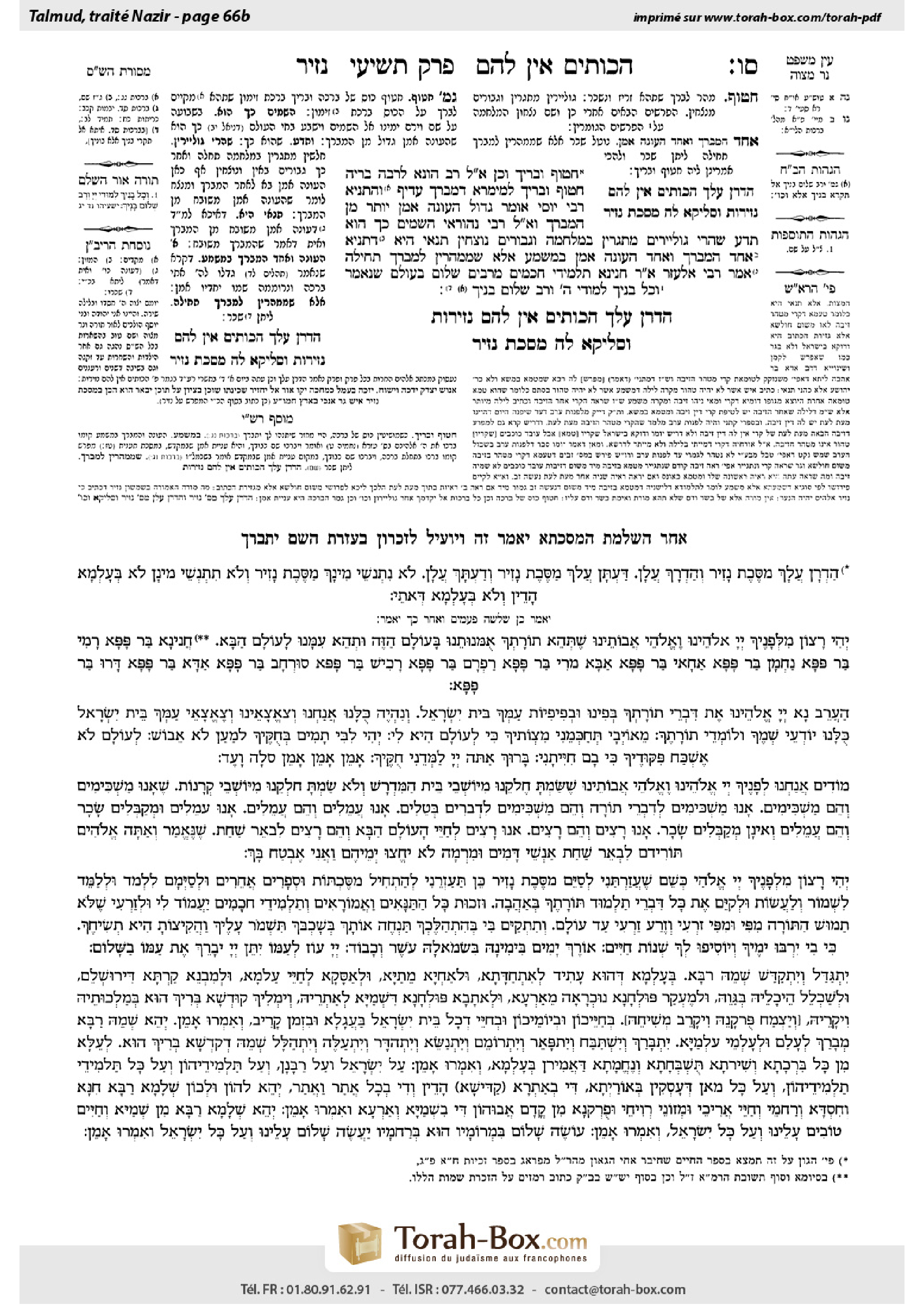
Nazir 66b: Talmud study for Daf Yomi
Daf Yomi is the daily study of one Talmud folio. Explore 37 tractates with scans, Hebrew text, Sefaria English and AI-generated French translations where annotated.
Passage selection and English or AI-generated French translation are available where the scan has annotations. Daf Study is independent of Torah-Box and Sefaria.
Browse Nazir · נזיר · All tractatesNazir 66b text and translations
This page of Nazir includes the Aramaic text, an English translation and an AI-generated French translation, alongside the scan above.
נזיר ס״ו ב · Aramaic and Hebrew text
חֲטוֹף וּבָרֵיךְ. וְכֵן אֲמַר לֵיהּ רַב הוּנָא לְרַבָּה בְּרֵיהּ: חֲטוֹף וּבָרֵיךְ.
לְמֵימְרָא דִּמְבָרֵךְ עֲדִיף? וְהָתַנְיָא, רַבִּי יוֹסֵי אוֹמֵר: גָּדוֹל הָעוֹנֶה ״אָמֵן״ יוֹתֵר מִן הַמְבָרֵךְ. וְאָמַר לוֹ רַבִּי נְהוֹרַאי: הַשָּׁמַיִם! כָּךְ הוּא: תֵּדַע שֶׁהֲרֵי גּוּלְיָירִים מִתְגָּרִין בַּמִּלְחָמָה, וְגִבּוֹרִים נוֹצְחִין.
תַּנָּאֵי הִיא, דְּתַנְיָא: אֶחָד הַמְבָרֵךְ וְאֶחָד הָעוֹנֶה ״אָמֵן״ בַּמַּשְׁמָע, אֶלָּא שֶׁמְּמַהֲרִין לַמְבָרֵךְ תְּחִילָּה.
אָמַר רַבִּי אֶלְעָזָר אָמַר רַבִּי חֲנִינָא: תַּלְמִידֵי חֲכָמִים מַרְבִּים שָׁלוֹם בָּעוֹלָם, שֶׁנֶּאֱמַר: ״וְכׇל בָּנַיִךְ לִמּוּדֵי ה׳ וְרַב שְׁלוֹם בָּנָיִךְ״.
הַדְרָן עֲלָךְ הַגּוֹיִם אֵין לָהֶם נְזִירוּת וּסְלִיקָא לַהּ מַסֶּכֶת נָזִיר
Nazir 66b · English translation
Seize the opportunity and quickly recite a blessing over the cup of blessing for the Grace after Meals. And similarly, Rav Huna said to his son, Rabba: Seize the opportunity and recite a blessing.
The Gemara asks: Is this to say that one who recites a blessing is preferable to one who answers amen? But isn’t it taught in a baraita that Rabbi Yosei says: The one who answers amen is greater than the one who recites the blessing? And Rabbi Nehorai said to him: By Heavens, it is so. Know that this is true, as the military assistants [gulyarim] descend to the battlefield and initiate the war and the mighty follow them and prevail. The amen that follows a blessing is compared to the mighty who join the war after the assistants, illustrating that answering amen is more significant than reciting the initial blessing.
The Gemara responds: This is a dispute between tanna’im, as it is taught in a baraita: Both the one who recites a blessing and the one who answers amen are included among those who “stand up and bless” (Nehemiah 9:5), but one hurries to first reward the one who recites the blessing. This baraita apparently holds that reciting the blessing is greater than answering amen.
Rabbi Elazar said that Rabbi Ḥanina said: Torah scholars increase peace in the world, as it is stated: “And all your children [banayikh] shall be taught of the Lord, and great shall be the peace of your children” (Isaiah 54:13). The Sages interpreted this verse homiletically: Do not read it as: “Your children [banayikh],” but as: Your builders [bonayikh]. Torah scholars are those who build peace for their generation.
Nazir 66b · Traduction française (IA)
Saisis l’occasion et récite sans tarder une bénédiction sur la coupe de bénédiction pour le Birkat Hamazone. De même, Rav Houna dit à son fils Rabba : « Saisis l’occasion et récite une bénédiction. »
La Guemara demande : Cela signifie-t-il que celui qui récite une bénédiction est supérieur à celui qui répond amen ? Pourtant, n’est-il pas enseigné dans une baraïta que Rabbi Yossi dit : « Celui qui répond amen est supérieur à celui qui récite la bénédiction » ? Rabbi Nehoraï lui dit alors : « Par le Ciel, c’est bien ainsi. Sache que c’est vrai : les auxiliaires de l’armée [gulyarim] descendent sur le champ de bataille et engagent le combat ; les hommes vaillants les suivent et remportent la victoire. L’amen qui suit une bénédiction est comparable aux hommes vaillants qui rejoignent le combat après les auxiliaires, ce qui montre que répondre amen est plus important que réciter la bénédiction initiale. »
La Guemara répond : Il s’agit d’un désaccord entre tannaïm, comme il est enseigné dans une baraïta : celui qui récite une bénédiction et celui qui répond amen sont tous deux inclus parmi ceux qui « se lèvent et bénissent » (Néhémie 9:5), mais on s’empresse de récompenser d’abord celui qui récite la bénédiction. Cette baraïta semble donc soutenir que réciter la bénédiction est supérieur à répondre amen.
Rabbi Elazar a dit au nom de Rabbi Hanina : Les érudits de la Torah accroissent la paix dans le monde, comme il est dit : « Tous tes enfants [banayikh] seront instruits par le Seigneur, et grande sera la paix de tes enfants » (Isaïe 54:13). Les Sages ont interprété ce verset de manière homilétique : ne lis pas « tes enfants [banayikh] », mais « tes bâtisseurs [bonayikh] ». Les érudits de la Torah sont ceux qui bâtissent la paix pour leur génération.
Traduction française générée par IA à partir de l’édition anglaise de Sefaria. Vérifie toujours un passage avec le texte source.
Text from Sefaria: William Davidson Edition - Vocalized Aramaic (CC BY NC); William Davidson Edition - English (CC BY NC).