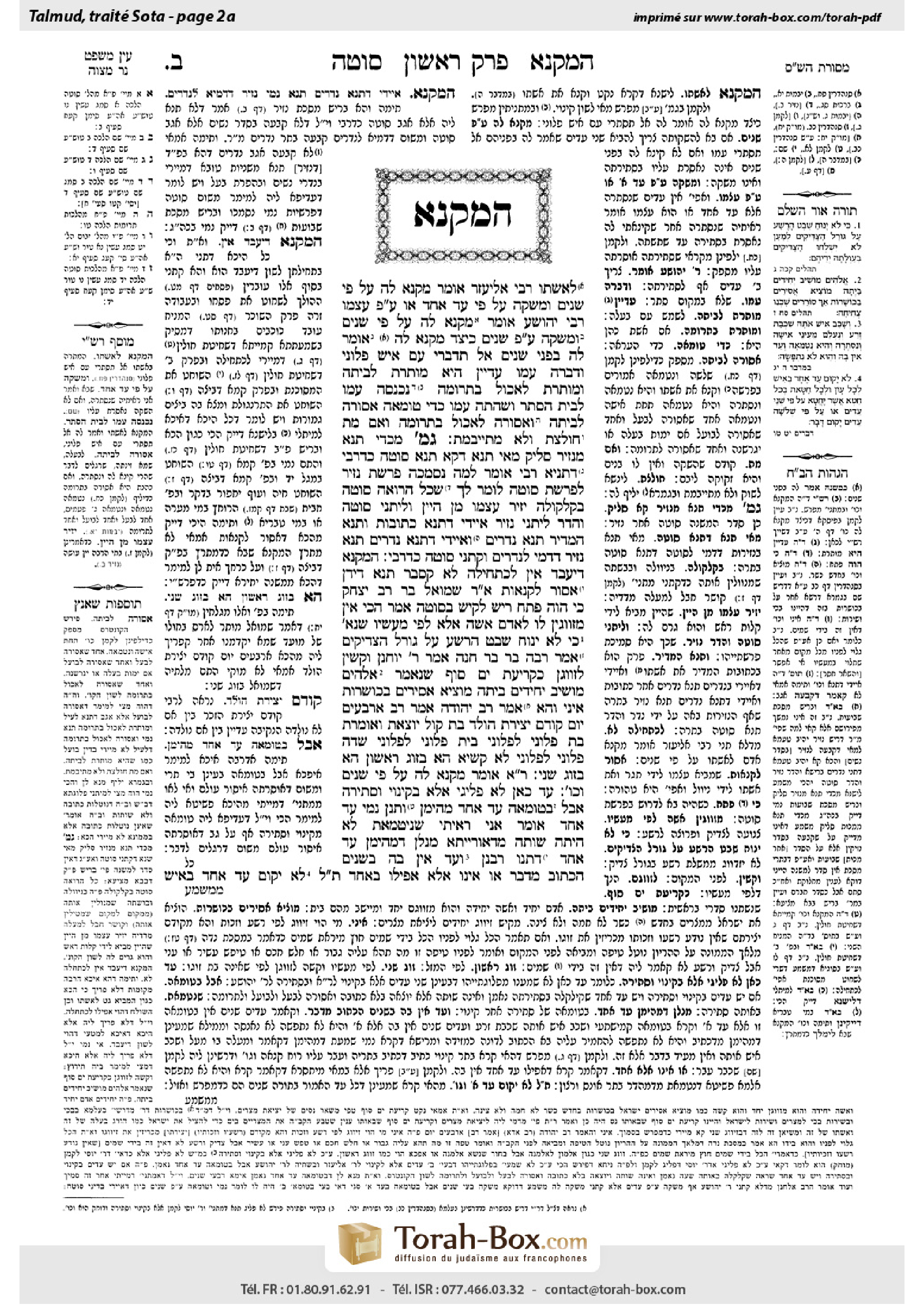
Sotah 2a: Talmud study for Daf Yomi
Daf Yomi is the daily study of one Talmud folio. Explore 37 tractates with scans, Hebrew text, Sefaria English and AI-generated French translations where annotated.
Passage selection and English or AI-generated French translation are available where the scan has annotations. Daf Study is independent of Torah-Box and Sefaria.
Browse Sotah · סוטה · All tractatesSotah 2a text and translations
This page of Sotah includes the Aramaic text, an English translation and an AI-generated French translation, alongside the scan above.
סוטה ב׳ א · Aramaic and Hebrew text
הַמְקַנֵּא לְאִשְׁתּוֹ, רַבִּי אֱלִיעֶזֶר אוֹמֵר: מְקַנֵּא לָהּ עַל פִּי שְׁנַיִם, וּמַשְׁקָהּ עַל פִּי עֵד אֶחָד, אוֹ עַל פִּי עַצְמוֹ. רַבִּי יְהוֹשֻׁעַ אוֹמֵר: מְקַנֵּא לָהּ עַל פִּי שְׁנַיִם, וּמַשְׁקָהּ עַל פִּי שְׁנַיִם.
כֵּיצַד מְקַנֵּא לָהּ? אוֹמֵר לָהּ בִּפְנֵי שְׁנַיִם: ״אַל תְּדַבְּרִי עִם אִישׁ פְּלוֹנִי״, וְדִבְּרָה עִמּוֹ — עֲדַיִין הִיא מוּתֶּרֶת לְבֵיתָהּ וּמוּתֶּרֶת לֶאֱכוֹל בִּתְרוּמָה.
נִכְנְסָה עִמּוֹ לְבֵית הַסֵּתֶר וְשָׁהֲתָה עִמּוֹ כְּדֵי טוּמְאָה — אֲסוּרָה לְבֵיתָהּ, וַאֲסוּרָה לֶאֱכוֹל בִּתְרוּמָה. וְאִם מֵת — חוֹלֶצֶת וְלֹא מִתְיַיבֶּמֶת.
גְּמָ׳ מִכְּדֵי תַּנָּא מִנָּזִיר סָלֵיק, מַאי תְּנָא דְּקָא תָּנֵא סוֹטָה?
כִּדְרַבִּי. דְּתַנְיָא, רַבִּי אוֹמֵר: לָמָּה נִסְמְכָה פָּרָשַׁת נָזִיר לְפָרָשַׁת סוֹטָה, לוֹמַר לָךְ: שֶׁכׇּל הָרוֹאֶה סוֹטָה בְּקִלְקוּלָהּ — יַזִּיר עַצְמוֹ מִן הַיַּיִן.
וְלִיתְנֵי סוֹטָה, וַהֲדַר לִיתְנֵי נָזִיר! אַיְּידֵי דִּתְנָא כְּתוּבּוֹת וּתְנָא ״הַמַּדִּיר״, תְּנָא נְדָרִים. וְאַיְּידֵי דִּתְנָא נְדָרִים — תְּנָא נָזִיר, דְּדָמֵי לִנְדָרִים. וְקָתָנֵי סוֹטָה, כִּדְרַבִּי.
״הַמְקַנֵּא״, דִּיעֲבַד — אִין, לְכַתְּחִילָּה — לָא. קָסָבַר תַּנָּא דִּידַן: אָסוּר לְקַנּאוֹת.
אָמַר רַב שְׁמוּאֵל בַּר רַב יִצְחָק: כִּי הֲוָה פָּתַח רֵישׁ לָקִישׁ בְּסוֹטָה, אָמַר הָכִי: אֵין מְזַוְּוגִין לוֹ לְאָדָם אִשָּׁה אֶלָּא לְפִי מַעֲשָׂיו, שֶׁנֶּאֱמַר: ״כִּי לֹא יָנוּחַ שֵׁבֶט הָרֶשַׁע עַל גּוֹרַל הַצַּדִּיקִים״. אָמַר רַבָּה בַּר בַּר חָנָה אָמַר רַבִּי יוֹחָנָן: וְקָשִׁין לְזַוְּוגָן כִּקְרִיעַת יַם סוּף, שֶׁנֶּאֱמַר: ״אֱלֹהִים מוֹשִׁיב יְחִידִים בַּיְתָה מוֹצִיא אֲסִירִים בַּכּוֹשָׁרוֹת״.
אִינִי? וְהָא אָמַר רַב יְהוּדָה אָמַר רַב: אַרְבָּעִים יוֹם קוֹדֶם יְצִירַת הַוָּלָד בַּת קוֹל יוֹצֵאת וְאוֹמֶרֶת: בַּת פְּלוֹנִי לִפְלוֹנִי, בֵּית פְּלוֹנִי לִפְלוֹנִי, שְׂדֵה פְלוֹנִי לִפְלוֹנִי! לָא קַשְׁיָא: הָא — בְּזוּג רִאשׁוֹן, הָא — בְּזוּג שֵׁנִי.
רַבִּי אֱלִיעֶזֶר אוֹמֵר: מְקַנֵּא לָהּ עַל פִּי שְׁנַיִם וְכוּ׳. עַד כָּאן לָא פְּלִיגִי אֶלָּא בְּקִינּוּי וּסְתִירָה, אֲבָל בְּטוּמְאָה — עֵד אֶחָד מְהֵימַן.
וּתְנַן נָמֵי: עֵד אֶחָד אוֹמֵר ״אֲנִי רָאִיתִי שֶׁנִּיטְמֵאת״ — לֹא הָיְתָה שׁוֹתָה.
מִדְּאוֹרָיְיתָא מְנָלַן דִּמְהֵימַן עֵד אֶחָד? דְּתָנוּ רַבָּנַן: ״וְעֵד אֵין בָּהּ״, בִּשְׁנַיִם הַכָּתוּב מְדַבֵּר.
אוֹ אֵינוֹ אֶלָּא אֲפִילּוּ בְּאֶחָד? תַּלְמוּד לוֹמַר: ״לֹא יָקוּם עֵד אֶחָד בְּאִישׁ״.
Sotah 2a · English translation
MISHNA: With regard to one who issues a warning to his wife not to seclude herself with a particular man, so that if she does not heed his warning she will assume the status of a woman suspected by her husband of having been unfaithful [sota], Rabbi Eliezer says: He issues a warning to her based on, i.e., in the presence of, two witnesses for the warning to be effective. If two witnesses were not present for the warning, she is not a sota even if two witnesses saw her seclusion with another man. And the husband gives the bitter water to her to drink based on the testimony of one witness who saw the seclusion, or even based on his own testimony that he himself saw them secluded together, as Rabbi Eliezer holds that only the warning requires witnesses, not the seclusion. Rabbi Yehoshua says: He both issues a warning to her based on two witnesses and gives the bitter water to her to drink based on the testimony of two witnesses.
The mishna asks: How does he issue a warning to her in an effective manner? If he says to her in the presence of two witnesses: Do not speak with the man called so-and-so, and she nevertheless spoke with him, she is still permitted to her home, i.e., she is permitted to engage in sexual intercourse with her husband, and if she is the wife of a priest she is still permitted to partake of teruma.
However, if after he told her not to speak with so-and-so, she entered into a secluded place and remained with that man long enough to become defiled, i.e., sufficient time to engage in sexual intercourse, she is forbidden to her home from that moment until she undergoes the sota rite. And likewise, if she was the wife of a priest she is prohibited from partaking of teruma, as she was possibly disqualified by her infidelity, so long as her innocence is not proven by means of the bitter water. And if her husband dies childless before she drinks the bitter water, she performs ḥalitza with her late husband’s brother and may not enter into levirate marriage, as, if she had been unfaithful, levirate marriage is forbidden.
GEMARA: The Gemara questions the placement of this tractate within the mishnaic order of Nashim. Now, the tanna arose from tractate Nazir, which is the tractate preceding Sota in the order of the Mishna. What did he teach in Nazir that required that he teach tractate Sota immediately afterward, as at first glance there seems to be no connection between this tractate and Nazir?
The Gemara answers: This was done in accordance with the statement of Rabbi Yehuda HaNasi with regard to the sequence of passages in the Torah, as it is taught in a baraita that Rabbi Yehuda HaNasi says: Why is the portion of a nazirite (Numbers, chapter 6) placed adjacent to the portion of a sota (Numbers, chapter 5)? This was done to tell you that anyone who sees a sota in her disgrace as she undergoes the rite of the bitter water should renounce wine, as wine is one of the causes of sexual transgression, as it loosens inhibitions. For the same reason that the Torah teaches these passages one after the other, Rabbi Yehuda HaNasi arranged these tractates one after the other.
The Gemara asks: But if so, let him teach tractate Sota first and then let him teach tractate Nazir, which is the way these topics are ordered in the Torah, and also accords better with the statement of Rabbi Yehuda HaNasi. The Gemara answers: Since the tanna taught tractate Ketubot, and in that tractate he taught a chapter that begins: One who vows, in which there are several mishnayot concerning vows between husbands and wives, he then taught tractate Nedarim, whose subject is the halakhot of vows. And since he taught tractate Nedarim, he then taught tractate Nazir, which is similar to tractate Nedarim in that one becomes a nazirite by taking a vow. And he then teaches tractate Sota, in accordance with the statement of Rabbi Yehuda HaNasi.
§ The Gemara begins clarifying the mishna. The mishna states: One who issues a warning to his wife. By employing the descriptive phrase: One who issues a warning, and not the prescriptive phrase: One issues a warning, the tanna indicates that after the fact, yes, it is effective if he issues a warning in this manner, but ideally, no, one should not issue a warning to his wife at all ab initio. Apparently, the tanna of our mishna holds that it is prohibited to issue a warning to one’s wife ab initio in a manner that can cause her to become a sota, and all the halakhot concerning a sota are for one who issued a warning when not obligated to do so.
Rav Shmuel bar Rav Yitzḥak says: When Reish Lakish would introduce his discussion of the Torah passage of sota he would say this: Heaven matches a woman to a man only according to his actions, as it is stated: “For the rod of wickedness shall not rest upon the lot of the righteous” (Psalms 125:3), indicating that if one has a wicked wife it is due to his own evil conduct. Rabba bar bar Ḥana says that Rabbi Yoḥanan says: And it is as difficult to match a couple together as was the splitting of the Red Sea, as it is stated in a verse that speaks of the exodus from Egypt: “God makes the solitary individuals dwell in a house; He brings out prisoners into prosperity [bakosharot]” (Psalms 68:7). God takes single individuals and causes them to dwell in a house by properly matching a man to a woman. This is similar to the exodus from Egypt, which culminated in the splitting of the Red Sea, where He released prisoners into prosperity.
The Gemara asks: Is that so that a man is matched to a woman according to his actions? But Rav Yehuda says that Rav says: Forty days before an embryo is formed a Divine Voice issues forth and says: The daughter of so-and-so is destined to marry so-and-so; such and such a house is destined to be inhabited by so-and-so; such and such a field is destined to be farmed by so-and-so. This clearly states that these matters, including marriage, are decreed for a person even before he is formed. The Gemara answers: This is not difficult. This statement that Rav Yehuda says in the name of Rav is with regard to a first match [zivug], while this statement of Rabba bar bar Ḥana in the name of Rabbi Yoḥanan is with regard to a second match. A first match is decreed in heaven; a second match is according to one’s actions.
§ The Gemara now clarifies the dispute in the mishna. Rabbi Eliezer says: The husband must issue a warning to her based on, i.e., in the presence of, two witnesses, and he gives the bitter water to her to drink based on the testimony of one witness. Rabbi Yehoshua says: He both issues a warning to her based on two witnesses and gives the bitter water to her to drink based on the testimony of two witnesses who saw them secluded together. The Gemara notes: Rabbi Eliezer and Rabbi Yehoshua disagree only with regard to the requisite number of witnesses for the warning and the seclusion, whether one or two witnesses are required, but with regard to the testimony concerning defilement after the warning was issued and seclusion had occurred, they agree that even the testimony of one witness is deemed credible to establish that the woman actually engaged in sexual intercourse with the man while secluded.
The Gemara comments: And we learned also in another mishna (31a) that if a single witness says: I saw that she was defiled, then she would not drink the bitter water, as the testimony is accepted, and her husband must divorce her and she forfeits payment of her marriage contract. Therefore, there is no need to perform the sota rite.
The Gemara asks: By Torah law, from where do we derive that one witness is deemed credible with regard to testifying that a sota engaged in sexual intercourse? The Gemara answers: As the Sages taught in reference to the verse describing the circumstances in which a woman defiled through an act of adultery becomes forbidden to her husband, which states: “And a man lie with her carnally and it be hid from the eyes of her husband, she being defiled secretly, and there is no witness [ed] against her” (Numbers 5:13), the verse is speaking of a lack of two witnesses. When the verse refers to the lack of an ed, written in the singular, it actually indicates that there are not two witnesses against her, but only one, as the baraita will now explain.
The baraita continues and asks: Or perhaps the verse is referring only to a case where there was not even one witness to the act of sexual intercourse, as the singular usage of the word ed would seem to indicate? The baraita now proves that elsewhere the word ed is used to indicate two witnesses, as the verse states: “One witness [ed] shall not rise up against a man for any iniquity or any sin that he sins; by the mouth of two witnesses or by the mouth of three witnesses shall a matter be established” (Deuteronomy 19:15).
Sotah 2a · Traduction française (IA)
MICHNA : À propos de celui qui met sa femme en garde contre le fait de s’isoler avec un homme précis, de sorte que, si elle ne tient pas compte de sa mise en garde, elle acquiert le statut de femme soupçonnée par son mari d’infidélité [sota], Rabbi Eliezer dit : Il la met en garde devant deux témoins pour que sa mise en garde soit valable. Si deux témoins n’étaient pas présents lors de la mise en garde, elle n’est pas une sota, même si deux témoins l’ont vue s’isoler avec un autre homme. Le mari lui fait boire les eaux amères sur le témoignage d’un seul témoin ayant vu l’isolement, voire sur son propre témoignage s’il les a lui-même vus isolés ensemble, car Rabbi Eliezer considère que seuls des témoins sont nécessaires pour la mise en garde, et non pour l’isolement. Rabbi Yehoshua dit : Il la met en garde devant deux témoins et lui fait boire les eaux amères sur le témoignage de deux témoins.
La Michna demande : Comment la met-il en garde de manière efficace ? S’il lui dit devant deux témoins : « Ne parle pas à l’homme appelé Untel », et qu’elle lui parle néanmoins, elle reste autorisée à retourner dans son foyer, c’est-à-dire à avoir des relations sexuelles avec son mari ; et, si elle est l’épouse d’un prêtre, elle reste autorisée à consommer de la terouma.
Cependant, si, après lui avoir dit de ne pas parler à Untel, elle entre dans un lieu isolé et y reste avec cet homme assez longtemps pour être souillée, c’est-à-dire pendant le temps nécessaire pour avoir des relations sexuelles, elle est interdite à son mari à partir de ce moment et jusqu’à ce qu’elle accomplisse le rite de la sota. De même, si elle est l’épouse d’un prêtre, il lui est interdit de consommer de la terouma, car elle a peut-être été disqualifiée par son infidélité, tant que son innocence n’a pas été prouvée au moyen des eaux amères. Et si son mari meurt sans enfant avant qu’elle ne boive les eaux amères, elle doit accomplir la ḥalitsa avec le frère de son défunt mari et ne peut pas contracter de mariage léviratique, car celui-ci lui est interdit si elle a été infidèle.
GUEMARA : La Guemara s’interroge sur la place de ce traité dans l’ordre des Michnayot consacré aux femmes. Or, le tanna vient d’achever le traité Nazir, qui précède Sotah dans l’ordre de la Michna. Quel enseignement a-t-il donné dans Nazir qui nécessitait qu’il enseigne ensuite immédiatement le traité Sotah, alors qu’à première vue, ce traité ne semble avoir aucun lien avec Nazir ?
La Guemara répond : Cela suit la déclaration de Rabbi Yehuda HaNasi concernant l’ordre des passages de la Torah, comme l’enseigne une baraïta : Rabbi Yehuda HaNasi dit : Pourquoi le passage du nazir (Nombres, chapitre 6) est-il placé à côté de celui de la sota (Nombres, chapitre 5) ? C’est pour t’apprendre que quiconque voit une sota dans son déshonneur, alors qu’elle subit le rite des eaux amères, doit renoncer au vin, car le vin est l’une des causes de la transgression sexuelle, puisqu’il libère les inhibitions. Pour la même raison que la Torah enseigne ces passages l’un après l’autre, Rabbi Yehuda HaNasi a disposé ces traités l’un après l’autre.
La Guemara demande : Mais dans ce cas, qu’il enseigne d’abord le traité Sotah, puis le traité Nazir, comme ces sujets sont ordonnés dans la Torah, ce qui s’accorde aussi mieux avec la déclaration de Rabbi Yehuda HaNasi. La Guemara répond : Le tanna ayant enseigné le traité Ketubot, dans lequel il a enseigné un chapitre qui commence par : « Celui qui fait un vœu », et qui contient plusieurs Michnayot sur les vœux entre maris et femmes, il a ensuite enseigné le traité Nedarim, consacré aux halakhot des vœux. Et puisqu’il a enseigné le traité Nedarim, il a ensuite enseigné le traité Nazir, qui lui ressemble en ce qu’on devient nazir en faisant un vœu. Puis il enseigne le traité Sotah, conformément à la déclaration de Rabbi Yehuda HaNasi.
§ La Guemara commence à examiner la Michna. La Michna dit : « Celui qui met sa femme en garde. » En employant la formule descriptive « celui qui met en garde », et non la formule prescriptive « on met en garde », le tanna indique qu’après coup, oui, la mise en garde faite de cette manière est valable, mais qu’en principe, non, on ne doit pas mettre sa femme en garde d’emblée. Il semble donc que le tanna de notre Michna considère qu’il est interdit de mettre sa femme en garde d’emblée d’une manière susceptible d’en faire une sota, et que toutes les halakhot concernant une sota s’appliquent à celui qui l’a mise en garde sans y être tenu.
Rav Shmuel bar Rav Yitzḥak dit : Lorsque Reish Lakish commençait à exposer le passage de la Torah relatif à la sota, il disait ceci : Le Ciel assortit une femme à un homme uniquement en fonction des actes de celui-ci, comme il est dit : « Car le sceptre de la méchanceté ne reposera pas sur le lot des justes » (Psaumes 125:3), ce qui indique que si un homme a une femme méchante, cela est dû à sa propre mauvaise conduite. Rabba bar bar Ḥana dit au nom de Rabbi Yoḥanan : Il est aussi difficile d’apparier un couple que de fendre la mer Rouge, comme il est dit dans un verset qui parle de la sortie d’Égypte : « Dieu fait habiter les solitaires dans une maison ; Il fait sortir les prisonniers dans la prospérité [bakosharot] » (Psaumes 68:7). Dieu prend des personnes seules et les fait habiter dans une maison en assortissant convenablement un homme et une femme. Cela ressemble à la sortie d’Égypte, qui a culminé avec la séparation de la mer Rouge, lorsqu’Il a libéré les prisonniers dans la prospérité.
La Guemara demande : Est-il donc vrai qu’un homme est assorti à une femme en fonction de ses actes ? Mais Rav Yehuda dit au nom de Rav : Quarante jours avant la formation de l’embryon, une Voix céleste proclame : La fille d’Untel est destinée à épouser Untel ; telle maison est destinée à être habitée par Untel ; tel champ est destiné à être cultivé par Untel. Cela affirme clairement que ces choses, y compris le mariage, sont décrétées pour une personne avant même qu’elle soit formée. La Guemara répond : Il n’y a pas de contradiction. La déclaration que Rav Yehuda rapporte au nom de Rav concerne une première union [zivug], tandis que celle que Rabba bar bar Ḥana rapporte au nom de Rabbi Yoḥanan concerne une seconde union. Une première union est décrétée au Ciel ; une seconde dépend des actes de la personne.
§ La Guemara examine maintenant la controverse de la Michna. Rabbi Eliezer dit : Le mari doit la mettre en garde devant deux témoins et lui fait boire les eaux amères sur le témoignage d’un seul témoin. Rabbi Yehoshua dit : Il la met en garde devant deux témoins et lui fait boire les eaux amères sur le témoignage de deux témoins qui les ont vus isolés ensemble. La Guemara note : Rabbi Eliezer et Rabbi Yehoshua ne sont en désaccord que sur le nombre requis de témoins pour la mise en garde et l’isolement, à savoir un ou deux témoins ; mais, concernant le témoignage d’une souillure survenue après la mise en garde et l’isolement, ils conviennent que même le témoignage d’un seul témoin est jugé fiable pour établir que la femme a effectivement eu des relations sexuelles avec l’homme alors qu’ils étaient isolés.
La Guemara fait remarquer : Nous avons également appris dans une autre Michna (31a) que si un témoin unique dit : « J’ai vu qu’elle a été souillée », elle ne boit pas les eaux amères, car son témoignage est accepté ; son mari doit divorcer d’elle et elle perd le montant de sa ketouba. Il n’est donc pas nécessaire d’accomplir le rite de la sota.
La Guemara demande : Selon la Torah, d’où déduisons-nous qu’un témoin unique est jugé fiable pour témoigner qu’une sota a eu des relations sexuelles ? La Guemara répond : Comme les Sages l’ont enseigné à propos du verset décrivant les circonstances dans lesquelles une femme souillée par un adultère devient interdite à son mari. Le verset dit : « Un homme aura couché charnellement avec elle, et cela sera caché aux yeux de son mari ; elle se sera souillée en secret, et il n’y aura pas de témoin [ed] contre elle » (Nombres 5:13). Le verset parle de l’absence de deux témoins. Lorsque le verset mentionne l’absence d’un ed, écrit au singulier, il indique en réalité qu’il n’y a pas deux témoins contre elle, mais seulement un, comme la baraïta va maintenant l’expliquer.
La baraïta poursuit et demande : Ou peut-être le verset fait-il seulement référence à un cas où il n’y avait même pas un seul témoin de l’acte sexuel, comme semble l’indiquer l’emploi au singulier du mot ed ? La baraïta prouve alors qu’ailleurs, le mot ed désigne deux témoins, comme il est dit : « Un témoin [ed] ne pourra pas se lever contre un homme pour quelque faute ou péché qu’il ait commis ; c’est par la bouche de deux témoins ou par la bouche de trois témoins qu’une affaire sera établie » (Deutéronome 19:15).
Traduction française générée par IA à partir de l’édition anglaise de Sefaria. Vérifie toujours un passage avec le texte source.
Text from Sefaria: William Davidson Edition - Vocalized Aramaic (CC BY NC); William Davidson Edition - English (CC BY NC).