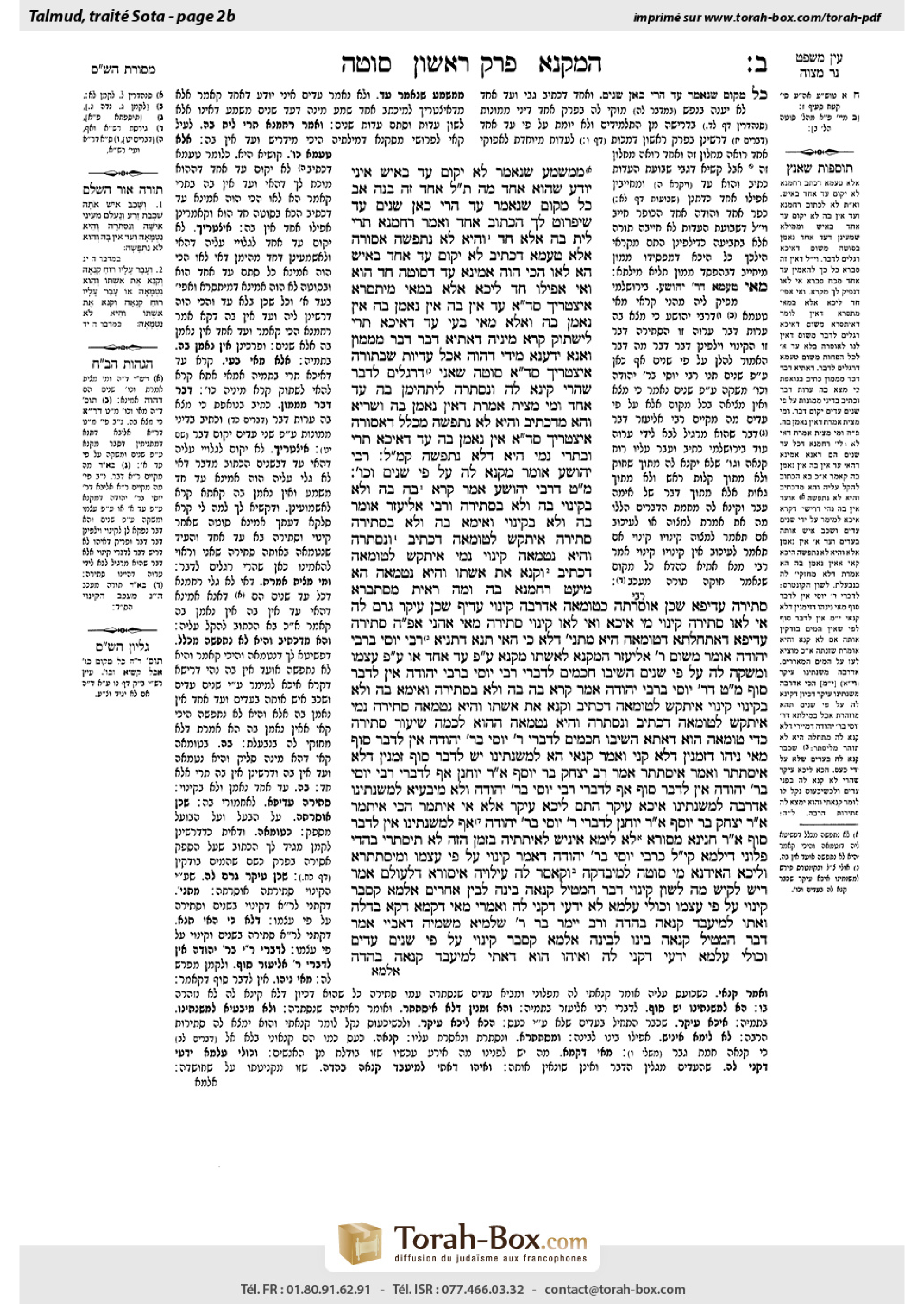
Sotah 2b: Talmud study for Daf Yomi
Daf Yomi is the daily study of one Talmud folio. Explore 37 tractates with scans, Hebrew text, Sefaria English and AI-generated French translations where annotated.
Passage selection and English or AI-generated French translation are available where the scan has annotations. Daf Study is independent of Torah-Box and Sefaria.
Browse Sotah · סוטה · All tractatesSotah 2b text and translations
This page of Sotah includes the Aramaic text, an English translation and an AI-generated French translation, alongside the scan above.
סוטה ב׳ ב · Aramaic and Hebrew text
מִמַּשְׁמַע שֶׁנֶּאֱמַר ״לֹא יָקוּם עֵד בְּאִישׁ״, אֵינִי יוֹדֵעַ שֶׁהוּא אֶחָד? מָה תַּלְמוּד לוֹמַר ״אֶחָד״? זֶה בָּנָה אָב: כׇּל מָקוֹם שֶׁנֶּאֱמַר ״עֵד״ — הֲרֵי כָּאן שְׁנַיִם, עַד שֶׁיִּפְרוֹט לְךָ הַכָּתוּב ״אֶחָד״.
וְאָמַר רַחֲמָנָא: תְּרֵי לֵית בַּהּ אֶלָּא חַד, ״וְהִיא לֹא נִתְפָּשָׂה״ — אֲסוּרָה.
אֶלָּא טַעְמָא דִּכְתִיב ״לֹא יָקוּם עֵד אֶחָד בְּאִישׁ״, הָא לָאו הָכִי הֲוָה אָמֵינָא ״עֵד״ דְּסוֹטָה חַד הוּא. וְאִי אֲפִילּוּ חַד לֵיכָּא, אֶלָּא בְּמַאי מִיתַּסְרָא?
אִיצְטְרִיךְ, סָלְקָא דַּעְתָּךְ אָמֵינָא: ״עֵד אֵין בָּהּ״ — אֵין נֶאֱמָן בָּהּ.
אֵין נֶאֱמָן בָּהּ?! וְאֶלָּא מַאי בָּעֵי —
עַד דְּאִיכָּא תְּרֵי? לִישְׁתּוֹק קְרָא מִינֵּיהּ. דְּאָתְיָא ״דָּבָר״ ״דָּבָר״ מִמָּמוֹן. וַאֲנָא יָדַעְנָא, מִידֵּי דְּהָוֵה אַכׇּל עֵדֻיוֹת שֶׁבַּתּוֹרָה!
אִיצְטְרִיךְ, סָלְקָא דַּעְתָּךְ אָמֵינָא: סוֹטָה שָׁאנֵי, דְּרַגְלַיִם לְדָבָר, שֶׁהֲרֵי קִינֵּא לָהּ וְנִסְתְּרָה — לִיתְהֵימַן בַּהּ עֵד אֶחָד.
וּמִי מָצֵית אָמְרַתְּ דְּאֵין נֶאֱמָן בָּהּ וְשַׁרְיָא? וְהָא מִדִּכְתִיב ״וְהִיא לֹא נִתְפָּשָׂה״ — מִכְּלָל דַּאֲסוּרָה!
אִיצְטְרִיךְ, סָלְקָא דַּעְתָּךְ אָמֵינָא: אֵין נֶאֱמָן בָּהּ — עַד דְּאִיכָּא תְּרֵי, וּבִתְרֵי נָמֵי ״הִיא דְּלֹא נִתְפָּשָׂה״, קָא מַשְׁמַע לַן.
רַבִּי יְהוֹשֻׁעַ אוֹמֵר: מְקַנֵּא לָהּ עַל פִּי שְׁנַיִם וְכוּ׳. מַאי טַעְמָא דְּרַבִּי יְהוֹשֻׁעַ? אָמַר קְרָא: ״בָּהּ״ — בָּהּ וְלֹא בְּקִינּוּי, ״בָּהּ״ — וְלֹא בִּסְתִירָה.
וְרַבִּי אֱלִיעֶזֶר אוֹמֵר: ״בָּהּ״ — וְלֹא בְּקִינּוּי.
וְאֵימָא: ״בָּהּ״ וְלֹא בִּסְתִירָה! סְתִירָה אִיתַּקַּשׁ לְטוּמְאָה, דִּכְתִיב: ״וְנִסְתְּרָה וְהִיא נִטְמָאָה״.
קִינּוּי נָמֵי אִיתַּקַּשׁ לְטוּמְאָה, דִּכְתִיב: ״וְקִנֵּא אֶת אִשְׁתּוֹ וְהִיא נִטְמָאָה״! הָא מִיעֵט רַחֲמָנָא ״בָּהּ״.
וּמָה רָאִיתָ? מִסְתַּבְּרָא סְתִירָה עֲדִיפָא, שֶׁכֵּן אוֹסַרְתָּהּ כְּטוּמְאָה.
אַדְּרַבָּה: קִינּוּי עָדִיף, שֶׁכֵּן עִיקָּר גָּרַם לָהּ.
אִי לָאו סְתִירָה, קִינּוּי מִי אִיכָּא? וְאִי לָאו קִינּוּי, סְתִירָה מַאי אַהֲנִי?
אֲפִילּוּ הָכִי, סְתִירָה עֲדִיפָא, דְּאַתְחַלְתָּא דְטוּמְאָה הִיא.
מַתְנִיתִין דְּלָא כִּי הַאי תַּנָּא. דְּתַנְיָא, רַבִּי יוֹסֵי בְּרַבִּי יְהוּדָה אוֹמֵר מִשּׁוּם רַבִּי אֱלִיעֶזֶר: הַמְקַנֵּא לְאִשְׁתּוֹ — מְקַנֵּא עַל פִּי עֵד אֶחָד אוֹ עַל פִּי עַצְמוֹ, וּמַשְׁקֶה לָהּ עַל פִּי שְׁנַיִם. הֵשִׁיבוּ חֲכָמִים: לְדִבְרֵי רַבִּי יוֹסֵי בְּרַבִּי יְהוּדָה אֵין לַדָּבָר סוֹף.
מַאי טַעְמָא דְּרַבִּי יוֹסֵי בְּרַבִּי יְהוּדָה? אָמַר קְרָא ״בָּהּ״ — בָּהּ וְלֹא בִּסְתִירָה.
וְאֵימָא: ״בָּהּ״ וְלֹא בְּקִינּוּי? קִינּוּי אִיתַּקַּשׁ לְטוּמְאָה, דִּכְתִיב: ״וְקִנֵּא אֶת אִשְׁתּוֹ וְהִיא נִטְמָאָה״.
סְתִירָה נָמֵי אִיתַּקַּשׁ לְטוּמְאָה, דִּכְתִיב: ״וְנִסְתְּרָה וְהִיא נִטְמָאָה״?! הַהוּא, לְכַמָּה שִׁיעוּר סְתִירָה — כְּדֵי טוּמְאָה, הוּא דַּאֲתָא.
הֵשִׁיבוּ חֲכָמִים: לְדִבְרֵי רַבִּי יוֹסֵי בְּרַבִּי יְהוּדָה אֵין לַדָּבָר סוֹף. מַאי נִיהוּ? דְּזִמְנִין דְּלָא קַנִּי וְאָמַר ״קַנַּאי״.
הָא לְמִשְׁנָתֵינוּ יֵשׁ לַדָּבָר סוֹף? זִמְנִין דְּלָא אִיסְתַּתַּר וְאָמַר ״אִיסְתַּתַּר״!
אָמַר רַב יִצְחָק בַּר יוֹסֵף אָמַר רַבִּי יוֹחָנָן: אַף לְדִבְרֵי רַבִּי יוֹסֵי בְּרַבִּי יְהוּדָה אֵין לַדָּבָר סוֹף.
אַף לְדִבְרֵי רַבִּי יוֹסֵי בְּרַבִּי יְהוּדָה, וְלֹא מִיבַּעְיָא לְמִשְׁנָתֵינוּ? אַדְּרַבָּה: לְמִשְׁנָתֵינוּ אִיכָּא עִיקָּר, הָתָם לֵיכָּא עִיקָּר!
אֶלָּא אִי אִיתְּמַר — הָכִי אִיתְּמַר, אָמַר רַב יִצְחָק בַּר יוֹסֵף אָמַר רַבִּי יוֹחָנָן: לְדִבְרֵי רַבִּי יוֹסֵי בְּרַבִּי יְהוּדָה, אַף לְמִשְׁנָתֵינוּ אֵין לַדָּבָר סוֹף.
אָמַר רַב חֲנִינָא מִסּוּרָא: לָא לֵימָא אִינִישׁ לְאִיתְּתֵיהּ בַּזְּמַן הַזֶּה ״לֹא תִּיסָּתְרִי בַּהֲדֵי פְלוֹנִי״, דִּילְמָא קַיְימָא לַן כְּרַבִּי יוֹסֵי בְּרַבִּי יְהוּדָה, דְּאָמַר קִינּוּי עַל פִּי עַצְמוֹ, וּמִיסְתַּתְּרָא, וְלֵיכָּא הָאִידָּנָא מֵי סוֹטָה לְמִיבְדְּקַהּ, וְקָאָסַר לַהּ עִילָּוֵיהּ אִיסּוּרָא דִּלְעוֹלָם.
אָמַר רֵישׁ לָקִישׁ: מָה לְשׁוֹן ״קִינּוּי״ — דָּבָר הַמֵּטִיל קִנְאָה בֵּינָהּ לְבֵין אֲחֵרִים. אַלְמָא קָסָבַר קִינּוּי עַל פִּי עַצְמוֹ, וְכוּלֵּי עָלְמָא לָא יָדְעִי דְּקַנִּי לַהּ, וְאָמְרִי: מַאי דְּקַמָּא דְּקָא בָּדְלָה, וְאָתוּ לְמִיעְבַּד קִנְאָה בַּהֲדַהּ.
וְרַב יֵימַר בַּר רַבִּי שֶׁלֶמְיָא מִשְּׁמֵיהּ דְּאַבָּיֵי אָמַר: דָּבָר הַמֵּטִיל קִנְאָה בֵּינוֹ לְבֵינָהּ. אַלְמָא קָסָבַר קִינּוּי עַל פִּי שְׁנַיִם עֵדִים, וְכוּלֵּי עָלְמָא יָדְעִי דְּקַנִּי לַהּ, וְאִיהוּ הוּא דְּאָתֵי לְמִיעְבַּד קִנְאָה בַּהֲדַהּ.
Sotah 2b · English translation
The baraita infers a general principle from this verse by asking: By inference from that which is stated in the verse, even with the omission of the word “one”: “A witness shall not rise up against a man” (Deuteronomy 19:15), do I not know that it is referring to one witness, as the term “rise up [yakum]” is written in the singular form? What is the meaning when the verse states explicitly: “One witness,” since it is obviously referring to only one witness? The baraita answers: This established a paradigm that every place where the word “witness [ed]” is stated in the Torah without specifying a number, there are two witnesses here, unless the verse specifies that it is referring to only one witness by writing the word “one.”
The baraita returns to discuss the verse concerning a sota. And the Merciful One states: “There is no witness [ed] against her” (Numbers 5:13), which therefore means that there are not two witnesses to the sexual intercourse that could testify with regard to her; rather, there is only one witness. The baraita completes its interpretation: Further in the verse it states: “And she was not taken,” indicating that the verse is referring to a case in which it is known that the woman had not been raped. This knowledge is based on the testimony of only one witness, as the verse had already stated that there were not two witnesses, and since one witness saw her willingly engage in sexual intercourse with another man, she is forbidden.
The Gemara questions this reasoning: But this would seem to indicate that the only reason to interpret the verse concerning a sota as referring to a case where there is only one witness is that it is written in the other verse: “One witness shall not rise up against a man” (Deuteronomy 19:15), indicating that any unspecified usage of the word ed in the Torah refers to two witnesses, but were it not for this inference, I would say that when the term witness is employed in the verse concerning a sota it is referring to one witness. However, this would mean that the woman is forbidden to her husband even if there is not even one witness who saw the alleged sexual intercourse, and if there is not even one witness to testify, then with what testimony does she become forbidden to her husband? Obviously, even without another verse, it must be understood that the verse is indicating that there are not two witnesses but there is one, or else there would be no testimony to her actions.
The Gemara answers: It was necessary to infer the interpretation of the verse concerning the sota from the other verse mentioning one witness. Otherwise it might enter your mind to say that the verse here that states: “There is no witness against her,” means that a single witness testifying about the sexual intercourse is not deemed credible with regard to her under any circumstances, and the testimony of one witness is not accepted in the case of a sota.
The Gemara questions this analysis: What would be the logic in interpreting the verse as indicating that a single witness is not deemed credible with regard to her? But if that is the interpretation, what does the verse require in order for a sota to be rendered forbidden?
The Gemara explains its question: If the verse is understood as indicating that a woman isn’t forbidden until there are two witnesses to testify to her infidelity, then let the verse be silent from any mention of witnesses, as the requirement for two witnesses in matters of sexual impropriety is derived by means of a verbal analogy from the word “matter” written with regard to forbidden relations, and the word “matter” written with regard to monetary matters. The verbal analogy by which it is learned that two witnesses are required is as follows: A verse concerning forbidden relations states: “Because he has found some unseemly matter about her” (Deuteronomy 24:1), and a verse concerning monetary matters states: “By the mouth of two witnesses or by the mouth of three witnesses shall a matter be established” (Deuteronomy 19:15). And I would know that the requirement that two witnesses testify applies in the case of a sota, just as it does in all other matters of testimony in the Torah.
The Gemara answers: It was necessary that the verse be stated in the case of a sota as well, for it might enter your mind to say that testimony concerning a sota is different from other testimony, and even testimony of one witness would be sufficient because there is a basis for anticipating the matter. Since the husband issued a warning to her about this particular man and she then secluded herself with him, perhaps even one witness should be deemed credible with regard to her. Therefore, the verse informs us that one witness is not deemed credible to render her forbidden to her husband.
The Gemara asks another question concerning its earlier analysis: But how can you think to say that the verse would be stating that one witness is not deemed credible with regard to her having engaged in sexual intercourse and she would remain permitted to her husband? But from the continuation of the same verse, from the fact that it is written: “And she was not taken,” which indicates that the verse is referring to a case where she was not raped, one concludes by inference that the verse is referring to a woman who becomes forbidden to her husband for engaging in consensual adulterous sexual intercourse.
The Gemara answers: Nevertheless, it still was necessary to teach the principle derived from the other verse that the term “ed” is referring to two witnesses even in the context of a sota, as it might enter your mind to say that the verse should be understood to mean that one witness is not deemed credible with regard to her, and she remains permitted until there are two witnesses who testify to the sexual intercourse, and with the testimony of two witnesses as well, it is only when she was not seized and forced to cohabit with the man. Therefore, to refute this possible interpretation, the baraita teaches us that “ed” always refers to two witnesses unless stated otherwise. Therefore, the phrase in the verse concerning a sota that says: “There is no witness [ed] against her,” means that there were not two witnesses, but if there was only one witness he is deemed credible.
The mishna teaches that Rabbi Yehoshua says: He both issues a warning to her based on two witnesses, and he gives the bitter water to her to drink based on the testimony of two witnesses who saw her secluded. The Gemara asks: What is the reasoning of Rabbi Yehoshua? The Gemara answers: The verse states: “And there is no witness [ed] against her [bah]” (Numbers 5:13), which was explained to mean there were not two witnesses, but only one, who testified concerning her defilement. Rabbi Yehoshua derives from the term bah, which could also be understood as: With regard to it, that in this matter of defilement one witness suffices, but not with regard to the warning. Additionally, he derives: With regard to it, but not with regard to the seclusion. Therefore, there must be two witnesses to testify about both the warning and the seclusion.
The Gemara now explains Rabbi Eliezer’s opinion. And Rabbi Eliezer says that the only derivation to be learned is: With regard to it, but not with regard to the warning. Therefore, the warning, unlike the defilement, requires two witnesses. The seclusion is not contrasted with the defilement, and, like the defilement, requires only one.
The Gemara questions Rabbi Eliezer’s opinion: But why not say that one should also derive: With regard to it, but not with regard to the seclusion, as does Rabbi Yehoshua? The Gemara answers: Rabbi Eliezer does not accept that derivation, as seclusion is juxtaposed to defilement by the verse, as it is written: “And she was defiled secretly” (Numbers 5:13), and the term “secretly” is referring to seclusion. Therefore, the same halakha should apply to both.
The Gemara asks: But the warning is also juxtaposed to defilement, as it is written: “And he warned his wife, and she had become defiled” (Numbers 5:14) and the same halakha should apply to both. The Gemara answers: The Merciful One excluded at least one of the two by use of the expression bah, which teaches that in one matter other than defilement, two witnesses are required.
The Gemara asks: And what did you see to determine that the exclusion from the halakha of one witness sufficing is with regard to the warning? Perhaps the exclusion from the halakha of one witness sufficing is with regard to the seclusion. The Gemara answers: It stands to reason that it is preferable to compare seclusion to defilement, as testimony with regard to seclusion forbids her to her husband just as testimony with regard to defilement does.
The Gemara rejects this reasoning: On the contrary, it is preferable to compare the warning to the defilement, as it is the main cause of her becoming forbidden. Seclusion alone, absent a warning, would not cause her to be forbidden to her husband.
The Gemara counters: If there is no seclusion, is there any significance to the warning? The warning results in a prohibition only after the warned woman secludes herself with the man. The Gemara counters: And if there is no warning, what effectiveness does seclusion have? Both the warning and the seclusion are required for her to be forbidden.
The Gemara concludes: Even so, it is preferable to compare the seclusion to the defilement, as the seclusion is the beginning of defilement. Therefore, just as the testimony of one witness suffices with regard to the defilement, the testimony of one witness suffices with regard to the seclusion.
The Gemara comments: The mishna is not in accordance with the opinion of this tanna, who presents a different version of Rabbi Eliezer’s opinion, as it is taught in a baraita (Tosefta 1:1) that Rabbi Yosei, son of Rabbi Yehuda, says in the name of Rabbi Eliezer: One who issues a warning to his wife issues a warning based on one witness or based on his own testimony, and he gives the bitter water to her to drink based on the testimony of two witnesses who saw her secluded. The baraita further states that the Rabbis responded: According to the statement of Rabbi Yosei, son of Rabbi Yehuda, as to Rabbi Eliezer’s opinion that one need not issue a warning in the presence of two witnesses, there is no end to the matter, as the Gemara will explain.
The Gemara explains: What is the reasoning of Rabbi Yosei, son of Rabbi Yehuda? The verse states: “Bah,” from which he infers that one witness suffices to testify with regard to it, i.e., the defilement, but not with regard to seclusion, as above.
The Gemara asks: But why not say that one should also derive: With regard to it, but not with regard to the warning? The Gemara answers: The warning is juxtaposed to defilement, as it is written: “And he warned his wife, and she had become defiled” (Numbers 5:14), and the same halakha should apply to both.
The Gemara counters this argument: Seclusion is also juxtaposed in the verse to defilement, as it is written: “And she was defiled secretly” (Numbers 5:13). Therefore, the same halakha should apply to both. The Gemara responds: That verse is coming to teach how much is the measure of seclusion, i.e., the amount of time that the man and woman must be secluded together for it to be defined as seclusion, which, as the comparison indicates, is the amount of time sufficient for defilement.
The Gemara continues to clarify the baraita. The Rabbis responded: According to the statement of Rabbi Yosei, son of Rabbi Yehuda, as to Rabbi Eliezer’s opinion, there is no end to the matter. The Gemara asks: What is the meaning of: There is no end to the matter? The Gemara answers: It is that there may be times when the husband did not warn his wife but after hearing of her seclusion with another man says: I warned her, which will be sufficient to render her forbidden to him until she drinks.
The Gemara is puzzled by this logic: But according to our mishna, does the matter in fact have an end? Rabbi Eliezer states in the mishna that a woman must drink the bitter water based upon her husband’s own statement that she secluded herself with the man about whom he had warned her. There too, one could ask whether there may be times when she did not seclude herself with the other man and where her husband says: She secluded herself, thereby rendering her forbidden to him until she drinks the bitter water. If so, why do the Rabbis take issue only with the version of Rabbi Eliezer’s opinion as presented by Rabbi Yosei, son of Rabbi Yehuda, and not with the version recorded in the mishna?
Rav Yitzḥak bar Yosef says that Rabbi Yoḥanan says: The Rabbis in the baraita meant to state that even according to the statement of Rabbi Yosei, son of Rabbi Yehuda, there is no end to the matter. The Rabbis wished to say that even according to his version of Rabbi Eliezer’s opinion, the husband can cause her to drink if he were to lie. The same is obviously true for the mishna.
The Gemara notes: The phrase even according to the statement of Rabbi Yosei, son of Rabbi Yehuda, indicates it is a lesser novelty to say that there is no end to the matter according to him, and it is not necessary to say that the same would be true according to the opinion of Rabbi Eliezer cited in our mishna. The Gemara asks: On the contrary, according to the opinion of Rabbi Eliezer cited in our mishna, there is a legitimate basis of suspicion with regard to the woman, as there are witnesses who saw the husband issue a warning to her, and therefore, it is understandable that the testimony of the husband may be relied upon when he testifies that she secluded herself with another man. By contrast, there, according to the opinion of Rabbi Yosei, son of Rabbi Yehuda, there is no legitimate basis to prohibit her to him, since there are no witnesses that she had been warned by her husband at all. Therefore, it may be that the Rabbis took issue only with the version of Rabbi Eliezer’s opinion presented by Rabbi Yosei, son of Rabbi Yehuda.
The Gemara clarifies the statement of Rabbi Yoḥanan: Rather, if it was stated, it was stated like this: Rav Yitzḥak bar Yosef says that Rabbi Yoḥanan says that the Rabbis said: According to the statement of Rabbi Yosei, son of Rabbi Yehuda, who is not concerned that accepting the testimony of one person with regard to the warning will enable false claims by the husband, even according to the opinion of Rabbi Eliezer cited in our mishna there is no end to the matter, since the concern there is less severe, as there is no legitimate basis to render her forbidden to her husband.
Rav Ḥanina of Sura says: In the present a man should not say to his wife: Do not seclude yourself with so-and-so. The reason is that perhaps we maintain that the halakha is in accordance with the opinion of Rabbi Yosei, son of Rabbi Yehuda, who says that a warning is effective even based on his own testimony, and if she were then to seclude herself with that man she would be required to drink the bitter water to render herself permitted to her husband, and since today the bitter water of a sota is not used to evaluate her fidelity and permit her to her husband, he will end up forbidding her to himself with an irrevocable prohibition.
§ Reish Lakish says: What is the meaning of the term: Warning [kinnui]? It means a matter that causes anger [kina] between her and others, as other men will not understand why she does not wish to be friendly with them any longer. The Gemara comments: Apparently, he holds that a warning is effective based on the husband’s own testimony, and therefore everyone else will not know that her husband issued a warning to her, and they will say: What is this matter happening before us that she separates herself from us, and they will come to act in anger with her.
And Rav Yeimar bar Rabbi Shelemya says in the name of Abaye: The term kinnui means a matter that causes anger between him and her, i.e., between husband and wife. The Gemara comments: Apparently, he holds that a warning is effective based on the testimony of two witnesses. And since there are two witnesses, everyone knows that he issued a warning to her. Therefore, the warning does not cause anger between her and others. And the husband is he who will come to act in anger with her, as they will have mutual antagonism toward each other.
Sotah 2b · Traduction française (IA)
La baraïta déduit de ce verset un principe général en posant la question suivante : À partir de ce qui est écrit dans le verset, même sans le mot « un » — « Un témoin ne se lèvera pas contre un homme » (Deutéronome 19,15) — ne sais-je pas qu’il s’agit d’un seul témoin, puisque le terme « se lèvera [yakum] » est au singulier ? Que signifie donc la précision du verset : « Un témoin », alors qu’il est évident qu’il s’agit d’un seul témoin ? La baraïta répond : Cela établit un principe : chaque fois que le mot « témoin [ed] » est employé dans la Torah sans indication de nombre, il s’agit de deux témoins, sauf si le verset précise qu’il s’agit d’un seul témoin en employant le mot « un ».
La baraïta revient au verset concernant une sota. Or le Miséricordieux dit : « Il n’y a pas de témoin [ed] contre elle » (Nombres 5,13), ce qui signifie qu’il n’y a pas deux témoins de la relation sexuelle qui puissent témoigner à son sujet ; il n’y en a donc qu’un seul. La baraïta complète son interprétation : Plus loin dans le verset, il est écrit : « Et elle n’a pas été prise », ce qui indique que le verset parle d’un cas où l’on sait que la femme n’a pas été violée. Cette connaissance repose sur le témoignage d’un seul témoin, puisque le verset a déjà indiqué qu’il n’y avait pas deux témoins ; et comme un témoin l’a vue avoir volontairement une relation sexuelle avec un autre homme, elle lui est interdite.
La Guemara met ce raisonnement en question : Cela semblerait indiquer que la seule raison d’interpréter le verset concernant une sota comme se rapportant à un cas où il n’y a qu’un seul témoin est que l’autre verset dit : « Un témoin ne se lèvera pas contre un homme » (Deutéronome 19,15), indiquant que, partout où le mot ed est employé sans indication de nombre dans la Torah, il désigne deux témoins. Mais sans cette déduction, j’aurais dit que, lorsque le terme « témoin » est employé dans le verset concernant une sota, il désigne un seul témoin. Cela signifierait toutefois que la femme est interdite à son mari même si aucun témoin n’a vu la relation sexuelle alléguée ; et s’il n’y a même pas un seul témoin pour déposer, par quel témoignage devient-elle interdite à son mari ? Il est évident que, même sans autre verset, il faut comprendre que le verset indique qu’il n’y a pas deux témoins, mais qu’il y en a un ; sinon, aucun témoignage ne porterait sur ses actes.
La Guemara répond : Il était nécessaire de déduire l’interprétation du verset concernant la sota de l’autre verset qui mentionne un seul témoin. Autrement, on aurait pu penser que le verset dit ici : « Il n’y a pas de témoin contre elle », signifie qu’un témoin unique déposant au sujet de la relation sexuelle n’est en aucun cas considéré comme crédible à son égard, et que le témoignage d’un seul témoin n’est pas accepté dans le cas d’une sota.
La Guemara met cette analyse en question : Quelle serait la logique d’interpréter le verset comme indiquant qu’un témoin unique n’est pas considéré comme crédible à son égard ? Mais si telle est l’interprétation, que requiert le verset pour qu’une sota soit rendue interdite ?
La Guemara explique sa question : Si l’on comprend le verset comme indiquant qu’une femme n’est interdite que lorsque deux témoins déposent au sujet de son infidélité, alors le verset aurait pu ne faire aucune mention de témoins, puisque l’exigence de deux témoins dans les affaires d’inconduite sexuelle est déduite par analogie verbale entre le mot « chose », employé à propos des relations interdites, et le mot « chose », employé à propos des affaires pécuniaires. L’analogie verbale par laquelle on apprend que deux témoins sont requis est la suivante : un verset concernant les relations interdites dit : « Parce qu’il a trouvé en elle quelque chose d’inconvenant » (Deutéronome 24,1), et un verset concernant les affaires pécuniaires dit : « La chose sera établie par la bouche de deux témoins ou par la bouche de trois témoins » (Deutéronome 19,15). J’aurais alors su que l’exigence de deux témoins s’applique au cas d’une sota, comme à toutes les autres matières de témoignage dans la Torah.
La Guemara répond : Il était nécessaire que le verset le précise aussi dans le cas d’une sota, car on aurait pu penser que le témoignage concernant une sota diffère des autres témoignages et que même le témoignage d’un seul témoin suffit, puisqu’il y a des raisons de soupçonner ce qui s’est passé. En effet, le mari l’a mise en garde au sujet de cet homme en particulier, puis elle s’est isolée avec lui ; peut-être donc même un témoin unique devrait-il être considéré comme crédible à son égard. Le verset nous enseigne donc qu’un seul témoin n’est pas considéré comme crédible pour la rendre interdite à son mari.
La Guemara soulève une autre question sur son analyse précédente : Mais comment peut-on penser que le verset enseigne qu’un témoin unique n’est pas considéré comme crédible quant au fait qu’elle ait eu une relation sexuelle, et qu’elle reste donc permise à son mari ? Pourtant, la suite du même verset, les mots « Et elle n’a pas été prise », indique que le verset parle d’un cas où elle n’a pas été violée ; on en conclut donc qu’il se rapporte à une femme qui devient interdite à son mari pour avoir volontairement eu une relation sexuelle adultère.
La Guemara répond : Il était néanmoins nécessaire d’enseigner le principe déduit de l’autre verset, selon lequel le terme « ed » désigne deux témoins, même dans le contexte d’une sota. On aurait pu penser que le verset signifie qu’un témoin unique n’est pas considéré comme crédible à son égard et qu’elle reste permise jusqu’à ce que deux témoins attestent de la relation sexuelle ; même dans le cas où deux témoins déposent, elle ne devient interdite que si elle n’a pas été prise et contrainte à cohabiter avec l’homme. Pour écarter cette interprétation possible, la baraïta nous enseigne que « ed » désigne toujours deux témoins, sauf indication contraire. Par conséquent, l’expression du verset concernant une sota — « Il n’y a pas de témoin [ed] contre elle » — signifie qu’il n’y avait pas deux témoins ; mais s’il n’y en avait qu’un seul, celui-ci est considéré comme crédible.
La Michna enseigne que Rabbi Yehoshua dit : Le mari la met en garde devant deux témoins et lui fait boire les eaux amères sur le témoignage de deux témoins qui l’ont vue s’isoler. La Guemara demande : Quel est le raisonnement de Rabbi Yehoshua ? La Guemara répond : Le verset dit : « Et il n’y a pas de témoin [ed] contre elle [bah] » (Nombres 5,13), ce qui a été expliqué comme signifiant qu’il n’y avait pas deux témoins, mais un seul, qui témoignait de sa souillure. Rabbi Yehoshua déduit du terme bah, qui peut aussi se comprendre comme « à son sujet », que dans cette affaire de souillure un témoin suffit, mais pas pour la mise en garde. Il déduit également : à son sujet, mais pas pour l’isolement. Il faut donc deux témoins pour attester à la fois de la mise en garde et de l’isolement.
La Guemara explique maintenant l’opinion de Rabbi Eliezer. Rabbi Eliezer dit qu’il faut seulement déduire : à son sujet, mais pas pour la mise en garde. Ainsi, contrairement à la souillure, la mise en garde exige deux témoins. L’isolement, lui, n’est pas opposé à la souillure et, comme celle-ci, ne requiert qu’un seul témoin.
La Guemara met en question l’opinion de Rabbi Eliezer : Mais pourquoi ne pas également déduire : à son sujet, mais pas pour l’isolement, comme le fait Rabbi Yehoshua ? La Guemara répond : Rabbi Eliezer n’accepte pas cette déduction, car l’isolement est rapproché de la souillure dans le verset, comme il est écrit : « Et elle s’était souillée en secret » (Nombres 5,13), et le terme « en secret » désigne l’isolement. La même halakha doit donc s’appliquer aux deux.
La Guemara demande : Mais la mise en garde est elle aussi rapprochée de la souillure, comme il est écrit : « Il mit sa femme en garde, et elle s’était souillée » (Nombres 5,14), de sorte que la même halakha devrait s’appliquer aux deux. La Guemara répond : Le Miséricordieux a exclu au moins l’un des deux par l’emploi de l’expression bah, qui enseigne que deux témoins sont requis pour une autre affaire que la souillure.
La Guemara demande : Et qu’as-tu vu pour décider que l’exclusion de la règle selon laquelle un seul témoin suffit concerne la mise en garde ? Peut-être cette exclusion concerne-t-elle l’isolement. La Guemara répond : Il est logique de préférer rapprocher l’isolement de la souillure, puisque le témoignage relatif à l’isolement l’interdit à son mari, tout comme le témoignage relatif à la souillure.
La Guemara rejette ce raisonnement : Au contraire, il est préférable de rapprocher la mise en garde de la souillure, car elle est la cause principale de l’interdiction qui la frappe. L’isolement seul, en l’absence de mise en garde, ne la rendrait pas interdite à son mari.
La Guemara rétorque : S’il n’y a pas d’isolement, la mise en garde a-t-elle la moindre portée ? La mise en garde ne produit une interdiction qu’après que la femme mise en garde s’est isolée avec l’homme. La Guemara rétorque : Et s’il n’y a pas de mise en garde, quelle efficacité l’isolement a-t-il ? La mise en garde et l’isolement sont tous deux nécessaires pour qu’elle soit interdite.
La Guemara conclut : Malgré tout, il est préférable de rapprocher l’isolement de la souillure, car l’isolement est le début de la souillure. Par conséquent, de même que le témoignage d’un seul témoin suffit concernant la souillure, celui d’un seul témoin suffit concernant l’isolement.
La Guemara fait remarquer que la Michna n’est pas conforme à l’opinion de ce tanna, qui présente une autre version de l’opinion de Rabbi Eliezer. En effet, il est enseigné dans une baraïta (Tossefta 1,1) que Rabbi Yosei, fils de Rabbi Yehuda, dit au nom de Rabbi Eliezer : Celui qui met sa femme en garde peut le faire sur la foi d’un seul témoin ou de son propre témoignage, et il lui fait boire les eaux amères sur le témoignage de deux témoins qui l’ont vue s’isoler. La baraïta ajoute que les Sages répondirent : Selon l’énoncé de Rabbi Yosei, fils de Rabbi Yehuda, concernant l’opinion de Rabbi Eliezer selon laquelle il n’est pas nécessaire de mettre une femme en garde devant deux témoins, il n’y a pas de limite à ce qui peut arriver, comme la Guemara va l’expliquer.
La Guemara explique : Quel est le raisonnement de Rabbi Yosei, fils de Rabbi Yehuda ? Le verset dit « bah », d’où il déduit qu’un seul témoin suffit pour déposer à son sujet, c’est-à-dire au sujet de la souillure, mais pas au sujet de l’isolement, comme précédemment.
La Guemara demande : Mais pourquoi ne pas également déduire : à son sujet, mais pas pour la mise en garde ? La Guemara répond : La mise en garde est rapprochée de la souillure, comme il est écrit : « Il mit sa femme en garde, et elle s’était souillée » (Nombres 5,14), et la même halakha doit s’appliquer aux deux.
La Guemara oppose à cet argument le fait que l’isolement est lui aussi rapproché de la souillure dans le verset, comme il est écrit : « Et elle s’était souillée en secret » (Nombres 5,13). La même halakha devrait donc s’appliquer aux deux. La Guemara répond : Ce verset vient enseigner la mesure de l’isolement, c’est-à-dire la durée pendant laquelle l’homme et la femme doivent être seuls ensemble pour que la situation soit définie comme un isolement ; comme l’indique le rapprochement, cette durée est celle qui suffit à la souillure.
La Guemara poursuit l’examen de la baraïta. Les Sages répondirent : Selon l’énoncé de Rabbi Yosei, fils de Rabbi Yehuda, concernant l’opinion de Rabbi Eliezer, il n’y a pas de limite à ce qui peut arriver. La Guemara demande : Que signifie « il n’y a pas de limite à ce qui peut arriver » ? La Guemara répond : Il se peut que le mari n’ait pas mis sa femme en garde, mais qu’après avoir appris qu’elle s’était isolée avec un autre homme, il dise : « Je l’ai mise en garde », ce qui suffirait à la rendre interdite à lui jusqu’à ce qu’elle boive.
La Guemara s’étonne de ce raisonnement : Mais selon notre Michna, la situation n’a-t-elle vraiment pas de limite ? Rabbi Eliezer affirme dans la Michna qu’une femme doit boire les eaux amères sur la foi de la propre déclaration de son mari, selon laquelle elle s’est isolée avec l’homme au sujet duquel il l’avait mise en garde. Là aussi, on pourrait demander s’il arrive qu’elle ne se soit pas isolée avec l’autre homme et que son mari dise : « Elle s’est isolée », la rendant ainsi interdite à lui jusqu’à ce qu’elle boive les eaux amères. Si tel est le cas, pourquoi les Sages contestent-ils uniquement la version de l’opinion de Rabbi Eliezer présentée par Rabbi Yosei, fils de Rabbi Yehuda, et non celle rapportée dans la Michna ?
Rav Yitzḥak bar Yosef dit au nom de Rabbi Yoḥanan : Les Sages de la baraïta voulaient dire que même selon l’énoncé de Rabbi Yosei, fils de Rabbi Yehuda, il n’y a pas de limite à ce qui peut arriver. Ils voulaient dire que même selon sa version de l’opinion de Rabbi Eliezer, le mari peut la faire boire s’il ment. Cela vaut évidemment aussi pour la Michna.
La Guemara fait remarquer que l’expression « même selon l’énoncé de Rabbi Yosei, fils de Rabbi Yehuda » laisse entendre qu’il est moins surprenant de dire qu’il n’y a pas de limite à ce qui peut arriver selon lui, et qu’il n’est pas nécessaire de préciser que cela vaut aussi selon l’opinion de Rabbi Eliezer citée dans notre Michna. La Guemara demande : Au contraire, selon l’opinion de Rabbi Eliezer citée dans notre Michna, il existe un motif légitime de soupçonner la femme, puisqu’il y a des témoins qui ont vu le mari la mettre en garde ; il est donc compréhensible que l’on puisse se fier au témoignage du mari lorsqu’il affirme qu’elle s’est isolée avec un autre homme. En revanche, selon l’opinion de Rabbi Yosei, fils de Rabbi Yehuda, il n’existe aucun motif légitime de la lui interdire, puisqu’aucun témoin n’atteste qu’elle ait été mise en garde par son mari. Il se peut donc que les Sages aient contesté uniquement la version de l’opinion de Rabbi Eliezer présentée par Rabbi Yosei, fils de Rabbi Yehuda.
La Guemara précise l’énoncé de Rabbi Yoḥanan : Il faut plutôt dire que, si cette tradition a été transmise, elle l’a été sous cette forme : Rav Yitzḥak bar Yosef dit au nom de Rabbi Yoḥanan que les Sages ont dit : Selon l’énoncé de Rabbi Yosei, fils de Rabbi Yehuda, qui ne se soucie pas du fait que l’acceptation du témoignage d’une seule personne concernant la mise en garde permette au mari de faire de fausses déclarations, même selon l’opinion de Rabbi Eliezer citée dans notre Michna, il n’y a pas de limite à ce qui peut arriver, puisque le risque y est moins grave : il n’existe aucun motif légitime de la rendre interdite à son mari.
Rav Ḥanina de Soura dit : À l’époque actuelle, un homme ne doit pas dire à sa femme : « Ne t’isole pas avec untel. » La raison en est que nous pourrions considérer que la halakha suit l’opinion de Rabbi Yosei, fils de Rabbi Yehuda, qui dit qu’une mise en garde est valable même si elle repose sur le propre témoignage du mari. Si elle s’isolait ensuite avec cet homme, elle serait tenue de boire les eaux amères afin d’être de nouveau permise à son mari. Or, aujourd’hui, les eaux amères d’une sota ne sont pas utilisées pour vérifier sa fidélité et la rendre permise à son mari ; il finirait donc par se l’interdire de manière irrévocable.
§ Reish Lakish dit : Que signifie le terme « mise en garde [kinnui] » ? Il désigne une situation qui provoque de la colère [kina] entre elle et les autres, car les autres hommes ne comprendront pas pourquoi elle ne souhaite plus être amicale avec eux. La Guemara fait remarquer : Il semble qu’il estime qu’une mise en garde est valable sur la foi du propre témoignage du mari ; les autres ne sauront donc pas que son mari l’a mise en garde et diront : « Que se passe-t-il sous nos yeux, puisqu’elle s’éloigne de nous ? » Ils en viendront alors à se mettre en colère contre elle.
Rav Yeimar bar Rabbi Shelemya dit au nom d’Abaye : Le terme kinnui désigne une situation qui provoque de la colère entre lui et elle, c’est-à-dire entre le mari et sa femme. La Guemara fait remarquer : Il semble qu’il estime qu’une mise en garde n’est valable que sur le témoignage de deux témoins. Et puisque deux témoins sont présents, tout le monde sait que le mari l’a mise en garde. La mise en garde ne provoque donc pas de colère entre elle et les autres. C’est le mari qui finira par se mettre en colère contre elle, car ils éprouveront une hostilité réciproque.
Traduction française générée par IA à partir de l’édition anglaise de Sefaria. Vérifie toujours un passage avec le texte source.
Text from Sefaria: William Davidson Edition - Vocalized Aramaic (CC BY NC); William Davidson Edition - English (CC BY NC).