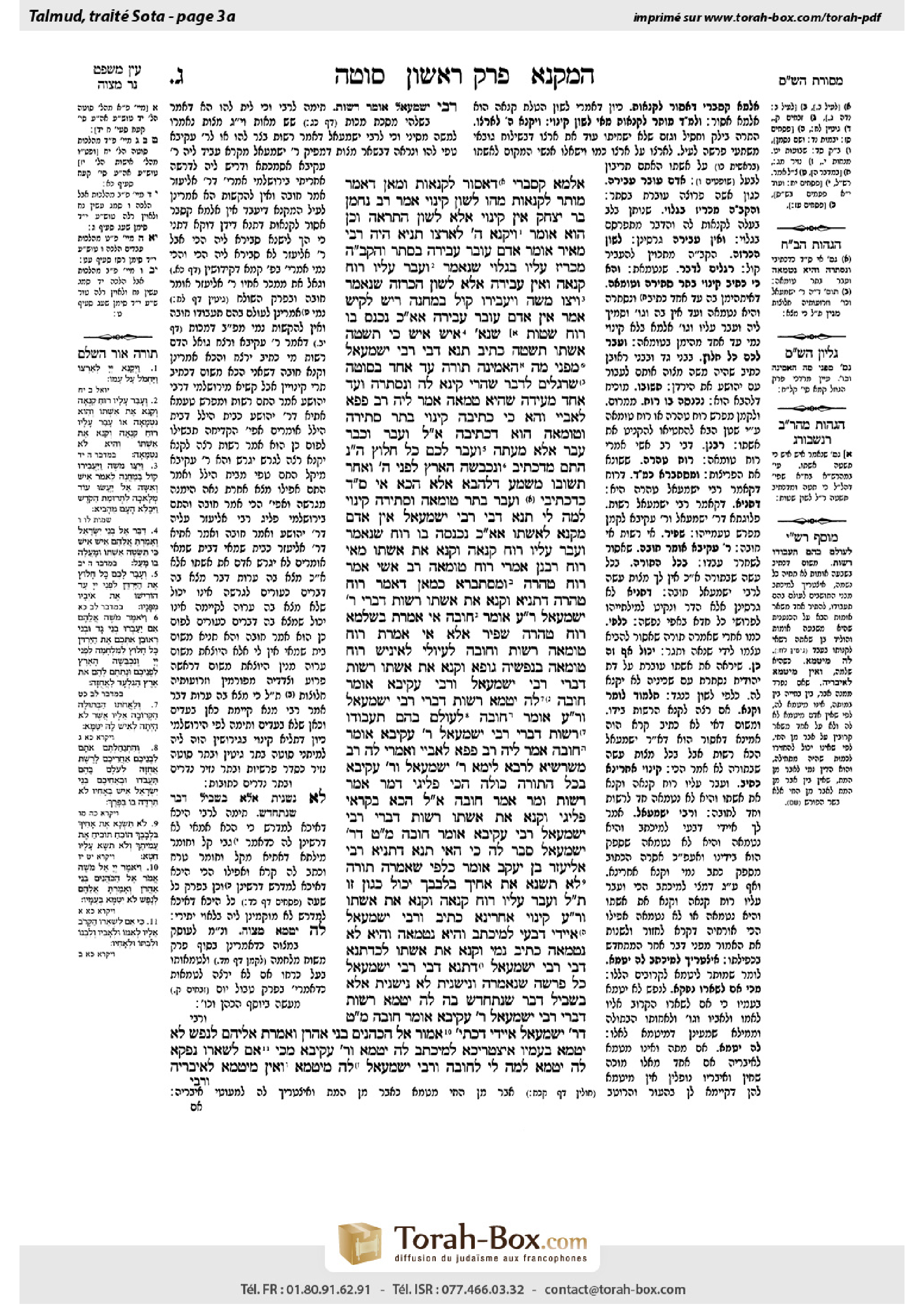
Sotah 3a: Talmud study for Daf Yomi
Daf Yomi is the daily study of one Talmud folio. Explore 37 tractates with scans, Hebrew text, Sefaria English and AI-generated French translations where annotated.
Passage selection and English or AI-generated French translation are available where the scan has annotations. Daf Study is independent of Torah-Box and Sefaria.
Browse Sotah · סוטה · All tractatesSotah 3a text and translations
This page of Sotah includes the Aramaic text, an English translation and an AI-generated French translation, alongside the scan above.
סוטה ג׳ א · Aramaic and Hebrew text
אַלְמָא קָסָבְרִי דְּאָסוּר לְקַנּאוֹת.
וּמַאן דְּאָמַר מוּתָּר לְקַנּאוֹת, מַהוּ לְשׁוֹן ״קִינּוּי״? אָמַר רַב נַחְמָן בַּר יִצְחָק: אֵין ״קִינּוּי״ אֶלָּא לְשׁוֹן הַתְרָאָה, וְכֵן הוּא אוֹמֵר: ״וַיְקַנֵּא ה׳ לְאַרְצוֹ״.
תַּנְיָא, הָיָה רַבִּי מֵאִיר אוֹמֵר: אָדָם עוֹבֵר עֲבֵירָה בַּסֵּתֶר וְהַקָּדוֹשׁ בָּרוּךְ הוּא מַכְרִיז עָלָיו בְּגָלוּי, שֶׁנֶּאֱמַר: ״וְעָבַר עָלָיו רוּחַ קִנְאָה״, וְאֵין עֲבֵירָה אֶלָּא לְשׁוֹן הַכְרָזָה, שֶׁנֶּאֱמַר: ״וַיְצַו מֹשֶׁה וַיַּעֲבִירוּ קוֹל בַּמַּחֲנֶה״.
רֵישׁ לָקִישׁ אָמַר: אֵין אָדָם עוֹבֵר עֲבֵירָה אֶלָּא אִם כֵּן נִכְנַס בּוֹ רוּחַ שְׁטוּת, שֶׁנֶּאֱמַר: ״אִישׁ אִישׁ כִּי תִשְׂטֶה אִשְׁתּוֹ״, ״תִּשְׁטֶה״ כְּתִיב.
תָּנָא דְּבֵי רַבִּי יִשְׁמָעֵאל: מִפְּנֵי מָה הֶאֱמִינָה תּוֹרָה עֵד אֶחָד בְּסוֹטָה — שֶׁרַגְלַיִם לַדָּבָר, שֶׁהֲרֵי קִינֵּא לָהּ, וְנִסְתְּרָה, וְעֵד אֶחָד מְעִידָהּ שֶׁהִיא טְמֵאָה.
אֲמַר לֵיהּ רַב פָּפָּא לְאַבָּיֵי: וְהָא כִּי כְּתִיבָה קִינּוּי, בָּתַר סְתִירָה וְטוּמְאָה הוּא דִּכְתִיבָה!
אֲמַר לֵיהּ: ״וְעָבַר״ — וּכְבָר עָבַר.
אֶלָּא מֵעַתָּה: ״וְעָבַר לָכֶם כׇּל חָלוּץ״, הָכִי נָמֵי?
הָתָם, מִדִּכְתִיב ״וְנִכְבְּשָׁה הָאָרֶץ לִפְנֵי ה׳ וְאַחַר תָּשֻׁבוּ״ — מַשְׁמַע דִּלְהַבָּא. אֶלָּא הָכָא, אִי סָלְקָא דַעְתָּךְ כְּדִכְתִיבִי, ״וְעָבַר״ בָּתַר טוּמְאָה וּסְתִירָה — קִינּוּי לְמָה לִי?
תָּנָא דְּבֵי רַבִּי יִשְׁמָעֵאל: אֵין אָדָם מְקַנֵּא לְאִשְׁתּוֹ אֶלָּא אִם כֵּן נִכְנְסָה בּוֹ רוּחַ, שֶׁנֶּאֱמַר: ״וְעָבַר עָלָיו רוּחַ קִנְאָה וְקִנֵּא אֶת אִשְׁתּוֹ״. מַאי רוּחַ?
רַבָּנַן אָמְרִי: רוּחַ טוּמְאָה. רַב אָשֵׁי אָמַר: רוּחַ טׇהֳרָה.
וּמִסְתַּבְּרָא כְּמַאן דְּאָמַר רוּחַ טׇהֳרָה. דְּתַנְיָא: ״וְקִנֵּא אֶת אִשְׁתּוֹ״ — רְשׁוּת, דִּבְרֵי רַבִּי יִשְׁמָעֵאל. רַבִּי עֲקִיבָא אוֹמֵר: חוֹבָה. אִי אָמְרַתְּ בִּשְׁלָמָא רוּחַ טׇהֳרָה — שַׁפִּיר, אֶלָּא אִי אָמְרַתְּ רוּחַ טוּמְאָה, רְשׁוּת וְחוֹבָה לְעַיּוֹלֵי לְאִינִישׁ רוּחַ טוּמְאָה בְּנַפְשֵׁיהּ?
גּוּפָא: ״וְקִנֵּא אֶת אִשְׁתּוֹ״ — רְשׁוּת, דִּבְרֵי רַבִּי יִשְׁמָעֵאל. וְרַבִּי עֲקִיבָא אוֹמֵר: חוֹבָה. ״לָהּ יִטַּמָּא״ — רְשׁוּת, דִּבְרֵי רַבִּי יִשְׁמָעֵאל. וְרַבִּי עֲקִיבָא אוֹמֵר: חוֹבָה.
״לְעֹלָם בָּהֶם תַּעֲבֹדוּ״ — רְשׁוּת, דִּבְרֵי רַבִּי יִשְׁמָעֵאל. רַבִּי עֲקִיבָא אוֹמֵר: חוֹבָה.
אֲמַר לֵיהּ רַב פָּפָּא לְאַבָּיֵי, וְאָמְרִי לַהּ רַב מְשַׁרְשְׁיָא לְרָבָא: לֵימָא רַבִּי יִשְׁמָעֵאל וְרַבִּי עֲקִיבָא בְּכׇל הַתּוֹרָה כּוּלָּהּ הָכִי פְּלִיגִי, דְּמָר אָמַר רְשׁוּת וּמָר אָמַר חוֹבָה? אֲמַר לֵיהּ: הָכָא בִּקְרָאֵי פְּלִיגִי.
״וְקִנֵּא אֶת אִשְׁתּוֹ״ — רְשׁוּת, דִּבְרֵי רַבִּי יִשְׁמָעֵאל. רַבִּי עֲקִיבָא אוֹמֵר: חוֹבָה.
מַאי טַעְמָא דְּרַבִּי יִשְׁמָעֵאל — סָבַר לַהּ כִּי הַאי תַּנָּא, דְּתַנְיָא, רַבִּי אֱלִיעֶזֶר בֶּן יַעֲקֹב אוֹמֵר: כְּלַפֵּי שֶׁאָמְרָה תּוֹרָה ״לֹא תִשְׂנָא אֶת אָחִיךָ בִּלְבָבֶךָ״, יָכוֹל כְּגוֹן זוֹ? תַּלְמוּד לוֹמַר: ״וְעָבַר עָלָיו רוּחַ קִנְאָה וְקִנֵּא אֶת אִשְׁתּוֹ״.
וְרַבִּי עֲקִיבָא: קִינּוּי אַחֲרִינָא כְּתִיב.
וְרַבִּי יִשְׁמָעֵאל? אַיְּידֵי דְּבָעֵי לְמִיכְתַּב ״וְהִיא נִטְמָאָה״ ״וְהִיא לֹא נִטְמָאָה״ — כְּתִיב נָמֵי ״וְקִנֵּא אֶת אִשְׁתּוֹ״.
לְכִדְתָנָא דְּבֵי רַבִּי יִשְׁמָעֵאל. דְּתָנָא דְּבֵי רַבִּי יִשְׁמָעֵאל: כָּל פָּרָשָׁה שֶׁנֶּאֶמְרָה וְנִישְׁנֵית — לֹא נִישְׁנֵית אֶלָּא בִּשְׁבִיל דָּבָר שֶׁנִּתְחַדֵּשׁ בָּהּ.
״לָהּ יִטַּמָּא״ — רְשׁוּת, דִּבְרֵי רַבִּי יִשְׁמָעֵאל. רַבִּי עֲקִיבָא אוֹמֵר: חוֹבָה.
מַאי טַעְמָא דְּרַבִּי יִשְׁמָעֵאל — אַיְּידֵי דִּכְתִיב: ״אֱמֹר אֶל הַכֹּהֲנִים בְּנֵי אַהֲרֹן וְאָמַרְתָּ אֲלֵיהֶם לְנֶפֶשׁ לֹא יִטַּמָּא בְּעַמָּיו״, אִיצְטְרִיכָא לְמִיכְתַּב ״לָהּ יִטַּמָּא״.
וְרַבִּי עֲקִיבָא מִ״כִּי אִם לִשְׁאֵרוֹ״ נָפְקָא, ״לָהּ יִטַּמָּא״ לְמָה לִי — לְחוֹבָה.
וְרַבִּי יִשְׁמָעֵאל: לָהּ מִיטַּמֵּא, וְאֵין מִיטַּמֵּא לְאֵיבָרֶיהָ.
Sotah 3a · English translation
Apparently, both Reish Lakish and Rav Yeimar bar Rabbi Shelemya hold that it is prohibited to issue a warning. Both are of the opinion that the word kinnui is a term for anger. Since causing anger is a negative trait, it follows that it is prohibited to issue a warning.
The Gemara asks: And according to the one who says that it is permitted for him to issue a warning, what is the meaning of the term kinnui? Rav Naḥman bar Yitzḥak says: The term kinnui means nothing other than a term of forewarning, and so it says: “Then the Lord warned [vayekanneh] concerning His land and had pity for His people” (Joel 2:18). As detailed in that passage, the Lord ordered the locusts to stop destroying Eretz Yisrael.
It is taught in a baraita that Rabbi Meir would say: A person commits a transgression in private and the Holy One, Blessed be He, proclaims about him openly, i.e., in public, that he transgressed, as it is stated concerning a sota, who transgressed in private: “The spirit of jealousy came [avar] upon him” (Numbers 5:14); and the term avira means nothing other than a term of proclamation, as it is stated: “And Moses gave the commandment, and they caused it to be proclaimed [vaya’aviru] throughout the camp” (Exodus 36:6).
Reish Lakish says: A man commits a transgression only if a spirit of folly [shetut] enters him, as it is stated: “If any man’s wife goes aside [tisteh]” (Numbers 5:12). The word tisteh is written with the Hebrew letter shin, affording an alternative reading of tishteh, which is related to the term for folly, the word shetut.
§ The Gemara discusses why the testimony of one witness suffices with regard to defilement. The school of Rabbi Yishmael taught a baraita: For what reason did the Torah deem credible a single witness with regard to the defilement of a sota? It is because there is a basis for anticipating the matter, as there is strong circumstantial evidence that she committed adultery. What is the basis for anticipating the matter? As he warned her not to seclude herself with a specific man, and she nevertheless secluded herself with him, and one witness testifies that she is defiled, then the combination of her behavior and the testimony renders it reasonable to assume that she has in fact committed adultery.
Rav Pappa said to Abaye: But when the warning is written in the Torah, it is written in the verse after seclusion and defilement are mentioned, indicating that the circumstance in which one witness is deemed credible with regard to defilement is even when there was no previous warning. The order in which the Torah describes the sota process seems to indicate that the husband’s warning is issued only after the wife already secluded herself with the other man and was defiled, as the verses state: “And a man lie with her carnally, and it was hidden from the eyes of her husband, and she was defiled secretly, and there is no witness against her, and she was not taken. And the spirit of jealousy came [ve’avar] upon him, and he warned his wife, and she had become defiled” (Numbers 5:13–14).
Abaye said to him in response: That which the verse states: “And the spirit of jealousy came [ve’avar] upon him,” means: And it had already come upon him, that the husband warned his wife not to seclude herself with a specific man prior to her seclusion and defilement.
The Gemara asks: If that is so, that “ve’avar” is referring to a matter that already occurred, then in the case of the agreement between Moses and the tribes of Gad and Reuben before they entered Eretz Yisrael, where he stated: “And every armed man of you will pass over [ve’avar] the Jordan” (Numbers 32:21), so too did he mean that they had already crossed? Moses was stipulating a condition with regard to the future; they had yet to cross the Jordan.
The Gemara answers: There, from the fact that it is written: “And the land be subdued before the Lord, and you return afterward” (Numbers 32:22), it is clear that it teaches concerning the future. But here, if it enters your mind that the verses should be understood as they are written in the Torah, that “ve’avar” (Numbers 5:14) is after the defilement and seclusion, then why do I need a warning? If the woman had already secluded herself with the man and become defiled, the husband’s warning would be irrelevant, as she had already become forbidden to him. Therefore, the word ve’avar in this context must be referring to a past event, i.e., the husband issuing a warning to his wife prior to the seclusion.
The school of Rabbi Yishmael taught: A man issues a warning to his wife only if a spirit entered him, as it is stated: “And the spirit of jealousy came upon him, and he warned his wife” (Numbers 5:14). The Gemara asks: Of what spirit does Rabbi Yishmael speak?
The Rabbis say: A spirit of impurity, as one should not issue a warning to one’s wife. Rav Ashi says: A spirit of purity, as issuing a warning indicates that he will not tolerate promiscuous behavior.
The Gemara comments: And it stands to reason like the one who says that Rabbi Yishmael was speaking of a spirit of purity, as it is taught in a baraita: “And he warned his wife,” i.e., the issuing of the warning, is optional, that the husband is neither enjoined to nor prohibited from issuing a warning; this is the statement of Rabbi Yishmael. Rabbi Akiva says: It is mandatory, as one who sees his wife behaving in an inappropriate manner with another man is obligated to warn her. The Gemara explains: Granted, if you say that Rabbi Yishmael was speaking of a spirit of purity, then it is well, as it may be optional, or even mandatory, to issue a warning. But if you say that he was speaking of a spirit of impurity, can it be optional or mandatory for a person to introduce a spirit of impurity into himself? The Torah would not require a husband to act in a manner that results from having a spirit of impurity enter him.
§ The Gemara discusses the matter itself. “And he warned his wife,” i.e., the warning, is optional; this is the statement of Rabbi Yishmael. And Rabbi Akiva says: It is mandatory. The Gemara notes that Rabbi Yishmael and Rabbi Akiva engage in a similar dispute with regard to several other verses. Although under normal circumstances it is prohibited for a priest to become ritually impure through contact with a corpse, the verse states that he may do so for the sake of burying his relatives. The baraita teaches: “For her may he become impure” (Leviticus 21:3), i.e., for a priest to participate in the burial of his sister, despite the fact that he will contract ritual impurity, is optional; this is the statement of Rabbi Yishmael. A priest is not obligated to participate, but he may. And Rabbi Akiva says: It is mandatory for him to do so.
The verse states: “Of them may you take your bondmen forever” (Leviticus 25:46), i.e., keeping one’s Canaanite slave forever, is optional, this is the statement of Rabbi Yishmael. One is not enjoined against emancipating a Canaanite slave, but one is permitted to keep his Canaanite slaves forever. Rabbi Akiva says: It is mandatory, and it is prohibited for one to free his Canaanite slave.
Rav Pappa said to Abaye, and some say that Rav Mesharshiyya said to Rava: Shall we say that Rabbi Yishmael and Rabbi Akiva disagree in this manner with regard to the entire Torah? In other words, is it so that whenever there is a statement where it is unclear whether it is referring to an optional or mandatory act, that one master, Rabbi Yishmael, says that it is optional, and the other master, Rabbi Akiva, says that it is mandatory. Abaye said to Rav Pappa in response: Here, in these particular cases, they disagree with regard to the meaning of these specific verses, but it is not a general dispute.
The Gemara explains their dispute in these specific contexts, beginning with the dispute concerning a man’s warning to his wife: “And he warned his wife,” the warning is optional; this is the statement of Rabbi Yishmael. Rabbi Akiva says: It is mandatory.
What is the reason of Rabbi Yishmael? He holds in accordance with the statement of this tanna, as it is taught in a baraita: Rabbi Eliezer ben Ya’akov says: With regard to that which the Torah said: “You shall not hate your brother in your heart” (Leviticus 19:17), one might have thought that this prohibition applies in a case such as this one, when one sees his wife behaving improperly with another man, and the verse would instruct the husband to avoid conflict and strife. Therefore, the verse states: “And the spirit of jealousy came upon him, and he warned his wife” (Numbers 5:14), teaching that it is permitted for one to issue a warning to his wife in such a case.
The Gemara asks: And how does Rabbi Akiva derive that it is mandatory? The Gemara answers: There is another warning written in the same verse, as the entire verse reads: “And the spirit of jealousy came upon him, and he warned his wife, and she be defiled; or if the spirit of jealousy came upon him, and he warned his wife, and she be not defiled.” Therefore, the first half of the verse teaches that it is permitted to issue a warning, and the second half teaches that it is in fact mandatory.
The Gemara asks: And how does Rabbi Yishmael explain the repetition? The Gemara answers: Since it needed to write in this verse both possibilities as to whether the woman was unfaithful: “And she be defiled,” and also: “And she be not defiled,” to teach that although it is uncertain whether she had become defiled, she is still forbidden to her husband, therefore, it is also written: “And he warned his wife,” a second time. This repetition should not be interpreted as rendering the issuance of the warning as mandatory.
This manner of interpreting verses is as taught by the school of Rabbi Yishmael, as the school of Rabbi Yishmael taught: Every passage in the Torah that was stated and repeated was repeated only for the novel element introduced therein. Although the Torah could have merely mentioned the element necessary to teach an additional halakha, one should not interpret the repetition of a previously mentioned matter as teaching a second additional halakha, as the style of the Torah is to repeat a passage even to teach only one additional halakha. In the case of the passage concerning a sota as well, the repetition of the warning does not teach a new halakha.
The Gemara discusses the second dispute between Rabbi Yishmael and Rabbi Akiva. The baraita teaches: “And for his sister a virgin, that is near to him, that has had no husband, for her may he become impure” (Leviticus 21:3), i.e., for a priest to participate in the burial of his sister despite the fact that he will contract ritual impurity is optional; this is the statement of Rabbi Yishmael. A priest is not obligated to participate, but he may do so. Rabbi Akiva says: It is mandatory for him to do so.
What is the reason of Rabbi Yishmael? Since it is written: “Speak to the priests, the sons of Aaron, and say to them: There shall none become impure for the dead among his people” (Leviticus 21:1), indicating that a priest is enjoined from contact with the dead, it was necessary to be written: “For her may he become impure,” which teaches that a priest may become impure at the burial of a relative.
The Gemara asks: And how does Rabbi Akiva derive that it is mandatory? The Gemara answers: He derives that it is permissible from the previous verse, which states: “Except for his kin, that is near to him” (Leviticus 21:2). Since it is derived that it is permitted from that verse, why do I need the additional verse: “For her may he become impure”? To teach that it is mandatory.
The Gemara asks: And how does Rabbi Yishmael explain the repetition? The Gemara answers: He explains that the verse teaches that he may become impure for her, but he may not become impure to bury only one of her limbs. This additional verse teaches that a priest may become ritually impure to bury a relative only in the case of burying a complete body.
Sotah 3a · Traduction française (IA)
Il semble donc que Reish Lakish et Rav Yeimar bar Rabbi Shelemya tiennent tous deux qu’il est interdit d’adresser un avertissement. Tous deux estiment que le terme kinnui désigne la colère. Puisque provoquer la colère est un trait négatif, il s’ensuit qu’il est interdit d’adresser un avertissement.
La Guemara demande : Et selon celui qui dit qu’il est permis d’adresser un avertissement, que signifie le terme kinnui ? Rav Naḥman bar Yitzḥak dit : Le terme kinnui désigne uniquement une mise en garde préalable, comme il est dit : « Alors le Seigneur se soucia de son pays [vayekanneh] et eut pitié de son peuple » (Joël 2:18). Comme le précise ce passage, le Seigneur ordonna aux sauterelles de cesser de dévaster Eretz Yisrael.
Il est enseigné dans une baraïta que Rabbi Meir disait : Un homme commet une transgression en secret, et le Saint, béni soit-Il, proclame publiquement, c’est-à-dire au vu de tous, qu’il a transgressé. En effet, il est dit au sujet d’une sota, qui a transgressé en secret : « L’esprit de jalousie vint [avar] sur lui » (Nombres 5:14) ; et le terme avira désigne uniquement une proclamation, comme il est dit : « Moïse donna cet ordre, et on le fit proclamer [vaya’aviru] dans tout le camp » (Exode 36:6).
Reish Lakish dit : Un homme ne commet une transgression que si un esprit de folie [shetut] entre en lui, comme il est dit : « Si la femme d’un homme s’écarte [tisteh] » (Nombres 5:12). Le mot tisteh s’écrit avec la lettre hébraïque shin, ce qui permet de le lire autrement, tishteh, terme apparenté au mot désignant la folie, shetut.
§ La Guemara examine pourquoi le témoignage d’un seul témoin suffit concernant la souillure. L’école de Rabbi Yishmael enseigna dans une baraïta : Pour quelle raison la Torah a-t-elle jugé crédible un seul témoin concernant la souillure d’une sota ? Parce qu’il existe des raisons de le présumer, puisqu’il y a de forts indices circonstanciels qu’elle a commis un adultère. Quelles sont ces raisons ? Son mari lui a interdit de s’isoler avec un homme en particulier, elle s’est néanmoins isolée avec lui, et un témoin atteste qu’elle est souillée. La combinaison de son comportement et du témoignage rend alors raisonnable de présumer qu’elle a effectivement commis un adultère.
Rav Pappa dit à Abaye : Mais, lorsque l’avertissement est mentionné dans la Torah, il apparaît dans le verset qui suit ceux où sont évoqués l’isolement et la souillure, ce qui indique qu’un seul témoin est jugé crédible concernant la souillure même en l’absence d’un avertissement préalable. L’ordre dans lequel la Torah décrit le processus de la sota semble indiquer que le mari ne donne son avertissement qu’après que sa femme s’est déjà isolée avec l’autre homme et a été souillée, car les versets disent : « Un homme coucha charnellement avec elle, cela fut caché aux yeux de son mari, elle fut souillée en secret, sans qu’il y ait de témoin contre elle et sans qu’elle ait été prise. L’esprit de jalousie vint [ve’avar] sur lui, il avertit sa femme, et elle était devenue souillée » (Nombres 5:13–14).
Abaye lui répondit : Ce que dit le verset : « L’esprit de jalousie vint [ve’avar] sur lui » signifie qu’il était déjà venu sur lui : le mari avait averti sa femme de ne pas s’isoler avec un homme en particulier, avant qu’elle ne s’isole et ne soit souillée.
La Guemara demande : S’il en est ainsi, si « ve’avar » désigne un événement déjà survenu, alors, dans le cas de l’accord conclu entre Moïse et les tribus de Gad et de Reuben avant leur entrée en Eretz Yisrael, lorsqu’il dit : « Et chacun de vos hommes en armes passera [ve’avar] le Jourdain » (Nombres 32:21), voulait-il également dire qu’ils avaient déjà traversé ? Moïse posait une condition concernant l’avenir ; ils n’avaient pas encore traversé le Jourdain.
La Guemara répond : Là, le fait qu’il soit écrit : « Le pays sera soumis devant le Seigneur, puis vous reviendrez » (Nombres 32:22) montre clairement que le verset parle de l’avenir. Mais ici, si tu pensais que les versets doivent être compris tels qu’ils sont écrits dans la Torah, et que « ve’avar » (Nombres 5:14) survient après la souillure et l’isolement, pourquoi faudrait-il un avertissement ? Si la femme s’était déjà isolée avec l’homme et avait été souillée, l’avertissement du mari serait sans objet, puisqu’elle lui serait déjà interdite. Par conséquent, dans ce contexte, le mot ve’avar désigne un événement passé, c’est-à-dire le fait que le mari ait averti sa femme avant son isolement.
L’école de Rabbi Yishmael enseigna : Un homme n’adresse un avertissement à sa femme que si un esprit est entré en lui, comme il est dit : « L’esprit de jalousie vint sur lui, et il avertit sa femme » (Nombres 5:14). La Guemara demande : De quel esprit Rabbi Yishmael parle-t-il ?
Les Sages disent : Un esprit d’impureté, car on ne devrait pas adresser d’avertissement à sa femme. Rav Ashi dit : Un esprit de pureté, car adresser un avertissement indique que l’homme ne tolérera pas les comportements licencieux.
La Guemara fait remarquer qu’il est logique de retenir l’avis selon lequel Rabbi Yishmael parlait d’un esprit de pureté, comme il est enseigné dans une baraïta : « Et il avertit sa femme », c’est-à-dire que l’avertissement est facultatif ; le mari n’est ni tenu ni empêché de l’adresser. Telle est la déclaration de Rabbi Yishmael. Rabbi Akiva dit : Il est obligatoire, car celui qui voit sa femme se comporter de manière inconvenante avec un autre homme est tenu de l’avertir. La Guemara explique : Il est logique, si tu dis que Rabbi Yishmael parlait d’un esprit de pureté, que l’avertissement puisse être facultatif, voire obligatoire. Mais si tu dis qu’il parlait d’un esprit d’impureté, une personne peut-elle choisir ou être tenue de faire entrer en elle un esprit d’impureté ? La Torah ne demanderait pas à un mari d’agir d’une manière qui résulte de l’entrée en lui d’un esprit d’impureté.
§ La Guemara examine le sujet lui-même. « Et il avertit sa femme », c’est-à-dire que l’avertissement est facultatif : telle est la déclaration de Rabbi Yishmael. Rabbi Akiva dit : Il est obligatoire. La Guemara relève que Rabbi Yishmael et Rabbi Akiva ont un débat semblable au sujet de plusieurs autres versets. Bien qu’en temps normal il soit interdit à un prêtre de contracter une impureté rituelle par contact avec un mort, le verset indique qu’il peut le faire pour enterrer ses proches. La baraïta enseigne : « Pour elle, il pourra se rendre impur » (Lévitique 21:3), c’est-à-dire que le prêtre peut choisir de participer à l’enterrement de sa sœur, bien qu’il contracte ainsi une impureté rituelle ; telle est la déclaration de Rabbi Yishmael. Le prêtre n’est pas tenu d’y participer, mais il le peut. Rabbi Akiva dit : Il est tenu de le faire.
Le verset dit : « Vous pourrez les garder comme esclaves pour toujours » (Lévitique 25:46), c’est-à-dire qu’il est facultatif de garder son esclave cananéen à perpétuité ; telle est la déclaration de Rabbi Yishmael. Il n’est pas interdit d’affranchir un esclave cananéen, mais il est permis de garder ses esclaves cananéens pour toujours. Rabbi Akiva dit : C’est obligatoire, et il est interdit d’affranchir son esclave cananéen.
Rav Pappa dit à Abaye — et certains disent que Rav Mesharshiyya dit à Rava : Faut-il donc dire que Rabbi Yishmael et Rabbi Akiva sont en désaccord de cette manière au sujet de toute la Torah ? Autrement dit, chaque fois qu’une déclaration ne permet pas de savoir clairement si elle porte sur un acte facultatif ou obligatoire, l’un des maîtres, Rabbi Yishmael, dit que l’acte est facultatif, et l’autre maître, Rabbi Akiva, dit qu’il est obligatoire ? Abaye répondit à Rav Pappa : Dans ces cas précis, leur désaccord porte sur le sens de ces versets particuliers ; il ne s’agit pas d’un désaccord général.
La Guemara explique leur désaccord dans ces contextes précis, en commençant par celui de l’avertissement adressé par un homme à sa femme : « Et il avertit sa femme » ; l’avertissement est facultatif. Telle est la déclaration de Rabbi Yishmael. Rabbi Akiva dit : Il est obligatoire.
Quelle est la raison de Rabbi Yishmael ? Il suit l’avis de ce tanna, comme il est enseigné dans une baraïta : Rabbi Eliezer ben Ya’akov dit : Au sujet de ce que la Torah a dit : « Tu ne haïras pas ton frère dans ton cœur » (Lévitique 19:17), on aurait pu penser que cette interdiction s’applique dans un cas comme celui-ci, où l’on voit sa femme se comporter de manière inconvenante avec un autre homme, et que le verset ordonne au mari d’éviter les conflits et les querelles. C’est pourquoi le verset dit : « L’esprit de jalousie vint sur lui, et il avertit sa femme » (Nombres 5:14), enseignant qu’il est permis d’adresser un avertissement à sa femme dans un tel cas.
La Guemara demande : Et comment Rabbi Akiva déduit-il que c’est obligatoire ? La Guemara répond : Le même verset contient un autre avertissement, car il dit dans son intégralité : « L’esprit de jalousie vint sur lui, il avertit sa femme, et elle est souillée ; ou bien l’esprit de jalousie vint sur lui, il avertit sa femme, et elle n’est pas souillée. » La première moitié du verset enseigne donc qu’il est permis d’adresser un avertissement, et la seconde moitié qu’il est en fait obligatoire.
La Guemara demande : Et comment Rabbi Yishmael explique-t-il la répétition ? La Guemara répond : Il fallait mentionner dans ce verset les deux possibilités concernant l’infidélité de la femme, « et elle est souillée » ainsi que « et elle n’est pas souillée », afin d’enseigner que, même s’il est incertain qu’elle ait été souillée, elle reste interdite à son mari. C’est pourquoi le verset répète également « et il avertit sa femme ». Cette répétition ne doit pas être interprétée comme rendant obligatoire l’avertissement.
Cette manière d’interpréter les versets correspond à l’enseignement de l’école de Rabbi Yishmael, qui enseigna : Tout passage de la Torah qui a été énoncé puis répété ne l’a été que pour l’élément nouveau qu’il introduit. Même si la Torah aurait pu ne mentionner que l’élément nécessaire à l’enseignement d’une halakha supplémentaire, il ne faut pas interpréter la répétition d’un sujet déjà mentionné comme l’enseignement d’une deuxième halakha supplémentaire, car la Torah a pour habitude de répéter un passage même lorsque cela ne sert qu’à enseigner une seule halakha supplémentaire. Dans le cas du passage concernant une sota également, la répétition de l’avertissement n’enseigne pas de nouvelle halakha.
La Guemara examine le deuxième désaccord entre Rabbi Yishmael et Rabbi Akiva. La baraïta enseigne : « Pour sa sœur vierge, qui lui est proche et n’a pas eu de mari, pour elle il pourra se rendre impur » (Lévitique 21:3), c’est-à-dire qu’il est facultatif pour un prêtre de participer à l’enterrement de sa sœur, bien qu’il contracte ainsi une impureté rituelle ; telle est la déclaration de Rabbi Yishmael. Le prêtre n’est pas tenu d’y participer, mais il le peut. Rabbi Akiva dit : Il est tenu de le faire.
Quelle est la raison de Rabbi Yishmael ? Puisqu’il est écrit : « Parle aux prêtres, fils d’Aaron, et dis-leur : Aucun d’eux ne se rendra impur pour un mort parmi son peuple » (Lévitique 21:1), ce qui indique qu’un prêtre doit s’abstenir de tout contact avec les morts, il fallait écrire : « Pour elle, il pourra se rendre impur », enseignant qu’un prêtre peut se rendre impur lors de l’enterrement d’un proche.
La Guemara demande : Et comment Rabbi Akiva déduit-il que c’est obligatoire ? La Guemara répond : Il déduit que cela est permis du verset précédent, qui dit : « Sauf pour son proche parent, qui lui est proche » (Lévitique 21:2). Puisqu’il ressort de ce verset que cela est permis, pourquoi faut-il le verset supplémentaire : « Pour elle, il pourra se rendre impur » ? Pour enseigner que c’est obligatoire.
La Guemara demande : Et comment Rabbi Yishmael explique-t-il la répétition ? La Guemara répond : Il explique que le verset enseigne qu’il peut se rendre impur pour elle, mais qu’il ne peut pas se rendre impur pour n’enterrer qu’un seul de ses membres. Ce verset supplémentaire enseigne qu’un prêtre ne peut contracter une impureté rituelle pour enterrer un proche que lorsqu’il s’agit d’enterrer un corps entier.
Traduction française générée par IA à partir de l’édition anglaise de Sefaria. Vérifie toujours un passage avec le texte source.
Text from Sefaria: William Davidson Edition - Vocalized Aramaic (CC BY NC); William Davidson Edition - English (CC BY NC).