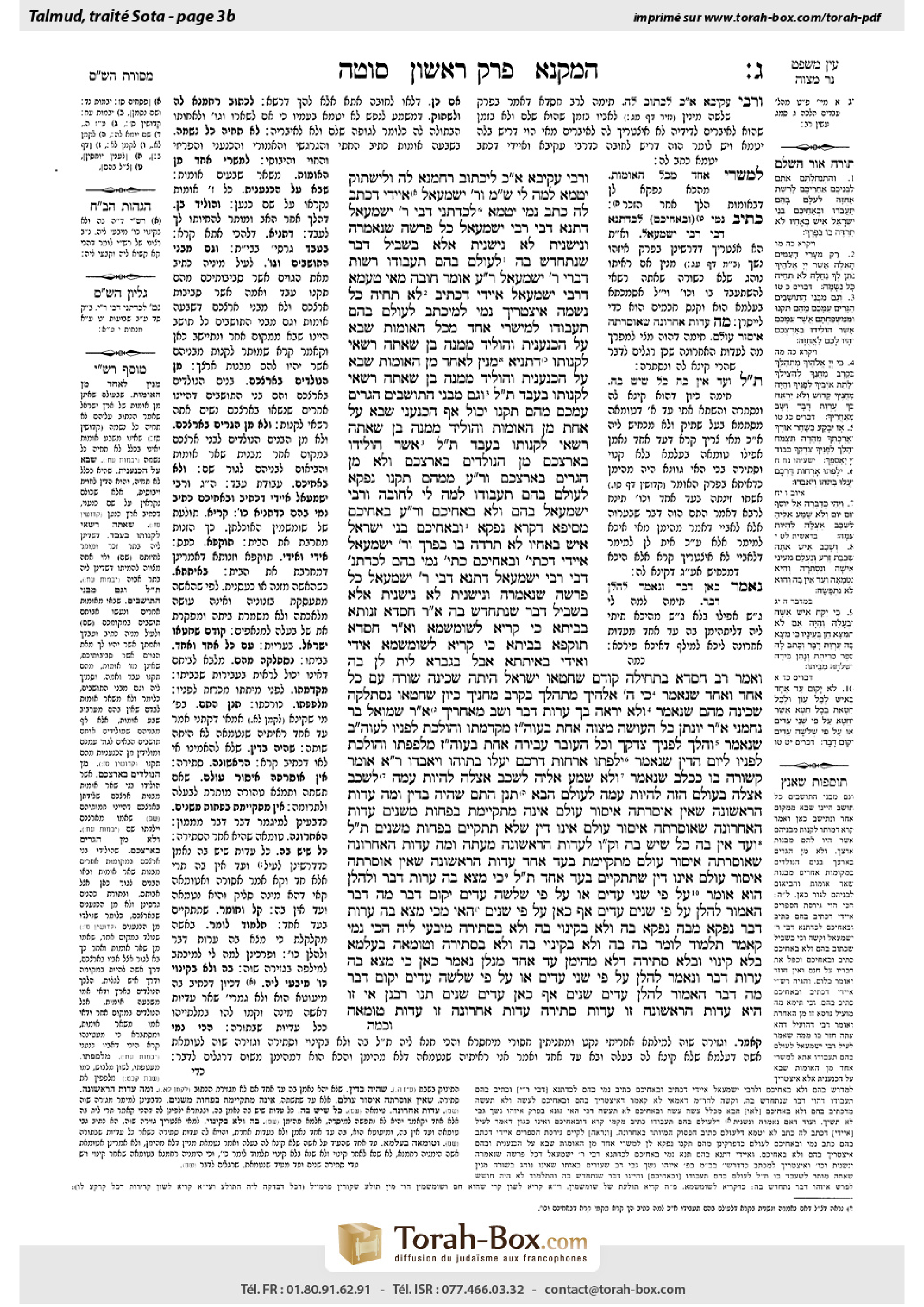
Sotah 3b: Talmud study for Daf Yomi
Daf Yomi is the daily study of one Talmud folio. Explore 37 tractates with scans, Hebrew text, Sefaria English and AI-generated French translations where annotated.
Passage selection and English or AI-generated French translation are available where the scan has annotations. Daf Study is independent of Torah-Box and Sefaria.
Browse Sotah · סוטה · All tractatesSotah 3b text and translations
This page of Sotah includes the Aramaic text, an English translation and an AI-generated French translation, alongside the scan above.
סוטה ג׳ ב · Aramaic and Hebrew text
וְרַבִּי עֲקִיבָא — אִם כֵּן, לִיכְתּוֹב רַחֲמָנָא ״לָהּ״ וְלִישְׁתּוֹק, ״יִטַּמָּא״ לְמָה לִי? שְׁמַע מִינַּהּ.
וְרַבִּי יִשְׁמָעֵאל, אַיְּידֵי דִּכְתַב ״לָהּ״, כְּתַב נָמֵי ״יִטַּמָּא״. לְכִדְתָנֵי דְּבֵי רַבִּי יִשְׁמָעֵאל. דְּתָנָא דְּבֵי רַבִּי יִשְׁמָעֵאל: כָּל פָּרָשָׁה שֶׁנֶּאֶמְרָה וְנִישְׁנֵית, לֹא נִישְׁנֵית אֶלָּא בִּשְׁבִיל דָּבָר שֶׁנִּתְחַדֵּשׁ בָּהּ.
״לְעֹלָם בָּהֶם תַּעֲבֹדוּ״ — רְשׁוּת, דִּבְרֵי רַבִּי יִשְׁמָעֵאל. רַבִּי עֲקִיבָא אוֹמֵר: חוֹבָה.
מַאי טַעְמָא דְּרַבִּי יִשְׁמָעֵאל — אַיְּידֵי דִּכְתִיב ״לֹא תְחַיֶּה כׇּל נְשָׁמָה״, אִיצְטְרִיךְ נָמֵי לְמִיכְתַּב ״לְעֹלָם בָּהֶם תַּעֲבֹדוּ״, לְמִישְׁרֵי אֶחָד מִכׇּל הָאוּמּוֹת שֶׁבָּא עַל הַכְּנַעֲנִית וְהוֹלִיד מִמֶּנָּה בֵּן, שֶׁאַתָּה רַשַּׁאי לִקְנוֹתוֹ.
דְּתַנְיָא: מִנַּיִן לְאֶחָד מִן הָאוּמּוֹת שֶׁבָּא עַל הַכְּנַעֲנִית וְהוֹלִיד מִמֶּנָּה בֵּן, שֶׁאַתָּה רַשַּׁאי לִקְנוֹתוֹ בְּעֶבֶד, תַּלְמוּד לוֹמַר: ״וְגַם מִבְּנֵי הַתּוֹשָׁבִים הַגָּרִים עִמָּכֶם מֵהֶם תִּקְנוּ״.
יָכוֹל אַף הַכְּנַעֲנִי שֶׁבָּא עַל אַחַת מִן הָאוּמּוֹת וְהוֹלִיד מִמֶּנָּה בֵּן, שֶׁאַתָּה רַשַּׁאי לִקְנוֹתוֹ בְּעֶבֶד, תַּלְמוּד לוֹמַר: ״אֲשֶׁר הוֹלִידוּ בְּאַרְצְכֶם״, מִן הַנּוֹלָדִים בְּאַרְצְכֶם, וְלֹא מִן הַגָּרִים בְּאַרְצְכֶם.
וְרַבִּי עֲקִיבָא מִ״מֵּהֶם תִּקְנוּ״ נָפְקָא, ״לְעֹלָם בָּהֶם תַּעֲבֹדוּ״ לְמָה לִי — לְחוֹבָה.
וְרַבִּי יִשְׁמָעֵאל: ״בָּהֶם״ — וְלֹא בְּאַחֵיכֶם.
וְרַבִּי עֲקִיבָא: בְּאַחֵיכֶם — מִסֵּיפָא דִּקְרָא נָפְקָא: ״וּבְאַחֵיכֶם בְּנֵי יִשְׂרָאֵל אִישׁ בְּאָחִיו לֹא תִרְדֶּה בוֹ בְּפָרֶךְ״.
וְרַבִּי יִשְׁמָעֵאל: אַיְּידֵי דִּכְתִיב ״וּבְאַחֵיכֶם״, כְּתִיב נָמֵי ״בָּהֶם״. לְכִדְתָנֵי דְּבֵי רַבִּי יִשְׁמָעֵאל. דְּתָנָא דְּבֵי רַבִּי יִשְׁמָעֵאל: כָּל פָּרָשָׁה שֶׁנֶּאֶמְרָה וְנִישְׁנֵית, לֹא נִישְׁנֵית אֶלָּא בִּשְׁבִיל דָּבָר שֶׁנִּתְחַדֵּשׁ בָּהּ.
אָמַר רַב חִסְדָּא: זְנוּתָא בְּבֵיתָא כִּי קַרְיָא לְשׁוּמְשְׁמָא. וְאָמַר רַב חִסְדָּא: תּוּקְפָּא בְּבֵיתָא כִּי קַרְיָא לְשׁוּמְשְׁמָא. אִידֵּי וְאִידֵּי בְּאִיתְּתָא, אֲבָל בְּגַבְרָא לֵית לַן בַּהּ.
וְאָמַר רַב חִסְדָּא: בַּתְּחִילָּה, קוֹדֶם שֶׁחָטְאוּ יִשְׂרָאֵל, הָיְתָה שְׁכִינָה שׁוֹרָה עִם כׇּל אֶחָד וְאֶחָד, שֶׁנֶּאֱמַר: ״כִּי ה׳ אֱלֹהֶיךָ מִתְהַלֵּךְ בְּקֶרֶב מַחֲנֶךָ״. כֵּיוָן שֶׁחָטְאוּ נִסְתַּלְּקָה שְׁכִינָה מֵהֶם, שֶׁנֶּאֱמַר: ״וְלֹא יִרְאֶה בְךָ עֶרְוַת דָּבָר וְשָׁב מֵאַחֲרֶיךָ״.
אָמַר רַבִּי שְׁמוּאֵל בַּר נַחְמָנִי אָמַר רַבִּי יוֹנָתָן: כׇּל הָעוֹשֶׂה מִצְוָה אַחַת בָּעוֹלָם הַזֶּה — מְקַדַּמְתּוֹ וְהוֹלֶכֶת לְפָנָיו לָעוֹלָם הַבָּא, שֶׁנֶּאֱמַר: ״וְהָלַךְ לְפָנֶיךָ צִדְקֶךָ״. וְכׇל הָעוֹבֵר עֲבֵירָה אַחַת בָּעוֹלָם הַזֶּה — מְלַפַּפְתּוֹ וְהוֹלֶכֶת לְפָנָיו לְיוֹם הַדִּין, שֶׁנֶּאֱמַר: ״יִלָּפְתוּ אׇרְחוֹת דַּרְכָּם יַעֲלוּ בַתֹּהוּ וְיֹאבֵדוּ״.
רַבִּי אֶלְעָזָר אוֹמֵר: קְשׁוּרָה בּוֹ כְּכֶלֶב, שֶׁנֶּאֱמַר: ״וְלֹא שָׁמַע אֵלֶיהָ לִשְׁכַּב אֶצְלָהּ לִהְיוֹת עִמָּהּ״. ״לִשְׁכַּב אֶצְלָהּ״ — בָּעוֹלָם הַזֶּה, ״לִהְיוֹת עִמָּהּ״ — לָעוֹלָם הַבָּא.
תְּנַן הָתָם, שֶׁהָיָה בַּדִּין:
וּמָה עֵדוּת הָרִאשׁוֹנָה, שֶׁאֵין אוֹסַרְתָּהּ אִיסּוּר עוֹלָם — אֵינָהּ מִתְקַיֶּימֶת בְּפָחוֹת מִשְּׁנַיִם, עֵדוּת הָאַחֲרוֹנָה, שֶׁאוֹסַרְתָּהּ אִיסּוּר עוֹלָם — אֵינוֹ דִּין שֶׁלֹּא תִּתְקַיֵּים בְּפָחוֹת מִשְּׁנַיִם?
תַּלְמוּד לוֹמַר: ״וְעֵד אֵין בָּהּ״, כֹּל שֶׁיֵּשׁ בָּהּ.
וְקַל וָחוֹמֶר לְעֵדוּת הָרִאשׁוֹנָה מֵעַתָּה: וּמָה עֵדוּת הָאַחֲרוֹנָה, שֶׁאוֹסַרְתָּהּ אִיסּוּר עוֹלָם — מִתְקַיֶּימֶת בְּעֵד אֶחָד, עֵדוּת הָרִאשׁוֹנָה, שֶׁאֵין אוֹסַרְתָּהּ אִיסּוּר עוֹלָם — אֵינוֹ דִּין שֶׁתִּתְקַיֵּים בְּעֵד אֶחָד?
תַּלְמוּד לוֹמַר: ״כִּי מָצָא בָהּ עֶרְוַת דָּבָר״, וּלְהַלָּן הוּא אוֹמֵר ״עַל פִּי שְׁנֵי עֵדִים אוֹ עַל פִּי שְׁלֹשָׁה עֵדִים יָקוּם דָּבָר״. מָה ״דָּבָר״ הָאָמוּר לְהַלָּן — עַל פִּי שְׁנַיִם עֵדִים, אַף כָּאן — עַל פִּי שְׁנַיִם.
הַאי מִ״כִּי מָצָא בָהּ עֶרְוַת דָּבָר״ נָפְקָא? מִ״בָּהּ״ נָפְקָא: בָּהּ — וְלֹא בְּקִינּוּי, בָּהּ — וְלֹא בִּסְתִירָה מִיבְּעֵי לֵיהּ!
הָכִי נָמֵי קָאָמַר: תַּלְמוּד לוֹמַר ״בָּהּ״: בָּהּ — וְלֹא בְּקִינּוּי, בָּהּ — וְלֹא בִּסְתִירָה.
וְטוּמְאָה בְּעָלְמָא בְּלֹא קִינּוּי וּבְלֹא סְתִירָה, דְּלָא מְהֵימַן עֵד אֶחָד, מְנָלַן? נֶאֱמַר כָּאן: ״כִּי מָצָא בָהּ עֶרְוַת דָּבָר״, וְנֶאֱמַר לְהַלָּן: ״עַל פִּי שְׁנֵי עֵדִים אוֹ עַל פִּי שְׁלֹשָׁה עֵדִים יָקוּם דָּבָר״. מָה ״דָּבָר״ הָאָמוּר לְהַלָּן — עֵדִים שְׁנַיִם, אַף כָּאן — עֵדִים שְׁנַיִם.
תָּנוּ רַבָּנַן: אֵי זוֹ הִיא עֵדוּת הָרִאשׁוֹנָה — זוֹ עֵדוּת סְתִירָה, עֵדוּת אַחֲרוֹנָה — זוֹ עֵדוּת טוּמְאָה.
Sotah 3b · English translation
And what does Rabbi Akiva respond to this claim? The Gemara answers: If so, that the verse serves to render it prohibited for a priest to become impure to bury a limb, then let the Merciful One write: “And for his sister a virgin, that is near to him, that has had no husband, for her,” and then be silent. Why do I need the verse to write: “May he become impure”? Learn from the additional phrase that making himself impure is mandatory.
And how does Rabbi Yishmael explain the additional phrase? Since the verse wrote: “For her,” it also wrote: “May he become impure,” for the same reason as was taught by the school of Rabbi Yishmael. As the school of Rabbi Yishmael taught: Every passage in the Torah that was stated and repeated, was repeated only for the novel element introduced therein. Therefore, it is possible that the verse serves to teach the halakha that a priest may not become impure in order to bury a limb, and that would account for the repetition of the phrase “may he become impure” as well.
The Gemara discusses the third dispute between Rabbi Yishmael and Rabbi Akiva. The verse states: “Of them may you take your bondmen forever” (Leviticus 25:46), i.e., the halakha that one keeps his Canaanite slave forever, is optional; this is the statement of Rabbi Yishmael. One is not enjoined against emancipating a Canaanite slave, but one is permitted to keep a Canaanite slave forever. Rabbi Akiva says: It is mandatory, and one is prohibited from freeing his Canaanite slave.
What is the reason of Rabbi Yishmael? Since it is written with regard to Canaanites: “You shall save alive nothing that breathes” (Deuteronomy 20:16), it was necessary to write: “Of them may you take your bondmen forever” (Leviticus 25:46), as well, in order to permit one from any of the other, non-Canaanite nations who engaged in sexual intercourse with a Canaanite woman and she bore him a child. This verse teaches that you are permitted to purchase the child as a slave, as he is not included in the mitzva “You shall save alive nothing that breathes” that was stated with regard to full-fledged Canaanites. Therefore, this verse cannot be teaching that it is mandatory.
This is as it is taught in a baraita: From where is it derived that in the case of one from any of the other, non-Canaanite nations who engaged in sexual intercourse with a Canaanite woman, and she bore him a child, that you are permitted to purchase the child as a slave? The verse states: “Moreover, of the children of the strangers that do sojourn among you, of them may you buy” (Leviticus 25:45). This verse permits the purchase of slaves from among those individuals who are not members of the Canaanite nations, even if they settle in Eretz Yisrael.
The baraita continues: One might have thought that even in the case of a Canaanite man who engaged in sexual intercourse with a woman from one of the other nations and she bore him a child, that you are permitted to purchase the child as a slave, despite the fact that his father is a Canaanite. Therefore, the same verse states: “Which they have given birth to in your land,” teaching that one is permitted to purchase slaves only from the ones who are born in your land but whose paternal origins are from other lands, but not from the ones who already reside in your land, i.e., ones who have a Canaanite father.
The Gemara asks: And how does Rabbi Akiva derive this halakha? The Gemara answers: He derives it from the words in the same verse: “Of them may you buy.” Once the halakha is already taught that one may purchase as a slave the child of a Canaanite woman and a man from another nation, why do I need the verse to state: “Of them may you take your bondmen forever” (Leviticus 25:46)? It is stated to teach that it is mandatory to enslave a Canaanite slave forever.
The Gemara asks: And what does Rabbi Yishmael derive from this verse? The Gemara answers: “Of them may you take your bondmen forever,” teaches that you can enslave “of them,” but not of your brethren, i.e., it is prohibited to enslave a fellow Jew, even a slave, forever.
The Gemara asks: And how does Rabbi Akiva derive this halakha? The Gemara answers: The prohibition against enslaving your brethren is derived from the latter phrase of the verse, where it is explicitly stated: “But over your brethren the children of Israel you shall not rule, one over another, with rigor” (Leviticus 25:46).
The Gemara asks: And what does Rabbi Yishmael derive from this verse? The Gemara answers: He holds that since it is written: “But over your brethren,” which explicitly states that it is prohibited to subjugate a Jew forever, it also writes with regard to Canaanites “of them,” but that phrase does not teach any novel halakha, because of the reason that was taught by the school of Rabbi Yishmael. As the school of Rabbi Yishmael taught: Every passage in the Torah that was stated and repeated, was repeated only for the novel element introduced therein. Therefore, it is possible that the verse serves to teach the halakha that one may enslave a Canaanite forever, and that would account for the ostensibly superfluous phrase “of them.”
§ The Gemara discusses matters related to sin and sexual impropriety. Rav Ḥisda says: Licentious behavior in a home causes damage like a worm [karya] causes damage to sesame [shumeshema]. And Rav Ḥisda says: Anger in a home causes damage like a worm causes damage to sesame. The Gemara comments: Both this and that, i.e., that licentious behavior and anger destroy a home, were said with regard to the woman of the house, but with regard to the man, although these behaviors are improper, we do not have the same extreme consequences with regard to it, as the woman’s role in the home is more significant, resulting in a more detrimental result if she acts improperly.
And Rav Ḥisda says: Initially, before the Jewish people sinned, the Divine Presence resided with each and every one of them, as it is stated: “For the Lord your God walks in the midst of your camp” (Deuteronomy 23:15). Once they sinned, the Divine Presence withdrew from them, as it is stated in that same verse: “That He see no unseemly matter in you, and turn away from you” (Deuteronomy 23:15), teaching that when there is an “unseemly matter” among the Jewish people, the Divine Presence no longer resides among them.
Rabbi Shmuel bar Naḥmani says that Rabbi Yonatan says: Anyone who fulfills one mitzva in this world, that mitzva precedes him and goes before him to the World-to-Come, as it is stated: “And your righteousness shall go before you, the glory of the Lord shall be your reward” (Isaiah 58:8). And anyone who commits one transgression in this world, it shrouds him and goes before him to the Day of Judgment, as it is stated: “The paths of their way do wind, they go up into the waste, and are lost” (Job 6:18).
Rabbi Elazar says: The transgression is chained to him and accompanies him like a dog, as it is stated concerning Joseph’s refusal to commit adultery with the wife of Potiphar: “That he listened not to her, to lie by her, or to be with her” (Genesis 39:10), which is understood to mean: If he would agree “to lie by her” in this world, the result would be that he would have “to be with her” forever, as the transgression would accompany him to the World-to-Come.
§ The Gemara returns to its discussion of the number of witnesses necessary for different elements of the process of a woman becoming a sota. We learned in a mishna elsewhere (31a) with regard to the credibility of one witness who testifies concerning a woman’s infidelity: The halakha that one witness is deemed credible concerning defilement needs to be stated, as, by right, it should not have been deemed credible based on the following a fortiori inference:
And just as with regard to the first testimony concerning seclusion, which does not forbid her to her husband with an irrevocable prohibition, as the woman can be found innocent, permitting her again to her husband by drinking the bitter water, it is not established with fewer than two witnesses, as that mishna is written in accordance with the opinion of Rabbi Yehoshua, who stated (2a) that testimony of two witnesses must be provided by two witnesses, then with regard to the final testimony concerning defilement, which forbids her with an irrevocable prohibition, is it not logical that it not be established with fewer than two witnesses?
Therefore, to counter this derivation, the verse states: “And there is no witness against her” (Numbers 5:13), teaching that any testimony that there is against her with regard to her defilement is sufficient, and two witnesses are not required.
The mishna asks: And now that it is established that one witness suffices to testify with regard to defilement, an a fortiori inference can be made with regard to the first testimony of seclusion: And just as with regard to the final testimony concerning defilement, which forbids her with an irrevocable prohibition, yet it is established with one witness, then with regard to the first testimony, which does not forbid her with an irrevocable prohibition, is it not logical that it should be established with only one witness?
Therefore, to counter this derivation, the verse states: “If a man marries a woman and lives with her and it will be that she not find favor in his eyes, because he has found some unseemly matter [davar] about her” (Deuteronomy 24:1), and there, in the verses concerning the halakhot of monetary matters, it states: “By the mouth of two witnesses or by the mouth of three witnesses shall a matter [davar] be established” (Deuteronomy 19:15). This teaches that just as the “matter” stated there is established by the mouth of two witnesses, so too here, the “matter” of her seclusion must be established by the mouth of two witnesses.
The Gemara asks: Is this need for two witnesses derived from: “Because he has found some unseemly matter about her” (Deuteronomy 24:1)? It is derived from: “And there is no witness [ed] against her [bah]” (Numbers 5:13), which was explained to mean there were not two witnesses, but only one, who testified concerning her defilement (2a). The Gemara above (2b) derives from the term “bah,” which could also be understood as: With regard to it, that in this matter of defilement one witness suffices, but not with regard to the warning. And one also derives: With regard to it, but not with regard to the seclusion. Therefore, there must be two witnesses to testify about both the warning and the seclusion. The mishna should have given this inference as the source for requiring two witnesses for seclusion, and not the juxtaposition of “matter” and “matter.”
The Gemara answers: That is also what he is saying. The mishna should read: The verse states: “And there is no witness against her [bah],” teaching that: With regard to it [bah], but not with regard to the warning. And one also derives: With regard to it, but not with regard to the seclusion.
The Gemara comments: And with regard to defilement in general, without a prior warning and without witnesses to seclusion, from where do we derive that one witness is not deemed credible? Here it is stated: “Because he has found some unseemly matter about her” (Deuteronomy 24:1), and there it is stated: “By the mouth of two witnesses or by the mouth of three witnesses shall a matter be established” (Deuteronomy 19:15), teaching that just as the “matter” stated there is established by two witnesses, so too here, with regard to defilement it is established by two witnesses.
The Sages taught (Tosefta 1:1): In the mishna quoted above, which is the first testimony? This is referring to the testimony of seclusion. Which is the final testimony? This is referring to the testimony of defilement.
Sotah 3b · Traduction française (IA)
Et quelle est la réponse de Rabbi Akiva à cette affirmation ? La Guemara répond : Si tel était le cas, que le verset sert à rendre interdit pour un prêtre de contracter une impureté pour enterrer un membre, alors que le Très-Haut écrive : « Et pour sa sœur vierge, qui est proche de lui, qui n'a pas eu de mari, pour elle », et qu'Il se taise ensuite. Pourquoi ai-je besoin que le verset écrive : « Qu'il contracte une impureté » ? Apprends de l'expression supplémentaire que le fait de se rendre impur est obligatoire.
Et comment Rabbi Yishmaël explique-t-il l'expression supplémentaire ? Puisque le verset a écrit : « Pour elle », il a également écrit : « Qu'il contracte une impureté », pour la même raison que celle enseignée par l'école de Rabbi Yishmaël. Comme l'a enseigné l'école de Rabbi Yishmaël : Tout passage de la Torah qui a été énoncé puis répété, a été répété uniquement pour l'élément nouveau introduit en son sein. Par conséquent, il est possible que le verset serve à enseigner la halakha selon laquelle un prêtre ne peut pas contracter une impureté pour enterrer un membre, et cela expliquerait également la répétition de l'expression « qu'il contracte une impureté ».
La Guemara discute de la troisième controverse entre Rabbi Yishmaël et Rabbi Akiva. Le verset énonce : « D'entre eux, vous pourrez prendre vos serviteurs à jamais » (Lévitique 25:46), c'est-à-dire que la halakha selon laquelle on garde son esclave cananéen à jamais est facultative ; c'est l'avis de Rabbi Yishmaël. On n'est pas tenu de ne pas affranchir un esclave cananéen, mais on est autorisé à garder un esclave cananéen à jamais. Rabbi Akiva dit : C'est obligatoire, et il est interdit de libérer son esclave cananéen.
Quelle est la raison de Rabbi Yishmaël ? Puisqu'il est écrit à propos des Cananéens : « Vous ne laisserez rien qui respire » (Deutéronome 20:16), il a été nécessaire d'écrire également : « D'entre eux, vous pourrez prendre vos serviteurs à jamais » (Lévitique 25:46), afin d'autoriser l'achat d'un enfant issu d'un homme d'une autre nation, non cananéenne, qui a eu des relations sexuelles avec une femme cananéenne et qui lui a donné un enfant. Ce verset enseigne que vous êtes autorisé à acheter cet enfant comme esclave, car il n'est pas inclus dans la mitsva « Vous ne laisserez rien qui respire » qui a été énoncée à propos des Cananéens à part entière. Par conséquent, ce verset ne peut pas enseigner que c'est obligatoire.
C'est ainsi qu'il est enseigné dans une baraïta : D'où déduit-on que dans le cas d'un homme d'une autre nation, non cananéenne, qui a eu des relations sexuelles avec une femme cananéenne, et qui lui a donné un enfant, vous êtes autorisé à acheter cet enfant comme esclave ? Le verset énonce : « De plus, des enfants des étrangers qui résident parmi vous, d'entre eux vous pourrez acheter » (Lévitique 25:45). Ce verset autorise l'achat d'esclaves parmi ces individus qui ne sont pas membres des nations cananéennes, même s'ils s'installent en Terre d'Israël.
La baraïta continue : On aurait pu penser que même dans le cas d'un homme cananéen qui a eu des relations sexuelles avec une femme d'une autre nation et qui lui a donné un enfant, vous êtes autorisé à acheter cet enfant comme esclave, malgré le fait que son père soit cananéen. Par conséquent, le même verset énonce : « Qu'ils ont engendrés dans votre pays », enseignant qu'on est autorisé à acheter des esclaves uniquement parmi ceux qui sont nés dans votre pays mais dont les origines paternelles proviennent d'autres terres, et non parmi ceux qui résident déjà dans votre pays, c'est-à-dire ceux qui ont un père cananéen.
La Guemara demande : Et comment Rabbi Akiva déduit-il cette halakha ? La Guemara répond : Il la déduit des mots du même verset : « D'entre eux, vous pourrez acheter ». Une fois que la halakha est déjà enseignée selon laquelle on peut acheter comme esclave l'enfant d'une femme cananéenne et d'un homme d'une autre nation, pourquoi ai-je besoin que le verset énonce : « D'entre eux, vous pourrez prendre vos serviteurs à jamais » (Lévitique 25:46) ? Il est énoncé pour enseigner qu'il est obligatoire de réduire en esclavage un esclave cananéen à jamais.
La Guemara demande : Et que déduit Rabbi Yishmaël de ce verset ? La Guemara répond : « D'entre eux, vous pourrez prendre vos serviteurs à jamais » enseigne que vous pouvez réduire en esclavage « d'entre eux », mais pas de vos frères, c'est-à-dire qu'il est interdit de réduire en esclavage un autre Juif, même un esclave, à jamais.
La Guemara demande : Et comment Rabbi Akiva déduit-il cette halakha ? La Guemara répond : L'interdiction de réduire en esclavage vos frères est déduite de la dernière partie du verset, où il est explicitement énoncé : « Mais sur vos frères, les enfants d'Israël, vous ne dominerez pas, l'un sur l'autre, avec rigueur » (Lévitique 25:46).
La Guemara demande : Et que déduit Rabbi Yishmaël de ce verset ? La Guemara répond : Il soutient que, puisque c'est écrit : « Mais sur vos frères », ce qui énonce explicitement qu'il est interdit de subjuguer un Juif à jamais, il est également écrit à propos des Cananéens « d'entre eux », mais cette expression n'enseigne aucune halakha nouvelle, en raison de la raison enseignée par l'école de Rabbi Yishmaël. Comme l'a enseigné l'école de Rabbi Yishmaël : Tout passage de la Torah qui a été énoncé puis répété l'a été uniquement pour l'élément nouveau introduit en son sein. Par conséquent, il est possible que le verset serve à enseigner la halakha selon laquelle on peut esclavagiser un Cananéen à jamais, et cela expliquerait l'expression apparemment superflue « d'entre eux ».
§ La Guemara discute des questions liées au péché et à l'indécence sexuelle. Rav Ḥisda dit : Les comportements licencieux dans un foyer causent des dommages comme le ver [karya] cause des dommages au sésame [shumeshema]. Et Rav Ḥisda dit : La colère dans un foyer cause des dommages comme le ver cause des dommages au sésame. La Guemara commente : Tant ceci que cela, c'est-à-dire que les comportements licencieux et la colère détruisent un foyer, ont été dits à propos de la femme du foyer, mais à propos de l'homme, bien que ces comportements soient impropres, nous n'avons pas les mêmes conséquences extrêmes à leur égard, car le rôle de la femme dans le foyer est plus significatif, entraînant un résultat plus préjudiciable si elle agit de manière inappropriée.
Et Rav Ḥisda dit : initialement, avant que le peuple juif ne pèche, la Présence divine résidait auprès de chacun d'entre eux, comme il est écrit : « Car l'Éternel, ton Dieu, marche au milieu de ton camp » (Deutéronome 23:15). Une fois qu'ils ont péché, la Présence divine s'est retirée d'eux, comme il est écrit dans ce même verset : « Afin qu'Il ne voie rien de mal en toi, et qu'Il ne se détourne pas de toi » (Deutéronome 23:15), enseignant que lorsqu'il y a une « chose malhonnête » parmi le peuple juif, la Présence divine ne réside plus parmi eux.
Rabbi Shmuel bar Naḥmani dit que Rabbi Yonatan dit : quiconque accomplit une mitsva dans ce monde, cette mitsva le précède et va devant lui vers le Monde à venir, comme il est écrit : « Et ta justice marchera devant toi, la gloire de l'Éternel sera ton arrière-garde » (Isaïe 58:8). Et quiconque commet une transgression dans ce monde, elle l'enveloppe et va devant lui vers le Jour du Jugement, comme il est écrit : « Les chemins de leur route sont tortueux, ils montent dans le désert et sont perdus » (Job 6:18).
Rabbi Elazar dit : la transgression est enchaînée à lui et l'accompagne comme un chien, comme il est écrit au sujet du refus de Joseph de commettre l'adultère avec la femme de Potiphar : « Il n'obéit pas à elle, pour se coucher avec elle, ni pour être avec elle » (Genèse 39:10), ce qui se comprend ainsi : s'il avait accepté « de se coucher avec elle » dans ce monde, le résultat aurait été qu'il aurait « à être avec elle » pour toujours, car la transgression l'accompagnerait jusqu'au Monde à venir.
§ La Guemara revient à sa discussion sur le nombre de témoins nécessaires pour les différents éléments du processus d'une femme devenant une sota. Nous avons appris dans une mishna ailleurs (31a) concernant la crédibilité d'un seul témoin qui témoigne de l'infidélité d'une femme : la halakha selon laquelle un seul témoin est considéré comme crédible concernant la souillure doit être énoncée, car, de droit, il ne devrait pas être considéré comme crédible sur la base du raisonnement a fortiori suivant :
Et de même qu'en ce qui concerne le premier témoignage relatif à la séquestration, qui ne l'interdit pas à son mari par une interdiction irrévocable, car la femme peut être déclarée innocente et lui permettre de revenir à son mari en buvant l'eau amère, il n'est pas établi par moins de deux témoins, car cette Michna est rédigée conformément à l'opinion de Rabbi Yehoshua, qui a déclaré (2a) que le témoignage de deux témoins doit être fourni par deux témoins, alors en ce qui concerne le témoignage final relatif à la souillure, qui l'interdit par une interdiction irrévocable, n'est-il pas logique qu'il ne soit pas établi par moins de deux témoins ?
Par conséquent, pour contrecarrer cette déduction, le verset déclare : « Et il n'y a pas de témoin contre elle » (Nombres 5:13), enseignant que tout témoignage attestant qu'il y a quelque chose contre elle en ce qui concerne sa souillure est suffisant, et que deux témoins ne sont pas requis.
La Michna demande : Et maintenant qu'il est établi qu'un seul témoin suffit pour témoigner en ce qui concerne la souillure, un raisonnement a fortiori peut être fait en ce qui concerne le premier témoignage de séquestration : Et de même qu'en ce qui concerne le témoignage final relatif à la souillure, qui l'interdit par une interdiction irrévocable, il est pourtant établi par un seul témoin, alors en ce qui concerne le premier témoignage, qui ne l'interdit pas par une interdiction irrévocable, n'est-il pas logique qu'il doive être établi par un seul témoin ?
Par conséquent, pour contrecarrer cette déduction, le verset énonce : « Si un homme épouse une femme et qu'il cohabite avec elle, et qu'il se trouve qu'elle ne trouve pas faveur à ses yeux, parce qu'il a trouvé en elle quelque chose de malhonnête [davar] » (Deutéronome 24:1), et là, dans les versets concernant les halakhot des affaires monétaires, il est dit : « Par la bouche de deux témoins ou par la bouche de trois témoins une affaire [davar] sera établie » (Deutéronome 19:15). Cela enseigne que de même que l'« affaire » énoncée là est établie par la bouche de deux témoins, de même ici, l'« affaire » de sa séquestration doit être établie par la bouche de deux témoins.
La Guemara demande : Ce besoin de deux témoins est-il dérivé de : « Parce qu'il a trouvé en elle quelque chose de malhonnête » (Deutéronome 24:1) ? Il est dérivé de : « Et il n'y a pas de témoin [ed] contre elle [bah] » (Nombres 5:13), qui a été expliqué pour signifier qu'il n'y avait pas deux témoins, mais seulement un, qui a témoigné concernant sa souillure (2a). La Guemara ci-dessus (2b) dérive du terme « bah », qui peut aussi être compris comme : Concernant cela, que dans cette affaire de souillure un seul témoin suffit, mais pas concernant l'avertissement. Et on dérive aussi : Concernant cela, mais pas concernant la séquestration. Par conséquent, il doit y avoir deux témoins pour témoigner à la fois de l'avertissement et de la séquestration. La mishna aurait dû donner cette déduction comme source pour exiger deux témoins pour la séquestration, et non la juxtaposition de « affaire » et « affaire ».
La Guemara répond : C'est aussi ce qu'il dit. La mishna devrait se lire ainsi : Le verset dit : « Et il n'y a pas de témoin contre elle [bah] », enseignant que : Concernant cela [bah], mais pas concernant l'avertissement. Et on dérive aussi : Concernant cela, mais pas concernant la séquestration.
La Guemara commente : Et en ce qui concerne la souillure en général, sans avertissement préalable et sans témoins de séquestration, d'où dérivons-nous qu'un seul témoin n'est pas considéré comme crédible ? Ici il est dit : « Parce qu'il a trouvé en elle quelque chose de malhonnête » (Deutéronome 24:1), et là il est dit : « Par la bouche de deux témoins ou par la bouche de trois témoins une affaire sera établie » (Deutéronome 19:15), enseignant que de même que l'« affaire » énoncée là est établie par deux témoins, de même ici, en ce qui concerne la souillure, elle est établie par deux témoins.
Les Sages ont enseigné (Tosefta 1:1) : Dans la Michna citée ci-dessus, quel est le premier témoignage ? Cela fait référence au témoignage de séquestration. Quel est le témoignage final ? Cela fait référence au témoignage de souillure.
Traduction française générée par IA à partir de l’édition anglaise de Sefaria. Vérifie toujours un passage avec le texte source.
Text from Sefaria: William Davidson Edition - Vocalized Aramaic (CC BY NC); William Davidson Edition - English (CC BY NC).