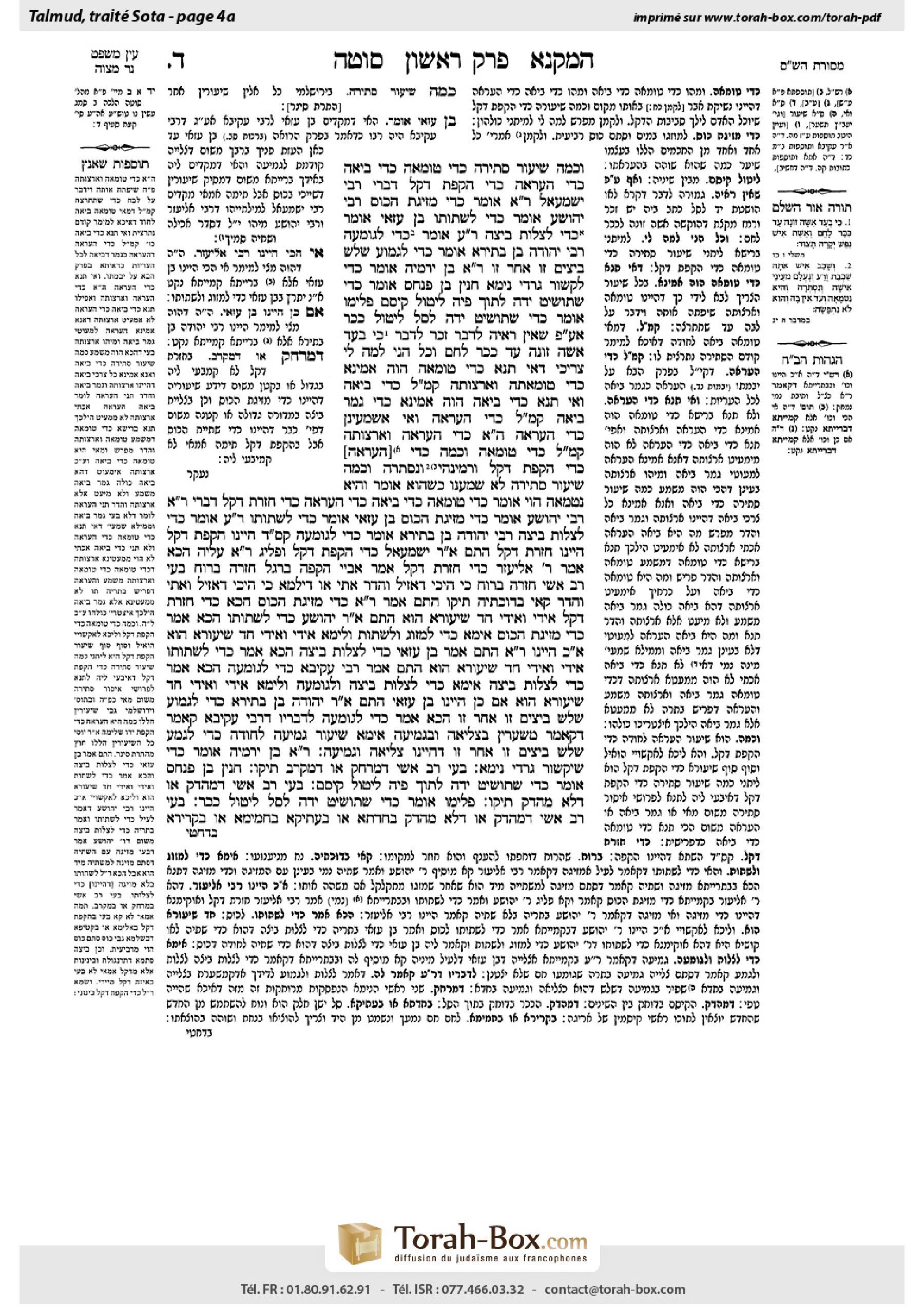
Sotah 4a: Talmud study for Daf Yomi
Daf Yomi is the daily study of one Talmud folio. Explore 37 tractates with scans, Hebrew text, Sefaria English and AI-generated French translations where annotated.
Passage selection and English or AI-generated French translation are available where the scan has annotations. Daf Study is independent of Torah-Box and Sefaria.
Browse Sotah · סוטה · All tractatesSotah 4a text and translations
This page of Sotah includes the Aramaic text, an English translation and an AI-generated French translation, alongside the scan above.
סוטה ד׳ א · Aramaic and Hebrew text
וְכַמָּה שִׁיעוּר סְתִירָה? כְּדֵי טוּמְאָה, כְּדֵי בִיאָה, כְּדֵי הַעֲרָאָה.
כְּדֵי הַקָּפַת דֶּקֶל, דִּבְרֵי רַבִּי יִשְׁמָעֵאל. רַבִּי אֱלִיעֶזֶר אוֹמֵר: כְּדֵי מְזִיגַת הַכּוֹס. רַבִּי יְהוֹשֻׁעַ אוֹמֵר: כְּדֵי לִשְׁתּוֹתוֹ.
בֶּן עַזַּאי אוֹמֵר: כְּדֵי לִצְלוֹת בֵּיצָה. רַבִּי עֲקִיבָא אוֹמֵר: כְּדֵי לְגוֹמְעָהּ. רַבִּי יְהוּדָה בֶּן בְּתֵירָא אוֹמֵר: כְּדֵי לִגְמוֹעַ שָׁלֹשׁ בֵּיצִים זוֹ אַחַר זוֹ. רַבִּי אֶלְעָזָר בֶּן יִרְמְיָה אוֹמֵר: כְּדֵי לִקְשׁוֹר גַּרְדִּי נִימָא.
חָנִין בֶּן פִּנְחָס אוֹמֵר: כְּדֵי שֶׁתּוֹשִׁיט יָדָהּ לְתוֹךְ פִּיהָ לִיטּוֹל קֵיסָם. פְּלֵימוֹ אוֹמֵר: כְּדֵי שֶׁתּוֹשִׁיט יָדָהּ לַסַּל לִיטּוֹל כִּכָּר. אַף עַל פִּי שֶׁאֵין רְאָיָה לַדָּבָר, זֵכֶר לַדָּבָר: ״כִּי בְעַד אִשָּׁה זוֹנָה עַד כִּכַּר לָחֶם״.
וְכׇל הָנֵי לְמָה לִי?
צְרִיכִי, דְּאִי תְּנָא כְּדֵי טוּמְאָה, הֲוָה אָמֵינָא: כְּדֵי טוּמְאָתָהּ וְאַרְצוּתָהּ, קָא מַשְׁמַע לַן כְּדֵי בִיאָה.
וְאִי תְּנָא כְּדֵי בִיאָה, הֲוָה אָמֵינָא: כְּדֵי גְּמַר בִּיאָה, קָא מַשְׁמַע לַן כְּדֵי הַעֲרָאָה.
וְאִי אַשְׁמְעִינַן כְּדֵי הַעֲרָאָה, הֲוָה אָמֵינָא: כְּדֵי הַעֲרָאָה וְאַרְצוּתָהּ, קָא מַשְׁמַע לַן כְּדֵי טוּמְאָה. וְכַמָּה כְּדֵי [הַעֲרָאָה] — כְּדֵי הַקָּפַת דֶּקֶל.
וּרְמִינְהִי ״וְנִסְתְּרָה״, וְכַמָּה שִׁיעוּר סְתִירָה לֹא שָׁמַעְנוּ. כְּשֶׁהוּא אוֹמֵר ״וְהִיא נִטְמָאָה״, הֱוֵי אוֹמֵר — כְּדֵי טוּמְאָה, כְּדֵי בִיאָה, כְּדֵי הַעֲרָאָה, כְּדֵי חֲזָרַת דֶּקֶל, דִּבְרֵי רַבִּי אֱלִיעֶזֶר.
רַבִּי יְהוֹשֻׁעַ אוֹמֵר: כְּדֵי מְזִיגַת הַכּוֹס. בֶּן עַזַּאי אוֹמֵר: כְּדֵי לִשְׁתּוֹתוֹ. רַבִּי עֲקִיבָא אוֹמֵר: כְּדֵי לִצְלוֹת בֵּיצָה. רַבִּי יְהוּדָה בֶּן בְּתֵירָא אוֹמֵר: כְּדֵי לְגוֹמְעָהּ.
קָא סָלְקָא דַּעְתִּין: הַיְינוּ הַקָּפַת דֶּקֶל, הַיְינוּ חֲזָרַת דֶּקֶל. הָתָם אָמַר רַבִּי יִשְׁמָעֵאל: כְּדֵי הַקָּפַת דֶּקֶל, וּפְלִיג רַבִּי אֱלִיעֶזֶר עֲלֵיהּ. הָכָא אָמַר רַבִּי אֱלִיעֶזֶר כְּדֵי חֲזָרַת דֶּקֶל!
אָמַר אַבָּיֵי: הַקָּפָה בָּרֶגֶל, חֲזָרָה בָּרוּחַ.
בָּעֵי רַב אָשֵׁי: חֲזָרָה בָּרוּחַ כִּי הֵיכִי דְּאָזֵיל וַהֲדַר אָתֵי, אוֹ דִילְמָא כִּי הֵיכִי דְּאָזֵיל וְאָתֵי וַהֲדַר קָאֵי בְּדוּכְתֵּיהּ. תֵּיקוּ.
הָתָם אָמַר רַבִּי אֱלִיעֶזֶר: כְּדֵי מְזִיגַת הַכּוֹס, הָכָא: כְּדֵי חֲזָרַת דֶּקֶל! אִידֵּי וְאִידֵּי חַד שִׁיעוּרָא הוּא.
הָתָם אָמַר רַבִּי יְהוֹשֻׁעַ: כְּדֵי לִשְׁתּוֹתוֹ, הָכָא אָמַר: כְּדֵי מְזִיגַת הַכּוֹס! אֵימָא כְּדֵי לִמְזוֹג וְלִשְׁתּוֹת. וְלֵימָא: אִידֵּי וְאִידֵּי חַד שִׁיעוּרָא הוּא! אִם כֵּן, הַיְינוּ רַבִּי אֱלִיעֶזֶר.
הָתָם אָמַר בֶּן עַזַּאי: כְּדֵי לִצְלוֹת בֵּיצָה, הָכָא אָמַר: כְּדֵי לִשְׁתּוֹתוֹ. אִידֵּי וְאִידֵּי חַד שִׁיעוּרָא הוּא.
הָתָם אָמַר רַבִּי עֲקִיבָא: כְּדֵי לְגוֹמְעָהּ, הָכָא אָמַר: כְּדֵי לִצְלוֹת בֵּיצָה! אֵימָא כְּדֵי לִצְלוֹת בֵּיצָה וּלְגוֹמְעָהּ. וְלֵימָא: אִידֵּי וְאִידֵּי חַד שִׁיעוּרָא הוּא! אִם כֵּן, הַיְינוּ בֶּן עַזַּאי.
הָתָם אָמַר רַבִּי יְהוּדָה בֶּן בְּתֵירָא: כְּדֵי לִגְמוֹעַ שָׁלֹשׁ בֵּיצִים זוֹ אַחַר זוֹ, הָכָא אָמַר: כְּדֵי לְגוֹמְעָהּ! לִדְבָרָיו דְּרַבִּי עֲקִיבָא קָאָמַר, דְּקָאָמַר מְשַׁעֲרִין בִּצְלִיאָה וּבִגְמִיעָה: אֵימָא שִׁיעוּר גְּמִיעָה לְחוֹדַהּ כְּדֵי לִגְמֹעַ שָׁלֹשׁ בֵּיצִים זוֹ אַחַר זוֹ, דְּהַיְינוּ צְלִיאָה וּגְמִיעָה.
רַבִּי אֶלְעָזָר בֶּן יִרְמְיָה אוֹמֵר: כְּדֵי שֶׁיִּקְשׁוֹר גַּרְדִּי נִימָא. בָּעֵי רַב אָשֵׁי: דִּמְרַחַק, אוֹ דִּמְקָרַב? תֵּיקוּ.
חָנִין בֶּן פִּנְחָס אוֹמֵר: כְּדֵי שֶׁתּוֹשִׁיט יָדָהּ לְתוֹךְ פִּיהָ לִיטּוֹל קֵיסָם. בָּעֵי רַב אָשֵׁי: דִּמְהַדַּק אוֹ דְּלָא מְהַדַּק? תֵּיקוּ.
פְּלֵימוֹ אוֹמֵר: כְּדֵי שֶׁתּוֹשִׁיט יָדָהּ לַסַּל לִיטּוֹל כִּכָּר. בָּעֵי רַב אָשֵׁי: דִּמְהַדַּק אוֹ דְּלָא מְהַדַּק? בְּחַדְתָּא אוֹ בְּעַתִּיקָא? בְּחַמִּימָא אוֹ בְּקָרִירָא?
Sotah 4a · English translation
The baraita clarifies: And what is the measure of seclusion, i.e., how is the seclusion of a sota defined? The measure of seclusion is equivalent to the time needed for defilement, which is equivalent to the time needed to perform intercourse, which is equivalent to the time needed to perform the initial stage of intercourse.
The baraita quotes several practical examples of this period of time. This is equivalent to the time needed for circling a palm tree; this is the statement of Rabbi Yishmael. Rabbi Eliezer says: This is equivalent to the time needed for mixing a cup of wine with water, with the total volume of a quarter-log. Rabbi Yehoshua says: This is equivalent to the time needed to drink that cup of wine.
The baraita quotes several more examples. Ben Azzai says: This is equivalent to the time needed to roast an egg. Rabbi Akiva says: This is equivalent to the time needed to swallow it. Rabbi Yehuda ben Beteira says: This is equivalent to the time needed to swallow three eggs one after another. Rabbi Elazar ben Yirmeya says: This is equivalent to the time needed for a weaver [gardi] to tie a string [nima].
Ḥanin ben Pineḥas says: This is equivalent to the time that a woman may need to extend her hand into her mouth to remove a wood chip from between her teeth. The Sage Peleimu says: This is equivalent to the time that she may need to extend her hand into a basket in order to take a loaf of bread. He adds: Although there is no explicit proof from a verse for the matter, there is an allusion to the matter from the verse: “For on account of a harlot a man is brought to a loaf of bread” (Proverbs 6:26).
The baraita stated that the measure of seclusion is equivalent to the time needed for defilement, which is equivalent to the time needed to perform sexual intercourse, which is equivalent to the time needed to perform the initial stage of intercourse, and it added nine practical examples of that length of time. The Gemara asks: And why do I need all these times when one should have sufficed?
The Gemara answers: All three are necessary, as if the baraita taught only: Equivalent to the time needed for defilement, I would say that the measure is equivalent to the time for her defilement and her appeasement, i.e., the amount of time needed to convince her to engage in sexual intercourse. Therefore, the baraita teaches us that the measure is equivalent to the time needed to perform sexual intercourse alone.
And if the baraita taught only: The measure of seclusion is equivalent to the time needed to perform sexual intercourse, I would say that the measure is equivalent to the time needed for the completion of the act of intercourse. Therefore, the baraita teaches us that the measure is equivalent to the time needed to perform the initial stage of intercourse.
And if the baraita taught only: The measure of seclusion is equivalent to the time needed to perform the initial stage of intercourse, I would say that the measure is equivalent to the time needed to perform the initial stage of intercourse and her appeasement. Therefore, the baraita teaches us that the measure is equivalent to the time needed for defilement, which does not include appeasement. The baraita concludes by offering a practical measure: And what is the measure of the equivalent amount of time needed to perform the initial stage of intercourse? It is equivalent to the time needed for circling a palm tree. Other Sages then offered their own practical examples.
And the Gemara raises a contradiction from a different baraita (Tosefta 1:2): The verse states: “And she was defiled secretly” (Numbers 5:13), and we have not heard what is the measure of seclusion. When it says in that verse: “And she was defiled secretly,” you must say that the measure of seclusion is equivalent to the time needed for defilement, which is equivalent to the time needed to perform sexual intercourse, which is equivalent to the time needed to perform the initial stage of intercourse, which is equivalent to the time needed for the returning of a palm tree; this is the statement of Rabbi Eliezer.
The baraita continues: Rabbi Yehoshua says: This is equivalent to the time needed for mixing a cup of wine with water, with the total volume of a quarter-log. Ben Azzai says: This is equivalent to the time needed to drink that cup of wine. Rabbi Akiva says: This is equivalent to the time needed to roast an egg. Rabbi Yehuda ben Beteira says: This is equivalent to the time needed to swallow it.
The Gemara now addresses several contradictions between this baraita and the one quoted earlier. The Gemara first comments: It might enter our mind to say that circling a palm tree is the same as the returning of a palm tree. The Gemara asks: There, in the first baraita, Rabbi Yishmael says it is equivalent to the time needed for circling a palm tree and Rabbi Eliezer disagreed with him, while here, in the second baraita, Rabbi Eliezer himself says it is equivalent to the time needed for the returning of a palm tree; doesn’t this contradict what he stated in the previous baraita?
To resolve this contradiction, Abaye says: These measures are not the same, as circling is referring to the amount of time it takes for one to circle a palm tree by foot, and returning is referring to the amount of time it takes for a palm branch blown by the wind to revert to its prior position.
Rav Ashi asks: This returning of the palm branch by the wind, is this the time only so that it goes forward with the wind and returns to its place one time, not including the time it is still moving back and forth due to the wind? Or perhaps it is the time so that it goes forward with the wind and comes back and returns until it settles in its place. The Gemara states: The question shall stand unresolved.
The Gemara presents another contradiction. There, in the first baraita, Rabbi Eliezer says: This is equivalent to the time needed for pouring a cup of wine. Here, in the second baraita, he says: This is equivalent to the time needed for the returning of a palm tree. The Gemara answers: This and that are one, i.e., the same, measure.
The Gemara presents another contradiction. There, in the first baraita, Rabbi Yehoshua says: This is equivalent to the time needed for drinking a cup of wine. Here, in the second baraita, he says: This is equivalent to the time needed for mixing a cup of wine. The Gemara answers: Say that he requires both together, i.e., he requires an amount of time equivalent to the time needed to both mix and drink a cup of wine. The Gemara asks: Instead of combining the measures, why not let us say that this and that are one measure? The Gemara answers: If so, this is the same as the opinion of Rabbi Eliezer in the first baraita, with whom Rabbi Yehoshua disagrees.
The Gemara presents another contradiction. There, in the first baraita, ben Azzai says: This is equivalent to the time needed to roast an egg. Here, in the second baraita, he says: This is equivalent to the time needed to drink a cup of wine. The Gemara answers: This and that are one measure.
The Gemara presents another contradiction. There, in the first baraita, Rabbi Akiva says: This is equivalent to the time needed to swallow an egg. Here, in the second baraita, he says: This is equivalent to the time needed to roast an egg. The Gemara answers: Say that he requires both together, i.e., he requires an amount of time equivalent to the time needed to roast an egg and to swallow it. The Gemara asks: Instead of combining the measures, why not let us say that this and that are one measure? The Gemara answers: If so, this is the same as the opinion of ben Azzai in the first baraita, with whom Rabbi Akiva disagrees.
The Gemara presents another contradiction. There, in the first baraita, Rabbi Yehuda ben Beteira says: This is equivalent to the time needed to swallow three eggs one after another. Here, in the second baraita, he says: This is equivalent to the time needed to swallow an egg, meaning one egg. The Gemara answers: In the first baraita, he did not state his own opinion, but stated his opinion in accordance with the statement of Rabbi Akiva, who stated that one measures according to the time needed for roasting and swallowing. Rabbi Yehuda responded: Say instead the measure of the time needed for swallowing alone, i.e., an amount of time equivalent to the time needed to swallow three eggs one after another, which is equal to the amount of time necessary for roasting and swallowing, and therefore Rabbi Akiva would not need to include roasting in the measurement.
The Gemara discusses an opinion cited in the first baraita. Rabbi Elazar ben Yirmeya says: This is equivalent to the time needed for a weaver to tie a string. Rav Ashi asks: Is this speaking of where the ends of the string to be tied are far apart from each other, or is it speaking of where they are near to each other? The Gemara states: The question shall stand unresolved.
The Gemara discusses another opinion cited in the first baraita. Ḥanin ben Pineḥas says: This is equivalent to the time that a woman may need to extend her hand into her mouth to remove a wood chip from between her teeth. Rav Ashi asks: Is this speaking of a case where the wood chip is stuck between her teeth, or is it speaking of a case where it is not stuck? The Gemara states: The question shall stand unresolved.
The Gemara discusses another opinion cited in the first baraita. Peleimu says: This is equivalent to the time that a woman may need to extend her hand into a basket in order to take a loaf of bread. Rav Ashi asks: Is this speaking of an occasion where the loaf adheres to the basket, or is it speaking of a case where it does not adhere? Is this speaking of a case where the basket is new, whereby the tips of the shoots forming the basket might restrain the loaf, or this speaking of where the basket is old and smooth, enabling easy removal? Is this speaking of a case where the loaf is hot and therefore softer and may adhere to the basket, or is this speaking of a case where the loaf is cold and easily removed?
Sotah 4a · Traduction française (IA)
La baraïta précise : quelle est la mesure de l’isolement, c’est-à-dire comment définit-on l’isolement d’une sota ? La mesure de l’isolement équivaut au temps nécessaire pour qu’ait lieu la souillure, qui équivaut au temps nécessaire pour avoir un rapport sexuel, lequel équivaut au temps nécessaire pour accomplir le début du rapport.
La baraïta cite plusieurs exemples concrets de cette durée. Elle équivaut au temps nécessaire pour faire le tour d’un palmier ; telle est l’opinion de Rabbi Yishmael. Rabbi Eliezer dit : elle équivaut au temps nécessaire pour mélanger du vin et de l’eau dans une coupe, dont le volume total est d’un quart de log. Rabbi Yehoshua dit : elle équivaut au temps nécessaire pour boire cette coupe de vin.
La baraïta cite plusieurs autres exemples. Ben Azzai dit : elle équivaut au temps nécessaire pour faire rôtir un œuf. Rabbi Akiva dit : elle équivaut au temps nécessaire pour l’avaler. Rabbi Yehuda ben Beteira dit : elle équivaut au temps nécessaire pour avaler trois œufs l’un après l’autre. Rabbi Elazar ben Yirmeya dit : elle équivaut au temps nécessaire pour qu’un tisserand [gardi] noue un fil [nima].
Ḥanin ben Pineḥas dit : elle équivaut au temps qu’une femme peut mettre à porter sa main à sa bouche pour retirer un éclat de bois coincé entre ses dents. Le Sage Peleimu dit : elle équivaut au temps qu’elle peut mettre à porter sa main dans un panier pour en prendre un pain. Il ajoute : bien qu’il n’y ait pas de preuve explicite tirée d’un verset à ce sujet, un verset y fait allusion : « À cause d’une prostituée, un homme en vient à manquer d’un pain » (Proverbes 6:26).
La baraïta a déclaré que la mesure de l’isolement équivaut au temps nécessaire pour qu’ait lieu la souillure, lequel équivaut au temps nécessaire pour avoir un rapport sexuel, lequel équivaut au temps nécessaire pour accomplir le début du rapport ; elle a ajouté neuf exemples concrets de cette durée. La Guemara demande : pourquoi toutes ces durées sont-elles nécessaires, alors qu’une seule aurait dû suffire ?
La Guemara répond : les trois formulations sont nécessaires. En effet, si la baraïta avait seulement enseigné : « le temps nécessaire pour qu’ait lieu la souillure », j’aurais dit que la mesure équivaut au temps nécessaire à sa souillure et à sa persuasion, c’est-à-dire au temps nécessaire pour la convaincre d’avoir un rapport sexuel. La baraïta nous enseigne donc que la mesure équivaut au temps nécessaire pour avoir un rapport sexuel seulement.
Et si la baraïta avait seulement enseigné : « La mesure de l’isolement équivaut au temps nécessaire pour avoir un rapport sexuel », j’aurais dit que la mesure équivaut au temps nécessaire pour achever le rapport. La baraïta nous enseigne donc qu’elle équivaut au temps nécessaire pour accomplir le début du rapport.
Et si la baraïta avait seulement enseigné : « La mesure de l’isolement équivaut au temps nécessaire pour accomplir le début du rapport », j’aurais dit que la mesure équivaut au temps nécessaire pour accomplir le début du rapport et la persuader. La baraïta nous enseigne donc que la mesure équivaut au temps nécessaire pour qu’ait lieu la souillure, ce qui n’inclut pas la persuasion. La baraïta conclut en donnant une mesure concrète : quelle est la durée correspondant au temps nécessaire pour accomplir le début du rapport ? Elle équivaut au temps nécessaire pour faire le tour d’un palmier. D’autres Sages ont ensuite proposé leurs propres exemples concrets.
La Guemara soulève une contradiction à partir d’une autre baraïta (Tossefta 1:2) : le verset dit : « Et elle s’est souillée en secret » (Nombres 5:13), mais nous n’avons pas appris quelle est la mesure de l’isolement. Puisque le verset dit : « Et elle s’est souillée en secret », il faut en conclure que la mesure de l’isolement équivaut au temps nécessaire pour qu’ait lieu la souillure, lequel équivaut au temps nécessaire pour avoir un rapport sexuel, lequel équivaut au temps nécessaire pour accomplir le début du rapport, lequel équivaut au temps nécessaire au retour d’une branche de palmier ; telle est l’opinion de Rabbi Eliezer.
La baraïta poursuit : Rabbi Yehoshua dit : elle équivaut au temps nécessaire pour mélanger du vin et de l’eau dans une coupe, dont le volume total est d’un quart de log. Ben Azzai dit : elle équivaut au temps nécessaire pour boire cette coupe de vin. Rabbi Akiva dit : elle équivaut au temps nécessaire pour faire rôtir un œuf. Rabbi Yehuda ben Beteira dit : elle équivaut au temps nécessaire pour l’avaler.
La Guemara examine maintenant plusieurs contradictions entre cette baraïta et celle qui a été citée précédemment. Elle fait d’abord remarquer : on pourrait penser que faire le tour d’un palmier et le retour d’une branche de palmier désignent la même chose. La Guemara demande : là, dans la première baraïta, Rabbi Yishmael dit que cela équivaut au temps nécessaire pour faire le tour d’un palmier, et Rabbi Eliezer est en désaccord avec lui ; tandis qu’ici, dans la seconde baraïta, Rabbi Eliezer lui-même dit que cela équivaut au temps nécessaire au retour d’une branche de palmier. N’est-ce pas en contradiction avec ce qu’il a déclaré dans la baraïta précédente ?
Pour résoudre cette contradiction, Abaye dit : ces mesures ne sont pas identiques. « Faire le tour » désigne le temps nécessaire pour faire le tour d’un palmier à pied, tandis que « le retour » désigne le temps nécessaire pour qu’une branche de palmier, poussée par le vent, revienne à sa position initiale.
Rav Ashi demande : pour ce retour de la branche de palmier poussée par le vent, s’agit-il uniquement du temps nécessaire pour qu’elle avance sous l’effet du vent puis revienne une fois à sa place, sans compter le temps pendant lequel elle continue à osciller sous l’effet du vent ? Ou bien s’agit-il du temps nécessaire pour qu’elle avance sous l’effet du vent, revienne et reparte jusqu’à se stabiliser à sa place ? La Guemara déclare : la question reste sans réponse.
La Guemara présente une autre contradiction. Là, dans la première baraïta, Rabbi Eliezer dit : cela équivaut au temps nécessaire pour verser une coupe de vin. Ici, dans la seconde baraïta, il dit : cela équivaut au temps nécessaire au retour d’une branche de palmier. La Guemara répond : ceci et cela constituent une seule et même mesure.
La Guemara présente une autre contradiction. Là, dans la première baraïta, Rabbi Yehoshua dit : cela équivaut au temps nécessaire pour boire une coupe de vin. Ici, dans la seconde baraïta, il dit : cela équivaut au temps nécessaire pour mélanger une coupe de vin. La Guemara répond : dis plutôt qu’il faut les deux ensemble, c’est-à-dire une durée équivalant au temps nécessaire à la fois pour mélanger et pour boire une coupe de vin. La Guemara demande : au lieu de combiner les mesures, pourquoi ne pas dire que ceci et cela constituent une seule et même mesure ? La Guemara répond : dans ce cas, son opinion serait identique à celle de Rabbi Eliezer dans la première baraïta, avec laquelle Rabbi Yehoshua est en désaccord.
La Guemara présente une autre contradiction. Là, dans la première baraïta, Ben Azzai dit : cela équivaut au temps nécessaire pour faire rôtir un œuf. Ici, dans la seconde baraïta, il dit : cela équivaut au temps nécessaire pour boire une coupe de vin. La Guemara répond : ceci et cela constituent une seule et même mesure.
La Guemara présente une autre contradiction. Là, dans la première baraïta, Rabbi Akiva dit : cela équivaut au temps nécessaire pour avaler un œuf. Ici, dans la seconde baraïta, il dit : cela équivaut au temps nécessaire pour faire rôtir un œuf. La Guemara répond : dis plutôt qu’il faut les deux ensemble, c’est-à-dire une durée équivalant au temps nécessaire pour faire rôtir un œuf et l’avaler. La Guemara demande : au lieu de combiner les mesures, pourquoi ne pas dire que ceci et cela constituent une seule et même mesure ? La Guemara répond : dans ce cas, son opinion serait identique à celle de Ben Azzai dans la première baraïta, avec laquelle Rabbi Akiva est en désaccord.
La Guemara présente une autre contradiction. Là, dans la première baraïta, Rabbi Yehuda ben Beteira dit : cela équivaut au temps nécessaire pour avaler trois œufs l’un après l’autre. Ici, dans la seconde baraïta, il dit : cela équivaut au temps nécessaire pour avaler un œuf, c’est-à-dire un seul œuf. La Guemara répond : dans la première baraïta, il n’a pas exprimé sa propre opinion, mais a formulé son avis conformément à la déclaration de Rabbi Akiva, selon laquelle la mesure se calcule d’après le temps nécessaire pour faire rôtir et avaler. Rabbi Yehuda a répondu : dis plutôt que la mesure correspond au temps nécessaire pour avaler seulement, c’est-à-dire une durée équivalant au temps nécessaire pour avaler trois œufs l’un après l’autre, ce qui correspond au temps nécessaire pour faire rôtir et avaler ; Rabbi Akiva n’aurait donc pas besoin d’inclure le rôtissage dans la mesure.
La Guemara examine une opinion citée dans la première baraïta. Rabbi Elazar ben Yirmeya dit : cela équivaut au temps nécessaire pour qu’un tisserand noue un fil. Rav Ashi demande : s’agit-il du cas où les extrémités du fil à nouer sont éloignées l’une de l’autre, ou bien du cas où elles sont proches l’une de l’autre ? La Guemara déclare : la question reste sans réponse.
La Guemara examine une autre opinion citée dans la première baraïta. Ḥanin ben Pineḥas dit : cela équivaut au temps qu’une femme peut mettre à porter sa main à sa bouche pour retirer un éclat de bois entre ses dents. Rav Ashi demande : s’agit-il du cas où l’éclat de bois est coincé entre ses dents, ou bien du cas où il ne l’est pas ? La Guemara déclare : la question reste sans réponse.
La Guemara examine une autre opinion citée dans la première baraïta. Peleimu dit : cela équivaut au temps qu’une femme peut mettre à porter sa main dans un panier pour en prendre un pain. Rav Ashi demande : s’agit-il d’un cas où le pain adhère au panier, ou d’un cas où il n’y adhère pas ? S’agit-il d’un panier neuf, dont les pointes des brins qui le composent pourraient retenir le pain, ou d’un panier ancien et lisse, permettant de le retirer facilement ? S’agit-il d’un pain chaud, donc plus mou et susceptible d’adhérer au panier, ou d’un pain froid, facile à retirer ?
Traduction française générée par IA à partir de l’édition anglaise de Sefaria. Vérifie toujours un passage avec le texte source.
Text from Sefaria: William Davidson Edition - Vocalized Aramaic (CC BY NC); William Davidson Edition - English (CC BY NC).