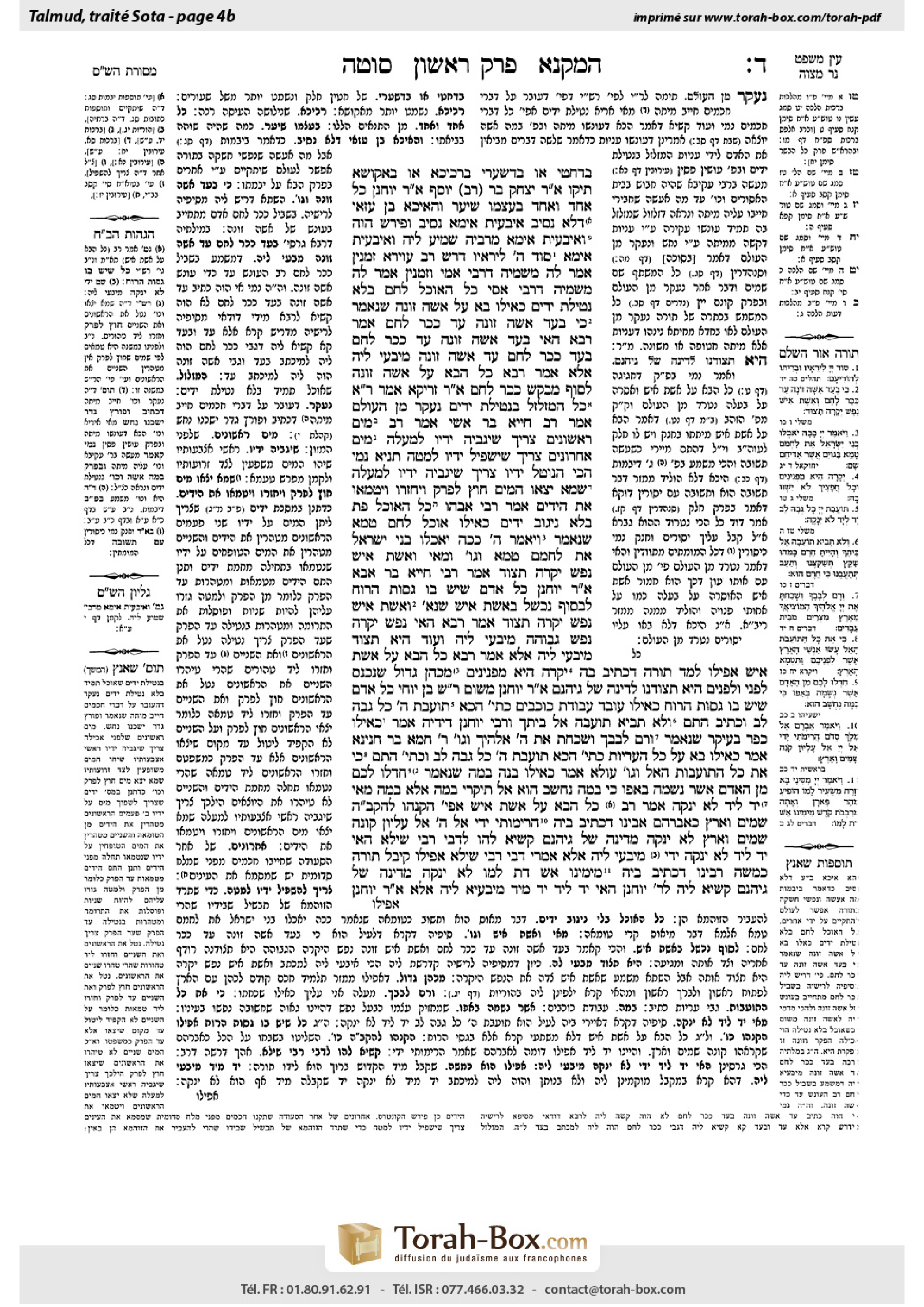
Sotah 4b: Talmud study for Daf Yomi
Daf Yomi is the daily study of one Talmud folio. Explore 37 tractates with scans, Hebrew text, Sefaria English and AI-generated French translations where annotated.
Passage selection and English or AI-generated French translation are available where the scan has annotations. Daf Study is independent of Torah-Box and Sefaria.
Browse Sotah · סוטה · All tractatesSotah 4b text and translations
This page of Sotah includes the Aramaic text, an English translation and an AI-generated French translation, alongside the scan above.
סוטה ד׳ ב · Aramaic and Hebrew text
בִּדְחִטֵּי אוֹ בְּדִשְׂעָרֵי? בְּרַכִּיכָא אוֹ בַּאֲקוֹשָׁא? תֵּיקוּ.
אָמַר רַב יִצְחָק בַּר רַב יוֹסֵף אָמַר רַבִּי יוֹחָנָן: כׇּל אֶחָד וְאֶחָד — בְּעַצְמוֹ שִׁיעֵר. וְהָאִיכָּא בֶּן עַזַּאי דְּלָא נְסֵיב?
אִיבָּעֵית אֵימָא: נְסֵיב וּפֵירַשׁ הֲוָה. וְאִיבָּעֵית אֵימָא: מֵרַבֵּיהּ שְׁמִיעַ לֵיהּ. וְאִיבָּעֵית אֵימָא: ״סוֹד ה׳ לִירֵאָיו״.
דָּרֵשׁ רַב עַוִּירָא, זִמְנִין אָמַר לַהּ מִשְּׁמֵיהּ דְּרַבִּי אַמֵּי, וְזִמְנִין אָמַר לַהּ מִשְּׁמֵיהּ דְּרַבִּי אַסִּי: כׇּל הָאוֹכֵל לֶחֶם בְּלֹא נְטִילַת יָדַיִם — כְּאִילּוּ בָּא עַל אִשָּׁה זוֹנָה. שֶׁנֶּאֱמַר: ״כִּי בְעַד אִשָּׁה זוֹנָה עַד כִּכַּר לָחֶם״.
אָמַר רָבָא: הַאי ״בְּעַד אִשָּׁה זוֹנָה עַד כִּכַּר לָחֶם״ — ״בְּעַד כִּכַּר לֶחֶם עַד אִשָּׁה זוֹנָה״ מִיבְּעֵי לֵיהּ! אֶלָּא אָמַר רָבָא: כׇּל הַבָּא עַל אִשָּׁה זוֹנָה, לְסוֹף מְבַקֵּשׁ כִּכַּר לֶחֶם.
אָמַר רַבִּי זְרִיקָא אָמַר רַבִּי אֶלְעָזָר: כׇּל הַמְּזַלְזֵל בִּנְטִילַת יָדַיִם נֶעֱקָר מִן הָעוֹלָם. אָמַר רַב חִיָּיא בַּר אָשֵׁי אָמַר רַב: מַיִם רִאשׁוֹנִים — צָרִיךְ שֶׁיַּגְבִּיהַּ יָדָיו לְמַעְלָה, מַיִם אַחֲרוֹנִים — צָרִיךְ שֶׁיַּשְׁפִּיל יָדָיו לְמַטָּה. תַּנְיָא נָמֵי הָכִי: הַנּוֹטֵל יָדָיו — צָרִיךְ שֶׁיַּגְבִּיהַּ יָדָיו לְמַעְלָה, שֶׁמָּא יֵצְאוּ הַמַּיִם חוּץ לַפֶּרֶק, וְיַחְזְרוּ וִיטַמְּאוּ אֶת הַיָּדַיִם.
אָמַר רַבִּי אֲבָהוּ: כׇּל הָאוֹכֵל פַּת בְּלֹא נִיגּוּב יָדַיִם — כְּאִילּוּ אוֹכֵל לֶחֶם טָמֵא, שֶׁנֶּאֱמַר: ״וַיֹּאמֶר ה׳ כָּכָה יֹאכְלוּ בְנֵי יִשְׂרָאֵל אֶת לַחְמָם טָמֵא וְגוֹ׳״.
וּמַאי ״וְאֵשֶׁת אִישׁ נֶפֶשׁ יְקָרָה תָצוּד״? אָמַר רַבִּי חִיָּיא בַּר אַבָּא אָמַר רַבִּי יוֹחָנָן: כׇּל אָדָם שֶׁיֵּשׁ בּוֹ גַּסּוּת הָרוּחַ — לְבַסּוֹף נִכְשָׁל בְּאֵשֶׁת אִישׁ, שֶׁנֶּאֱמַר: ״וְאֵשֶׁת אִישׁ נֶפֶשׁ יְקָרָה תָצוּד״.
אָמַר רָבָא: הַאי ״נֶפֶשׁ יְקָרָה״ — ״נֶפֶשׁ גְּבוֹהָה״ מִיבְּעֵי לֵיהּ. וְעוֹד: ״הִיא תָּצוּד״ מִיבְּעֵי לֵיהּ! אֶלָּא אָמַר רָבָא: כׇּל הַבָּא עַל אֵשֶׁת אִישׁ, אֲפִילּוּ לָמַד תּוֹרָה דִּכְתִיב בַּהּ ״יְקָרָה הִיא מִפְּנִינִים״, מִכֹּהֵן גָּדוֹל שֶׁנִּכְנָס לִפְנַי וְלִפְנִים, ״הִיא תְּצוּדֶנּוּ״ — לְדִינָהּ שֶׁל גֵּיהִנָּם.
אָמַר רַבִּי יוֹחָנָן מִשּׁוּם רַבִּי שִׁמְעוֹן בֶּן יוֹחַי: כׇּל אָדָם שֶׁיֵּשׁ בּוֹ גַּסּוּת הָרוּחַ — כְּאִילּוּ עוֹבֵד עֲבוֹדָה זָרָה. כְּתִיב הָכָא: ״תּוֹעֲבַת ה׳ כׇּל גְּבַהּ לֵב״, וּכְתִיב הָתָם: ״וְלָא תָבִיא תוֹעֵבָה אֶל בֵּיתֶךָ״.
וְרַבִּי יוֹחָנָן דִּידֵיהּ אָמַר: כְּאִילּוּ כָּפַר בָּעִיקָּר, שֶׁנֶּאֱמַר: ״וְרָם לְבָבֶךָ וְשָׁכַחְתָּ אֶת ה׳ אֱלֹהֶיךָ וְגוֹ׳״.
רַבִּי חָמָא בַּר חֲנִינָא אָמַר: כְּאִילּוּ בָּא עַל כׇּל הָעֲרָיוֹת. כְּתִיב הָכָא: ״תּוֹעֲבַת ה׳ כׇּל גְּבַהּ לֵב״, וּכְתִיב הָתָם: ״כִּי אֶת כׇּל הַתּוֹעֵבוֹת הָאֵל וְגוֹ׳״.
עוּלָּא אָמַר: כְּאִילּוּ בָּנָה בָּמָה, שֶׁנֶּאֱמַר: ״חִדְלוּ לָכֶם מִן הָאָדָם אֲשֶׁר נְשָׁמָה בְּאַפּוֹ כִּי בַּמֶּה נֶחְשָׁב הוּא״ — אַל תִּיקְרֵי ״בַּמֶּה״, אֶלָּא ״בָּמָה״.
מַאי ״יָד לְיָד לֹא יִנָּקֶה״? אָמַר רַב: כׇּל הַבָּא עַל אֵשֶׁת אִישׁ, אֲפִילּוּ הִקְנָהוּ לְהַקָּדוֹשׁ בָּרוּךְ הוּא שָׁמַיִם וָאָרֶץ כְּאַבְרָהָם אָבִינוּ, דִּכְתִיב בֵּיהּ: ״הֲרִימֹתִי יָדִי אֶל ה׳ אֵל עֶלְיוֹן קֹנֵה שָׁמַיִם וָאָרֶץ״ — לֹא יִנָּקֶה מִדִּינָהּ שֶׁל גֵּיהִנָּם.
קַשְׁיָא לְהוּ לִדְבֵי רַבִּי שֵׁילָא: הַאי ״יָד לְיָד לֹא יִנָּקֶה״, ״יָדִי״ מִיבְּעֵי לֵיהּ!
אֶלָּא אָמְרִי דְּבֵי רַבִּי שֵׁילָא: אֲפִילּוּ קִיבֵּל תּוֹרָה כְּמֹשֶׁה רַבֵּינוּ, דִּכְתִיב בֵּיהּ ״מִימִינוֹ אֵשׁ דָּת לָמוֹ״ — לֹא יִנָּקֶה מִדִּינָהּ שֶׁל גֵּיהִנָּם.
קַשְׁיָא לֵיהּ לְרַבִּי יוֹחָנָן: הַאי ״יָד לְיָד״, ״יָד מִיָּד״ מִיבַּעְיָא לֵיהּ!
אֶלָּא אָמַר רַבִּי יוֹחָנָן:
Sotah 4b · English translation
Is this speaking of a case where the loaf is made of wheat, which is slippery and takes longer to remove, or is this speaking of a case where the loaf is made of barley, which is easily removed? Is this speaking of a case where the loaf is soft, so that it may catch upon the side of the basket, or a case where the loaf is hard, where this is not a concern? The Gemara states: These questions shall stand unresolved.
The Gemara notes: Rav Yitzḥak bar Rav Yosef says that Rabbi Yoḥanan says: Each and every one of these Sages who presented an opinion with regard to the time needed for the initial stage of intercourse estimated based on himself, i.e., based on his own experience. The Gemara asks: But there is ben Azzai, who did not marry, so how could he estimate based on his own experience?
The Gemara answers: If you wish, say that he was married and separated from his wife. And if you wish, say that he heard from his teacher. And if you wish, say his knowledge can be understood based on the verse: “The counsel of the Lord is with them that fear Him” (Psalms 25:14), teaching that those who fear God are privy to knowledge beyond their personal experience.
§ Having quoted an allusion from the verse: “For on account of a harlot a man is brought to a loaf of bread” (Proverbs 6:26), the Gemara offers another interpretation of that verse. Rav Avira interpreted a verse homiletically; there were times he said this interpretation in the name of Rabbi Ami and there were times he said it in the name of Rabbi Asi: Concerning anyone who eats bread without washing his hands, it is as if he engaged in sexual intercourse with a prostitute, as it is stated: “For on account of a harlot a man is brought to a loaf of bread.”
Rava said: This phrase: “For on account of a harlot a man is brought to a loaf of bread,” is not how the verse would present this idea. It should have stated: “On account of a loaf a man is brought to a harlot.” Rather, Rava says the verse should be interpreted as follows: Anyone who engages in sexual intercourse with a harlot will eventually be reduced to poverty and beg people for a loaf of bread.
The Gemara continues its discussion of washing hands. Rabbi Zerika says that Rabbi Elazar says: Anyone who treats the ritual of washing hands with contempt is uprooted from the world. Rav Ḥiyya bar Ashi says that Rav says: With regard to the first water, i.e., the water used when washing one’s hands before a meal, one must raise his hands upward after washing. With regard to the last water, i.e., the water used when washing one’s hands at the conclusion of the meal before reciting Grace after Meals, one must lower his hands downward. This distinction is also taught in a baraita (Tosefta, Yadayim 2:2): One who washes his hands before a meal must raise his hands upward after washing, lest the water advance past the joint onto the part of the hands that he was not required to wash, becoming impure, and then return to the area he had washed, rendering his hands ritually impure.
Rabbi Abbahu says: Anyone who eats bread without wiping his hands dry after washing them causes the bread to become repulsive and is considered as if he were eating impure bread, since the verse refers to repulsive bread as impure bread, as it is stated: “And the Lord said: Even thus shall the children of Israel eat their bread unclean among the nations where I will drive them” (Ezekiel 4:13). Eating bread with wet hands causes the bread to become repulsive. The verse deems eating in an uncouth manner, as did the gentiles among whom the Jewish people were exiled, as akin to eating ritually impure bread.
§ The Gemara now continues the interpretation of the above quoted verse: “For on account of a harlot a man is brought to a loaf of bread” (Proverbs 6:26). The Gemara asks: And what is the meaning of the continuation of the verse: “But the adulteress hunts for the precious life”? Rabbi Ḥiyya bar Abba says that Rabbi Yoḥanan says: Any person who has arrogance within him will eventually stumble by sinning with an adulteress, as it is stated: “But the adulteress hunts for the precious life,” i.e., she sins with one who considers himself precious.
Rava said: This phrase: “The precious life,” is not how the verse would present this idea. It should have stated: An arrogant life. And further, it should have stated: A precious life, she hunts for the adulteress, indicating that the precious soul will entrap the adulteress, and not vice versa, as the verse indicates as written. Rather, Rava says that the verse should be interpreted as follows: Anyone who engages in sexual intercourse with an adulteress, even if that man studied Torah, about which it is written: “She is more precious than rubies [peninim]” (Proverbs 3:15), which, based on its etymological connection with the Hebrew term for the Holy of Holies, lifnai velifnim, is interpreted by the Sages to mean that one who studies Torah is more precious than a High Priest, who enters the innermost sanctum, still, this transgression of adultery will entrap him into the judgment of Gehenna, and the Torah he studied will not be able to save him.
Rabbi Yoḥanan says in the name of Rabbi Shimon ben Yoḥai: Any person who has arrogance within him is considered as if he were an idol worshipper, as it is written here: “Everyone that is proud in heart is an abomination to the Lord” (Proverbs 16:5), and it is written there concerning the destruction of idols: “And you shall not bring an abomination into your house” (Deuteronomy 7:26).
And Rabbi Yoḥanan said his own statement: Any person who has arrogance within him is considered as if he has denied the core belief in God’s existence, as it is stated: “Then your heart be lifted up, and you forget the Lord your God” (Deuteronomy 8:14).
Rabbi Ḥama bar Ḥanina says: Any person who has arrogance within him is considered as if he engaged in sexual intercourse with all of those with whom relations are forbidden, as it is written here: “Everyone who is proud in heart is an abomination to the Lord” (Proverbs 16:5), and it is written there, at the end of the passage concerning forbidden sexual relationships: “For all these abominations have the men of the land done” (Leviticus 18:27).
Ulla says: Any person who has arrogance within him is considered as if he built a personal altar for idol worship, as it is stated: “Cease you from man, in whose nostrils there is breath, for how little [bammeh] is he to be accounted” (Isaiah 2:22), referring to an arrogant person. Do not read the verse as it is written, bammeh, how little. Rather, read it as bama, altar.
Having interpreted the phrase: “Everyone who is proud in heart is an abomination to the Lord” (Proverbs 16:5), the Gemara interprets the continuation of the verse. What is the meaning of: “Hand to hand, he shall not be unpunished” (Proverbs 16:5)? Rav says: Anyone who engages in sexual intercourse with an adulteress, even if he were to have attributed possession of heaven and earth to the Holy One, Blessed be He, just as Abraham our forefather did, that it is written with regard to him: “I have lifted up my hand to the Lord, God Most High, Maker of heaven and earth” (Genesis 14:22), he will not be unpunished from the judgment of Gehenna. Abraham is described as one whose hands were lifted to declare the glory of God, yet this verse declares that even if one who engaged in forbidden sexual intercourse were to use his hands in the same way, still, due to his sin, the verse says: “He shall not be unpunished.”
This interpretation poses a difficulty to the Sages of the school of Rabbi Sheila: This phrase: “Hand to hand, he shall not be unpunished,” is not how the verse would present this idea. It should have stated: My hand, as that is the term employed in the verse with regard to Abraham.
Rather, the Sages of the school of Rabbi Sheila say: This teaches that even if one who engages in sexual intercourse with an adulteress had received the Torah from the hand of God like Moses our teacher did, that it is written with regard to him: “At His right hand was a fiery law unto them” (Deuteronomy 33:2), i.e., God gave the Torah from His right hand into the hand of Moses in order to give to the Jewish people, the sinner will not be unpunished from the judgment of Gehenna.
This interpretation also poses a difficulty to Rabbi Yoḥanan: This phrase “hand to hand” is not how the verse would present this idea. It should have stated: Hand from hand, as that is the term employed in the verse with regard to Moses.
Rather Rabbi Yoḥanan says:
Sotah 4b · Traduction française (IA)
S’agit-il d’un cas où la miche est faite de blé, qui est glissante et prend plus de temps à retirer, ou d’un cas où elle est faite d’orge et s’en retire facilement ? S’agit-il d’un cas où la miche est molle, de sorte qu’elle risque de s’accrocher au bord du panier, ou d’un cas où elle est dure, et où cela ne pose donc pas de problème ? La Guemara conclut : Ces questions restent sans réponse.
La Guemara relève : Rav Yitzḥak bar Rav Yosef dit au nom de Rabbi Yoḥanan : Chacun des Sages qui ont exprimé un avis sur le temps nécessaire à la phase initiale du rapport sexuel l’a estimé d’après sa propre expérience. La Guemara demande : Mais ben Azzai ne s’est pas marié ; comment a-t-il donc pu l’estimer d’après sa propre expérience ?
La Guemara répond : Si tu veux, dis qu’il s’était marié, puis qu’il s’était séparé de sa femme. Et si tu veux, dis qu’il l’avait appris de son maître. Et si tu veux, dis que son savoir s’explique par le verset : « Le conseil de l’Éternel est pour ceux qui le craignent » (Psaumes 25, 14), ce qui enseigne que ceux qui craignent Dieu ont accès à un savoir qui dépasse leur expérience personnelle.
§ Après avoir cité une allusion tirée du verset : « À cause d’une prostituée, un homme en vient à un morceau de pain » (Proverbes 6, 26), la Guemara propose une autre interprétation de ce verset. Rav Avira interprétait un verset de manière homilétique ; tantôt il rapportait cette interprétation au nom de Rabbi Ami, tantôt au nom de Rabbi Asi : Quiconque mange du pain sans se laver les mains, c’est comme s’il avait eu des rapports sexuels avec une prostituée, ainsi qu’il est dit : « À cause d’une prostituée, un homme en vient à un morceau de pain. »
Rava dit : Le verset n’aurait pas formulé cette idée en disant : « À cause d’une prostituée, un homme en vient à un morceau de pain. » Il aurait dû dire : « À cause d’un morceau de pain, un homme en vient à une prostituée. » Rava dit plutôt qu’il faut interpréter le verset ainsi : Quiconque a des rapports sexuels avec une prostituée finira par tomber dans la pauvreté et mendier auprès des gens un morceau de pain.
La Guemara poursuit son exposé sur le lavage des mains. Rabbi Zerika dit au nom de Rabbi Elazar : Quiconque traite avec mépris le rituel du lavage des mains est retranché du monde. Rav Ḥiyya bar Ashi dit au nom de Rav : Après le premier lavage, c’est-à-dire celui effectué avant le repas, il faut relever les mains. Après le dernier lavage, c’est-à-dire celui effectué à la fin du repas, avant de réciter le Birkat Hamazon, il faut abaisser les mains. Cette distinction est également enseignée dans une baraïta (Tosefta, Yadayim 2, 2) : Celui qui se lave les mains avant le repas doit les relever après le lavage, de peur que l’eau ne dépasse l’articulation et n’atteigne une partie des mains qu’il n’était pas tenu de laver, devenant ainsi impure, puis ne revienne sur la partie qu’il avait lavée et ne rende ses mains rituellement impures.
Rabbi Abbahu dit : Quiconque mange du pain sans s’essuyer les mains après les avoir lavées rend le pain répugnant ; c’est comme s’il mangeait du pain impur, puisque le verset désigne un pain répugnant comme un pain impur, ainsi qu’il est dit : « L’Éternel dit : C’est ainsi que les enfants d’Israël mangeront leur pain impur parmi les nations où je les chasserai » (Ézéchiel 4, 13). Manger du pain avec les mains mouillées rend le pain répugnant. Le verset assimile le fait de manger de manière grossière, comme le faisaient les nations parmi lesquelles le peuple juif fut exilé, au fait de manger du pain rituellement impur.
§ La Guemara poursuit l’interprétation du verset cité plus haut : « À cause d’une prostituée, un homme en vient à un morceau de pain » (Proverbes 6, 26). La Guemara demande : Que signifie la suite du verset : « Mais la femme adultère chasse une vie précieuse » ? Rabbi Ḥiyya bar Abba dit au nom de Rabbi Yoḥanan : Quiconque est habité par l’orgueil finira par trébucher et pécher avec une femme adultère, ainsi qu’il est dit : « Mais la femme adultère chasse une vie précieuse », c’est-à-dire qu’elle pèche avec un homme qui se considère comme précieux.
Rava dit : Le verset n’aurait pas formulé cette idée en disant : « une vie précieuse ». Il aurait dû dire : « une vie orgueilleuse ». De plus, il aurait dû dire : « Une vie précieuse chasse la femme adultère », ce qui indiquerait que l’âme précieuse prendrait la femme adultère au piège, et non l’inverse, comme le suggère le verset tel qu’il est formulé. Rava dit plutôt qu’il faut interpréter le verset ainsi : Quiconque a des rapports sexuels avec une femme adultère, même s’il a étudié la Torah, dont il est dit : « Elle est plus précieuse que les rubis [peninim] » (Proverbes 3, 15) — expression que les Sages, en raison de son lien étymologique avec le terme hébreu désignant le Saint des Saints, lifnai velifnim, interprètent comme signifiant que celui qui étudie la Torah est plus précieux qu’un Grand Prêtre qui pénètre dans le sanctuaire le plus intérieur —, sera néanmoins pris au piège par cette transgression d’adultère et condamné au jugement de la Géhenne ; la Torah qu’il a étudiée ne pourra pas le sauver.
Rabbi Yoḥanan dit au nom de Rabbi Shimon ben Yoḥai : Quiconque est habité par l’orgueil est considéré comme s’il adorait des idoles, ainsi qu’il est écrit ici : « Tout cœur orgueilleux est une abomination pour l’Éternel » (Proverbes 16, 5), et qu’il est écrit ailleurs, au sujet de la destruction des idoles : « Tu ne feras pas entrer une abomination dans ta maison » (Deutéronome 7, 26).
Et Rabbi Yoḥanan dit en son propre nom : Quiconque est habité par l’orgueil est considéré comme s’il niait la croyance fondamentale en l’existence de Dieu, ainsi qu’il est dit : « Alors ton cœur s’élèvera et tu oublieras l’Éternel, ton Dieu » (Deutéronome 8, 14).
Rabbi Ḥama bar Ḥanina dit : Quiconque est habité par l’orgueil est considéré comme s’il avait eu des rapports sexuels avec toutes les personnes avec lesquelles les relations sont interdites, ainsi qu’il est écrit ici : « Tout cœur orgueilleux est une abomination pour l’Éternel » (Proverbes 16, 5), et qu’il est écrit ailleurs, à la fin du passage concernant les relations sexuelles interdites : « Car les hommes du pays ont commis toutes ces abominations » (Lévitique 18, 27).
Ulla dit : Quiconque est habité par l’orgueil est considéré comme s’il avait construit un autel privé pour le culte idolâtre, ainsi qu’il est dit : « Cessez de vous fier à l’homme, qui n’a qu’un souffle dans les narines ; car que vaut-il [bammeh] ? » (Isaïe 2, 22), ce qui fait référence à une personne orgueilleuse. Ne lis pas le verset tel qu’il est écrit, bammeh, « que vaut-il ? ». Lis plutôt bama, « autel ».
Après avoir interprété l’expression « Tout cœur orgueilleux est une abomination pour l’Éternel » (Proverbes 16, 5), la Guemara interprète la suite du verset. Que signifie : « Main contre main, il ne restera pas impuni » (Proverbes 16, 5) ? Rav dit : Quiconque a des rapports sexuels avec une femme adultère ne restera pas impuni au jugement de la Géhenne, même s’il avait attribué la possession du ciel et de la terre au Saint, béni soit-Il, comme l’a fait Abraham, notre ancêtre, au sujet duquel il est écrit : « J’ai levé la main vers l’Éternel, Dieu Très-Haut, créateur du ciel et de la terre » (Genèse 14, 22). Abraham est décrit comme ayant levé la main pour proclamer la gloire de Dieu ; pourtant, ce verset enseigne que même si celui qui a eu des rapports sexuels interdits levait les mains de la même manière, il ne resterait pas impuni en raison de son péché.
Cette interprétation pose une difficulté aux Sages de l’école de Rabbi Sheila : Le verset n’aurait pas formulé cette idée en disant : « Main contre main, il ne restera pas impuni. » Il aurait dû dire : « Ma main », puisque c’est le terme employé dans le verset au sujet d’Abraham.
Les Sages de l’école de Rabbi Sheila disent plutôt : Cela enseigne que même si celui qui a des rapports sexuels avec une femme adultère avait reçu la Torah de la main de Dieu, comme Moïse, notre maître, à qui elle fut destinée, ainsi qu’il est écrit : « À sa droite, une loi de feu leur fut donnée » (Deutéronome 33, 2) — c’est-à-dire que Dieu transmit la Torah de sa main droite à Moïse, afin qu’il la transmette au peuple juif —, le pécheur ne restera pas impuni au jugement de la Géhenne.
Cette interprétation pose également une difficulté à Rabbi Yoḥanan : L’expression « main contre main » n’est pas la manière dont le verset aurait formulé cette idée. Il aurait dû dire : « Main de main », puisque c’est le terme employé dans le verset au sujet de Moïse.
Rabbi Yoḥanan dit plutôt :
Traduction française générée par IA à partir de l’édition anglaise de Sefaria. Vérifie toujours un passage avec le texte source.
Text from Sefaria: William Davidson Edition - Vocalized Aramaic (CC BY NC); William Davidson Edition - English (CC BY NC).