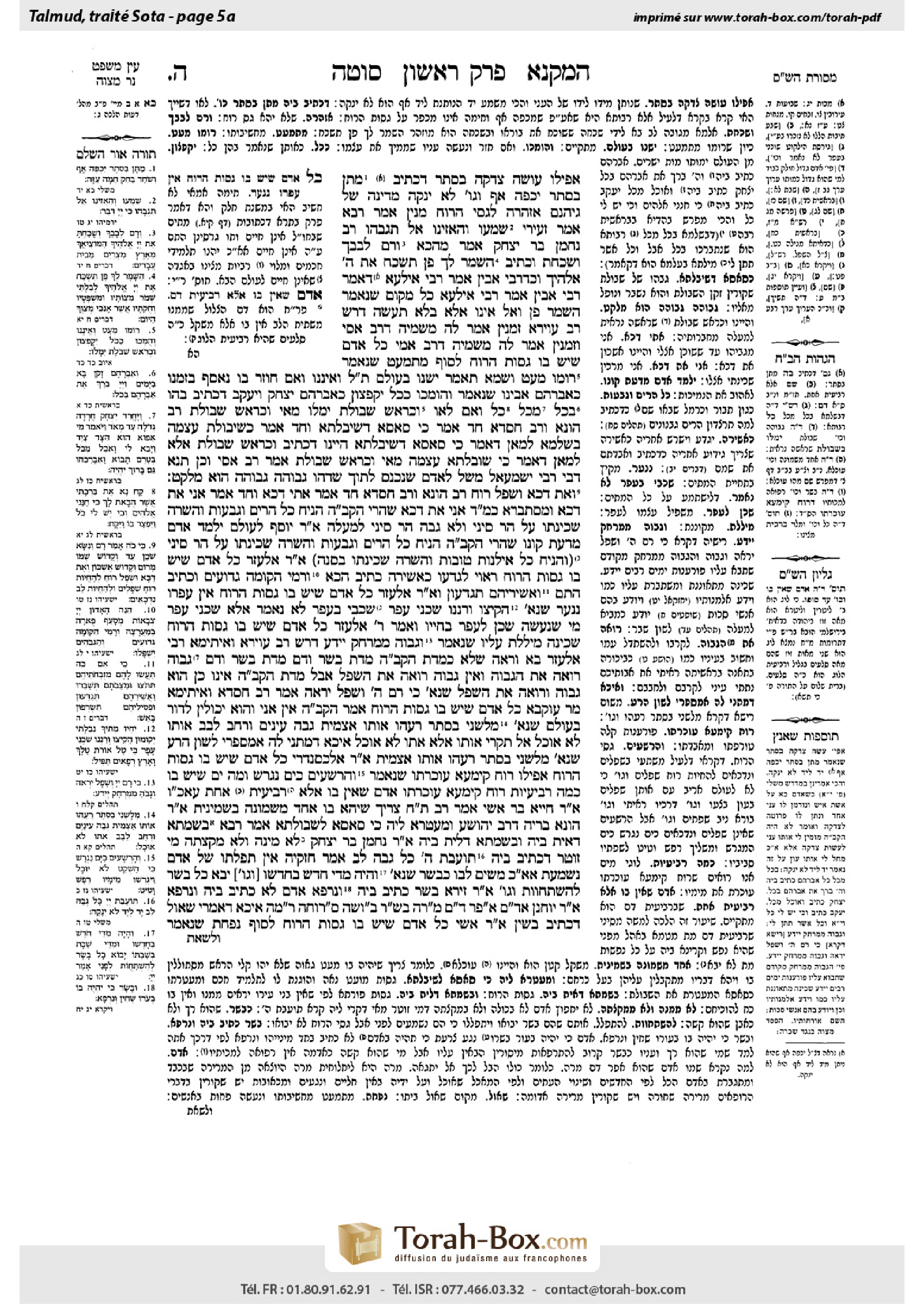
Sotah 5a: Talmud study for Daf Yomi
Daf Yomi is the daily study of one Talmud folio. Explore 37 tractates with scans, Hebrew text, Sefaria English and AI-generated French translations where annotated.
Passage selection and English or AI-generated French translation are available where the scan has annotations. Daf Study is independent of Torah-Box and Sefaria.
Browse Sotah · סוטה · All tractatesSotah 5a text and translations
This page of Sotah includes the Aramaic text, an English translation and an AI-generated French translation, alongside the scan above.
סוטה ה׳ א · Aramaic and Hebrew text
אֲפִילּוּ עוֹשֶׂה צְדָקָה בַּסֵּתֶר, דִּכְתִיב: ״מַתָּן בַּסֵּתֶר יִכְפֶּה אָף וְגוֹ׳״ — לֹא יִנָּקֶה מִדִּינָהּ שֶׁל גֵּיהִנָּם.
אַזְהָרָה לְגַסֵּי הָרוּחַ מִנַּיִן? אָמַר רָבָא אָמַר זְעֵירִי: ״שִׁמְעוּ וְהַאֲזִינוּ אַל תִּגְבָּהוּ״. רַב נַחְמָן בַּר יִצְחָק אָמַר, מֵהָכָא: ״וְרָם לְבָבֶךָ וְשָׁכַחְתָּ״ וּכְתִיב: ״הִשָּׁמֶר לְךָ פֶּן תִּשְׁכַּח אֶת ה׳ אֱלֹהֶיךָ״.
וְכִדְרַבִּי אָבִין אָמַר רַבִּי אִילְעָא. דְּאָמַר רַבִּי אָבִין אָמַר רַבִּי אִילְעָא: כׇּל מָקוֹם שֶׁנֶּאֱמַר ״הִשָּׁמֶר״ ״פֶּן״ וְ״אַל״ — אֵינוֹ אֶלָּא בְּלֹא תַּעֲשֶׂה.
דָּרֵשׁ רַב עַוִּירָא, זִמְנִין אָמַר לַהּ מִשְּׁמֵיהּ דְּרַב אַסִּי וְזִמְנִין אָמַר לַהּ מִשְּׁמֵיהּ דְּרַב אַמֵּי: כׇּל אָדָם שֶׁיֵּשׁ בּוֹ גַּסּוּת הָרוּחַ לְסוֹף מִתְמַעֵט, שֶׁנֶּאֱמַר: ״רוֹמּוּ מְּעַט״. וְשֶׁמָּא תֹּאמַר יֶשְׁנוֹ בָּעוֹלָם, תַּלְמוּד לוֹמַר: ״וְאֵינֶנּוּ״.
וְאִם חוֹזֵר בּוֹ — נֶאֱסָף בִּזְמַנּוֹ כְּאַבְרָהָם אָבִינוּ, שֶׁנֶּאֱמַר: ״וְהֻמְּכוּ כַּכֹּל יִקָּפְצוּן״. כְּאַבְרָהָם יִצְחָק וְיַעֲקֹב דִּכְתִיב בְּהוּ: ״בַּכֹּל״, ״מִכֹּל״, ״כֹּל״. וְאִם לָאו — ״וּכְרֹאשׁ שִׁבֹּלֶת יִמָּלוּ״.
מַאי ״וּכְרֹאשׁ שִׁבֹּלֶת״? רַב הוּנָא וְרַב חִסְדָּא, חַד אָמַר: כִּי סָאסָא דְשִׁיבַּלְתָּא, וְחַד אָמַר: כְּשִׁיבּוֹלֶת עַצְמָהּ. בִּשְׁלָמָא לְמַאן דְּאָמַר כִּי סָאסָא דְשִׁיבַּלְתָּא — הַיְינוּ דִּכְתִיב: ״וּכְרֹאשׁ שִׁבֹּלֶת״, אֶלָּא לְמַאן דְּאָמַר כִּי שׁוּבַּלְתָּא עַצְמָהּ, מַאי ״וּכְרֹאשׁ שִׁבֹּלֶת״? אָמַר רַב אַסִּי, וְכֵן תָּנָא דְּבֵי רַבִּי יִשְׁמָעֵאל: מָשָׁל לְאָדָם שֶׁנִּכְנָס לְתוֹךְ שָׂדֵהוּ — גְּבוֹהָה גְּבוֹהָה הוּא מְלַקֵּט.
״וְאֶת דַּכָּא וּשְׁפַל רוּחַ״. רַב הוּנָא וְרַב חִסְדָּא, חַד אָמַר: אִתִּי דַּכָּא, וְחַד אָמַר: אֲנִי אֶת דַּכָּא.
וּמִסְתַּבְּרָא כְּמַאן דְּאָמַר אֲנִי אֶת דַּכָּא, שֶׁהֲרֵי הַקָּדוֹשׁ בָּרוּךְ הוּא הִנִּיחַ כׇּל הָרִים וּגְבָעוֹת, וְהִשְׁרָה שְׁכִינָתוֹ עַל הַר סִינַי וְלֹא גָּבַהּ הַר סִינַי לְמַעְלָה.
אָמַר רַב יוֹסֵף: לְעוֹלָם יִלְמַד אָדָם מִדַּעַת קוֹנוֹ, שֶׁהֲרֵי הַקָּדוֹשׁ בָּרוּךְ הוּא הִנִּיחַ כׇּל הָרִים וּגְבָעוֹת, וְהִשְׁרָה שְׁכִינָתוֹ עַל הַר סִינַי. וְהִנִּיחַ כׇּל אִילָנוֹת טוֹבוֹת, וְהִשְׁרָה שְׁכִינָתוֹ בַּסְּנֶה.
אָמַר רַבִּי אֶלְעָזָר: כׇּל אָדָם שֶׁיֵּשׁ בּוֹ גַּסּוּת הָרוּחַ רָאוּי לְגַדְּעוֹ כַּאֲשֵׁירָה. כְּתִיב הָכָא: ״וְרָמֵי הַקּוֹמָה גְּדוּעִים״, וּכְתִיב הָתָם: ״וַאֲשֵׁירֵיהֶם תְּגַדֵּעוּן״.
וְאָמַר רַבִּי אֶלְעָזָר: כׇּל אָדָם שֶׁיֵּשׁ בּוֹ גַּסּוּת הָרוּחַ — אֵין עֲפָרוֹ נִנְעָר, שֶׁנֶּאֱמַר: ״הָקִיצוּ וְרַנְּנוּ שֹׁכְנֵי עָפָר״, ״שֹׁכְבֵי בֶּעָפָר״ לֹא נֶאֱמַר, אֶלָּא ״שֹׁכְנֵי עָפָר״ — מִי שֶׁנַּעֲשָׂה שָׁכֵן לֶעָפָר בְּחַיָּיו.
וְאָמַר רַבִּי אֶלְעָזָר: כׇּל אָדָם שֶׁיֵּשׁ בּוֹ גַּסּוּת הָרוּחַ, שְׁכִינָה מְיַלֶּלֶת עָלָיו, שֶׁנֶּאֱמַר: ״וְגָבֹהַּ מִמֶּרְחָק יְיֵדָע״.
דָּרֵשׁ רַב עַוִּירָא, וְאִיתֵּימָא רַבִּי אֶלְעָזָר: בֹּא וּרְאֵה שֶׁלֹּא כְּמִדַּת הַקָּדוֹשׁ בָּרוּךְ הוּא מִדַּת בָּשָׂר וְדָם. מִדַּת בָּשָׂר וָדָם — גָּבוֹהַּ רוֹאֶה אֶת הַגָּבוֹהַּ, וְאֵין גָּבוֹהַּ רוֹאֶה אֶת הַשָּׁפֵל. אֲבָל מִדַּת הַקָּדוֹשׁ בָּרוּךְ הוּא אֵינוֹ כֵּן, הוּא גָּבוֹהַּ וְרוֹאֶה אֶת הַשָּׁפֵל, שֶׁנֶּאֱמַר: ״כִּי רָם ה׳ וְשָׁפָל יִרְאֶה״.
אָמַר רַב חִסְדָּא, וְאִיתֵּימָא מָר עוּקְבָא: כׇּל אָדָם שֶׁיֵּשׁ בּוֹ גַּסּוּת הָרוּחַ, אָמַר הַקָּדוֹשׁ בָּרוּךְ הוּא: אֵין אֲנִי וָהוּא יְכוֹלִין לָדוּר בָּעוֹלָם, שֶׁנֶּאֱמַר: ״מְלׇשְׁנִי בַסֵּתֶר רֵעֵהוּ אוֹתוֹ אַצְמִית גְּבַהּ עֵינַיִם וּרְחַב לֵבָב אֹתוֹ לֹא אוּכָל״. אַל תִּקְרֵי ״אֹתוֹ״, אֶלָּא ״אִתּוֹ לֹא אוּכָל״. אִיכָּא דְּמַתְנֵי לַהּ אַמְּסַפְּרֵי לָשׁוֹן הָרָע, שֶׁנֶּאֱמַר: ״מְלׇשְׁנִי בַסֵּתֶר רֵעֵהוּ אוֹתוֹ אַצְמִית״.
אָמַר רַבִּי אֲלֶכְּסַנְדְּרִי: כׇּל אָדָם שֶׁיֵּשׁ בּוֹ גַּסּוּת הָרוּחַ, אֲפִילּוּ רוּחַ קִימְעָא עוֹכַרְתּוֹ, שֶׁנֶּאֱמַר: ״וְהָרְשָׁעִים כַּיָּם נִגְרָשׁ״, וּמָה יָם שֶׁיֵּשׁ בּוֹ כַּמָּה רְבִיעִיּוֹת — רוּחַ קִימְעָא עוֹכַרְתּוֹ, אָדָם שֶׁאֵין בּוֹ אֶלָּא רְבִיעִית אַחַת — עַל אַחַת כַּמָּה וְכַמָּה.
אָמַר רַב חִיָּיא בַּר אָשֵׁי אָמַר רַב: תַּלְמִיד חָכָם צָרִיךְ שֶׁיְּהֵא בּוֹ אֶחָד מִשְּׁמוֹנָה בִּשְׁמִינִית. אָמַר רַב הוּנָא בְּרֵיהּ דְּרַב יְהוֹשֻׁעַ: וּמְעַטְּרָא לֵיהּ כִּי סָאסָא לְשׁוּבַּלְתָּא. אָמַר רָבָא: בְּשַׁמְתָּא דְּאִית בֵּיהּ, וּבְשַׁמְתָּא דְּלֵית בֵּיהּ.
אָמַר רַב נַחְמָן בַּר יִצְחָק: לָא מִינַּהּ וְלָא מִקְצָתַהּ, מִי זוּטַר דִּכְתִיב בֵּיהּ ״תּוֹעֲבַת ה׳ כׇּל גְּבַהּ לֵב״?
אָמַר חִזְקִיָּה: אֵין תְּפִלָּתוֹ שֶׁל אָדָם נִשְׁמַעַת אֶלָּא אִם כֵּן מֵשִׂים לִבּוֹ כְּבָשָׂר, שֶׁנֶּאֱמַר: ״וְהָיָה מִדֵּי חֹדֶשׁ בְּחׇדְשׁוֹ [וְגוֹ׳] יָבֹא כׇּל בָּשָׂר לְהִשְׁתַּחֲווֹת וְגוֹ׳״.
אָמַר רַבִּי זֵירָא: ״בָּשָׂר״ כְּתִיב בֵּיהּ ״וְנִרְפָּא״, ״אָדָם״ לָא כְּתִיב בֵּיהּ ״וְנִרְפָּא״.
אָמַר רַבִּי יוֹחָנָן, אָדָם: אֵפֶר, דָּם, מָרָה. בָּשָׂר: בּוּשָׁה, סְרוּחָה, רִמָּה. אִיכָּא דְּאָמְרִי: שְׁאוֹל, דִּכְתִיב בְּשִׁין.
אָמַר רַב אָשֵׁי: כׇּל אָדָם שֶׁיֵּשׁ בּוֹ גַּסּוּת הָרוּחַ לְסוֹף נִפְחָת, שֶׁנֶּאֱמַר:
Sotah 5a · English translation
Even if the one who committed adultery performs charitable deeds secretly, as alluded to in the phrase “hand to hand,” and even if one might think that one who does so will go unpunished, as it is written with regard to charity of this kind: “A gift in secret pacifies wrath” (Proverbs 21:14), nevertheless, he will not be unpunished from the judgment of Gehenna.
§ The Gemara previously discussed the impropriety of the trait of arrogance. Now the Gemara discusses the source of its prohibition. From where is the warning derived, i.e., what is the source prohibiting the behavior of the arrogant? Rava says that Ze’eiri says: The source is from the verse: “Hear, you, and give ear, be not proud, for the Lord has spoken” (Jeremiah 13:15). Rav Naḥman bar Yitzḥak said the warning is from here: “Then your heart be lifted up, and you forget the Lord your God” (Deuteronomy 8:14), and it is also written in that same passage: “Beware lest you forget the Lord your God” (Deuteronomy 8:11).
The Gemara explains: And these sources are in accordance with a statement that Rabbi Avin says that Rabbi Ile’a says, as Rabbi Avin says that Rabbi Ile’a says: Wherever it is stated in a verse “beware,” “lest,” or “not,” this is nothing other than a prohibition. Since these verses employ these terms in the context of one who is arrogant, they serve as sources for the prohibition.
Rav Avira interpreted the following verse homiletically: “They are exalted for a little while, and they are gone; yes, they are brought low, they are gathered in as all others, and wither as the tops of the husks” (Job 24:24). There were times when he said this interpretation in the name of Rav Asi and there were times when he said it in the name of Rav Ami: Any person who has arrogance within him will ultimately be diminished in standing, as it is stated in the phrase: “They are exalted for a little while,” indicating that one who raises himself above others will be exalted only briefly. And lest you say that even if he is diminished he will still exist in this world and live a full life, the verse states: “And they are gone,” indicating that they die before their time.
He continues the interpretation: But if he repents from his arrogance, he is gathered in death at his proper time like Abraham our forefather, as it is stated: “Yes, they are brought low, they are gathered in as all [kakkol] others” (Job 24:24), indicating that when he repents from his arrogance he will die like Abraham, Isaac, and Jacob, as it is written about them that they were blessed with the term “all,” as in the verse above. With regard to Abraham, the verse states: “And the Lord had blessed Abraham in all things [bakkol]” (Genesis 24:1). With regard to Isaac, the verse states: “And I have eaten of all [mikkol]” (Genesis 27:33). With regard to Jacob, the verse states: “And because I have all [khol]” (Genesis 33:11). And if one does not repent, then, the verse in Job continues: “And wither like the tops of the husks.”
The Gemara asks: What is the meaning of the phrase “and wither like the tops of the husks”? Rav Huna and Rav Ḥisda offered differing interpretations. One says that it means: Like the awn of bristle-like growth on the top of the husk, and one says that it means: Like the husk itself. The Gemara comments: Granted, according to the one who says: Like the awn of bristle-like growth on the top of the husk, that is that which is written in the verse: “And wither like the tops of the husks,” since this awn is on the top of the husk. But according to the one who says: Like the husk itself, what is the meaning of the expression “and wither like the tops of the husks”? Rav Asi says, and similarly the school of Rabbi Yishmael taught: This can be explained by way of an analogy to a person who enters into his field, as he gathers the taller stalks before the shorter ones. The verse is therefore referring to the tallest stalks, not the tops of the stalks.
The Gemara continues the discussion of arrogance, and its converse, humility. The verse states: “For thus says the High and Lofty One that inhabits eternity, whose name is Holy: I dwell in the high and holy place, also with him that is of a contrite and humble spirit, to revive the spirit of the humble, and to revive the heart of the contrite ones” (Isaiah 57:15). Rav Huna and Rav Ḥisda offered differing interpretations of this verse. One says that the verse means: Together with Me is the person who is contrite and humble. In other words, God elevates the humble. And one says that the verse means: I, God, descend, and am found together with the person who is contrite and humble.
The Gemara comments on this: And it stands to reason that the meaning of the verse is like the one who says: I am with the contrite person, as the Holy One, Blessed be He, disregarded all of the mountains and hills, and rested His Divine Presence on the lowly Mount Sinai, and He did not choose to raise Mount Sinai up toward Him. God chose to give the Torah on Mount Sinai, as it was a symbol of humility due to its lack of height, and He lowered His Divine Presence, as it were, to the mountain.
Rav Yosef says: A person should always learn proper behavior from the wisdom of his Creator, as the Holy One, Blessed be He, disregarded all of the mountains and hills and rested His Divine Presence on the lowly Mount Sinai. And similarly, when appearing to Moses, He disregarded all of the beautiful trees and rested His Divine Presence on the bush (Exodus 3:2).
Rabbi Elazar says: Concerning any person who has arrogance within him, it is fitting to hew him down, as a tree designated for idolatry [asheira] is hewn down, as it is written here with regard to the arrogant: “And the high ones of stature shall be hewn down [gedu’im]” (Isaiah 10:33), and it is written there with regard to trees designated for idolatry: “And hew down [teggade’un] their trees worshipped as part of idolatrous rites [asheireihem]” (Deuteronomy 7:5).
And Rabbi Elazar also says: Concerning any person who has arrogance within him, his dust, i.e., his remains in his grave, will not stir at the time of the resurrection of the dead, as it is stated: “Awake and sing for joy, you who dwell in the dust” (Isaiah 26:19). It is not stated: You who lie in the dust, which would indicate that all the dead will be awakened in the future, but rather: “You who dwell in the dust,” indicating that only one who became a neighbor to the dust in his lifetime by living with extreme humility will stir at the time of the resurrection.
And Rabbi Elazar says: Concerning any person who has arrogance within him, the Divine Presence wails over him. As it is stated: “For though the Lord is high, yet regards He the lowly, and from the haughty He is pained from afar” (Psalms 138:6).
Rav Avira interpreted a verse homiletically, and some say that Rabbi Elazar interpreted as follows: Come and see that the attribute of the Holy One, Blessed be He, is not like the attribute of flesh and blood. The attribute of flesh and blood is that the elevated sees the elevated, but the elevated does not see the lowly. But the attribute of the Holy One, Blessed be He, is not like that. He is elevated but sees specifically the lowly, as it is stated: “For though the Lord is high, yet regards He the lowly” (Psalms 138:6).
Rav Ḥisda says, and some say that Mar Ukva says: Concerning any person who has arrogance within him, the Holy One, Blessed be He, said: He and I cannot dwell together in the world, as it is stated: “He who slanders his neighbor in secret, him will I destroy; he who is haughty of eye and proud of heart, him will I not suffer [oto lo ukhal]” (Psalms 101:5–6). These verses should be understood as follows: Do not read the verse as: “Oto lo ukhal”; rather, read it as: Itto lo ukhal, meaning, with him, I cannot bear to dwell. There are those who teach that this was stated with regard to those who speak slander because the beginning of the verse states: “He who slanders his neighbor in secret, him will I destroy.”
Rabbi Alexandri says: Concerning any person who has arrogance within him, even a slight wind disturbs him, as it is stated: “But the wicked are like the troubled sea, for it cannot rest” (Isaiah 57:20). And if with regard to the sea, which contains many quantities of quarters of a log of water, yet a slight wind disturbs it, certainly with regard to a person, who has in his body only one quarter-log of essential lifeblood, all the more so will a slight wind disturb him.
Rav Ḥiyya bar Ashi says that Rav says: Despite the opprobrium assigned to one who exhibits the trait of arrogance, a Torah scholar must have one-eighth of one-eighth of arrogance. Rav Huna, son of Rav Yehoshua, said: And this minute measure of arrogance crowns him as the awn of bristle-like growth on the top of the husk. Rava said: A Torah scholar who has arrogance should be excommunicated, and one who does not have arrogance at all should be excommunicated as well. As such, he must have only a minute measure of arrogance.
Rav Naḥman bar Yitzḥak said: Even a Torah scholar should not have any arrogance or any part of arrogance, i.e., not even one-eighth of one-eighth. He explains why arrogance should be avoided entirely by asking: Is it a small matter that it is written with regard to arrogance: “Everyone that is proud of heart is an abomination to the Lord” (Proverbs 16:5)?
Ḥizkiyya says: The prayers of a person are heard only if he casts his heart to be like flesh, by being free of arrogance. As it is stated: “And it shall come to pass, that from one New Moon to another, and from one Sabbath to another, shall all flesh come to worship before Me, says the Lord” (Isaiah 66:23).
Rabbi Zeira said: Concerning leprosy of the flesh, it is written in the verse with regard to it: “And when the flesh has in the skin thereof a boil, and it is healed” (Leviticus 13:18), but concerning the leprosy of a person, it is not written in the verse with regard to it: And it is healed. Both verses discussing leprosy of a person make no mention of healing (Leviticus 13:2, 13:9). This indicates that one who sees himself as flesh will be cured, but one who holds himself in high regard will not be cured.
Rabbi Yoḥanan said: The Hebrew word for person, adam, written: Alef, dalet, mem, is an acronym for efer, dust; dam, blood; and mara, bile, alluding to man’s insignificance. Similarly, the Hebrew word for flesh, basar, written: Beit, sin, reish, is an acronym for busha, shame; seruḥa, putrid; and rimma, worm, also alluding to his insignificance. There are those who say that the letter sin of the word basar actually is referring to a different word, sheol, the netherworld, as it is written with the Hebrew letter shin. The letter sin is phonetically similar to the letter samekh, the first letter of the word seruḥa, but is orthographically similar to the letter shin, the first letter of the word sheol. The dispute is whether the acronym should be based upon the pronunciation or upon the way it is written.
Rav Ashi says: Any person who has arrogance within him will ultimately be diminished in stature, as it is stated with regard to different types of leprosy:
Sotah 5a · Traduction française (IA)
Même si celui qui a commis l’adultère accomplit secrètement des actes de charité, comme le suggère l’expression « de la main à la main », et même si l’on pouvait penser qu’il échappera au châtiment, puisqu’il est écrit au sujet de ce type de charité : « Un présent fait en secret apaise la colère » (Proverbes 21:14), il n’échappera pourtant pas au jugement de la Géhenne.
§ La Guemara a précédemment évoqué le caractère inconvenant de l’arrogance. Elle aborde maintenant la source de son interdiction. De quelle source tire-t-on l’avertissement, c’est-à-dire quel verset interdit le comportement arrogant ? Rava dit que Ze’eiri dit : la source est le verset : « Écoutez, prêtez l’oreille, ne soyez pas orgueilleux, car l’Éternel a parlé » (Jérémie 13:15). Rav Naḥman bar Yitzḥak dit que l’avertissement se trouve ici : « Que ton cœur ne s’élève pas et que tu n’oublies l’Éternel, ton Dieu » (Deutéronome 8:14), et il est également écrit dans ce même passage : « Garde-toi d’oublier l’Éternel, ton Dieu » (Deutéronome 8:11).
La Guemara explique : Ces sources concordent avec une déclaration de Rabbi Avin au nom de Rabbi Ile’a. En effet, Rabbi Avin dit au nom de Rabbi Ile’a : chaque fois qu’un verset emploie les termes « garde-toi », « de peur que » ou « ne… pas », il s’agit nécessairement d’une interdiction. Puisque ces termes apparaissent dans ces versets à propos de l’homme arrogant, ils constituent des sources de l’interdiction.
Rav Avira interpréta par homélie le verset suivant : « Ils sont élevés pour un peu de temps, puis ils disparaissent ; oui, ils sont abaissés, recueillis comme tous les autres et se fanent comme les cimes des enveloppes » (Job 24:24). Tantôt il rapportait cette interprétation au nom de Rav Asi, tantôt au nom de Rav Ami : toute personne qui porte en elle de l’arrogance finira par voir sa stature diminuée, comme l’indique l’expression : « Ils sont élevés pour un peu de temps », qui signifie que celui qui s’élève au-dessus des autres ne le sera que brièvement. Et si tu dis que, même abaissé, il continuera d’exister dans ce monde et vivra jusqu’au terme de sa vie, le verset dit : « Puis ils disparaissent », ce qui indique qu’ils meurent avant leur heure.
Il poursuit son interprétation : s’il se repent de son arrogance, il sera recueilli dans la mort au moment qui lui est destiné, comme Abraham notre ancêtre, ainsi qu’il est dit : « Oui, ils sont abaissés, recueillis comme tous [kakkol] les autres » (Job 24:24). Cela indique que, s’il se repent de son arrogance, il mourra comme Abraham, Isaac et Jacob, dont il est écrit qu’ils furent bénis par le terme « tout », comme dans le verset cité plus haut. Au sujet d’Abraham, le verset dit : « L’Éternel avait béni Abraham en toutes choses [bakkol] » (Genèse 24:1). Au sujet d’Isaac, le verset dit : « J’ai mangé de tout [mikkol] » (Genèse 27:33). Au sujet de Jacob, le verset dit : « Et puisque j’ai tout [khol] » (Genèse 33:11). Mais s’il ne se repent pas, le verset de Job poursuit : « Et ils se fanent comme les cimes des enveloppes. »
La Guemara demande : que signifie l’expression « et ils se fanent comme les cimes des enveloppes » ? Rav Huna et Rav Ḥisda proposent des interprétations différentes. Selon l’un, cela signifie : comme l’arête hérissée qui se trouve au sommet de l’enveloppe ; selon l’autre, comme l’enveloppe elle-même. La Guemara commente : il est compréhensible que, selon celui qui dit « comme l’arête hérissée qui se trouve au sommet de l’enveloppe », le verset dise « et ils se fanent comme les cimes des enveloppes », puisque cette arête se trouve au sommet de l’enveloppe. Mais selon celui qui dit « comme l’enveloppe elle-même », que signifie l’expression « et ils se fanent comme les cimes des enveloppes » ? Rav Asi dit, et de même l’école de Rabbi Yishmael a enseigné : on peut l’expliquer par l’analogie avec une personne qui entre dans son champ : elle récolte les tiges les plus hautes avant les plus courtes. Le verset désigne donc les tiges les plus hautes, et non le sommet des tiges.
La Guemara poursuit son propos sur l’arrogance et son contraire, l’humilité. Le verset dit : « Car ainsi parle le Très-Haut et le Sublime, qui demeure éternellement et dont le nom est saint : j’habite dans un lieu élevé et saint, mais aussi avec celui qui est contrit et humble d’esprit, afin de ranimer l’esprit des humbles et de ranimer le cœur des contrits » (Isaïe 57:15). Rav Huna et Rav Ḥisda proposent des interprétations différentes de ce verset. Selon l’un, le verset signifie : avec Moi se trouve celui qui est contrit et humble. Autrement dit, Dieu élève l’homme humble. Selon l’autre, le verset signifie : Moi, Dieu, je descends et me trouve auprès de celui qui est contrit et humble.
La Guemara commente : il est raisonnable de comprendre le verset selon celui qui dit : « Je suis auprès de celui qui est contrit », car le Saint, béni soit-Il, a délaissé toutes les montagnes et toutes les collines et a fait résider Sa Présence divine sur le mont Sinaï, qui est bas ; Il n’a pas choisi d’élever le mont Sinaï vers Lui. Dieu choisit de donner la Torah sur le mont Sinaï, symbole d’humilité en raison de sa faible hauteur, et, pour ainsi dire, fit descendre Sa Présence divine sur la montagne.
Rav Yosef dit : l’homme doit toujours apprendre une conduite convenable de la sagesse de son Créateur, car le Saint, béni soit-Il, a délaissé toutes les montagnes et toutes les collines et a fait résider Sa Présence divine sur le mont Sinaï, qui est bas. De même, lorsqu’Il apparut à Moïse, Il délaissa tous les arbres magnifiques et fit résider Sa Présence divine sur le buisson (Exode 3:2).
Rabbi Elazar dit : il convient d’abattre toute personne qui porte en elle de l’arrogance, comme on abat un arbre destiné à l’idolâtrie [asheira], ainsi qu’il est écrit ici, au sujet des arrogants : « Les plus élevés seront abattus [gedu’im] » (Isaïe 10:33), et qu’il est écrit là, au sujet des arbres destinés à l’idolâtrie : « Vous abattrez [teggade’un] leurs arbres voués aux rites idolâtres [asheireihem] » (Deutéronome 7:5).
Rabbi Elazar dit également : la poussière de toute personne qui porte en elle de l’arrogance, c’est-à-dire ses restes dans sa tombe, ne remuera pas au moment de la résurrection des morts, ainsi qu’il est dit : « Réveillez-vous et chantez de joie, vous qui demeurez dans la poussière » (Isaïe 26:19). Il n’est pas écrit : « Vous qui reposez dans la poussière », ce qui indiquerait que tous les morts seront réveillés à l’avenir ; il est écrit au contraire : « Vous qui demeurez dans la poussière », ce qui indique que seul celui qui, de son vivant, s’est fait le voisin de la poussière en vivant dans une humilité extrême remuera au moment de la résurrection.
Rabbi Elazar dit : la Présence divine gémit sur toute personne qui porte en elle de l’arrogance, ainsi qu’il est dit : « Car l’Éternel est élevé, mais Il regarde celui qui est humble ; quant à l’orgueilleux, Il le connaît de loin avec déplaisir » (Psaumes 138:6).
Rav Avira interpréta un verset par homélie, et certains disent que Rabbi Elazar l’interpréta ainsi : viens et vois que l’attribut du Saint, béni soit-Il, n’est pas semblable à celui des êtres de chair et de sang. Chez les êtres de chair et de sang, celui qui est élevé regarde celui qui est élevé, mais ne regarde pas celui qui est humble. L’attribut du Saint, béni soit-Il, n’est pas ainsi : Il est élevé, mais regarde précisément celui qui est humble, ainsi qu’il est dit : « Car l’Éternel est élevé, mais Il regarde celui qui est humble » (Psaumes 138:6).
Rav Ḥisda dit, et certains disent que c’est Mar Ukva qui le dit : au sujet de toute personne qui porte en elle de l’arrogance, le Saint, béni soit-Il, a dit : « Lui et Moi ne pouvons demeurer ensemble dans le monde », ainsi qu’il est dit : « Celui qui calomnie son prochain en secret, je le réduirai au silence ; celui qui a le regard hautain et le cœur orgueilleux, je ne le supporterai pas [oto lo ukhal] » (Psaumes 101:5–6). Il faut comprendre ces versets ainsi : ne lis pas le verset « oto lo ukhal » ; lis plutôt « itto lo ukhal », c’est-à-dire : « Avec lui, je ne peux supporter de demeurer. » Certains enseignent que cette déclaration concerne ceux qui calomnient, car le début du verset dit : « Celui qui calomnie son prochain en secret, je le réduirai au silence. »
Rabbi Alexandri dit : toute personne qui porte en elle de l’arrogance est troublée par le moindre souffle de vent, ainsi qu’il est dit : « Mais les méchants sont comme la mer agitée, qui ne peut se calmer » (Isaïe 57:20). Et si la mer, qui contient d’innombrables quarts de log d’eau, est troublée par un léger vent, à plus forte raison en va-t-il ainsi d’un homme, qui ne possède dans son corps qu’un quart de log de sang vital : un léger souffle de vent le troublera d’autant plus.
Rav Ḥiyya bar Ashi dit au nom de Rav : malgré le mépris attaché à celui qui manifeste de l’arrogance, un érudit en Torah doit en avoir un huitième de huitième. Rav Huna, fils de Rav Yehoshua, dit : cette infime mesure d’arrogance le couronne comme l’arête hérissée qui se trouve au sommet de l’enveloppe. Rava dit : un érudit en Torah qui a de l’arrogance doit être mis au ban, et celui qui n’en a pas du tout doit également être mis au ban. Il ne doit donc en avoir qu’une infime mesure.
Rav Naḥman bar Yitzḥak dit : même un érudit en Torah ne doit avoir aucune arrogance, ni la moindre part d’arrogance, c’est-à-dire pas même un huitième de huitième. Il explique pourquoi il faut éviter entièrement l’arrogance en demandant : est-ce peu de chose que ce qui est écrit au sujet de l’arrogance : « Tout cœur orgueilleux est une abomination pour l’Éternel » (Proverbes 16:5) ?
Ḥizkiyya dit : les prières d’une personne ne sont entendues que si elle fait de son cœur un cœur de chair, en se débarrassant de l’arrogance, ainsi qu’il est dit : « Et il arrivera que, de nouvelle lune en nouvelle lune et de sabbat en sabbat, toute chair viendra se prosterner devant Moi, dit l’Éternel » (Isaïe 66:23).
Rabbi Zeira dit : au sujet de la lèpre de la chair, le verset dit : « Lorsqu’il y a sur la peau de la chair une tumeur, et qu’elle est guérie » (Lévitique 13:18). Mais au sujet de la lèpre d’une personne, le verset ne dit pas : « Et elle est guérie. » Aucun des deux versets qui traitent de la lèpre d’une personne ne mentionne la guérison (Lévitique 13:2, 13:9). Cela indique que celui qui se considère comme de la chair sera guéri, mais que celui qui se tient en haute estime ne le sera pas.
Rabbi Yoḥanan dit : le mot hébreu désignant l’homme, adam, écrit alef, dalet, mem, est un acronyme de efer, poussière ; dam, sang ; et mara, bile, ce qui évoque la petitesse de l’homme. De même, le mot hébreu désignant la chair, basar, écrit beit, sin, reish, est un acronyme de busha, honte ; seruḥa, putréfaction ; et rimma, ver, ce qui évoque également sa petitesse. Certains disent que la lettre sin du mot basar renvoie en réalité à un autre mot, sheol, le monde souterrain, qui s’écrit avec la lettre hébraïque shin. La lettre sin se prononce comme la lettre samekh, première lettre du mot seruḥa, mais s’écrit comme la lettre shin, première lettre du mot sheol. Le désaccord porte sur la question de savoir si l’acronyme doit se fonder sur la prononciation ou sur l’orthographe.
Rav Ashi dit : toute personne qui porte en elle de l’arrogance finira par voir sa stature diminuée, ainsi qu’il est dit au sujet des différentes formes de lèpre :
Traduction française générée par IA à partir de l’édition anglaise de Sefaria. Vérifie toujours un passage avec le texte source.
Text from Sefaria: William Davidson Edition - Vocalized Aramaic (CC BY NC); William Davidson Edition - English (CC BY NC).