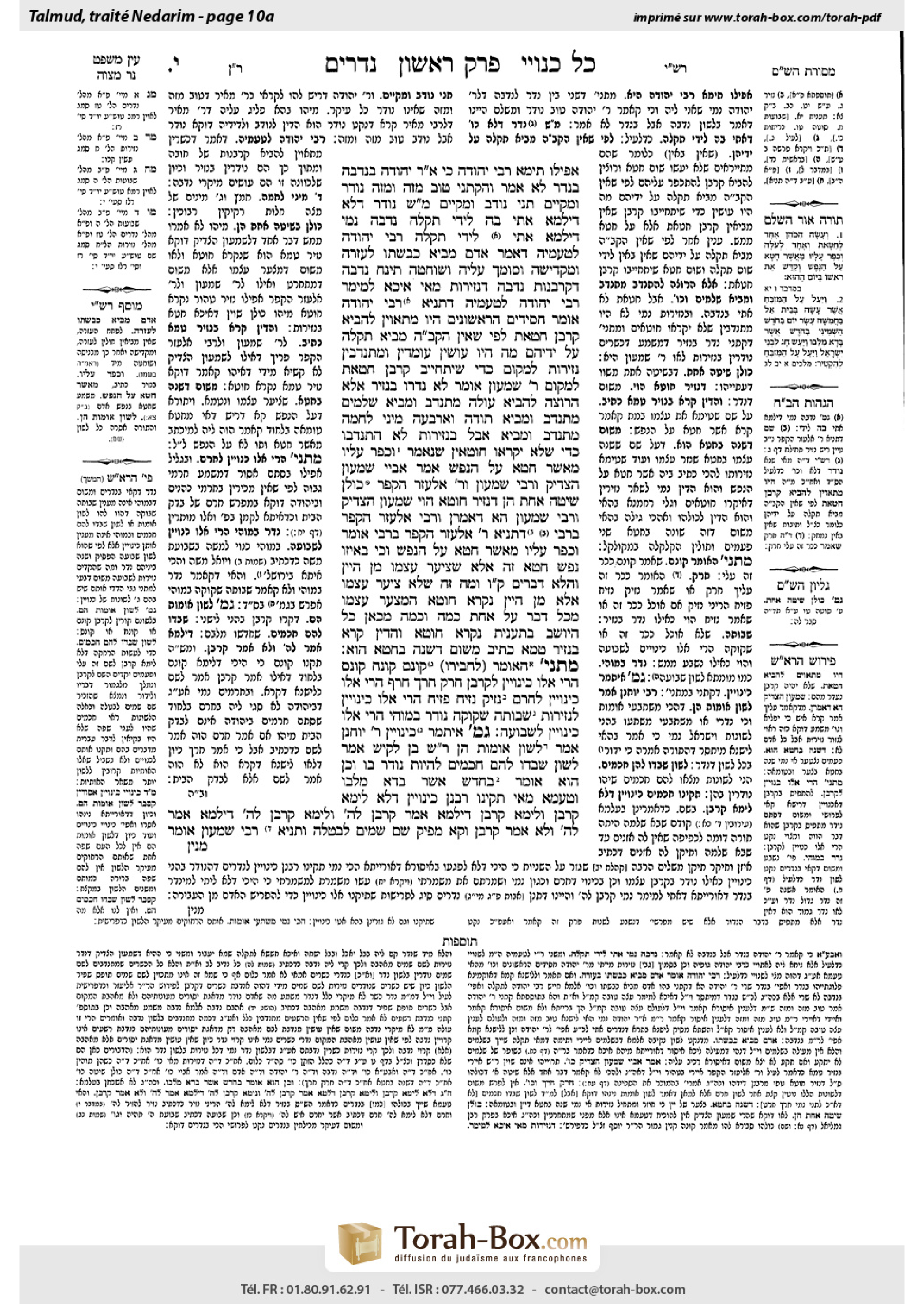
Nedarim 10a: Talmud study for Daf Yomi
Daf Yomi is the daily study of one Talmud folio. Explore 37 tractates with scans, Hebrew text, Sefaria English and AI-generated French translations where annotated.
Passage selection and English or AI-generated French translation are available where the scan has annotations. Daf Study is independent of Torah-Box and Sefaria.
Browse Nedarim · נדרים · All tractatesNedarim 10a text and translations
This page of Nedarim includes the Aramaic text, an English translation and an AI-generated French translation, alongside the scan above.
נדרים י׳ א · Aramaic and Hebrew text
אֲפִילּוּ תֵּימָא רַבִּי יְהוּדָה, כִּי אָמַר רַבִּי יְהוּדָה — בִּנְדָבָה, בְּנֶדֶר לָא אָמַר.
וְהָקָתָנֵי: ״טוֹב מִזֶּה וּמִזֶּה נוֹדֵר וּמְקַיֵּים״! תְּנִי: ״נוֹדֵב וּמְקַיֵּים״.
מַאי שְׁנָא נוֹדֵר דְּלָא, דִילְמָא אָתֵי בָּהּ לִידֵי תַקָּלָה? נְדָבָה נָמֵי, דִּילְמָא אָתֵי בָּהּ לִידֵי תַקָּלָה!
רַבִּי יְהוּדָה לְטַעְמֵיהּ, דְּאָמַר: אָדָם מֵבִיא כִּבְשָׂתוֹ לָעֲזָרָה, וּמַקְדִּישָׁה, וְסוֹמֵךְ עָלֶיהָ, וְשׁוֹחֲטָהּ.
תִּינַח נְדָבָה דְקׇרְבָּנוֹת, נְדָבָה דִנְזִירוּת מַאי אִיכָּא לְמֵימַר?
רַבִּי יְהוּדָה לְטַעְמֵיהּ. דְּתַנְיָא, רַבִּי יְהוּדָה אוֹמֵר: חֲסִידִים הָרִאשׁוֹנִים הָיוּ מִתְאַוִּין לְהָבִיא קׇרְבַּן חַטָּאת. לְפִי שֶׁאֵין הַקָּדוֹשׁ בָּרוּךְ הוּא מֵבִיא תַּקָּלָה עַל יְדֵיהֶם, מָה הָיוּ עוֹשִׂין? עוֹמְדִים וּמִתְנַדְּבִין נְזִירוּת לַמָּקוֹם, כְּדֵי שֶׁיִּתְחַיֵּיב קׇרְבַּן חַטָּאת לַמָּקוֹם.
רַבִּי שִׁמְעוֹן אוֹמֵר: לֹא נָדְרוּ בְּנָזִיר, אֶלָּא: הָרוֹצֶה לְהָבִיא עוֹלָה — מִתְנַדֵּב וּמֵבִיא, שְׁלָמִים — מִתְנַדֵּב וּמֵבִיא, תּוֹדָה וְאַרְבָּעָה מִינֵי לַחְמָהּ — מִתְנַדֵּב וּמֵבִיא. אֲבָל בִּנְזִירוּת לֹא הִתְנַדְּבוּ, כְּדֵי שֶׁלֹּא יִקָּרְאוּ חוֹטְאִין. שֶׁנֶּאֱמַר ״וְכִפֶּר עָלָיו מֵאֲשֶׁר חָטָא עַל הַנָּפֶשׁ״.
אָמַר אַבָּיֵי: שִׁמְעוֹן הַצַּדִּיק וְרַבִּי שִׁמְעוֹן וְרַבִּי אֶלְעָזָר הַקַּפָּר כּוּלָּן שִׁיטָה אַחַת הֵן, דְּנָזִיר חוֹטֵא הָוֵי: שִׁמְעוֹן הַצַּדִּיק וְרַבִּי שִׁמְעוֹן הָא דַּאֲמַרַן.
וְרַבִּי אֶלְעָזָר הַקַּפָּר בְּרַבִּי, דְּתַנְיָא, רַבִּי אֶלְעָזָר הַקַּפָּר בְּרַבִּי אוֹמֵר: ״וְכִפֶּר עָלָיו מֵאֲשֶׁר חָטָא עַל הַנָּפֶשׁ״. וְכִי בְּאֵיזוֹ נֶפֶשׁ חָטָא זֶה? אֶלָּא: שֶׁצִּיעֵר עַצְמוֹ מִן הַיַּיִן. וַהֲלֹא דְּבָרִים קַל וָחוֹמֶר: וּמָה זֶה שֶׁלֹּא צִיעֵר עַצְמוֹ אֶלָּא מִן הַיַּיִן נִקְרָא חוֹטֵא, הַמְצַעֵר עַצְמוֹ מִכׇּל דָּבָר עַל אַחַת כַּמָּה וְכַמָּה. מִכָּאן כׇּל הַיּוֹשֵׁב בְּתַעֲנִית נִקְרָא חוֹטֵא.
וְהָדֵין קְרָא בְּנָזִיר טָמֵא כְּתִיב! מִשּׁוּם דְּשָׁנָה בְּחֵטְא הוּא.
מַתְנִי׳ הָאוֹמֵר (לַחֲבֵירוֹ) ״קֻוֽנָּם״ ״קוּנָּח״ ״קוּנָּס״ — הֲרֵי אֵלּוּ כִּינּוּיִין לַקׇּרְבָּן. ״חֶרֶק״ ״חֶרֶךְ״ ״חֶרֶף״ — הֲרֵי אֵלּוּ כִּינּוּיִין לַחֵרֶם. ״נָזִיק״ ״נָזִיחַ״ ״פָּזִיחַ״ — הֲרֵי אֵלּוּ כִּינּוּיִין לִנְזִירוּת. ״שְׁבוּתָה״ ״שְׁקוּקָה״, נוֹדֵר בְּ״מוֹהִי״ — הֲרֵי אֵלּוּ כִּינּוּיִין לַשְּׁבוּעָה.
גְּמָ׳ אִיתְּמַר כִּינּוּיִין, רַבִּי יוֹחָנָן אָמַר: לְשׁוֹן אוּמּוֹת הֵן. רַבִּי שִׁמְעוֹן בֶּן לָקִישׁ אָמַר: לָשׁוֹן שֶׁבָּדוּ לָהֶם חֲכָמִים לִהְיוֹת נוֹדֵר בּוֹ. וְכֵן הוּא אוֹמֵר: ״בַּחֹדֶשׁ אֲשֶׁר בָּדָא מִלִּבּוֹ״.
וְטַעְמָא מַאי תַּקִּינוּ רַבָּנַן כִּינּוּיִין? דְּלָא לֵימָא ״קׇרְבָּן״. וְלֵימָא ״קׇרְבָּן״? דִּילְמָא אָמַר ״קׇרְבָּן לַה׳״. וְלֵימָא ״קׇרְבָּן לַה׳״? דִּילְמָא אָמַר ״לַה׳״ וְלָא אָמַר ״קׇרְבָּן״, וְקָא מַפֵּיק שֵׁם שָׁמַיִם לְבַטָּלָה.
וְתַנְיָא, רַבִּי שִׁמְעוֹן אוֹמֵר:
Nedarim 10a · English translation
Even if you say that the mishna is in accordance with the opinion of Rabbi Yehuda, it can be argued that when Rabbi Yehuda said that it is good to take a vow and fulfill it, he said it with regard to a gift offering, but he did not say it with regard to vows.
The Gemara asks: But isn’t the mishna teaching that according to Rabbi Yehuda, better than both this and that is one who vows [noder] and pays, which indicates that he says this even about vows? The Gemara answers: Teach the opinion of Rabbi Yehuda with the following, emended formulation: Better than both this and that is one who volunteers [nodev] a gift offering and pays it.
The Gemara asks: What is different about one who vows, i.e., one who says: It is incumbent upon me to bring an offering, which is not proper to do due to the concern that perhaps he will encounter a stumbling block and not bring it promptly, thereby violating the prohibition against delaying? One should also not designate a particular animal as a gift offering, due to the concern that perhaps he will encounter a stumbling block with it.
The Gemara answers: Rabbi Yehuda conforms to his standard line of reasoning, as he said explicitly in a baraita: A person brings his lamb to the Temple courtyard and consecrates it there, and immediately leans on it and slaughters it. Consequently, there is no concern that he will encounter a stumbling block.
The Gemara asks: That works out well with regard to voluntary gifts in the context of offerings, but with regard to the voluntary acceptance of naziriteship, what is there to say? There is still room for concern that one will not fulfill the obligations incumbent upon him as a nazirite.
The Gemara answers: Here, too, Rabbi Yehuda conforms to his standard line of reasoning, as it is taught in a baraita that Rabbi Yehuda says: The early generations of pious men would desire to bring a sin-offering but did not have the opportunity to do so because the Holy One, Blessed be He, does not bring about a stumbling block through them, and they would not sin even unwittingly. What would they do? They would rise and volunteer naziriteship to the Omnipresent in order to be liable to bring a sin-offering of a nazirite to the Omnipresent.
Rabbi Shimon says: They did not take a vow of naziriteship. Rather, one who would want to bring a burnt-offering would volunteer and bring it; one who would want to bring a peace-offering would volunteer and bring it; and one who would want to bring a thanks-offering and its four types of bread would volunteer and bring them. However, they did not volunteer naziriteship in order that they not be called sinners. According to Rabbi Shimon, naziriteship involves some element of sin, as it is stated: “And he shall make atonement for him, for that he sinned against the soul” (Numbers 6:11).
§ Abaye said: Shimon HaTzaddik, Rabbi Shimon, and Rabbi Elazar HaKappar are all of the same opinion, that a nazirite is a sinner. The statements of Shimon HaTzaddik and Rabbi Shimon in this regard are that which we already said.
And Rabbi Elazar HaKappar the Distinguished agrees, as it is taught in a baraita that Rabbi Elazar HaKappar the Distinguished says: It is written with regard to the priest who sacrificed the offering of a nazirite: “And he shall make atonement for him, for that he sinned against the soul.” Against which soul did the nazirite sin? Rather, his sin is that he caused himself suffering by refraining from wine. Are these matters not inferred a fortiori: Just as this nazirite, who causes himself suffering only by refraining from wine, is called a sinner, one who causes himself suffering by refraining from everything is all the more so to be considered a sinner. From here it can be derived that whoever fasts unnecessarily is called a sinner.
The Gemara raises a question with regard to the opinion of Rabbi Elazar HaKappar. Isn’t this verse written with regard to a ritually impure nazirite? Consequently, only a nazirite who becomes impure shall be considered a sinner. The Gemara answers: Rabbi Elazar HaKappar holds that the verse uses this terminology with regard to a ritually impure nazirite because he repeated his sin. However, becoming a nazirite is itself considered a sin.
MISHNA: In the case of one who says to another that a certain object is konam, konaḥ, or konas, these expressions are substitutes for the term offering [korban], and the vow takes effect. Ḥerek, ḥerekh and ḥeref; these are substitutes for the term indicating a dedication [ḥerem] to the Temple treasury. Nazik, naziaḥ, and paziaḥ; these are substitutes for the term naziriteship [nazir]. Shevuta, shekuka, or one who vows with the term mohi, these are substitutes for the term oath [shevua].
GEMARA: It was stated that amora’im disagreed about substitutes for the language of vows. Rabbi Yoḥanan said: They are terms from a language of other nations that mean offering, dedication, naziriteship, or oath. Rabbi Shimon ben Lakish said: These terms employ language that the Sages devised [badu] with which one can take a vow. In order to explain the word badu, he adds: And so it states with regard to Jeroboam: “In the month that he had devised [bada] in his own heart” (I Kings 12:33).
And according to the opinion of Rabbi Shimon ben Lakish, what is the reason that the Sages established substitutes for the language of vows? The Gemara answers: It is so that one not explicitly say the term offering. The Gemara asks: And let him say the term offering; what is wrong with that? The Gemara answers: Perhaps he will say: An offering to the Lord. The Gemara asks: And let him say: An offering to the Lord. The Gemara answers: Perhaps he will say: To the Lord, and he will then change his mind and not say: An offering, and he will thereby express the name of Heaven in vain.
And similarly, it is taught in a baraita that Rabbi Shimon says:
Nedarim 10a · Traduction française (IA)
Même si tu dis que la Michna est conforme à l’opinion de Rabbi Yehuda, on peut soutenir que, lorsqu’il a dit qu’il est préférable de faire un vœu et de l’accomplir, Rabbi Yehuda parlait d’une offrande volontaire, mais pas des vœux.
La Guemara demande : Mais la Michna n’enseigne-t-elle pas que, selon Rabbi Yehuda, mieux que l’un et l’autre est celui qui fait un vœu [noder] et s’en acquitte, ce qui indique qu’il dit cela même à propos des vœux ? La Guemara répond : Il faut enseigner l’opinion de Rabbi Yehuda selon la formulation corrigée suivante : mieux que l’un et l’autre est celui qui offre volontairement [nodev] une offrande et s’en acquitte.
La Guemara demande : En quoi celui qui fait un vœu diffère-t-il, c’est-à-dire celui qui dit : « Il m’incombe d’apporter une offrande », ce qu’il ne convient pas de faire, de crainte qu’il ne trébuche et ne l’apporte pas sans tarder, transgressant ainsi l’interdiction de différer ? Il ne convient pas non plus de désigner un animal précis comme offrande volontaire, de crainte qu’il ne trébuche à son sujet.
La Guemara répond : Rabbi Yehuda reste fidèle à sa ligne de raisonnement habituelle, comme il l’a explicitement déclaré dans une baraïta : Une personne amène son agneau dans le parvis du Temple et le consacre là, puis s’appuie immédiatement sur lui et l’égorge. Il n’y a donc pas lieu de craindre qu’elle ne trébuche.
La Guemara demande : Cela convient pour les offrandes volontaires dans le contexte des sacrifices, mais que dire de l’acceptation volontaire du naziréat ? Il reste à craindre que l’on n’accomplisse pas les obligations qui nous incombent en tant que nazir.
La Guemara répond : Ici aussi, Rabbi Yehuda reste fidèle à sa ligne de raisonnement habituelle, comme l’enseigne une baraïta dans laquelle Rabbi Yehuda dit : Les premières générations de pieux désiraient apporter un sacrifice expiatoire, mais n’en avaient pas l’occasion, car le Saint, béni soit-Il, ne fait pas trébucher les justes, et ils ne péchaient même pas par inadvertance. Que faisaient-ils ? Ils se levaient et acceptaient volontairement le naziréat envers le Maître de l’univers, afin d’être tenus d’apporter au Maître de l’univers le sacrifice expiatoire d’un nazir.
Rabbi Shimon dit : Ils ne faisaient pas vœu de naziréat. Au contraire, celui qui voulait apporter un holocauste s’engageait volontairement à l’apporter ; celui qui voulait apporter un sacrifice de paix s’engageait volontairement à l’apporter ; et celui qui voulait apporter un sacrifice de reconnaissance et ses quatre sortes de pains s’engageait volontairement à les apporter. Toutefois, ils ne s’engageaient pas volontairement dans le naziréat, afin de ne pas être appelés pécheurs. Selon Rabbi Shimon, le naziréat comporte une part de péché, comme il est dit : « Il fera pour lui le rite d’expiation, car il a péché contre son âme » (Nombres 6:11).
§ Abaye dit : Shimon HaTzaddik, Rabbi Shimon et Rabbi Elazar HaKappar sont tous du même avis : le nazir est un pécheur. Nous avons déjà cité les propos de Shimon HaTzaddik et de Rabbi Shimon à ce sujet.
Rabbi Elazar HaKappar le Doyen est également de cet avis, comme l’enseigne une baraïta dans laquelle Rabbi Elazar HaKappar le Doyen dit : À propos du prêtre qui a offert le sacrifice d’un nazir, il est écrit : « Il fera pour lui le rite d’expiation, car il a péché contre son âme. » Contre quelle âme le nazir a-t-il péché ? Son péché est plutôt de s’être infligé une souffrance en s’abstenant de vin. Ne peut-on pas déduire ces choses a fortiori ? Si ce nazir, qui ne s’inflige une souffrance qu’en s’abstenant de vin, est appelé pécheur, celui qui s’inflige une souffrance en s’abstenant de tout l’est à plus forte raison. On peut en déduire que quiconque jeûne sans nécessité est appelé pécheur.
La Guemara soulève une question concernant l’opinion de Rabbi Elazar HaKappar. Ce verset n’est-il pas écrit à propos d’un nazir devenu rituellement impur ? Par conséquent, seul un nazir qui devient impur devrait être considéré comme un pécheur. La Guemara répond : Rabbi Elazar HaKappar estime que le verset emploie cette expression à propos d’un nazir devenu rituellement impur parce qu’il a commis une nouvelle fois son péché. Cependant, devenir nazir est en soi considéré comme un péché.
MICHNA : Dans le cas de celui qui dit à un autre qu’un objet donné est konam, konaḥ ou konas, ces expressions remplacent le terme « offrande » [korban], et le vœu prend effet. Ḥerek, ḥerekh et ḥeref remplacent le terme désignant une consécration [ḥerem] au trésor du Temple. Nazik, naziaḥ et paziaḥ remplacent le terme « naziréat » [nazir]. Shevuta, shekuka ou le terme mohi employé par celui qui fait un vœu remplacent le terme « serment » [shevua].
GUEMARA : Il a été rapporté que des amoraïm sont en désaccord au sujet des substituts des termes de vœu. Rabbi Yoḥanan dit : Ce sont des mots issus de langues étrangères qui signifient « offrande », « consécration », « naziréat » ou « serment ». Rabbi Shimon ben Lakish dit : Ces termes emploient un langage que les Sages ont forgé [badu] et au moyen duquel on peut faire un vœu. Pour expliquer le mot badu, il ajoute : Il est également dit à propos de Jéroboam : « Au mois qu’il avait imaginé [bada] dans son cœur » (I Rois 12:33).
Et selon l’opinion de Rabbi Shimon ben Lakish, pourquoi les Sages ont-ils établi des substituts aux termes de vœu ? La Guemara répond : Afin que l’on ne prononce pas explicitement le terme « offrande ». La Guemara demande : Qu’y a-t-il de mal à prononcer le terme « offrande » ? La Guemara répond : Peut-être dira-t-il : « Une offrande pour le Seigneur. » La Guemara demande : Qu’il dise donc : « Une offrande pour le Seigneur. » La Guemara répond : Peut-être dira-t-il : « Pour le Seigneur », puis changera d’avis et ne dira pas « offrande » ; il prononcera ainsi le Nom du Ciel en vain.
Et de même, une baraïta enseigne que Rabbi Shimon dit :
Traduction française générée par IA à partir de l’édition anglaise de Sefaria. Vérifie toujours un passage avec le texte source.
Text from Sefaria: William Davidson Edition - Vocalized Aramaic (CC BY NC); William Davidson Edition - English (CC BY NC).